
CÉLINE SEMAAN: How did the Orange Tree Series come about for you?
VIC MENSA: I was between albums and looking for a way to express myself, connect to people, and fill that time meaningfully.
CÉLINE: The Orange Tree Series establishes you as a politically savvy individual with a lot to teach. When did you start connecting with politics?
VIC: Music is political because the people who make the music exist inside of systems, and systems are dictated by politics. We are expressing our humanity, our hopes, our dreams, our traumas—all of which are shaped by the political realities of the time and the place we exist within. Hip hop music has a long political lineage. Some might trace it to Gil Scott-Heron, one of the most politically brilliant lyricists of all time, the rapper with the song “The Revolution Will Not Be Televised.” Hip hop has that DNA, and I’ve used it as a way to teach what I have to offer.
CÉLINE: I’m sure you’re reading a lot. Where do you get your news, and where are you pulling your information from?
VIC: A lot of the information comes from lived experience. We all have the internet, but we all have different experiences. Being in Palestine informed my perspective on what’s happening with the genocide today in a different way. Going to Cuba earlier this year informed my perspective in a different way [Vic went to Cuba as part of the Nuestra América Convoy, an international solidarity mission bringing humanitarian aid to Cuba, which has been suffering under one of the longest economic blockades in modern history]. I grew up in the South Side of Chicago and have roots in West Africa. I was surrounded by incarceration, biochemical warfare in the form of crack cocaine, as well as the Black Panther Party and the Nation of Islam. All these elements influence what I talk about. Also, coming from the literal Gold Coast of Africa, where our gold mines have been raped, controlled, and pillaged by European colonialists… All those different factors influence what I talk about, but I read a lot, too.
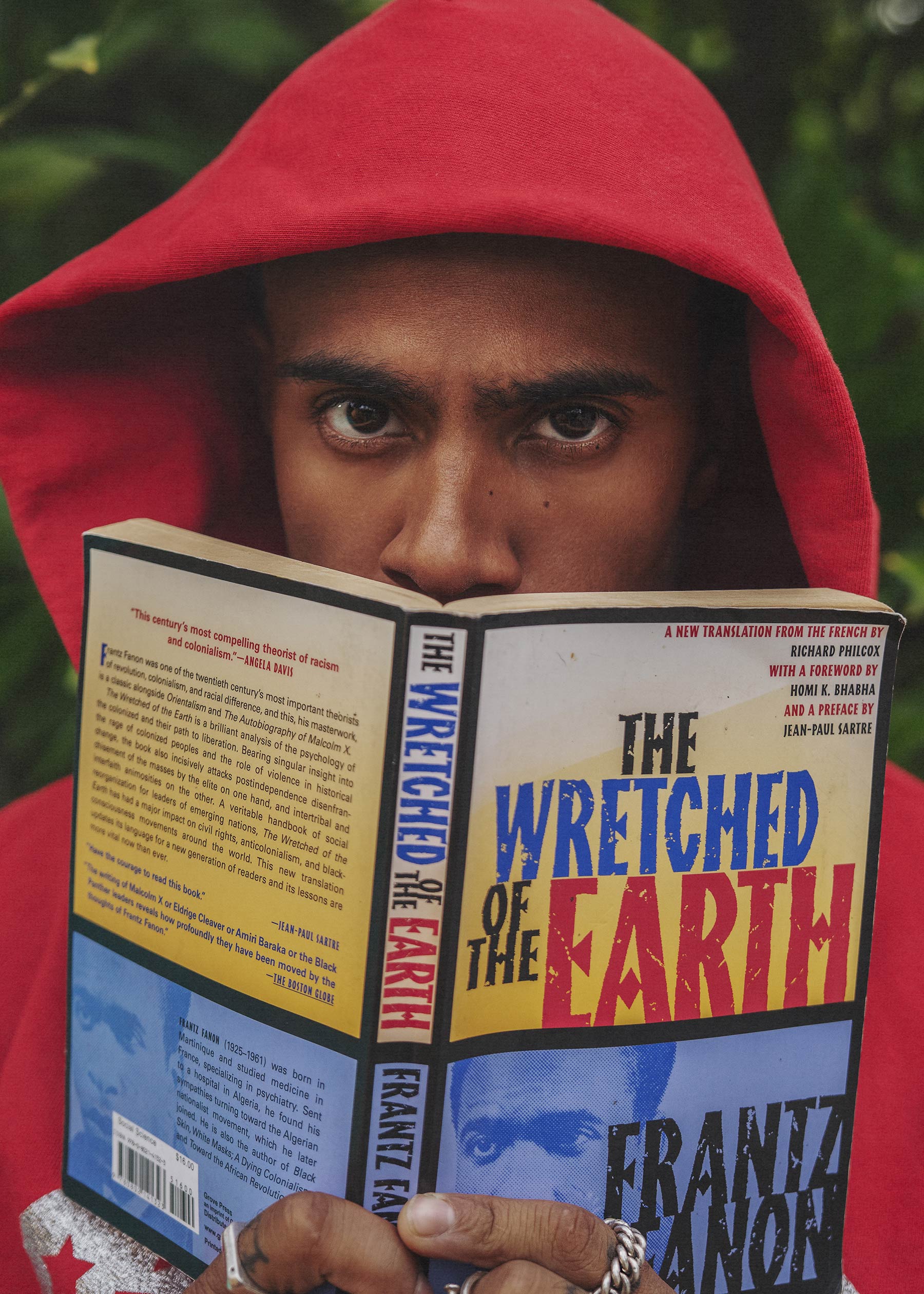
I’ve always been an avid reader. My sister, Aja Monet, a poet and writer, told me you should read twice as much as you write. Right now I’m reading (Martinican poet, playwright, and politician) Aimé Césaire’s Discourse on Colonialism. Recently, I read Ibram X. Kendi’s Chain of Ideas: The Origins of Our Authoritarian Age (details the global rise of the “Great Replacement Theory” and how it has fueled the modern rise of authoritarianism). Before I had an outlet, as I do now, I used raps and essays to express my thoughts and observations. I try to make sure that I’m getting information from well-developed sources.
CÉLINE: Tell us a little bit about your experience going to Cuba.
VIC: Cuba has always held a special place in my heart as a Black American student of Assata Shakur. She’d lived in Cuba as an exile from the United States since 1984 (after escaping a life sentence in the U.S. for the 1973 murder of a New Jersey state trooper). I was in Cuba in the middle of a nationwide blackout caused by the U.S. siege. I witnessed the devastating impact of sanctions—something I didn’t really understand before that trip. The sanctions imposed by the United States around the world have killed approximately 38 million people in the last 50 years. It’s like a silent genocide. We can see the visual manifestations of genocide before our eyes, but sanctions kill in a sneaky way.
While in Cuba, I saw premature babies who barely had access to formula because of the U.S. sanctions. Sanctions restrict hospital equipment from coming in, so life-saving procedures can’t take place. They murder human beings by restricting the resources they need to survive, and then push out false narratives about the people who come to shed light on the issue being the cause of deaths. At the end of the day, these humanitarian trips have shit all to do with a 60-year embargo with the stated intention to cause suffering and starvation to induce the people to overthrow their government. That was the stated United States intention in Cuba in 1960. I don’t blame anyone for being misled by propaganda, because that’s the purpose of propaganda.
Governments impose sanctions that starve premature babies, not a couple of people showing up for a humanitarian trip to Cuba. The concert was full of Cuban people, and they were enjoying themselves. There was an Irish band, revolutionary dudes, and they brought suitcases of baby formula. Ultimately, Cuba’s freedom is not in the hands of the artists, musicians, and activists going there on a humanitarian trip. Narrative warfare is powerful.
CÉLINE: You went to Palestine in 2017 with a cohort of activists from the United States. Tell me a little bit about how that trip came about and how that trip changed you.
VIC: What struck me the most was that I was not the “n**”; young Palestinians were the “n**s.” I was in the old city of Jerusalem with Marc Lamont Hill watching a young Palestinian kid being thrown against a wall by IDF soldiers. Nobody involved was older than 21.
The young Palestinian kid’s body language mirrored the behavior of a young Black kid on the South Side of Chicago getting abused by the police. I don’t speak Arabic, but I knew what he was saying.
— “If you take off the fucking army fatigues, I’ll fuck you up!” I could sense it; I could taste the words. I know it so intimately; that’s our experience as Black people in Chicago, in America.
I was in Hebron—the site of many pivotal massacres of Palestinian people—with my sister and some local Palestinian men who were spearheading our trip and showing us everything. A settler got out of a truck, came over, and prevented the Palestinian men from walking down the street. Because we were Americans (even though we were Black), we were fine to go, the settler said. “Americans can come; Arabs, no. This street is only for Jews. Arabs come, they make terrorist attacks,” he said, smiling. This was straight-up Jim Crow. I was aghast.
At one point during our trip—when we were sitting in a Bedouin refugee camp where the schools had been consistently ransacked by settlers who would destroy everything and threaten everybody—we were speaking with an old, wizened man who asked us to go and tell the story of the abuse and violence to the world. I promised him that I would do that.
CÉLINE: It was such a blessing to have that story shared with you and to be given permission to share it. It’s a blessing, because usually they don’t want you to go tell their stories. I know you’ve sacrificed a lot in speaking for Palestine. How has it been for you in the music industry? What’s the response? You know, what are the sacrifices you had to make?
VIC: I lost industry relationships and a lot of big deals worth $100,000 in endorsement revenue. My feeling is that I’m privileged in comparison to people who are losing their lives or having their children blown to bits. I am in an industry dominated by Zionists, and I was brash about how I felt at first, and I faced a lot of loss and backlash. And now the whole world has witnessed the genocide. How many babies do we need to see torn in half, and how many aerial satellite photographs do we need to see of an entire land razed to the fucking ground to believe our eyes?
CÉLINE: I know, it’s so extreme. You went independent recently. Was it related to this, or did you go independent because you wanted more control over your music.
VIC: Independence is just the way the game’s going right now. The old models don’t really make sense. Streaming is mathematically unsustainable and everyone’s trending towards independence in one way or another. The structure of deals is changing, the budgets aren’t the same. My choice to go independent was just a part of that natural progression.
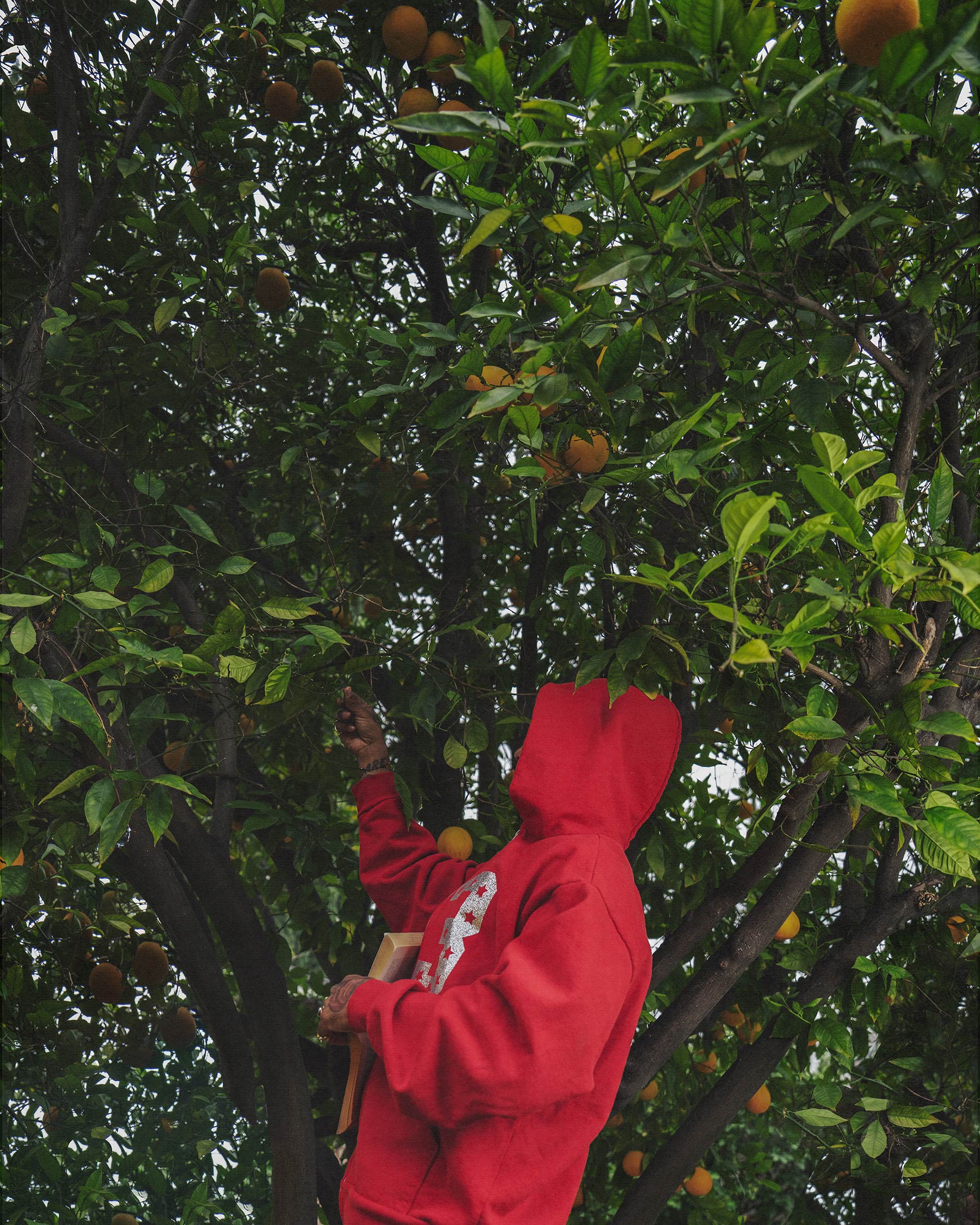
There are always an infinite number of blessings to be grateful for right now, the breath in my lungs, the fruit trees in my backyard, clean air, water to drink, and no bombs overhead. I don’t consciously spend a lot of time focusing on the past. I do my best to stay in the present.
CÉLINE: Is that part of your spiritual practice? I know you recently converted to Islam. Tell me a little bit about your spiritual life.
VIC: I started practicing Islam about five years ago now. The discipline of Islam is what attracted me… I came to Islam at a very low point in my life. I had multiple people trying to kill me. I was often addicted to drugs and in spirals of violence, and Islam came to me as an answer to those ailments. Not in some ethereal way, but by being a doctrine of well-being, by being a spiritual system that incentivizes you to treat other people well, to make honest decisions, to live honestly, to live soberly, to be focused, to bridle one’s lower self. All of those were like water to me in a drought. I was just going through it; I was fucking dead broke, dealing with so much darkness and drama. I went to the mosque for the first time. Islam helps me stay focused and grounded, knowing that there’s a witness to all things said and unsaid. Allah is paying attention. They say there are two angels on our shoulders recording all deeds; that was valuable for me. There was shit I got away with that came back to bite me in the ass from another direction, and I wouldn’t recognize why I was in ruin, and so Islam gave me a lot of refuge from myself and continues to give me a lot of refuge from myself. I think the things I’ve learned in this short time practicing Islam have become intertwined with my new sense of self, my new behavioral patterns, and my new thought patterns to the point that I don’t often even contextualize them as religious behaviors. I have just absorbed them into a lifestyle of spiritual awareness.
CÉLINE: You said you went to the mosque. How did you go to the mosque? What happened? Was it in Palestine?
VIC: The mosque in the ‘hood, man. It was a Black ghetto storefront mosque… I’ve been surrounded by Muslims my whole life. I grew up two blocks away from the Honorable Minister Louis Farrakhan and in and around a Muslim street organization called The Almighty Black P. Stone Nation. I know an amazing imam named Abdullah; he has been a guide and light to me. He speaks in a language that relates to my experience, my struggles, and my aspirations. Abdullah is a brother from the South Side of Chicago who trained in Egypt and speaks Arabic. Maybe his parents were in the Nation of Islam. The Nation practices an offshoot of Islam that has its own mythology and ideas—things that many people in mainstream Islam don’t jam with. Abdullah taught me not to pass judgment on somebody as if I were the Lord. I’ll never run out of my own flaws and sins to worry about in this lifetime. There’s no need for me to spend my time focused on yours.
CÉLINE: That’s beautiful. We need more of that. Five years ago you entered your transformative journey into Islam, into spiritual awareness. How did you manifest the life you’re living now?
VIC: I have been praying—and still pray—that God will provide me with immense wealth so that I can pay Zakat (a mandatory Islamic financial obligation and one of the five pillars of Islam) and give Sadaqah (voluntary charity). I pray that God allows me to make my charity great. Abdullah taught me to give people what I really want. He would say, “Don’t give them the old dusty suit that’s sitting up in the back of the closet that you haven’t looked at for five years; get them the brand new, clean suit that you want to wear this weekend.”
One day, I got my warmest winter coat and drove around the ‘hood until I found my guy Ron. Ron lives out on the street on 39th Street, by where I used to live. I wasn’t in a good place financially, but my focus was beginning to shift, and I was beginning to understand that gratitude and giving open the door for receiving. Gratitude is the door through which the blessings come pouring in. I do think that things like that have contributed to the manifestation of more beautiful things in my life. There were times when I had a lot and had no gratitude for what I had. I was pompous and arrogant because I was hurt and sad.
None of the money—the mansions, the fucking Maseratis, the women, the millions, the $300,000 endorsements for bullshit—none of it fed me spiritually at all. It didn’t even begin to chip away at my sadness. It actually widened the well of my sadness, because the more I poured into it, the emptier I felt. I was in the dark, and I felt naked… I started to hear whispers of God, then I learned (and continue to learn) how to lead with grace, charity, and kindness. I don’t always reach the mark, but I do try.
CÉLINE: That’s beautiful. I feel like what you’re talking about—this culture, this spiritual framework—is how I was raised in the Middle East, as if the person in front of you is God, disguised as a person. We need to teach this type of generosity, this idea of giving…
VIC: I got a homie named Rami who has an organization in Chicago called Iman Inner City Muslim Action Network, and I can’t tell him I like anything he’s wearing because he’ll just take it off and give it to me. I think he’s Palestinian, and I’ve learned that this is common in the culture. I think that’s beautiful.
CÉLINE: What more can we do, individually and collectively?
VIC: Just being a caring human being in the midst of a burning world. That’s a daring act of defiance in a society that is relying on your complicity in its massacres, murders, genocides, denials, and revisionist history. If I can be present, focused, caring, conscious, poised, balanced, faithful in the midst of all that shit, there’s no way I’m not going to take some kind of action.
CÉLINE: Is religion political?
VIC: Religion is super political. I used to be disdainful of religion because of the way religion has been presented to me as an African person. Christianity was brought to us in chains, but oftentimes Islam came to us in chains as well. Throughout West Africa, Islam spread through trade and in many other ways, but in a lot of places in North Africa, Black men are still slaves. Anti-Blackness is all across the globe… So, I had a lot of disdain for religion, but when I started to practice Islam and apply it to my life, I took a lot of value from it. I continue to take a lot of value, and it helps me to treat people better. At the end of the day, it helps me to be a better father and a better brother to mankind.