

%20(1).jpg)
Figure 1 Book cover for Black Public Joy, written by Jay Pitter and published by McClelland and Stewart (2026). Image provided by McClelland and Stewart.
Given the daily white supremacist attacks against Black folks (and everyone else) Black Public Joy: No Permit or Permission Required is a balm for the exhausted soul. In this recently published book, author Jay Pitter, a Jamaican-Canadian public space practitioner and researcher, explores Black public joy not only as a vital form of expression, but as “spatial intelligence, ritual practice, cultural knowledge, and a form of infrastructure that has shaped public life across generations”.
As a former Toronto public housing kid, Pitter draws upon her intersectional lived experiences of gender, race, nationality, and class in urban spaces to highlight the emotional urgency of Black public joy. Through these experiences, her scholarly research, and public space projects across Turtle Island, she intentionally documents the historical and contemporary joys of Black public life.
.jpg)
Figure 2 Head shot of Jay Pitter, a Jamaican-Canadian public space expert and author of Black Public Joy. Image provided by Jay Pitter.
In this conversation with Dori Tunstall, design anthropologist and author of Decolonizing Design: A Cultural Justice Guidebook, Pitter shares how this work can teach us about belonging, the spatial intelligence gained by deep listening to old African-American ladies, and the wisdom required for designers, architects, and planners to help co-create conditions for Black public joy.
This interview has been edited for length and clarity.
DORI TUNSTALL: So, why did you write the book Black Public Joy?
JAY PITTER: I decided to write this book because there is an abundance of literature, research, film, and music focused on Black people’s harm and trauma. While I deeply appreciate the scholars, writers, and community leaders who have documented Black struggle, resistance, and liberation movements, I made a deliberate decision to bend the narrative arc toward joy. Not because joy, specifically public joy, negates hardship, but because expanding our stories expands our possibilities, in literature, public life, and our individual sense of spatial entitlement.
There is a tremendous amount of spatial intelligence, ancestral knowledge, placemaking rituals, daily celebrations, and public space pageantry that Black people possess and practice, not only within our own communities. The way that Black people have moved through public life has defined popular culture and been an invitation for other communities, people of other identities, to move through public life in ways that are more creative and audacious.
DORI: So tell me, what is the difference between Black public joy as expression versus infrastructure? Because you talk about that in the book. And for the non-design-minded, would you tell me what you mean by infrastructure?
JAY: When people hear the term infrastructure, they think of bridges, streets, or a waterway of some kind. Something that is tangible, that you can touch. It generally supports public life, so it helps people transport goods or supports public health, or connects people to opportunities. That’s how infrastructure is generally conceived in people’s minds: physical, tangible. I can touch it, walk on it, walk across it. It gets me to places, or it gets me to access to opportunities and things. Of course, in more recent times, infrastructure also includes the digital world, which does all of the same things – connection, prosperity, and it allows you to travel across places online.
I assert, first and foremost, that public joy is of all kinds. So Black public joy, and all public joy is indeed infrastructure. I’ll define public joy as belonging, collective prosperity, connectivity, and spatial entitlement–which means taking up space in ways that are life-affirming, full of agency, and authentic. I also want to make a little caveat. We talk about belonging without talking about the importance of a relative degree of safety and comfort in not always belonging. Because sometimes you need to do your own thing, and be your own person. So, when I talk about public joy, I also talk about democracy, meaning the transparent conversations and processes that allow us to practice democracy in everyday life. That’s what public joy is.
DORI: In the book, you describe the numerous developments and urban design projects that you have had the opportunity to visit led by Black architects, urban planners, and other designers. Would you provide some concrete examples of Black public joy?
JAY: I have a Public Joy Framework, which informs Black public joy and has already being applied to actual sites like Ethos Lab in Vancouver, British Columbia. And it has three pillars: civic, cultural, and spatial. When you talk about expressions, those tend to fall into the civic and cultural pillars of my Public Joy Framework. That would be things like protests and demonstrations, mutual aid networks, storytelling, laughter, and stewardship practices in public spaces. What I wanted to make clear in my book is that despite the fact that Black people have experienced, and are experiencing, profound place-based harm, we have profound spatial intelligence, which falls into the spatial pillar of my public joy framework.
So, many of the verandas that were built by enslaved people were informed by craftspeople from the African continent, who had built those forms there. The Black basement party and the dance hall, the ways that people have laid out those spaces, used interior design and space planning design principles for flow — carefully identifying where the curry goat and the fried chicken station was going to go, where the DJ booth was going to be set up, and where people could exit to get fresh air.
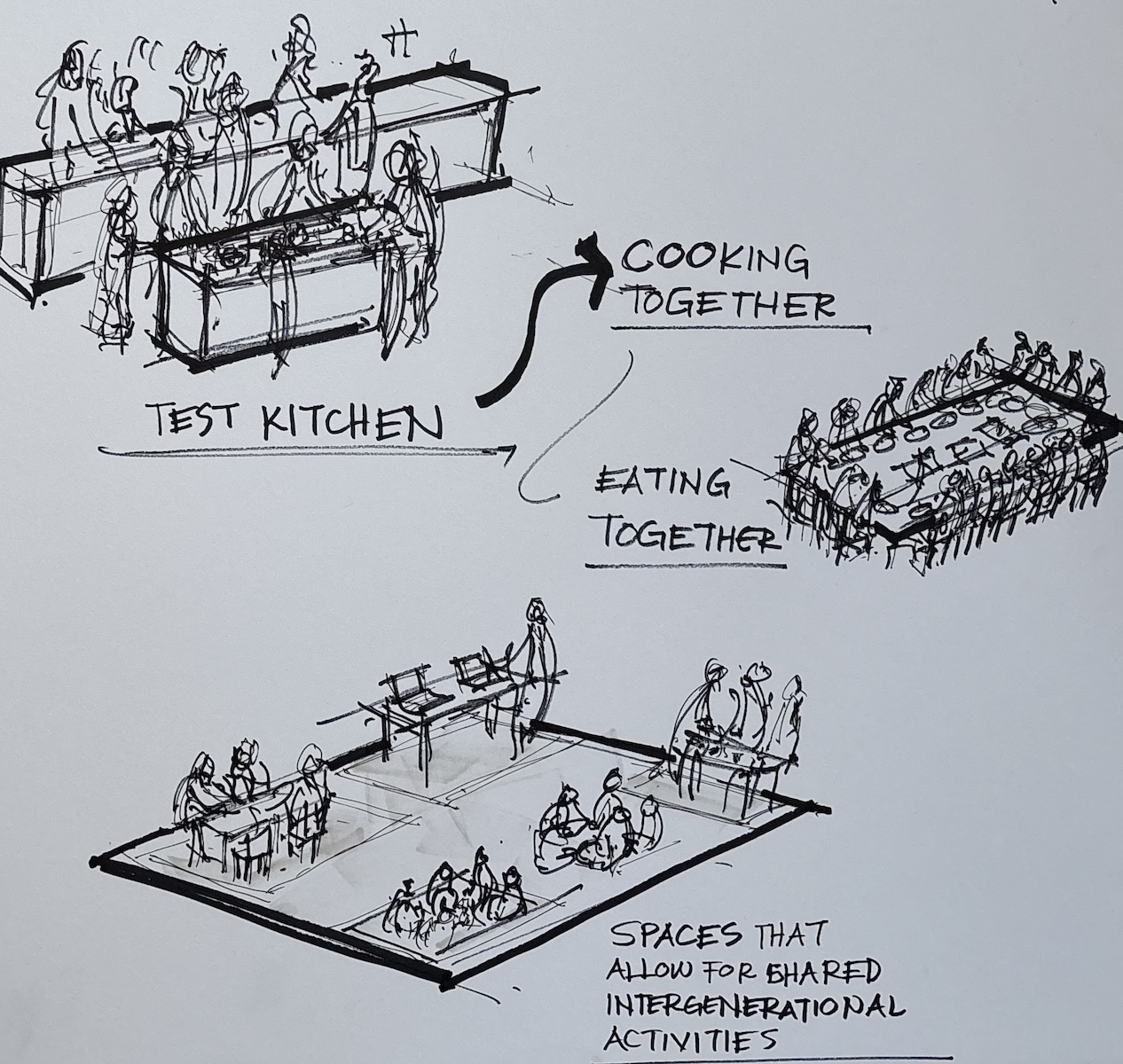
Figure 3 Sketches of spatial requirements for supporting food and intergenerational activities as aspects of Black public joy as infrastructure. Images provided by Jay Pitter.
DORI: Let’s shift the conversation to building trust, because in some ways, what you are flagging is that Black public joy is not just an individual’s knowledge to acquire, but it’s a community knowledge and an ancestral knowledge, which in some ways, you have to work hard to be able to tap into.
JAY: Of course, yes, and thank you for framing it that way. I didn’t sit down at my desk and be “this is what Black public joy is.” That would be quite arrogant and very indicative of how the design sectors work. Whether it’s the Creative City or the Beautiful City, all of those paradigms are very much hinged to these personalities and egos. And so, there is a reason that I highlight people and places. Even the process of the book is operating within an ancestral process. If you look at the acknowledgement section in my book, I acknowledge everybody that I talked about in the book. I felt I needed to do so in terms of modeling ancestral knowledge, because this idea of a single author in a really traditional sense is actually not how we arrive at a place of Black public joy. And so, there was a lot of research that was entailed in writing this book, and there was also a lot of listening, a lot of trust building, as you said.
I think of instances in the book where two Black Elders took me to a place called Orange Mound. What I was really struck by was that they vetted me in a strip mall for two whole hours. I thought we weren’t going to get to go because there is nobody more fierce and discerning than an old African-American lady. These ladies had me under interrogation. At one point in the conversation, they were asking me about myself. They did not care about my practice profile or the fancy universities where I’d lectured. They were asking me about my daughter, and what I do on the weekend. And in my mind, I am thinking, “Um’ lady, are we going to go to this community or not like?”. But at one point, I just had to submit to the process and be. Because it got dark and started to rain, I was thinking, “I’m probably not seeing this community today. But, I’ve had the blessing and the privilege of sitting with two of my elders and that’s got to be enough.” And when I leaned into that blessing and privilege and let go any other type of agenda or desire, then they said, “Let’s go,” and we toured that community in the dark and the rain.
And when I knew that I had gained a certain level of trust was when the tour of the community was over and one of the elders, Miss Mary Mitchell, she said to me, “Before you leave, I want to show you the house where I was born.” And I knew that I had done something right even if it was just to keep my big mouth shut. And we went to her house, and we sat there, and I heard generations of stories tied to that home and that front porch. So yeah, I don’t care what architectural school you went to, you’re not going to get that. And that’s what Black Public Joy is. It’s that trust. It’s that deep listening. It’s that embodied experience.
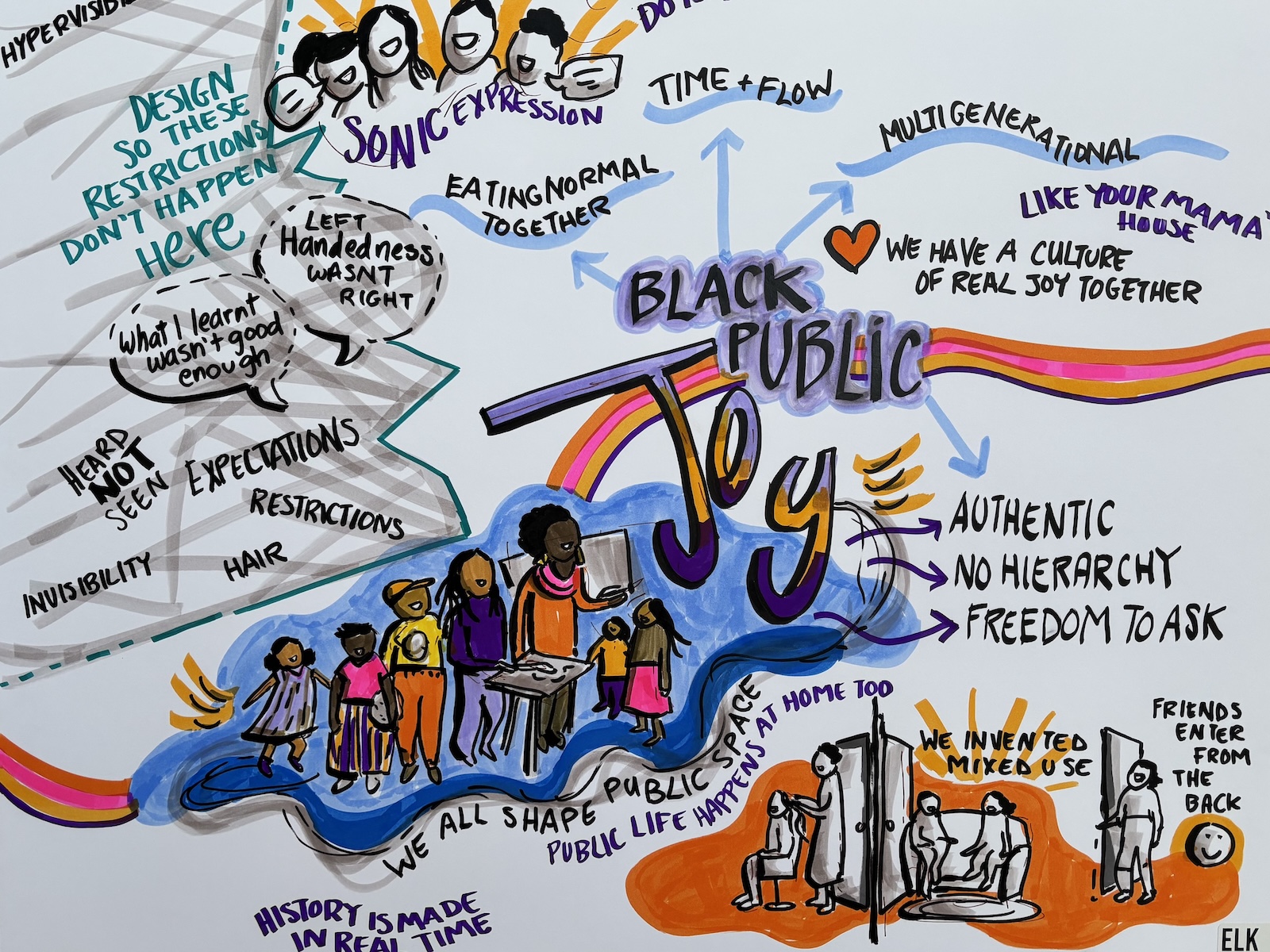
Figure 4 Sketch note by ELK of Pitter’s guidelines for Black public joy from her recent Ethos Lab workshop.
DORI: My last question is “If you wanted to embrace and co-create the conditions for Black public joy, what is it that you need to do to be able to do that? What kind of knowledges, in plural, is required to be able to do that in the right way?”
JAY: I think that you need to understand the Indigeneity of whatever place you’re working at whatever and wherever the site is. I recognize Indigenous peoples in this book and I think it’s important to do that in practice as well.
Next, I think you need methods that allow communities to surface their distinct Black public joy histories, rituals, informal celebrations, mutual care networks, and sites not obvious on maps, whether it’s in the South, or Brooklyn, or Harlem, or Detroit, or Little Jamaica. That can happen through storytelling circles, interviews, mapping exercises, collective cooking, community walks, memory work, and other participatory processes.
The goal is not simply to collect stories, but to understand the spatial intelligence embedded within them. The mistake many public space and urban planning practitioners make is stopping there. The work is not simply to listen. The work is to translate what is learned into tangible interventions. If people repeatedly speak about witnessing, intergenerational connection, music, gathering, respite, food sharing, cultural expression, or informal stewardship, those themes should be reflected in the design of public spaces, programming, amenities, policies, and governance structures. To avoid performative engagement or underdelivering on the process promise, tangible translation to the built environment and policy is non-negotiable.