

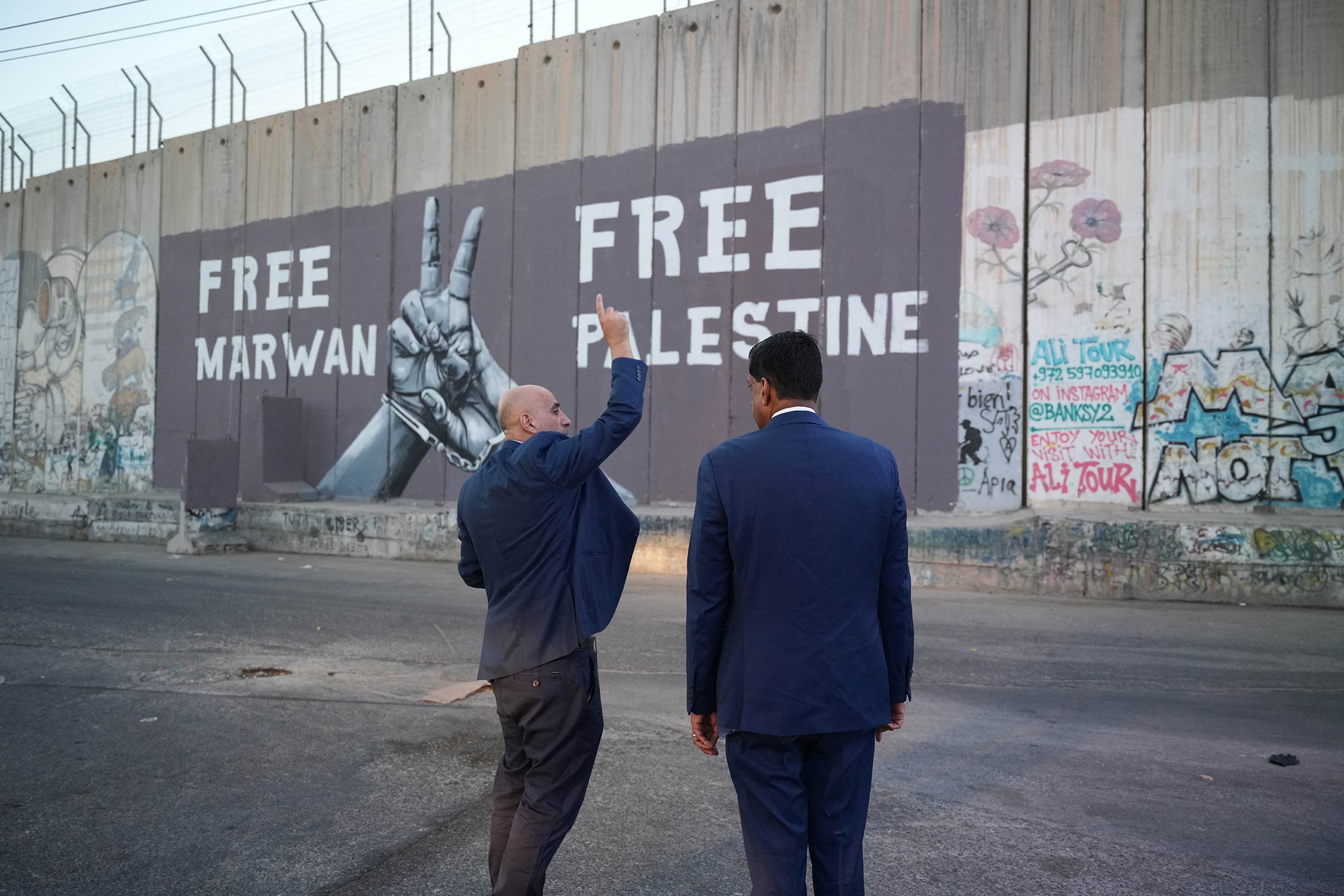
The headlines focused on the detention. When Congressman Ro Khanna and Cameron Kasky sat down with Everything Is Political’s Céline Semaan and Maya AlZaben, they wanted to talk about something they felt was more urgent: the Palestinians they had spent three days meeting across the occupied West Bank.
Khanna admits he felt apprehensive before boarding the plane out of New York to Ben Gurion airport in Tel Aviv. He understood the risks involved. And he knew the trip would be politically contentious in Washington. What he didn’t know is how it would be received in Bethlehem, Beit Sahour or Beit Jala.
For three days during the week of July 6th, Khanna traveled across the occupied West Bank with pro-Palestine advocate Cameron Kasky meeting with Palestinian families and community leaders living under military occupation. And while American coverage fixed its lens on the congressman’s detention, the people they met were out of the headlines – again. So, this is their story as much as it is Khanna’s.
Across Palestinian villages, mayors told Khanna they had never met a senior American politician. Families told him they had never spoken directly to a member of Congress. Now that one was sitting in their living rooms, they wanted to show him how they lived.
“They wanted to share the facts of life,” Khanna says. “They were counting on me to retell that when I got back to America.”
Those “facts of life” included rationing water because there wasn’t enough to wash clothes or flush toilets, military checkpoints, separate roads and the constant fear of settler violence.
“We witnessed the injustices Palestinians faced—the fear of settlers simply showing up and taking things from them,” Khanna says.
One Palestinian-American told Khanna he had been beaten at a checkpoint after returning from the United States. Years abroad had eroded his once fluent Hebrew. Soldiers, he said, didn’t believe him. He was beaten and robbed of $9,300.
Elsewhere, Khanna visited three homes a Palestinian-American businessman had been trying to build. Construction had stalled under repeated settler attacks. Before the delegation arrived, scouts were sent ahead to make sure the route was safe. Minutes after the group left, settlers returned and seized one of the scouts’ tractors.
The timing was impossible to ignore. Even the presence of a U.S. congressman wasn’t enough to deter settlers from returning within minutes. Khanna saw that there was no real separation between “conflict” and everyday life. Building a home required advance scouts, and leaving for just a few minutes means risking everything left behind.
“We shouldn’t be talking abstractly about the peace process—we need to be talking about the here and now and the facts on the ground. What are we doing to arrest these violent settlers? What are we doing to demolish these illegal outposts? What are we doing to protect Palestinians living there?”
“Yes, we ultimately need Palestinian self-determination and a Palestinian state, but there is so much on-the-ground reality that needs to be addressed—and can be addressed—without elaborate peace talks.”
Core for Khanna, the daily realities of the occupation cannot remain secondary to future diplomacy. Protecting Palestinians from settler violence and enforcing international law, Khanna argues, are obligations that exist now, not after a final political settlement.
It’s an argument he has increasingly tried to reflect in Congress. Days after returning, he publicly backed Rep. Thomas Massie’s (R-KY) amendment to eliminate the $3.3 billion in annual U.S. military aid to Israel—the first House vote in years to seriously test what had long been treated as politically untouchable. Although the amendment failed, support from more than 100 House Democrats underscored how quickly the debate inside Congress is changing.
Khanna also uses the “A” word, a word that many of his peers avoid using to describe Israeli treatment of Palestinians. For him, there isn’t another word for it. “It’s apartheid on the ground. People are being treated without respect because they’re brown, because they’re Palestinian.” He reiterates that we cannot wait for a grand plan to make sure people have dignity in Palestine.
It was this apartheid that framed the most widely reported moment of the trip, the detainment in the South Hebron Hills. There, settlers held both Americans and Palestinians alike on the delegation. It was in Khirbet Zanuta, a village whose residents had been driven out by continuous attacks by masked, armed settlers.
The detention even prompted Netanyahu’s mendacious response that Israel is a lawful nation that doesn’t tolerate “vigilantes.” Khanna retorted: the IDF is lying.
“I asked Ro if he wanted to wrap up the day,” Kasky says. “He said, ‘No, we have more stuff to do.’” Instead of returning to the hotel after they were captured, the group continued on to Susya.
A Palestinian New York Times photographer was also with them that day. Far from being relieved that a journalist was present, Kasky feared for her. Nearly 300 journalists in Gaza, the West Bank, and Lebanon have been killed by Israel since October 7th, 2023.
“I wish she wasn’t there,” he says. “I wish none of the Palestinians we were with were there, because it put them in more danger.”
Later, one of the Palestinians traveling with them apologized to him for what had happened.
“I don’t know if there is a better distillation of the way Israel-Palestine is handled in the world than violent Jewish settlers holding a group of Jews and Palestinians captive, and the Palestinian apologizing to the Jew for it,” Kasky says.
“I said, ‘Are you fucking kidding me? You’re apologizing to me?’”
The inversion was almost absurd. The Palestinians who had just lived through the confrontation, those who had been put at risk simply by accompanying the Americans, were the ones apologizing.
Before speaking with Everything Is Political, Khanna told Drop Site News that his visit to Palestine was “the most emotionally powerful trip” he had ever taken. We asked him what he meant—and whether he saw himself returning.
“I heard such stories of cruelty, of injustice,” he says. “I saw so much suffering.”
The story that visibly moved Khanna most was that of a father whose 14-year-old Palestinian-American son was shot 21 times by an Israeli soldier. The boy had gone out with his cousins and thrown rocks at a settler. The father didn’t try to hide that fact. But, he asked, did that justify what happened next?
When Khanna visited the family’s home, the boy’s bedroom had been left untouched. His bed was still made. His belongings remained exactly where he had left them. His parents hadn’t been able to change a thing.
As the father spoke, he broke down. More than anything, he wanted answers. And he told Khanna he had been unable to secure a meaningful investigation into his son’s killing.
“I’ll never forget that story,” Khanna says. “There are a number of others I’ll never forget, too.” There were many. A father whose home was attacked by extremist settlers night after night, leaving his daughter unable to sleep or study for her exams. Shopkeepers in Hebron who described rotten vegetables, metal objects, urine, and even acid thrown at them as they tried to keep their businesses open. A Palestinian-American who watched homes being vandalized and witnessed an elderly woman beaten by settlers. No one was held accountable.
“It is clear that there is a cruelty to the oppression,” Khanna says. “Those committing the oppression take almost a sadistic joy in it.”
Khanna also met with the family of slain Saif Musallet while visiting Al-Mazra’a ash-Sharqiya, where he and Kasky were hosted for dinner by Zahir Ibrahim, the son of Mohammad Ibrahim, who spent ten months in Israeli detention before being released.
Around the dinner table, one theme kept coming up. Palestinian-Americans told Khanna they no longer felt their U.S. citizenship protected them.
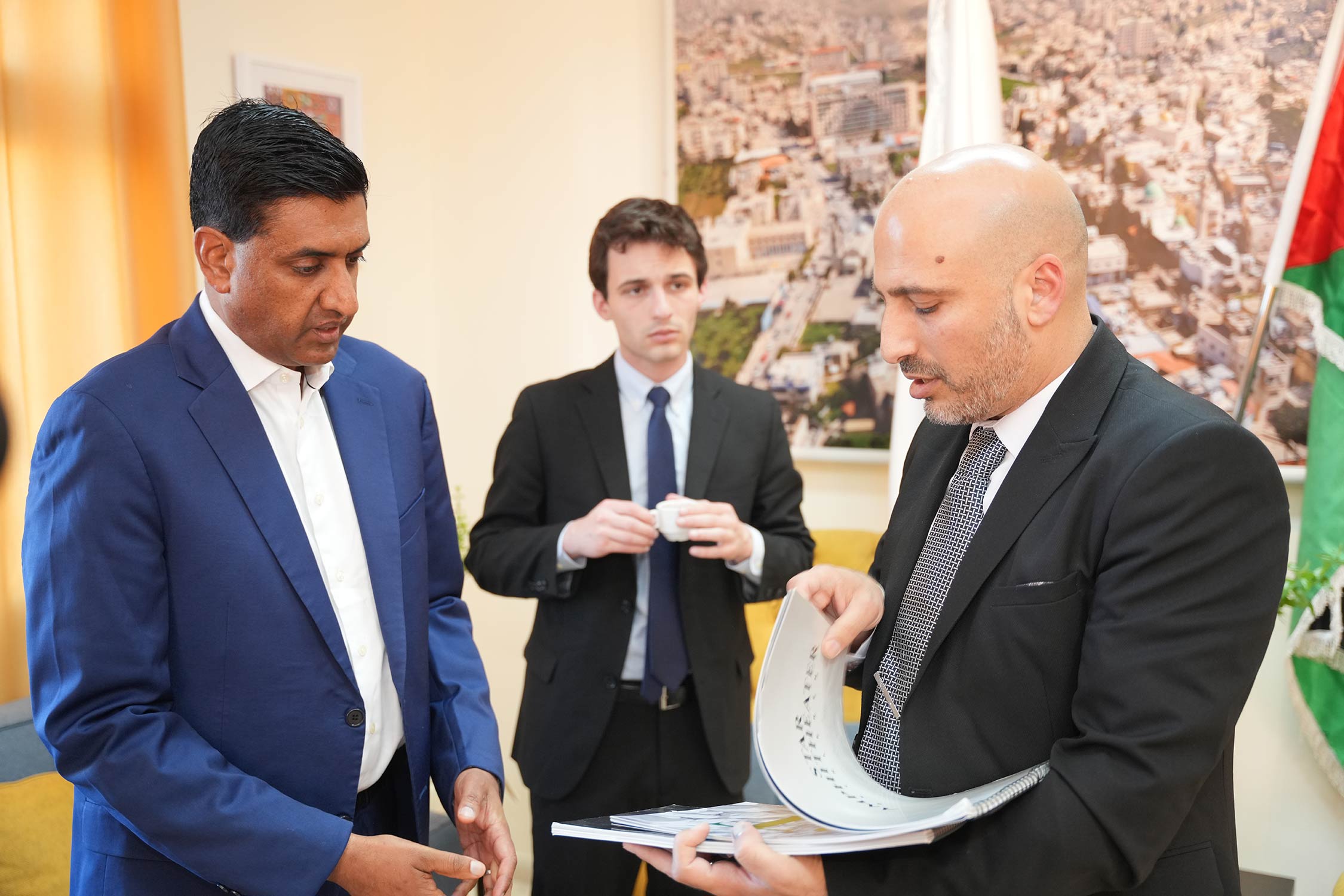
“They were telling Cameron and me that being American actually puts more of a target on their back right now,” Khanna says. If anything, their citizenship made them more visible; settlers knew their presence could draw international attention.
And yet, everywhere they went, Palestinians welcomed them into their homes. Families shared maklouba with them, a traditional Palestinian rice dish, black Arabic coffee, and stories of life under occupation.
“They were very generous in inviting me back,” Khanna says. “But what they really need from me as a member of Congress is to stand up for their human rights and to try to make an impact.”
Despite the detainment, Khanna says he wants to return.
“I certainly want to go back,” he says. “I just don’t want to go back empty-handed.”
Khanna has traveled to Israel three times before. This was the first time he traveled only through Palestine. “America has been ignorant for decades to the stories of Palestinians,” he says. “If my trip accomplishes one thing, I hope it changes the paradigm—for more American politicians to visit Palestine and the occupied West Bank, and to listen to the Palestinian perspective.”
He says that these politicians need to see how people live to understand that this isn’t ideological; it’s about the reality on the ground.
“And if they haven’t done that, they should at least see some of the videos we’re putting out here from Palestinians.”
The families that fed him asked for nothing more than that: to be seen. He was counting on himself to retell their facts of life. Now he has.
Special statement from Cameron Kasky, after his trip:
A free Palestine is the last stand we have for human rights.There is nothing more important to me than the freedom and liberation of these people, and nothing will stop me from giving this cause everything I can.
A Palestinian father told me he believes the Jewish people in America who speak out against Israel are some of the bravest people in the world. But I don’t feel brave. The bravest people in the world in my eyes are Palestinians.
Some Palestinians we met told us they do not believe they will know freedom in our lifetime. I do not blame them for feeling this way when the occupation continues to get more and more violent.
But I do not feel the same way. I believe the Palestinian people will know freedom and the occupation will end. And the Palestinians whose children, parents, and siblings lost their lives standing up for freedom will get to see the result of their courage.
Palestine will be free. Olive trees will be planted and outposts will be destroyed and journalists will not only be safe, but uplifted. Israel is afraid of people like me not because we’re violent, but because we have decisively ended the narrative that their apartheid state is inextricable from the identity of the Jewish people. It’s over.