
Why Cameron Kasky Ended His New York Congressional Run to Call Attention to the West Bank
Political urgency has a way of shifting when you witness systemic, unflinching violence and oppression. The 25-year-old activist Cameron Kasky knows this from experience. Last December, Kasky traveled to the West Bank while running for Congress, expecting the experience to inform his platform. Instead, his visit to the West Bank rearranged his priorities entirely. His campaign, and the limits of electoral politics, stopped making sense.
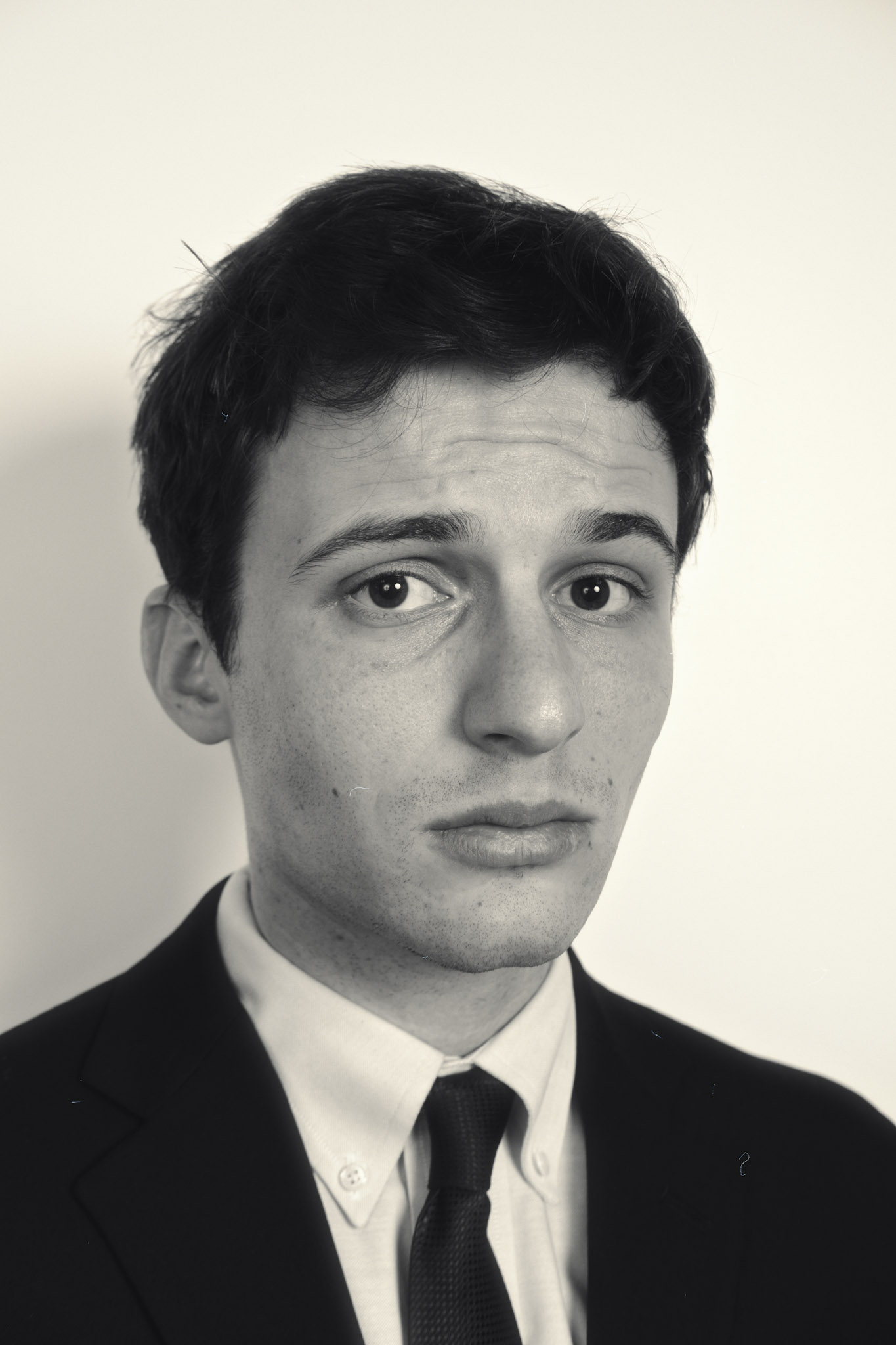
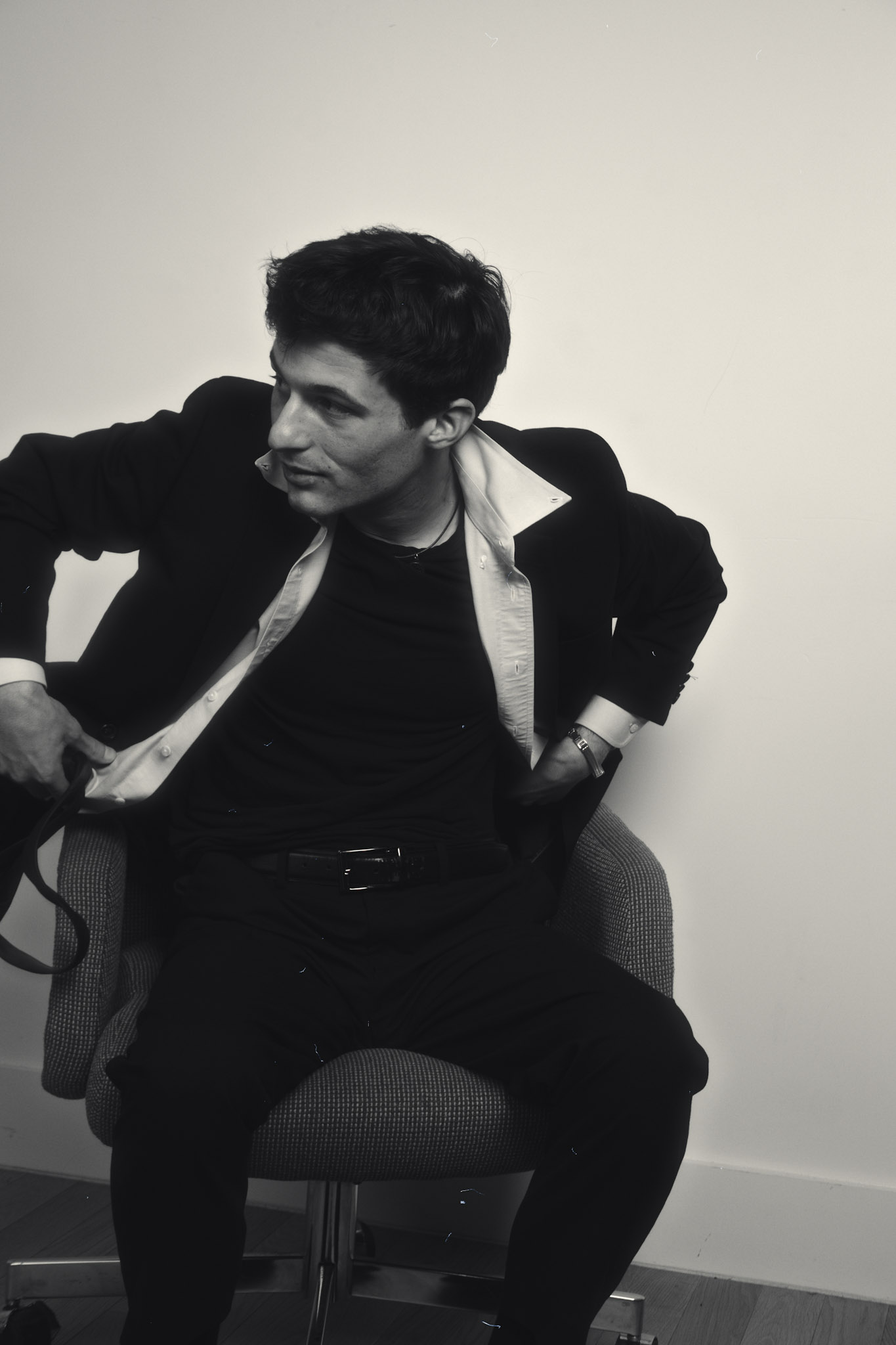
“Fuck my political career,” Kasky told me, midway through our portrait photoshoot as he unbuttoned his suit jacket and set it aside. “People are dying.”
Kasky, who is best known in the U.S. as a Parkland high school shooting survivor and gun reform activist, had spent days moving between Palestinian villages under military occupation. He went as an American citizen but more importantly, as a candidate running to succeed Congressman Jerry Nadler in New York’s 12th Congressional District. But when he returned, Kasky realized that what he witnessed could not wait for election cycles or party alignment. So he bowed out of the race.
“When you see the conditions people there are living under [in the West Bank], [I began to have a] one-track mind, which is: what can I do to help everyone?” he said. “Given my circumstances, given the nature of where we are at on Israel-Palestine, the upcoming midterm being something for which many politicians are going to want to reposition themselves on Palestine, and given the momentum that I have in this political context in the country, I do not know if I will be able to help as much six months from now.”

Kasky was tired when he showed up to our shoot. He was fresh off a train from lobbying in D.C. for justice in the West Bank. Actually, taking off the suit was his idea. He wanted to look like what he felt like: just another guy. He chose to wear a simple black T-shirt and an olive tree necklace he’d picked up in Hebron. When I asked what he wanted to listen to while we snapped the photos, he said anything but the Drake I already had on. He wanted to look sad, because, he said, that was the truth. And still—visibly exhausted—he couldn’t stop talking, in the best way, about everything that happened during his trip to the West Bank.
While in the West Bank, Kasky traveled through Beit Sahour, Hebron, Sebastia, Tuwani, Tulkarem, Bethlehem, and a small shepherd village in the South Hebron Hills called Umm al-Khair. Each place looked different, but they all shared the condition of occupation.
As an American, his body moved differently through space than that of the Palestinians he had met. He could pass where Palestinians could not. He could film until a soldier barked at him to stop. In Hebron, for instance, he accompanied a woman named Nasrin home through a military checkpoint. What should have been a 10-minute walk became 90, as Israeli soldiers turned people away arbitrarily and with no explanation.
Umm al-Khair, however, is where things really changed for him. The village is surrounded by Israeli settlements. There are no paved roads, no infrastructure, and at least 14 demolition orders hanging over it. Every night, residents stay awake watching grainy security cameras for settlers who might arrive on ATVs or in so-called “security vehicles.” Children grow up with the knowledge that their homes can disappear at any moment.
There, Kasky met a 19-year-old student who had been kidnapped and beaten by settlers at 17. When asked about his future, the boy answered simply: “There is no future. I only think about tomorrow. Will there be settlers tomorrow?” What struck Kasky was how plainly he said it.
“And it was just so interesting to me because he didn’t say that to try and make a political point or to add some sort of dramatic effect to the conversation. He was just speaking from his heart and saying, I don’t get to think in the future. I don’t know what the future is. My home can be destroyed.”
In another encounter, Kasky met a young woman whose husband had been shot dead by a settler while holding their baby.
She showed him a photo of her children. Kasky told her he dreamed of having beautiful children of his own someday. The woman replied: “Inshallah, they will play together.”
He knows they probably never will.
“I will never be allowed into the state of Israel again,” he said. “And you’re even more likely to be turned away trying to come in from Jordan. So an unfathomable amount of things would have to change dramatically for me to ever be able to see the people of Umm al-Khair again.”
Even still, he tries to keep in touch with all of the people he met in Umm al-Khair, though he knows that danger lurks for them at every corner. Every time the young woman Kasky met takes more than a couple of hours to write him back, he feels a creeping fear that something unthinkable has happened. When she finally does, there is a rush of relief. But that, he says, is the feeling people there live with all the time.
All throughout his experience, one nagging thought couldn’t escape his mind. “‘God damn it, I can’t believe I have to run for Congress right now,’” he kept thinking. “Because if I weren’t running for Congress right now, I would spend a very long time here.”
When Umm al-Khair residents say, ”See you tomorrow, Inshallah,” they are not saying these words casually. It’s clear in the darkly sardonic inflection of their voice that they say it because they genuinely do not know if they will see each other again. When they promise tomorrow, they have to say “God-willing,” because only God can bless them with another day.
Although morbid, Kasky says the residents continue to infuse every day with humor, love, and a real sense of community.
“It was so shocking to me because I was like, ‘If I were living in these conditions, I don’t understand how I could laugh at all,”’ he explained. “But then I remembered my own experience as a school shooting survivor with all these victims of gun violence whom I’ve met, and everybody’s funny. And you realize that it’s because humor is one of the only weapons we have against trauma.”
The violence in Gaza, he says, felt indistinguishable from what he had witnessed as a child. He struggled to reconcile the outrage Americans expressed over the shooting at his school with their relative silence about violence abroad. That’s why, when he returned to the U.S., Kasky no longer believed politics could come first.
People questioned his decision to step away from the congressional race, especially his ability to help. Some voiced that perhaps he could do more for Palestine if he actually got elected—that Israel would not pause its next violent move to see how his election turned out.
“The people I met can’t wait until November,” he said, thinking back to the residents of Umm al-Khair. “Their villages can be destroyed any day… Settlers who come from my own district in New York could kill them. I can’t make an emergency less urgent just because I’m running for office.”
So, he began working directly with lawmakers, including California Congressman Ro Khanna, to push for legislation that addresses the human rights violations in the West Bank. Kasky says that having this experience, being in the West Bank physically, gives him leverage with lawmakers.
“It’s easier to get a meeting when you say: ‘I saw this with my own eyes.’”
The villages changed the scale of what he was seeing. For Kasky, Gaza and the West Bank are not separate moral categories. Destruction in Gaza is explosive and immediate, but it is just as procedural in the West Bank.
“What’s happening in Gaza is snapping their neck,” he said. “What’s happening in the West Bank is slowly choking them out.”
He rejects the idea that settler violence is a fringe problem, pointing to the leadership now shaping anti-Palestinian violence in the West Bank for evidence, namely Israel’s Finance Minister Bezalel Smotrich, who has publicly called for Palestinian towns to be destroyed and pushed to legalize settlements built in violation of international law. More recently, he has advanced policies allowing Israelis to purchase land in the occupied West Bank.
“[Smotrich] makes Netanyahu look like a Care Bear,” Kasky explains. “He is exploiting the world’s attention towards Gaza to turn the West Bank into even more of a Wild West murder party. And nobody’s paying attention.”
In addition to legislative action, Kasky also seeks to challenge the language Zionists, particularly American Zionists, are taught. As a Jewish American raised in a Zionist education system, Kasky feels a responsibility to speak directly to those who were shaped by it, having seen up close how its worldview is taught.
“When you have a Zionist upbringing and you have friends with progressive values, you are presented with a choice when Israel-Palestine comes into the conversation,” Kasky said. “You can either blame your friends and assume that they’re wrong and fall victim to some predatory form of Jew hatred. Or you could make yourself uncomfortable and engage with educational materials to which you had previously been unexposed.”
“I’ve lost [extended] family members over this ,” he said. “They think I’m a terrorist, and I’m like, ‘Okay, whatever. If you love this foreign country more than you love your family, that’s your problem.’”

As the shoot came to a close, Kasky seemed visibly more at ease. Somewhere in the conversation, I learned he is a Scorpio and that his parents were divorced. Small facts, but ones that shifted the tone. He felt more relaxed. He truly was just another guy who wanted to make a difference.
I later asked Kasky what the word “activist” meant to him. In a world where activism is often reduced to slogans online, he talked about action.
“It could mean accompanying undocumented individuals to immigration court to make sure they have somebody with them to serve as a support system while ICE is presumably waiting in the wings to pounce on their right to be free and safe,” Kasky said.
He also thought back to a lot of the Westerners that he met in Palestine who sought to help by simply being there–a “protective presence,” he called it. “You are accompanying people who are on their own land to plow their fields and live their lives so you can serve as something of a buffer when the armed settlers come.” In his view, activism is simply knowing what tools are at your disposal and putting them to work for something that matters. It’s carrying the stories and experiences people in the West Bank shared with him—and telling the world about them.
As he took his leave, Kasky turned to me and made a little gesture that I’ll never forget. It is a gesture he had learned from Muslim friends in the U.S. years earlier, one that took on new meaning in Palestine: a hand to the heart, then a subtle nod.
Tap. “See you tomorrow, Inshallah.” Nod. That’s how he says hello and goodbye now.