
Photo Credit: Sarah Sinno
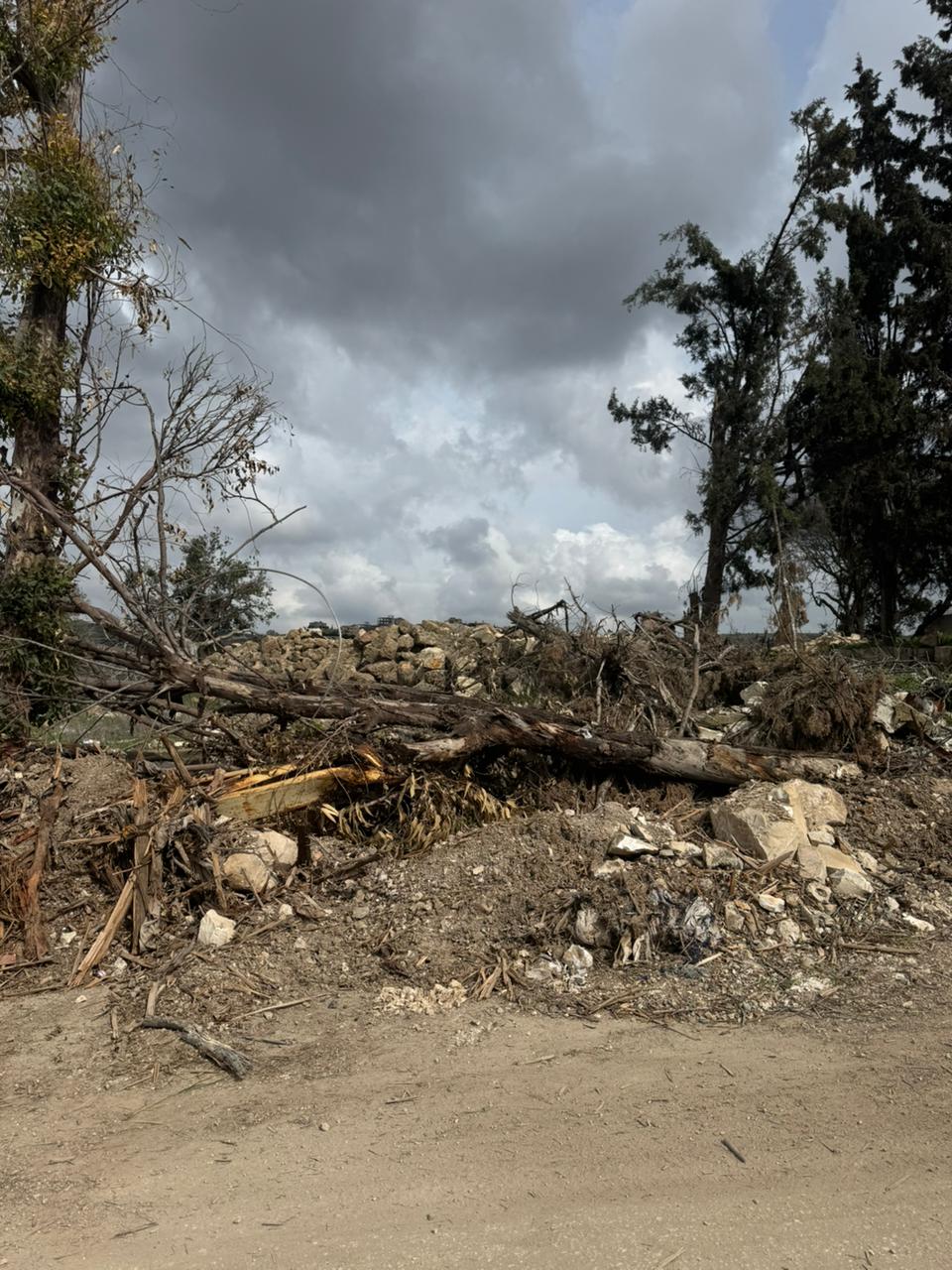
On February 2, the United Nations Interim Force in Lebanon (UNIFIL)issued a statement announcing that Israeli occupation forces had instructed their personnel to remain under cover near the border between south Lebanon and occupied Palestine. They were ordered to keep their distance because the IOF had planned aerial activity involving the release of a “non-toxic substance.” Samples collected and analyzed by Lebanon’s Ministries of Agriculture and Environment, in coordination with the Lebanese Army and UNIFIL, confirmed that the substance sprayed by Israel was the herbicide, glyphosate. Laboratory results showed that, in some locations, concentration levels were 20 to 30 times higher than normal. Not to mention, this is not the first instance of herbicide spraying over southern Lebanon, nor is the practice confined to Lebanon. Similar tactics have been documented in Gaza, the West Bank, and Quneitra in Syria.
While the IOF didn’t provide further explanation as to its purpose, these operations are part of a broader Israeli strategy to establish so-called “buffer zones” by dismantling the ecological foundations upon which communities depend. The deployment of chemical agents kills vegetation, producing de facto “security” no-go areas that empty entire regions of their Indigenous inhabitants. Cultivated fields are deliberately destroyed, soil fertility declines, and water systems become polluted. Farmers lose their livelihoods, and communities are forcibly uprooted. Demographic realities are reshaped, and space is incrementally cleared for future settlers. Simply put, these tactics function as a mechanism of displacement, dispossession, and elimination—and are importantly part of a long history of this kind of colonial territorial engineering.
Glyphosate and Ecological Harm
For decades, glyphosate has been marketed as a formulation designed to kill weeds only and increase crop yields. But the consequences of its use on humans and the environment cannot be ignored: In 2015, Glyphosate was classified by the International Agency for Research on Cancer (IARC) as “probably carcinogenic to humans,” and it has been associated with a range of additional health risks, including endocrine disruption, potential harm to reproductive health, as well as liver and kidney damage. In November of last year, the scientific journal Regulatory Toxicology and Pharmacology formally withdrew a study published in 2000 that had asserted the chemical’s safety.
Beyond its human health implications, glyphosate is ecologically harmful. Studies have shown that it degrades soil microorganisms; others have linked it to increased plant vulnerability to disease. It can also leach into water systems, contaminating surface and groundwater sources. Exposure may be lethal to certain species like bees. Even when it does not cause immediate mortality, glyphosate eliminates vegetation that provides habitat and shelter for bees, birds, and other animals, disrupting food webs and ecological balance. What’s more, research indicates that glyphosate can alter animal behavior, affecting foraging and feeding patterns, anti-predator responses, reproduction, learning and memory, and social interactions.
Despite a growing body of scientific literature highlighting its risks to both human health and the environment, and bearing in mind that corporate giants manufacturing such products have been known to fund and even ghostwrite research to promote the opposite, glyphosate remains the most widely used herbicide globally.
The Monsanto Model
To understand how it became so deeply entrenched, normalized within agriculture systems in some contexts, and used as a weapon of war in others, it is necessary to look more closely at the corporation responsible for its global expansion: Monsanto.
Founded in 1901, Monsanto’s corporate history reflects a longstanding pattern of chemical production linked to environmental devastation. Over the past century, the corporation has manufactured products later proven harmful and has faced tens of thousands of lawsuits, resulting in billions of dollars in settlements.
Among the products it manufactured were polychlorinated biphenyls (PCBs), synthetic industrial chemicals that were eventually banned worldwide due to their toxicity. Through their production and disposal, including the discharge of millions of pounds of PCBs into waterways and landfills, Monsanto contributed to some of the most enduring chemical contamination crises in modern history, the consequences of which continue to reverberate today.
One of the most notorious cases unfolded in Anniston, Ala., where Monsanto’s chemical factory polluted the entire town from 1935 through the 1970s, causing widespread harm to the community. Despite being fully aware of the toxic effects of PCBs, the company concealed evidence, according to internal documents, a conduct that reflects a longstanding pattern of disregard for both environmental care and human health. Whether in the case of PCBs or glyphosate, the underlying logic remains consistent: ecological systems and communities are harmed in order to prioritize profit and, at times, territorial expansion.
Monsanto also became the world’s largest seed company. Through the enforcement of restrictive patents on genetically modified seeds, the corporation consolidated unprecedented control over global food systems. By prohibiting seed saving, a practice upheld by farmers and Indigenous communities for millennia, it undermined seed sovereignty and compelled farmers to purchase new seeds each season rather than replanting from their own harvests. What had long functioned as part of the commons since the origins of human civilization, the foundational basis of food and life itself, was privatized. Monsanto transferred control over seeds from cultivators to corporations, further creating systems of structural dependency.
What was once embedded in reciprocal relationships between land, seed, and cultivator is now controlled by the same chemical-producing corporations implicated in the degradation of land—as is the case of what is unfolding in southern Lebanon. Power is thus consolidated within an industrial architecture that, at times, prohibits the exchange and regeneration of seeds and, at other times, renders the land uninhabitable. In both cases, it undermines the ability to grow food and remain rooted in the land, thereby threatening the conditions necessary for survival.
Chemical Warfare
Alongside its record of manufacturing carcinogenic products, dumping hazardous chemicals into the environment, and contributing to the destruction of agricultural systems, Monsanto has also been linked to chemical warfare. During the Vietnam War (1962–1971), it was among the U.S. military contractors that manufactured Agent Orange, a defoliant used to strip forests and destroy crops that provided cover and food to Vietnamese communities.
The chemical contained dioxin, one of the most toxic compounds known, contributing to the defoliation of millions of acres of forest and farmland. It has been associated with hundreds of thousands of deaths and long-term illnesses, including cancers and birth defects.
Although acts of ecocide long predated this period, well before the term itself was coined, it was in the aftermath of Agent Orange that the word “ecocide” was first used to describe the deliberate destruction of ecosystems and began to enter political and legal discourse.
The Vietnam War exposed a structural link between chemical production, corporate power, and a military doctrine in which ecosystems and farmlands are targeted precisely because they sustain human life. Nature, because it nourished, protected, and anchored Indigenous communities, was treated as an obstacle to military and imperial control. As a result, it became a battlefield in its own right.
Capital and Ruin
This historical precedent continues to reverberate today in Lebanon, Palestine, and Syria. Decades apart, these are not isolated acts of ecological destruction but part of a continuous trajectory carried out by the same imperial, corporate, and financial machinery.
In 2018, Monsanto was acquired by Bayer. Bayer’s largest institutional shareholders include BlackRock and Vanguard, the world’s two largest asset management firms.
Both firms have been identified in reports, including those by UN Special Rapporteur Francesca Albanese, as major investors in corporations linked to Israel’s occupation apparatus, military industry, and surveillance infrastructure. These include Palantir Technologies, Lockheed Martin, Caterpillar Inc., Microsoft, Amazon, and Elbit Systems.
Mapping these financial linkages reveals how ecocide is structurally embedded within broader systems of violence that are deeply entrenched and mutually reinforcing. Ecocide and genocide are financed through overlapping capital networks that connect chemical production, militarization, and territorial control.
The spraying of glyphosate over agricultural land in southern Lebanon must therefore be situated within this historical continuum. The same corporate-financial structure that profits from destructive chemicals and agricultural control is interwoven with the industries that maintain a settler-colonial stronghold.