
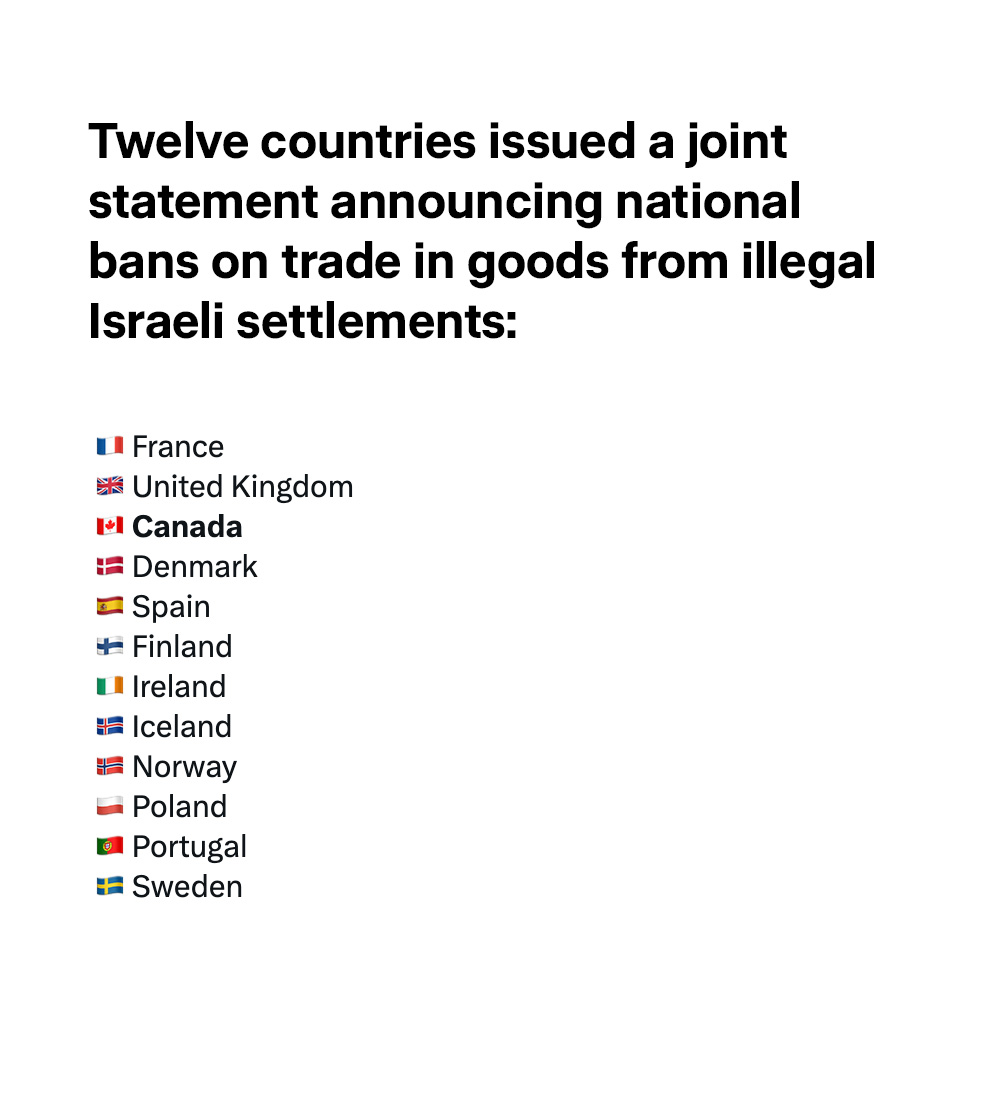
12 countries are moving to restrict trade with illegal israeli settlements in the occupied West Bank. Canada, Denmark, Finland, France, Iceland, Ireland, Norway, Poland, Portugal, Spain, Sweden and the UK announced today that they will introduce, support or consider measures restricting settlement trade. France, the UK and Canada have specifically committed to moving forward with bans on settlement goods. israel approved plans last month for 1,200 new housing units in E1, a settlement project that would cut off East Jerusalem, alongside a rise in settler attacks.
This is significant because israeli settlements have been considered illegal under international law for decades, but that consensus has rarely translated into meaningful economic consequences. Governments have condemned settlement expansion while goods produced on occupied Palestinian land continued to enter international markets and companies continued to build and profit from the settlements themselves. UK Foreign Secretary Ed Miliband told parliament Britain would introduce an “import ban on goods from illegal settlements,” accusing israel of turning a blind eye to what he called ethnic cleansing by settlers. israel responded by ordering the closure of the British consulate in Jerusalem.
We started to see a shift in 2024, when the U.S., UK and EU imposed sanctions on individual israeli settlers and organizations involved in violence against Palestinians and the seizure of Palestinian land. The Trump administration later rescinded the U.S. sanctions in 2025, while other governments continued imposing their own measures. What is happening now goes further because the conversation is beginning to move beyond punishing individual settlers and toward restricting parts of the economy that allow the settlement project to function (the flow of goods, not just the people building on the land). There is also an important history here that makes today’s announcement difficult to separate from the treatment of Palestinian-led boycott movements. Activists for Palestine have advocated boycott, divestment and sanctions (BDS) since 2005 as a nonviolent strategy for applying economic pressure on israel, yet across the United States, lawmakers have passed measures specifically intended to discourage participation in boycotts of israel. Texas, for example, restricts certain government contracts with companies that boycott israel, and versions of anti-boycott legislation have been adopted in dozens of other states.
For years, Palestinians calling for economic pressure on israel have watched BDS be legislated against in the U.S., condemned by governments and framed as an unacceptable form of political action. Now some of those same governments are acknowledging, through their own policies, that restricting trade can be a legitimate response to an illegal occupation. Their argument is that these measures target settlements rather than israel as a whole, but it still raises an obvious question about why Palestinian calls for economic accountability have been treated so differently in the first place.
Whether all 12 countries ultimately adopt and enforce meaningful restrictions remains to be seen. Ireland’s own settlement-goods bill, for instance, has already been narrowed to cover only goods, not services, and delayed past this year. But after decades of governments calling the settlements illegal while continuing to trade with them, the distinction between condemning the occupation and economically participating in it is finally being put under pressure.