

Before patterns, there was fabric and a body. Cloth was wrapped, folded, and adjusted to changing weather, movement, landscape and individual needs. Garments adapted to the body rather than forcing the body to adapt to them.
Today, most clothing begins with a pattern - a template based on measurements, averages, and assumptions about what a body should be. The pattern became a tool for standardization of bodies, embedding ideas of normality, productivity, gender, and beauty into the very construction of clothing. As industrial fashion expanded, fashion gradually shifted from serving bodies to disciplining them and demanding conformity.
Garments increasingly came to dictate how bodies should look and move, leaving little room for physical difference, disability, aging, or cultural variation. How did this happen and what alternatives can be found?
The invention of sewing patterns goes back to the 18th century, more recent than one would think. While at first only professional tailors used them to make garments, they started to become popular in the general public very quickly through magazines like Godey’s Lady’s Book and The Lady’s Magazine. Shortly after, they were commercialized through companies like Butterick and McCall in the late 1800s. In combination with the popularization of the sewing machine around the same time, and the industrial revolution, the groundwork for mass production was laid. For the growing population and the arising need of clothes, that was a win. But what was lost through this process?
A pattern can be adapted individually and makes it possible for people to produce their own clothes at home. Politically, the pattern becomes interesting at the point where standardized measurement becomes the ideal, and deviation becomes the error.
A pattern does more than tell us where to cut. It tells us what kind of body we are cutting for, what kind of body is assumed when making the pattern.
A pattern is not simply a technical tool. It is an idea of the body translated into paper. Once clothing is produced from standardized measurements, bodily difference becomes something to be corrected rather than accommodated. Standardization does make production easier, but therefore it makes difference a problem. Mass-produced clothing is rarely designed with bodily change in mind. A pattern fixes a particular shape: A waist at a particular circumference, a sleeve at a particular length, a body at a particular moment.
But bodies do not remain fixed. They grow, age, gain and lose weight, become pregnant, recover from illness, experience hormonal changes or simply change over time. Instead of allowing clothing to change with the body, our current system often asks the opposite of us: squeeze into the old size, alter the body, or buy something new. A changing body becomes a reason for consumption.
The garment is not expected to adapt; the person is expected to replace it.
What appears to be a failure of the body to fit is therefore also a business model: If clothes are designed for a fixed body, every change creates another potential purchase. So, what if clothing did not begin with the assumption that the body has to fit the garment?
To understand what change came with the commercialization of patterns, it can be helpful to look at pattern-less clothing traditions. Many ancient clothing traditions as well as many different cultures that worked with draping, wrapping, and adaptability, help us imagine forms of clothing rooted in care, fluidity, and bodily diversity.
Usually draped garments are made of one single piece of fabric wrapped around the body in a specific way, using diverse wrapping techniques. The fabric is neither stitched nor cut but simply held by knots, pins, fibulae, drawstrings or belts. The design is simple and adaptable to different bodies. In ancient Greece, for example, garments such as the peplos, chiton and himation were largely made from rectangular pieces of wool, linen or silk, often worn with a belt. The fabric was usually fastened around the body with the help of bronze fibulae pins at the shoulders. This technique was later on adapted in a similar way in ancient Rome. Rather than being cut into a fixed shape, the fabric could be arranged and adjusted according to the wearer through folding and wrapping.
Similar principles can be found far beyond the Mediterranean. The Indian sari, for instance, consists traditionally of a long, unstitched piece of fabric that is wrapped around the body in different regional styles. Ancient Egyptian clothing also made extensive use of rectangular linen textiles that could be wrapped around the body, particularly in response to the hot climate. These garments were not necessarily free from social rules or hierarchies. Clothing could still communicate gender, status, class and social belonging.
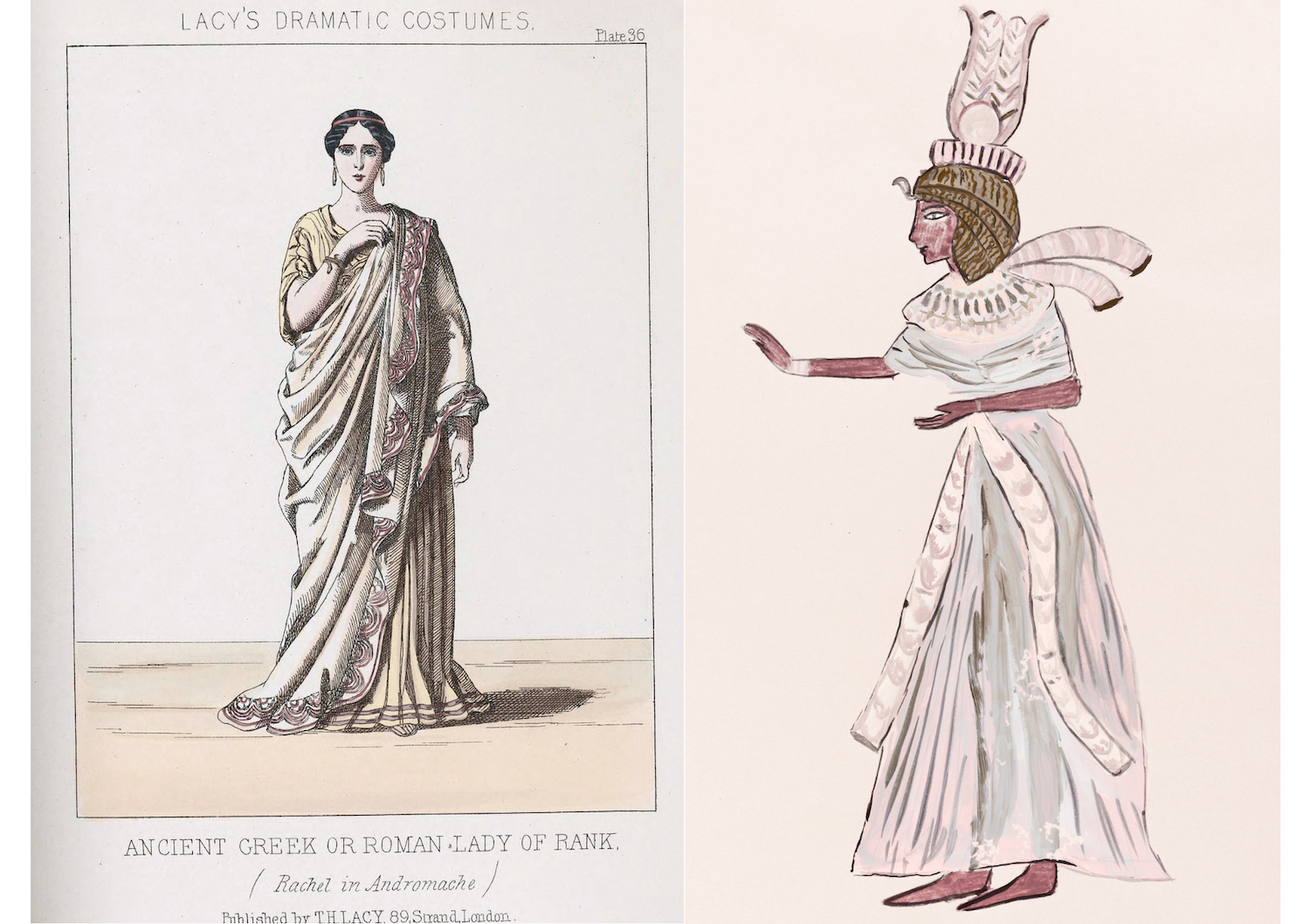
Another good example of draped clothing can be found in the robes traditionally worn by desert communities, such as the Tuareg and Bedouins. Draping fabrics made of breathing textures is a way to allow the body to move freely and at the same time cover the skin, protecting the body from extreme temperatures, sun and sandstorms. Looking at one of the harshest environments in the world, these garments are necessary for survival. The fact that clothes are actually there to protect us from weathering is often forgotten. Clothing is a technology of inhabiting a landscape. By providing what is needed in the specific environment, garments connect people to the land and the environment surrounding them.
A static pattern not only fails to account for a body in constant change; it also struggles to respond to a landscape that is never static. Land is fluid. Conditions shift from burning sun to sudden sandstorms, from heat to cold, often within a matter of hours. Garments that are not fixed to a particular shape can respond more fluidly to these conditions. Through different ways of wrapping, folding and fastening, the same piece of fabric can reveal or cover more of the body, loosen or tighten, adapt to heat, wind and movement.
Instead of separating clothing from its environment, this kind of garment allows the wearer to continuously negotiate between body, fabric and landscape.
One contemporary response to the rigidity of standardized sizing is the growing movement towards adjustable clothing. Designers are experimenting with garments that can expand, contract and change shape with the wearer rather than being tied to a single size. Adjustable waistbands, ties, buttons, wrap constructions, modular pieces and transformable garments allow one garment to accommodate different bodies and different moments in a person’s life. This is particularly relevant for bodies that change through pregnancy, weight fluctuations, aging or changes in shape throughout the day. Instead of treating these changes as a reason to buy a new size, adjustable clothing builds change into the garment itself. It shifts the question from “Which size am I?” to “How can this garment adapt to me?”
Contemporary designers are beginning to challenge the assumption that a garment should have a fixed shape and size. Finnish designer Sofia Ilmonen, for example, has developed a modular clothing system in which garments are made from small, interchangeable pieces that can be rearranged and expanded. Instead of buying a new garment when the body changes, the wearer can modify the existing one. Her approach treats clothing less as a finished object and more as a system that can evolve with the person wearing it.
Designer and researcher Alice Gielen pushes this idea even further with PAUX, a clothing system developed around the changing body during pregnancy and postpartum. Drawing on techniques such as origami, kirigami and smocking, Gielen experiments with structures that can expand and contract as the body changes. Here, adaptability is not added as a practical feature after the garment has been designed; it is built into the material and its construction from the beginning.
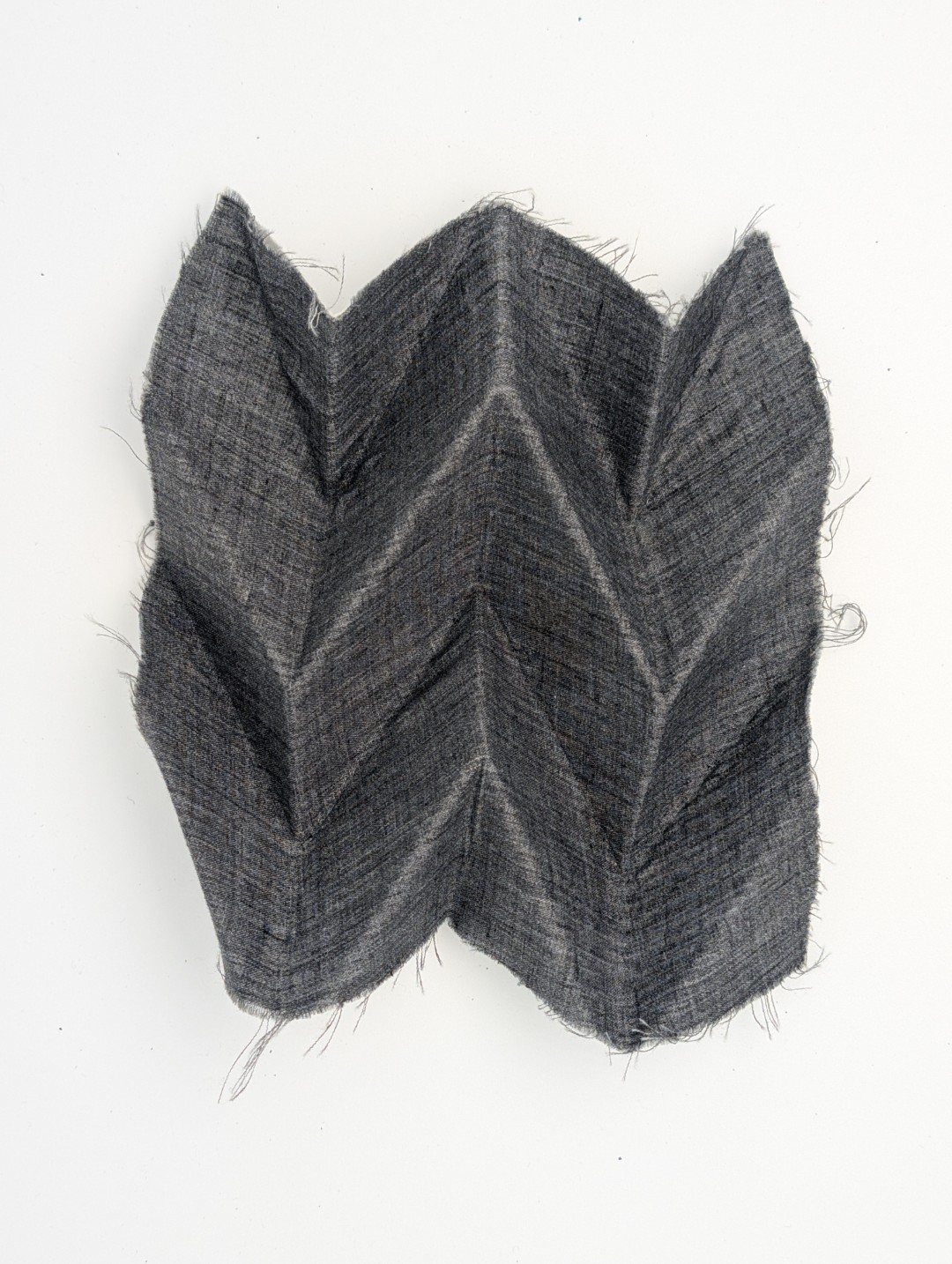
Courtesy of Alice Gielen
These approaches suggest a different logic of sizing: rather than asking which size a body belongs to, they ask how a garment can respond to a body that is never entirely fixed. This idea is no longer confined to experimental fashion. In 2026, adjustable clothing has begun to enter the mainstream fashion conversation. The Independent recently described “fit-as-you-grow” garments as an emerging fashion trend, pointing to designers and smaller labels developing clothes that can accommodate changing bodies rather than requiring a new size with every change. The Financial Times has similarly noted the growing use of elasticated waists, drawstrings, corset ties, tabs and stretch panels by designers including Dries Van Noten, Loewe, Max Mara and Sacai.
The logic behind these garments is simple but radical: If bodies change constantly, why should clothing remain fixed?
Instead of producing more sizes, some designers are beginning to design clothes that can contain several bodies, several moments and even several stages of a life. What looks like a small technical adjustment therefore points towards a different model of fashion — one based not on replacing clothes when bodies change, but on allowing clothes to change with them.
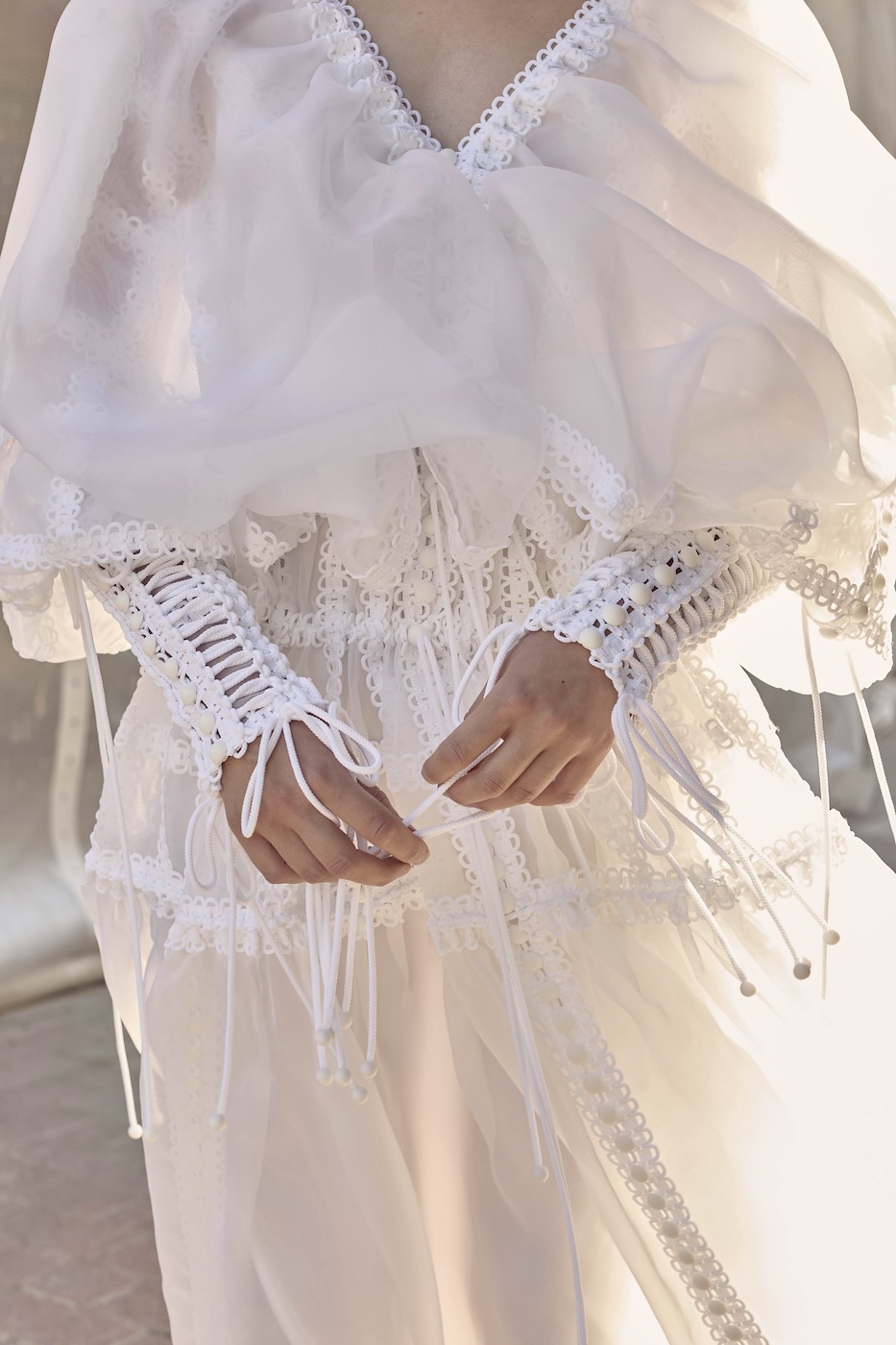
Courtesy of Sofia Ilmonen (Designer) and Päivi Ristell (Photographer)
The idea of adjustable clothing is not entirely new. In many historical sewing traditions, garments were made with change in mind. Extra fabric was sometimes deliberately left in seams, hems or pleats so that a garment could later be let out, shortened or otherwise altered as the wearer’s body changed. Children’s clothes in particular were often designed to grow with the child, using adjustable hems, ties or folded fabric. Clothing was not necessarily understood as a finished object with a fixed lifespan, but as something that could be opened, altered and repaired.
The techniques were simple, but they reflected a very different relationship to the garment: instead of replacing a piece of clothing when the body changed, the garment itself could change with the body.
Draped clothing can be seen as a radical rejection of the idealized body - and therefore becomes highly political. But the alternative to the standardized body doesn’t have to be a return to a premodern past. Obviously, the goal cannot be to dress like the ancient Greeks or to transform contemporary fashion into desert garments. But we do need a different idea of adaptation. The goal should be to question how we can give fashion back the freedom to be an ongoing negotiation between fabric, body, and environment. Through this process, our perception of our own bodies can be freed as well.