

When I was four, we moved to a house on the outskirts of Jalgaon, a small city in North Maharashtra.
My grandfather wanted a home away from the noise of the colony where we used to live. To me, the new house felt empty. I had no friends in the neighbouring houses, and the language spoken around us was unfamiliar. In our previous home, my best friend lived next door, and we would spend our evenings together in the narrow lane in front of our house. The kitchen was connected through a back door, through which Sheela Aunty would sneak in as soon as my grandfather left. That back door led to stairs going up to the upper floor, where my cousins and I would gather in the evenings. The houses were tightly packed, clinging to each other with walls so thin that if you pressed your ear against one, you could hear the soft murmurs of life next door. In the evenings, the aunties would sit on the otak, combing their hair, their voices weaving stories of the past.
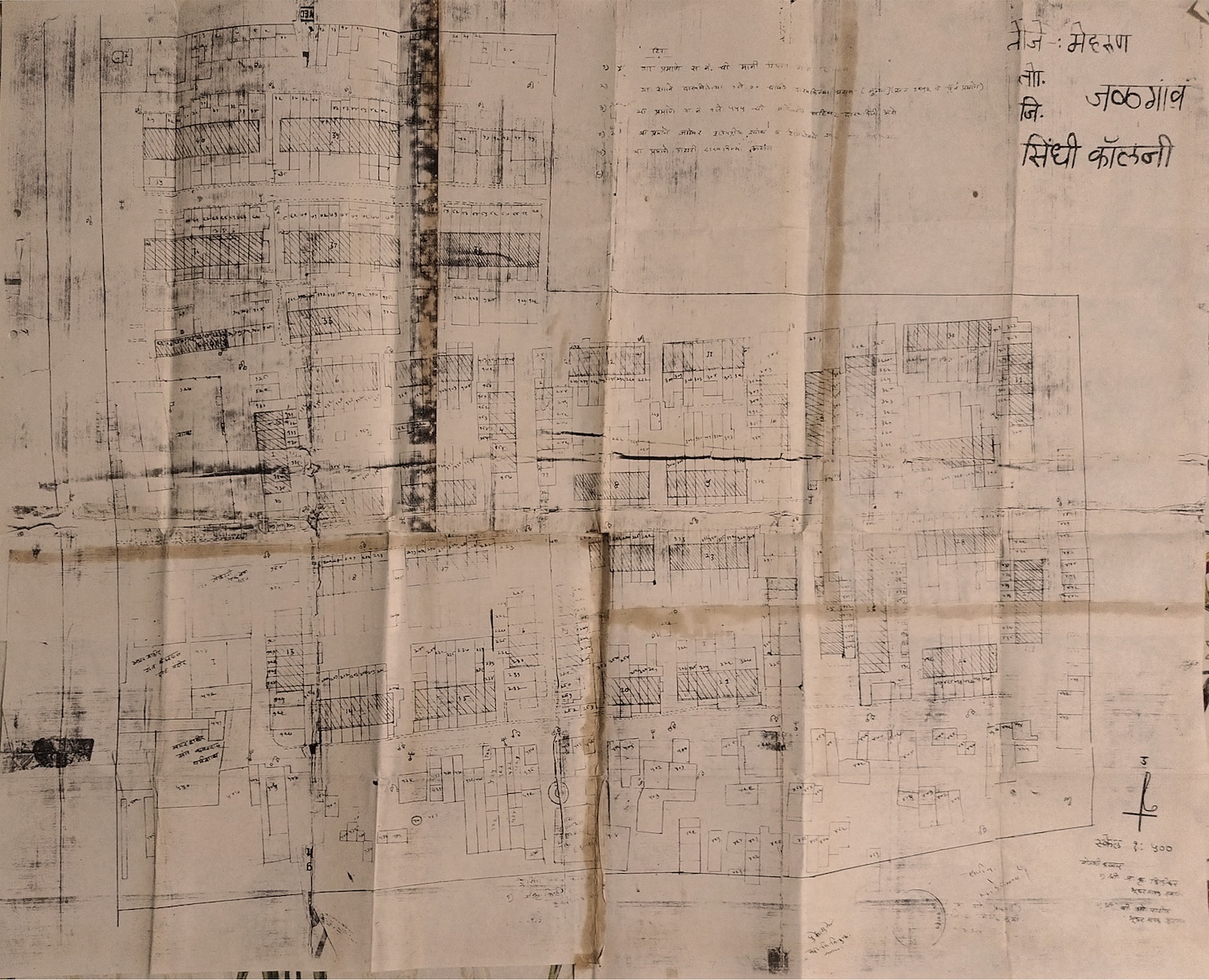
Khushboo Tejwani / Refugee Settlement / c.1950 / Digitised archival document / Partition series
This settlement of about a hundred houses had been given to refugee families when they arrived in India from Sindh. My great-grandfather was one of those residents. He had lived in Ubauro, Sindh, with his family, but had to leave Pakistan due to the riots that erupted after the sudden influx of refugees from India following Partition. Many Sindhi refugees took the sea route from Karachi to Mumbai, a mere 589 nautical miles away. This was the safest way to reach India, unlike the millions who crossed the borders amidst physical violence, bloodshed, and atrocities.
The residents of our neighbourhood came from different refugee camps - Kalyan, Deolali, Madh, and Pimpri; some had their roots in Rajasthan and Gujarat. Initially, the settlement was located beyond the city boundaries of that time, a physical reminder of how refugees were often seen as outsiders. In a conversation with Professor Dayanand Visrani, a history professor, he shared how perceptions of the refugee body influenced the space allocated to them.
Bade batate hai, yaane bhai, ye jo rehvaasi wahan se aaye hue hai, sab kuch chhodh kar aaye hai, kya pata kaunse nature ke honge, lootere toh nahi honge, sir phire toh nahi honge. Isiliye uss samay ke nagar adyaksh ne iss tarah ek konne main ye jagah de di.
“They tell me that these refugees who have come from the other side of the border, they have left everything behind and are here; who knows what kind of people they will be? What if they are looters or nomads of some kind? That is why the city chief of that time gave us a space in the corner of the city.”
The space itself doesn’t overtly reveal its past but holds it quietly, like the lines on a hand.
You can see the past in the corners of the streets, at the entrances of houses, and in the food stalls set up along the road. There are countless ways in which “Sindh” continues to live in places far removed from it, both geographically and culturally. For the first generation of Sindhi refugees, making a home was a continuous process that shaped their bodies, rituals, and belongings. Deeply rooted in tangible memories of Sindh, they built spatial markers in Jalgaon that echoed their cultural lineage.
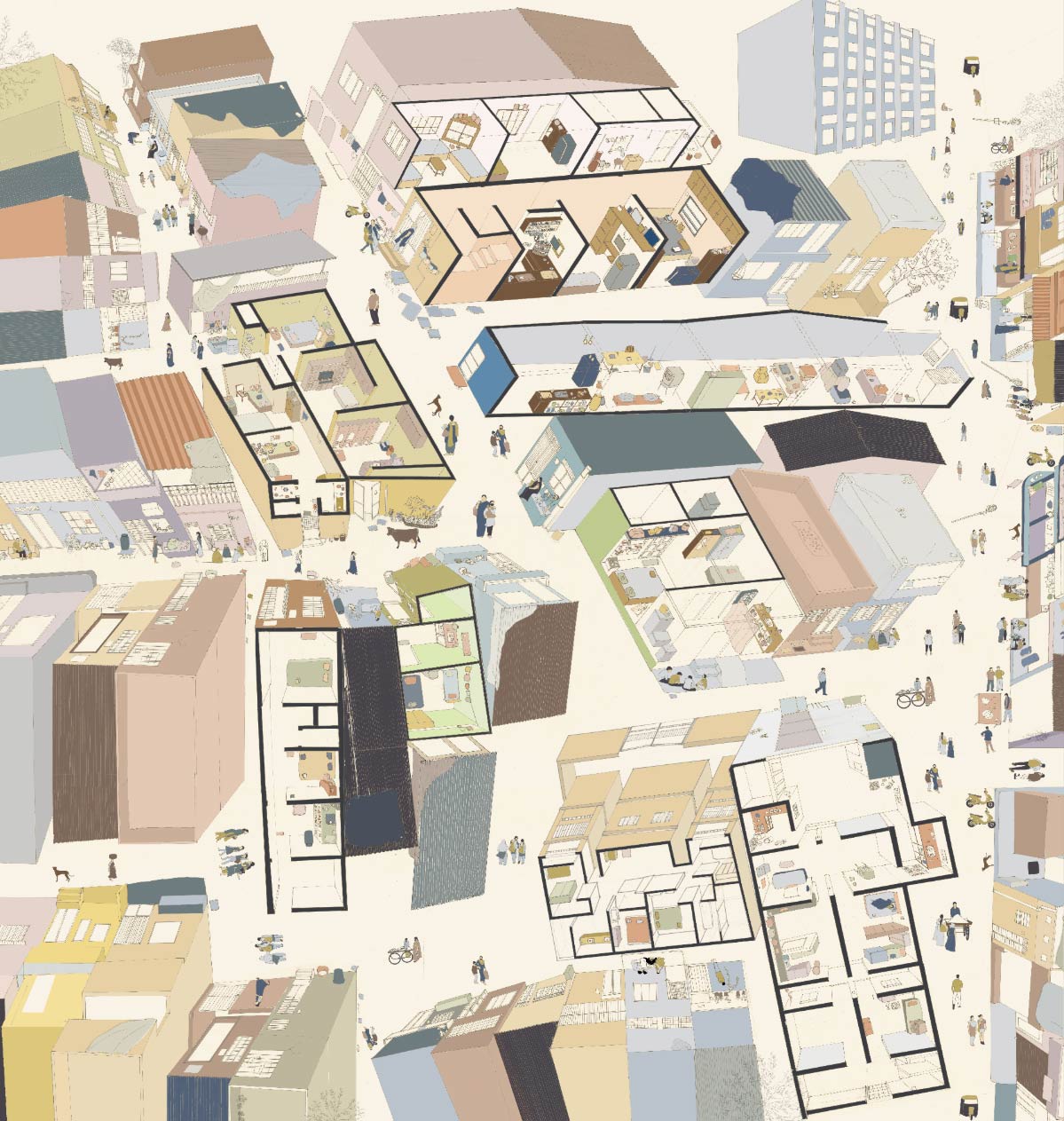
Khushboo Tejwani / Rooms that grew / 2024 / Hand drawn illustration and digital collage / Partition series
As I walk down the lane of the colony today, I entered my neighbour Durga’s house, a simple home built in 1966 named ‘Mayakunj’. The pistachio-green walls showed the marks of age, areas swollen from damp air, and patches where the paint had peeled. Durga greeted me with a hug. She immediately recognised me as Kalyani’s granddaughter, and without hesitation, held me in her arms and asked about my life. Durga always called my grandmother ‘Kalyani’ - a name she had adopted from the Kalyan camp where my grandmother had once lived.
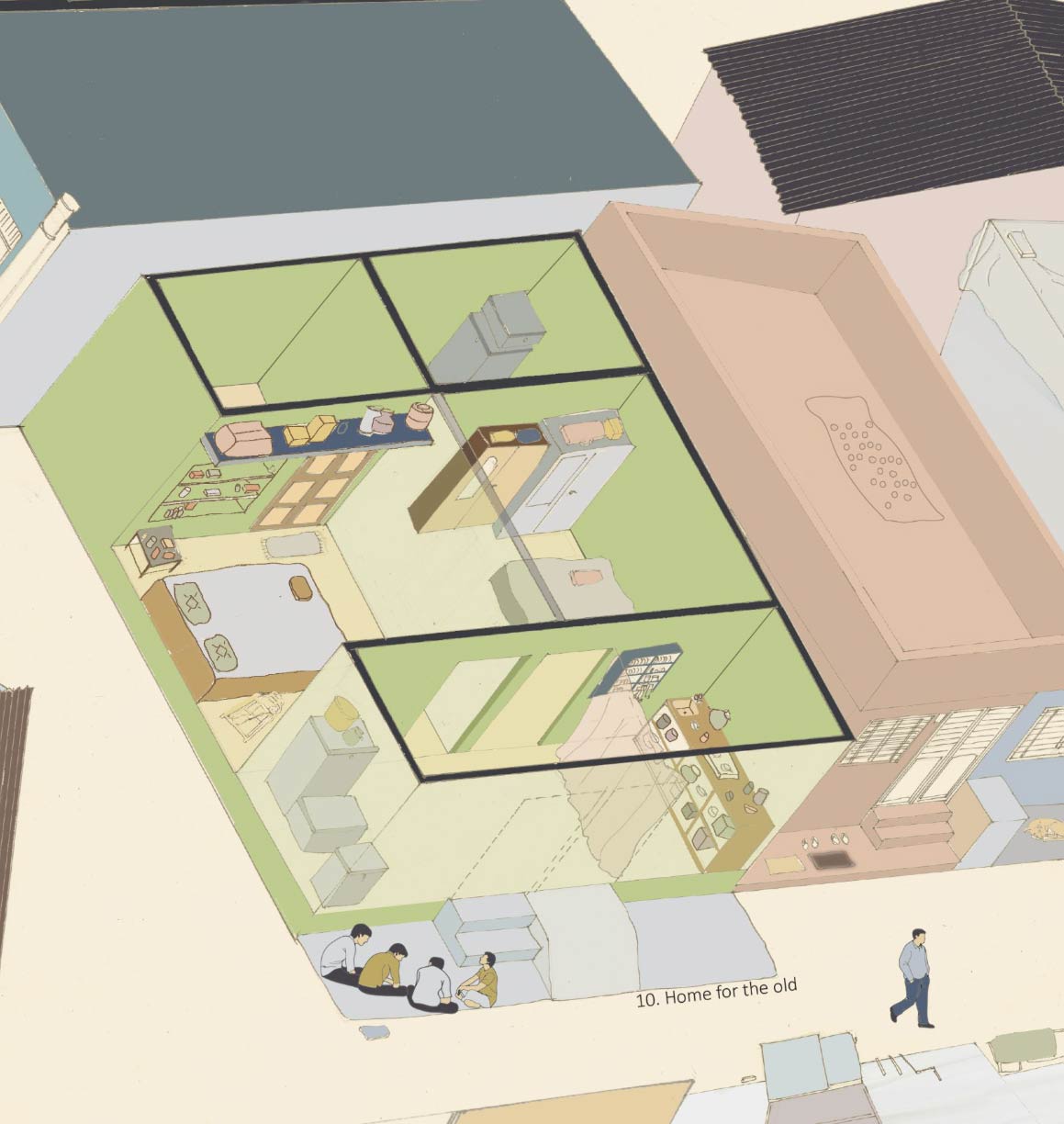
Khushboo Tejwani / Home for the old / 2024 / Hand drawn illustration and digital collage / Partition series
Durga, now 84 years old, lives alone with her son and his daughter. The three of them share the house, though her son spends most of his days at work. Durga, who is currently bedridden, spends her time in one room, where her granddaughter looks after her. They have combined two kothis and removed the wall in the middle. Durga’s room is opposite to her granddaughter’s room, separated by a curtain. The home here doubles as a place of care.
.jpg)
Khushboo Tejwani / Home as an Assemblage / 2024 / Digital Collage / Partition series
When I asked Durga if she remembered anything about her journey during the partition. She paused before replying, saying that she barely remembered. So much time had passed, and at her age, memory often felt distant. Yet, after saying this, she began recounting fragments of memories. She recalled being six years old when her family fled to India, escaping the violent riots that erupted with the sudden influx of refugees into Sindh.
I remember someone banging on our door, asking:
Yahan ladki hai kya? “Is there a girl here?”
My mother held my mouth shut so I wouldn’t say anything,” she said. “We stayed in India for a few months to seek refuge, but eventually, we moved back to Sindh. Life there was difficult, with violence never seeming to end. After struggling for two years, we finally returned to India.”
Durga then recalled a disturbing memory. “I remember seeing dead bodies lined up when we arrived. It was somewhere. I think it was Mirpur. Yes, Mirpur,” she said, the name coming to her suddenly.
Though Durga initially claimed she remembered little, she spoke for over an hour about the violence, describing memories of abductions and harrowing scenes she had witnessed as a child. The past had not been forgotten, but repressed.
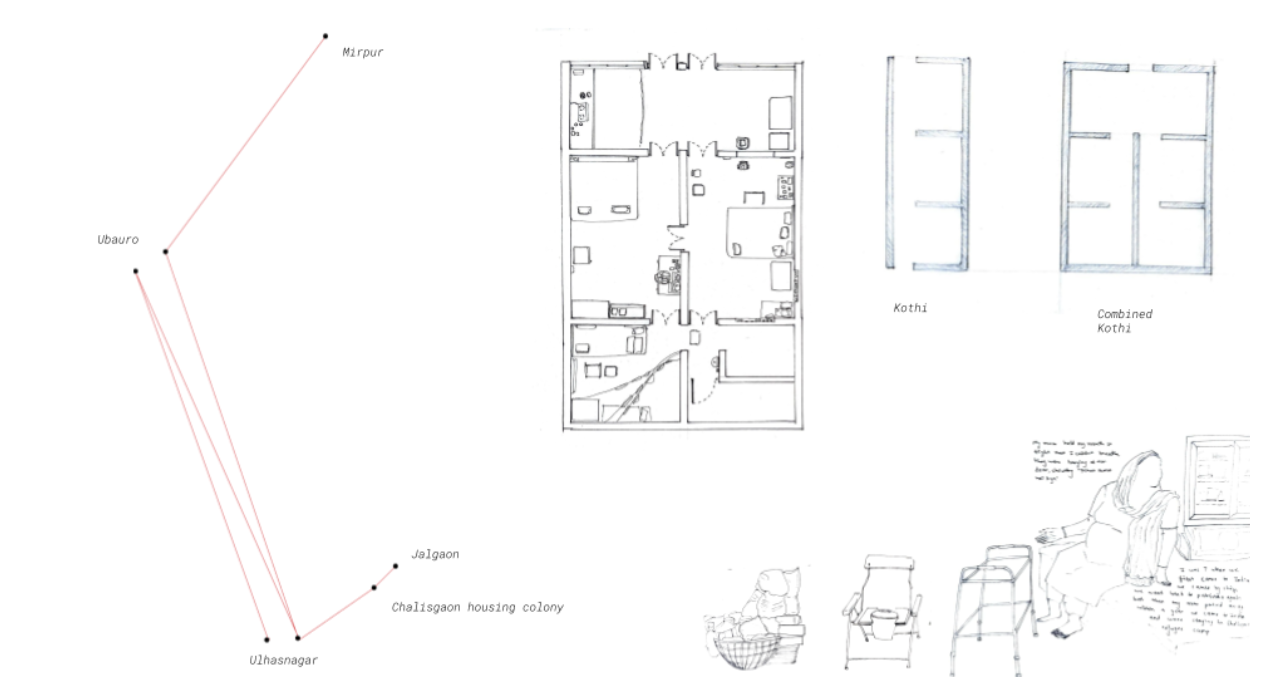
Khushboo Tejwani / On site diagram / 2024 / Hand drawn diagram / Partition series
While Durga had a barrack to extend and make a home, for some there was only a ground to claim.
Sheela’s family came to Amravati Refugee colony from Raharki, Sindh, and later moved to Jalgaon in search for work. In 1975, they squatted on land at the edge of the refugee colony, marking their space with wooden sticks and constructing a room using sand-lime bricks.
Assan plot velare chadyo si an pancho ghar dhato.
“We settled on the plot here and made our own home.”
Sheela described how, upon their arrival, they built a single room with a small padar outside. This padar, or courtyard, had a small open kitchen and a wash area. They didn’t have a toilet then, instead, they relied on one of the ten public toilets in the refugee colony, which everyone used. They finally added a toilet to their home about seven years ago.
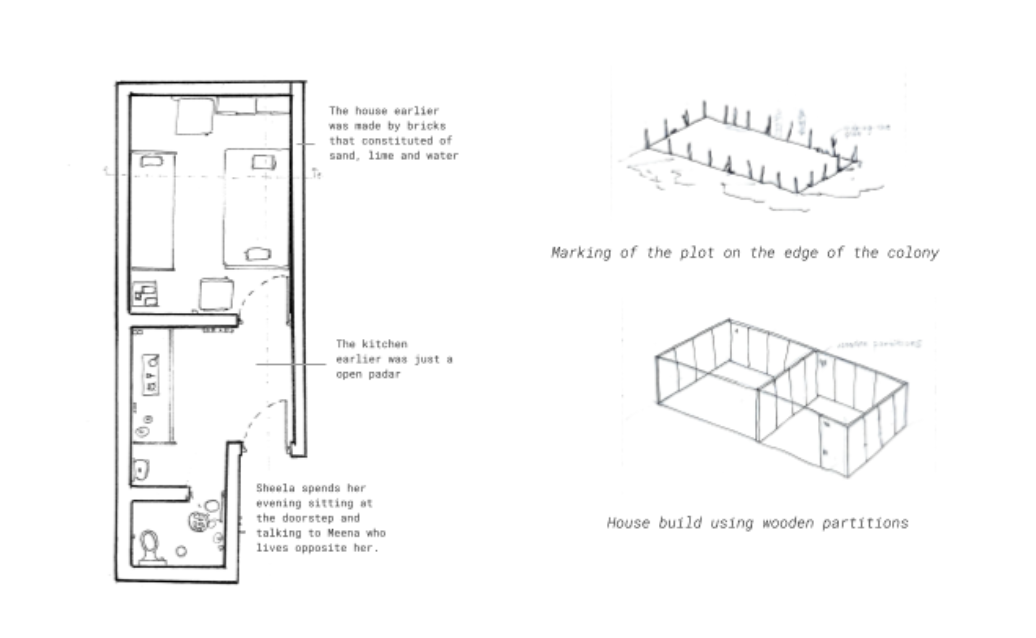
Khushboo Tejwani / On site diagram / 2024 / Hand-drawn diagram / Partition series
In conversation, Sheela shared how, when her husband became abusive, Kalyani would keep an eye on her from the back door, monitoring the situation to make him more self-conscious. As soon as her husband left, Kalyani would come over to support her and offer comfort. Care moved through the houses.
What could not be built in space then was pursued on paper. Tikamdas, a businessman in the colony, tells me about how his father and uncle kept filing claims to rebuild their lives.
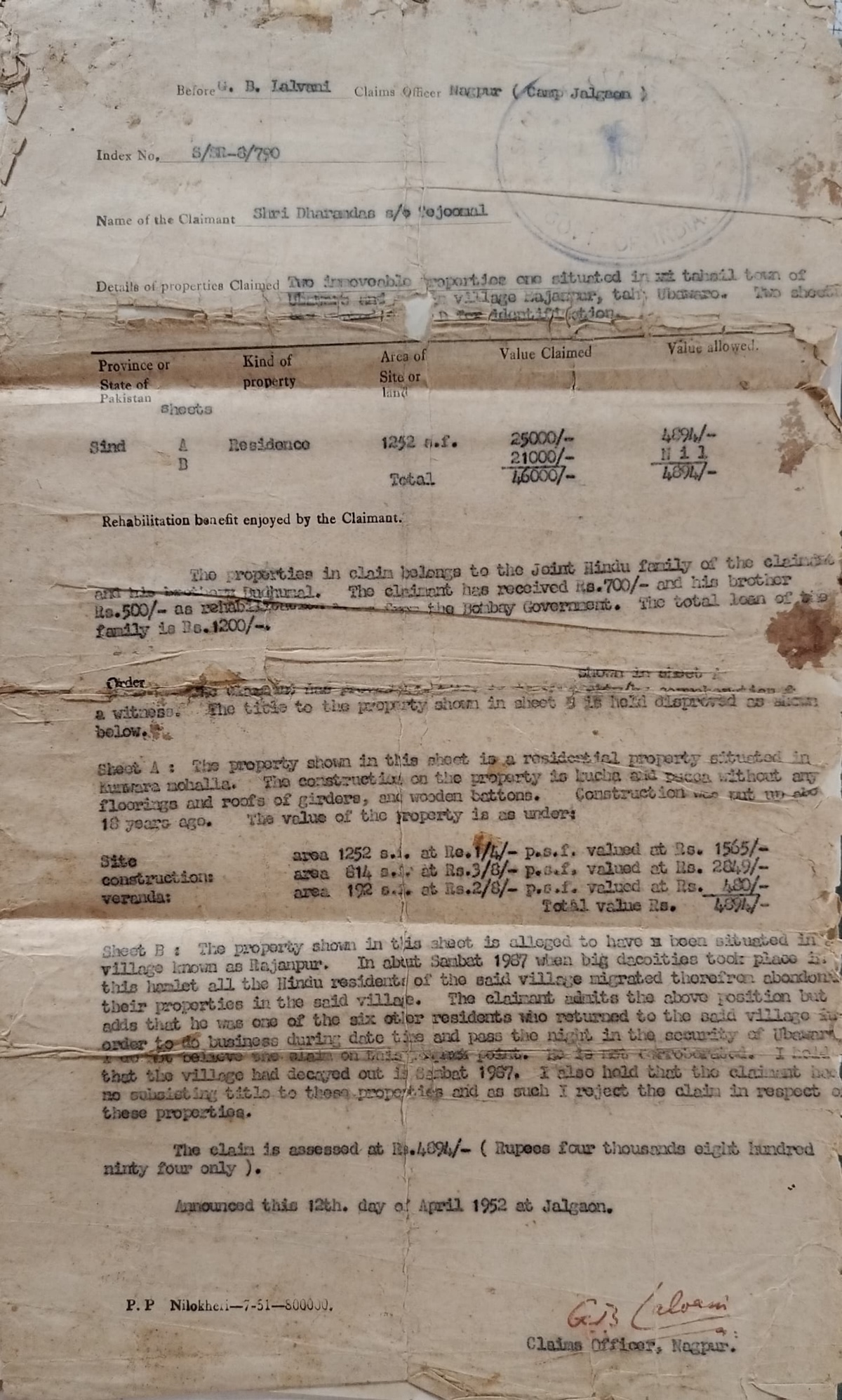
Khushboo Tejwani / Claim Resettlement / c.1952 / Digitised archival document / Partition series
“My uncle, Dharamdas, was 35 when he came here, and he spent a lot of time filing claims, trying to get compensation for the property he’d lost in Sindh. He submitted multiple applications to the claims commissioner in Delhi, sending letter after letter. But, despite all his efforts, there was no reply. In those days, you just had to keep pushing forward. He also tried to secure loans to start a business that could support his family of six.”
I asked him about those early days in India, and he paused, choosing his words thoughtfully.
“In Nashik, both Dharamdas and my father, Budhumal, took any work they could find, mostly as labourers on the railway tracks. That work kept us going; it was all they could do to make sure we had enough to eat. After a year in Deolali, the collector assigned us room no. 199 in Jalgaon. Later, when we moved to Jalgaon, we rented room no. 200 right next door, giving both families the space we needed as we grew.”
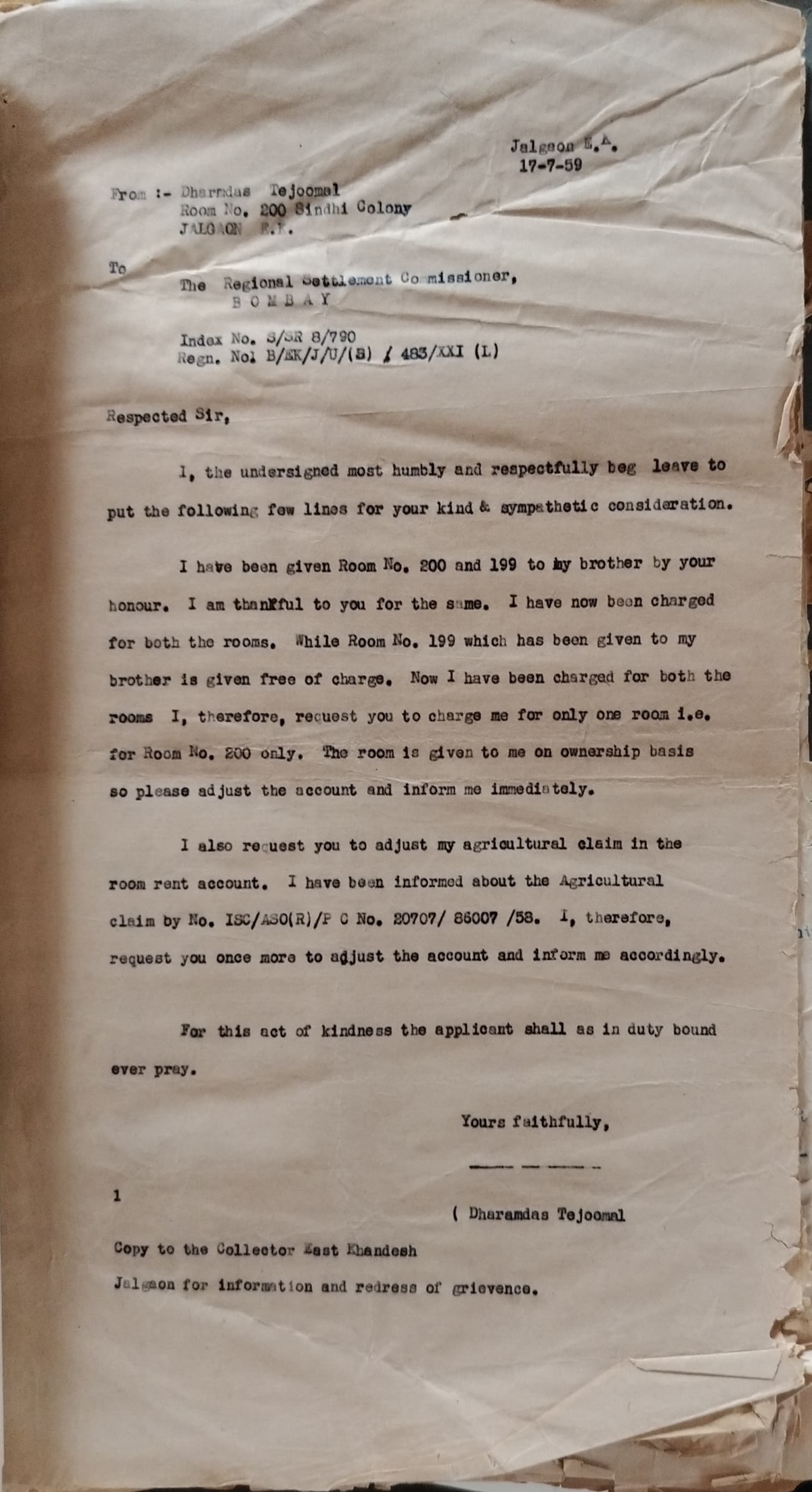
Khushboo Tejwani / Rooms allocated / c.1959 / Digitised archival document / Partition series
Tikamdas’s family belongs to the Bhaiband community, known for its mercantile roots. His uncle initially set up a small kirana (grocery) shop in the refugee settlement with the little money he had. A few years later, their sons began trading, travelling to Singapore and Bangkok to bring back affordable Chinese goods to sell in the settlement. Today, the third generation has expanded into wholesale hosiery, sourcing materials from Bombay and Calcutta to supply markets in Jalgaon.
These stories reveal how people have claimed their space in various ways and forms within the land provided to them. Each story presents a different approach to how gently these claims unfold, and how people, either individually or collectively, have generated their spaces.
For those who arrived from Sindh, home was never fully recovered. It had to be made again, through rooms extended, businesses built, relationships sustained. For those who came after, home is less singular. It stretches between what was inherited and what is lived in.
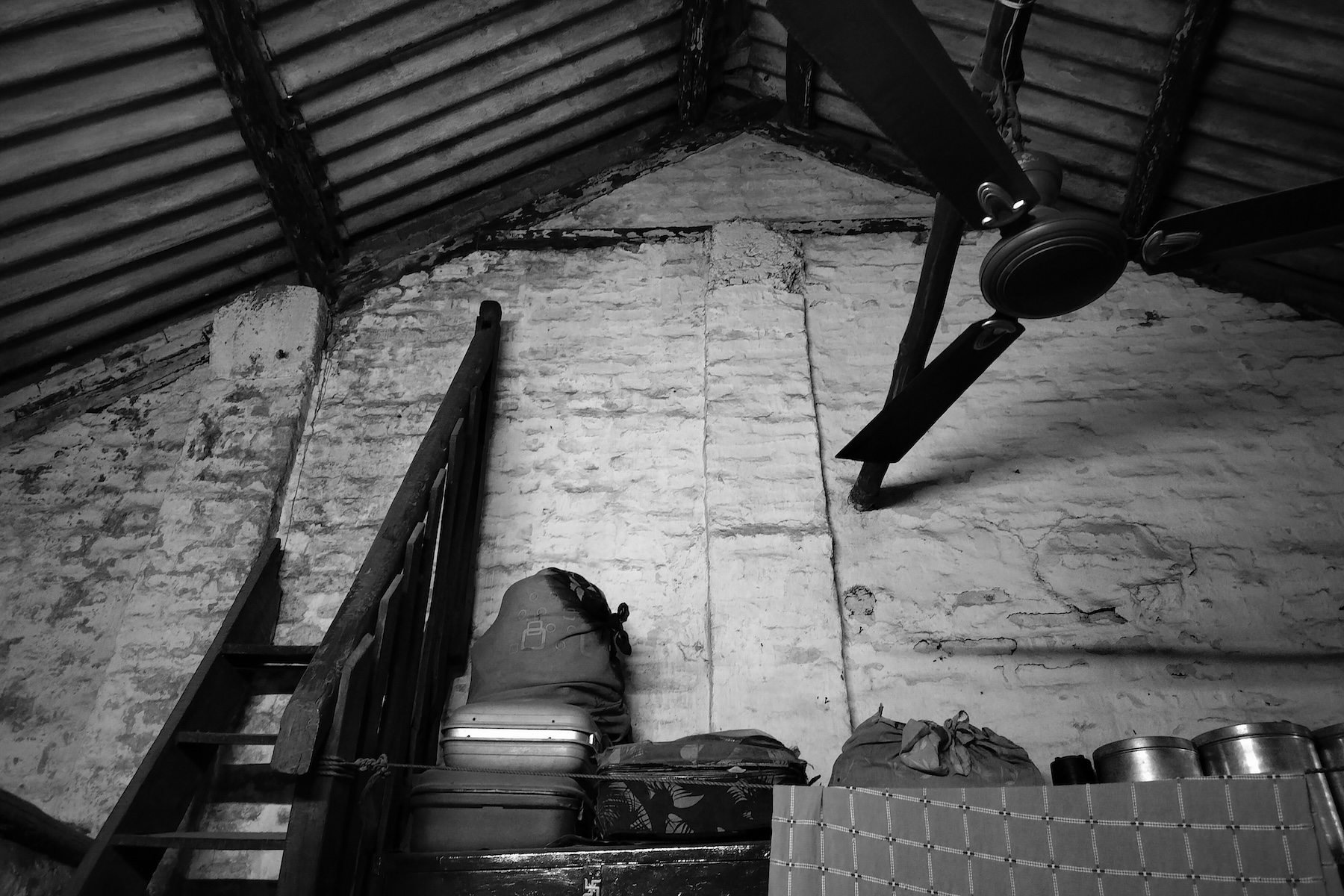
Khushboo Tejwani / A Staircase Waiting for a Room / 2024 / Digital photograph / Partition series
The colony’s houses were never finished. Walls moved, rooms were joined together, and new floors rose above old foundations. Refugee housing is thought of as temporary, as something meant to be left behind. But in many cases, the temporary becomes permanent, not by design, but through use: a record of how people rebuilt their lives after Partition.
The original kothis remain visible beneath these additions, not as relics of displacement but as evidence of what people made from it. The colony continues to grow, carrying Sindh forward room by room.