

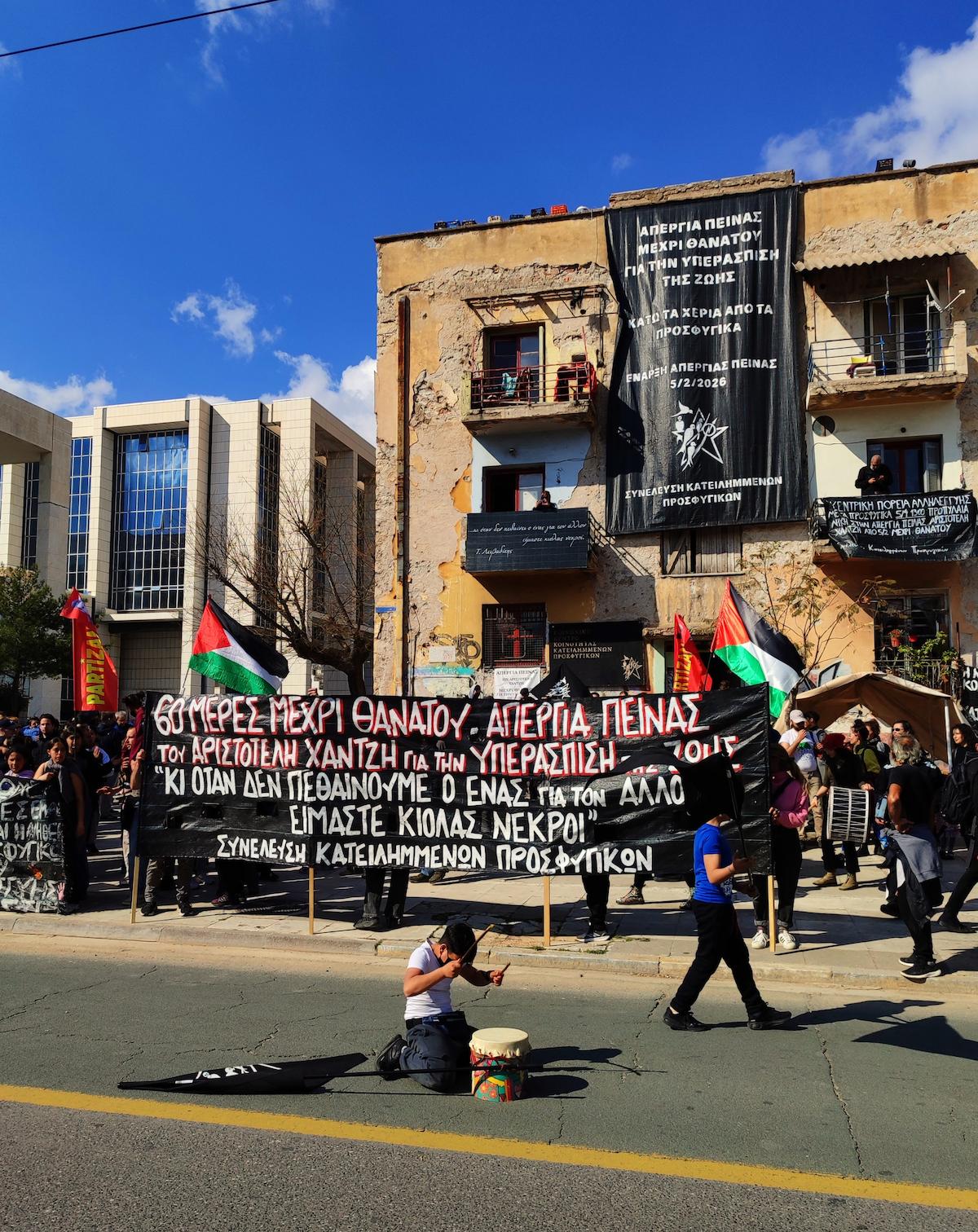
Walking along Alexandras Avenue, one of the main arteries in central Athens, it is hard to miss the Prosfygika housing complex.
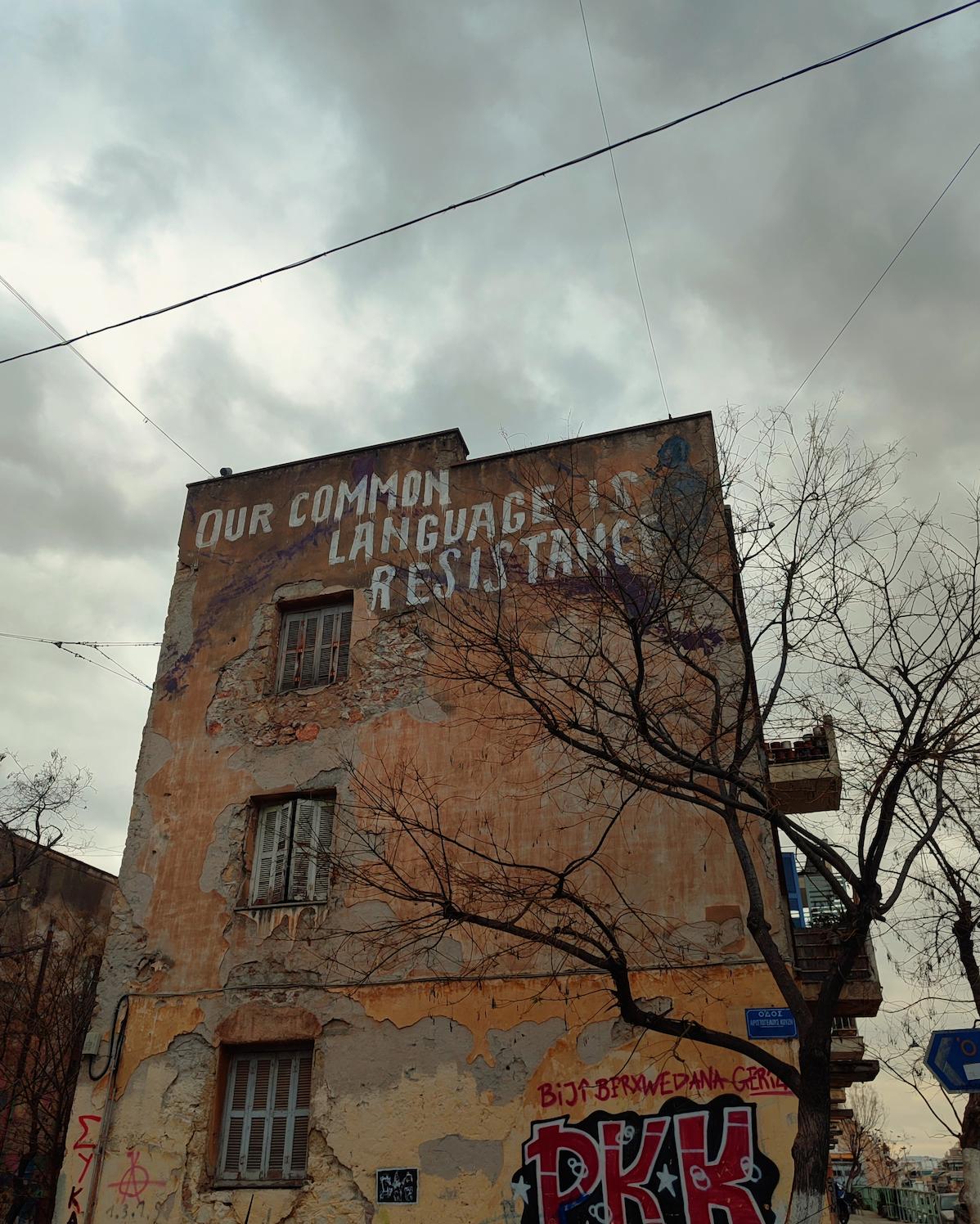
The low-rise buildings with their peeling ochre walls, the small balconies dotted with colourful curtains, and the large hand-painted black banners unfurled across the facades create a stark visual contrast with the two vast, austere government buildings of glass and steel that rise on either side of the rows of flats: the Court of Appeal to the left, and the Attica Police Directorate headquarters to the right.
In front of the first block, on the pavement running along the avenue, a white gazebo has stood since early February. Every day, it fills with people handing out printed texts in Greek and English, inviting passers-by to sign a petition against the imminent eviction of the community living in Prosfygika.
Behind the gazebo, hanging from the facade of one of the buildings, a sign bears the name of a member of the community, Aristotelis Chantzis. Beneath it, a number updated daily since 5 February: the days of his hunger strike, now past sixty.
A place steeped in political memory
Prosfygika is not simply a housing occupation, but a long-standing self-organised community. It is a place that holds a collective memory rooted in a long tradition of resistance, around which various marginalised social groups have gathered over time.
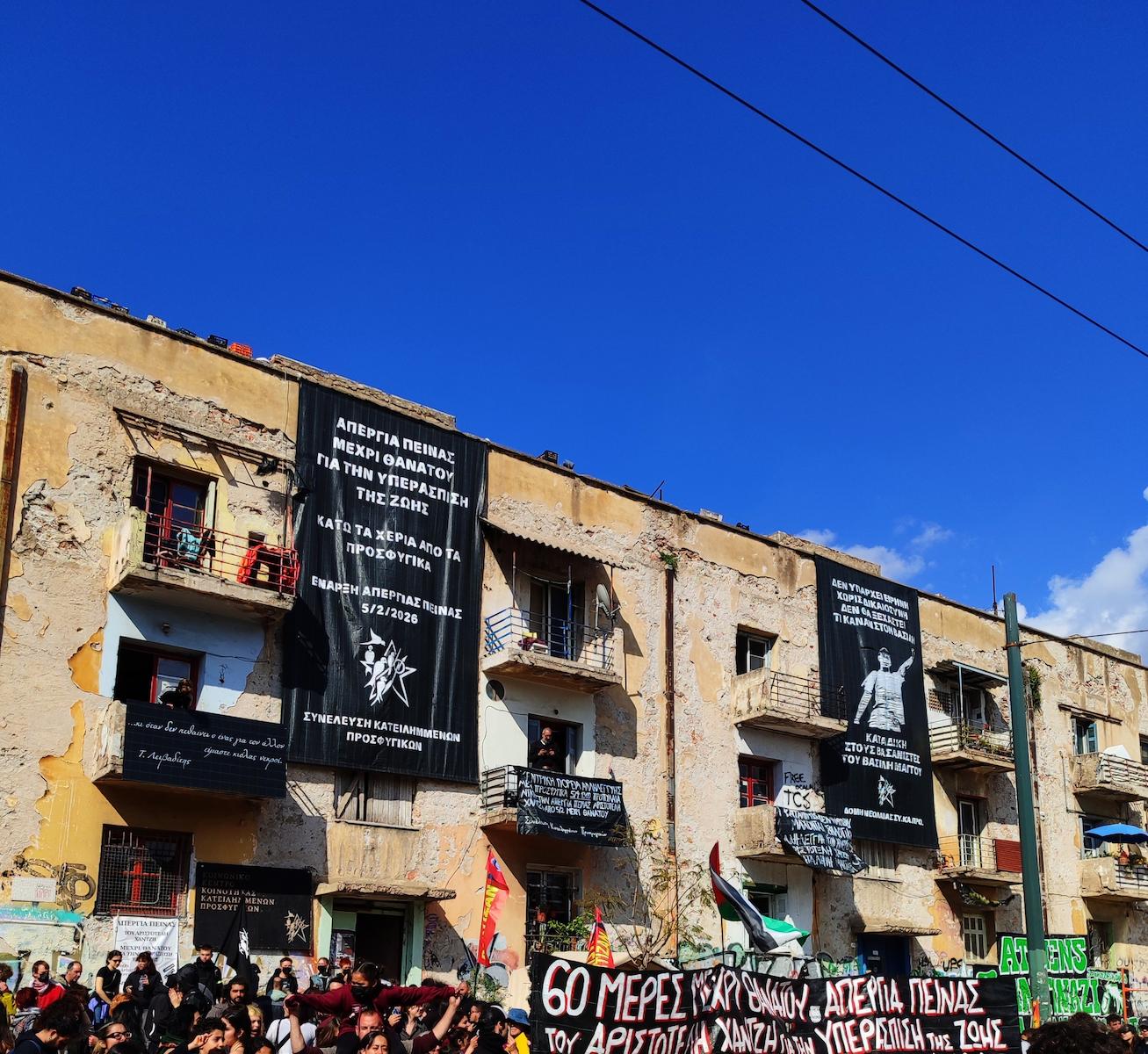
The 228 flats spread across eight buildings were constructed in the 1930s to house Greek refugees from Asia Minor fleeing the genocide that followed the Greco-Turkish war of 1919–1922. During the December 1944 uprising, which saw self-organised left-wing militias battle the Greek national army and British forces, Prosfygika became a strategic hub for partisan fighters, as evidenced by the bullet holes still visible on the outer walls of the buildings.
In the decades that followed, the complex experienced a gradual period of abandonment. Until the early 2000s, many flats stood empty or were occupied by individual squatters, while some buildings became bases for activities associated with drug trafficking.
In 2010, in the midst of the economic crisis, residents began organising to give the occupying community a more solid structure. The process of collectivisation culminated in 2012 with the creation of the Community of Squatted Prosfygika (SY.KA.PRO), marking the beginning of a long social experiment embedded in the centre of a city undergoing profound transformation, where access to housing was becoming increasingly difficult for large sections of the population.
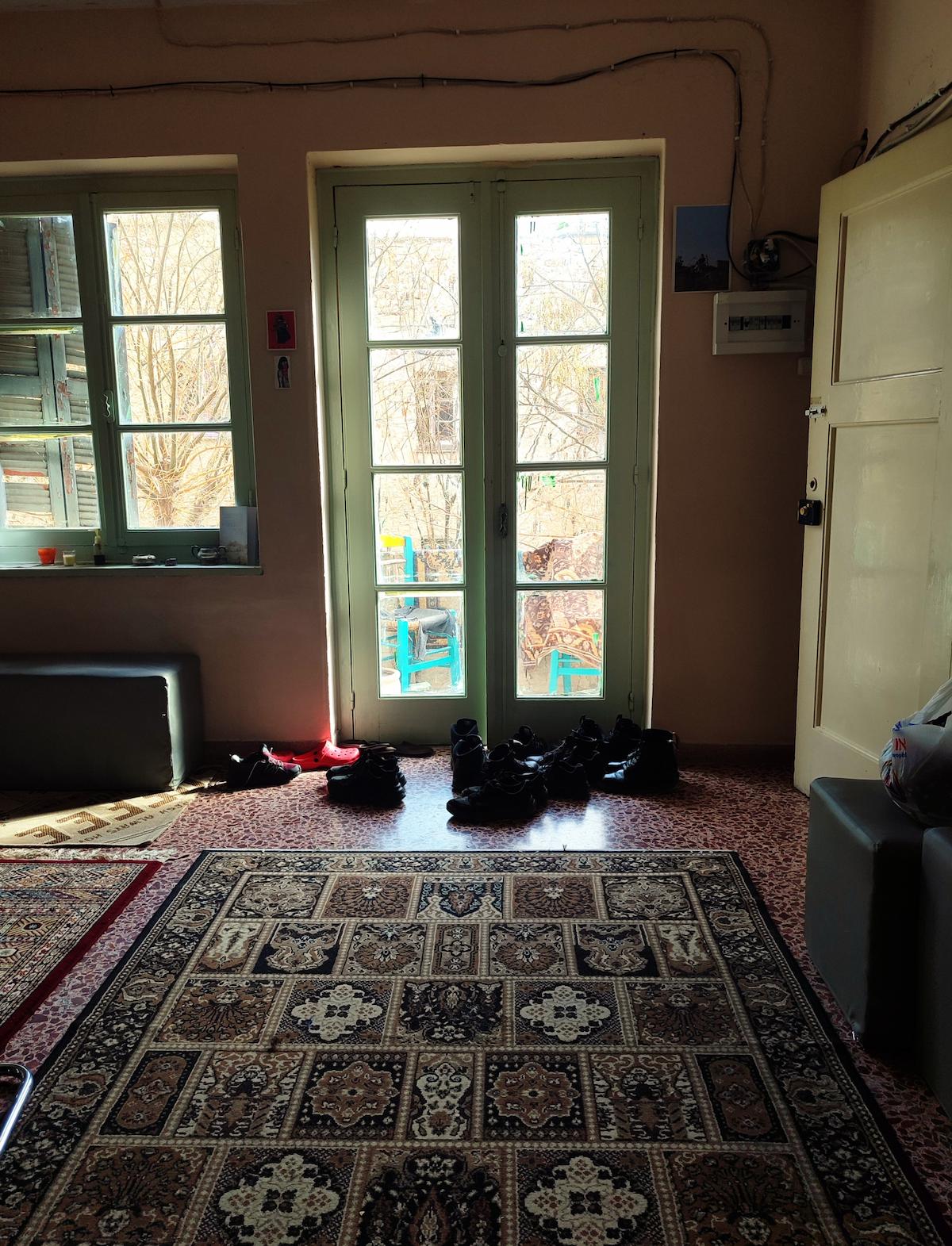
Today, Prosfygika is home to more than 400 people from 27 different countries. The community operates according to horizontal organisational principles that take shape through a weekly residents’ assembly. Over the past decade and a half, the occupation has developed a complex network of twenty-two self-organised structures designed to meet the needs of both the internal community and residents in surrounding neighbourhoods: from a collective bakery to a social pharmacy, from educational spaces for children to cultural and film activities, as well as food distribution initiatives.
One of the most significant organisational features of Prosfygika is the Women’s Structure. Initially launched in 2019 as a Women’s Café, it was created to give women and femininities from different backgrounds a safe space to spend time together, get to know one another, and discuss shared problems and challenges. Over time, the structure has gradually gained increasing importance. Today, alongside the general assembly that brings together all community residents, the Women’s Structure holds decision-making power.
“It was a revolution within the revolution,” explained Suzon, a resident of Prosfygika for five years, stressing that the Women’s Structure has introduced further elements of change into the community’s organisational model, with a significant and lasting impact. “It has played a major role in keeping the community as a community,” she added. “It has changed the way we understand our relationships with one another, and it helped us develop a different perspective on how to deal with problematic behaviours: that’s what we call transformative justice.”
Yet this radical experiment in self-management is now at risk of being erased.
Evicting in the name of “regeneration”
Between the end of 2025 and the beginning of 2026, local media reported that regional authorities had approved an urban ‘regeneration’ plan for the Prosfygika complex. The project, estimated at around €15 million, would initially concern only the first four housing blocks due to ownership disputes. The plan includes the construction of social housing and a hostel for relatives of patients at the nearby Agios Savvas oncology hospital. According to the official timetable, the tendering process should conclude in the first quarter of 2026, with construction scheduled to finish by 2028.
From the residents’ perspective, the plan appears deeply paradoxical. Prosfygika already functions as an informal model of social housing, providing accommodation to hundreds of people who would struggle to find affordable alternatives in Athens’ housing market. Through its self-organised structures, the occupation also offers support to patients and relatives connected to the oncology hospital.
“It’s the most serious plan of the last few years,” explained Venetia, who has lived in Prosfygika for around three years, referring to the eviction threats that have resurfaced repeatedly since the 1990s. “The so-called regeneration of the first four blocks actually means an attack on the whole neighbourhood and community of Prosfygika.”
Against this backdrop, Aristotelis Chantzis has decided to embark on a hunger strike until death. In a public message released on 5 February, he described this choice as an act of responsibility aimed at defending not only the homes of Prosfygika but also the political and social project the community represents. “The attack we are facing is part of a broader attack by the state and capitalism on the world of community, self-organisation and social resistance,” he wrote.
The hunger strike is intended to secure the community’s demands: the immediate cancellation of the regional plan, the guarantee that residents can continue living in the complex, and the recognition of the building restoration project proposed by the community itself.
Suzon explained that so far the authorities have remained silent. For this reason, the entire community has been in a state of general mobilisation for months, to push the institutions to take at least a public position. “The hunger strike is a vital aspect of our struggle and is inseparable from our other strategies for defending the community,” Suzon added. “We are hosting different assemblies and events, and we are inviting people to come here and stay in the community, because the more we are, the more difficult it will be for the police to evict us.”
Gentrification as a deliberate strategy of expulsion
What is happening in Prosfygika is not an isolated case. In recent years, Athens has become the stage for a sweeping and accelerated process of gentrification, driven by the uncontrolled expansion of tourism, real estate speculation and the massive influx of private foreign capital.
One of the most striking examples is Exarcheia, the city’s historic anarchist neighbourhood and a long-standing centre of social mobilisation. Over the past decade, the area has been subjected to intense property pressure, accompanied by systematic evictions, the militarisation of public space and major infrastructure projects, such as the construction of a new metro station that resulted in the closure of the neighbourhood square. Today, Exarcheia is an area where soaring rents have progressively forced out much of the original population, replaced by tourists and relatively affluent digital nomads.
Behind these transformations presented as ‘urban regeneration’ lies a clear political strategy: reshaping the city’s social balance by pushing out communities deemed ‘hostile’, to make room for private investment and a population compatible with a speculative, tourism-driven economy of short-term rentals.
As Suzon put it, the essence of Prosfygika is summed up by the “conscious choice to constitute and operate as a community”, sustained by everyday practices of mutual aid that reshape not only the rules of housing but also relationships between people and with the surrounding environment. That is precisely what makes it a target to be dismantled at all costs. Prosfygika stands as living proof that alternative, self-managed models, detached from the logic of profit and consumption, can exist, function, and benefit everyone.
“What we are doing is a political proposition for wider society”, Suzon concluded. “We want to show that a different model of social relations, a different type of culture can be built in the here and now. It’s a process that takes time, but we need to remember that it’s embedded in our daily lives: even the smallest gestures are important elements that constitute the practices and network upon which what we call ‘communal life’ is built.”
The slow construction of trust and community described by Suzon is something that speculative urbanism cannot commodify and, thus, cannot tolerate. In this sense, Prosfygika carries a meaning that extends far beyond its geographical location. In a constellation of European and global cities that are increasingly being cannibalised and rendered inaccessible to precarious and impoverished populations, this community of just 400 people invites us to question the way our urban spaces are organised – a question that reveals a great deal about the kind of society we have built.