
Courtesy of Press on Press
In recent years, the Berlin-based collective, Pass on Press, has emerged as a balm against Germany’s pro-Israel sentiment. The guerrilla group, made up of five individuals across disciplines, including illustration, graphic design, education, and social work, wishes to remain anonymous, partially for safety reasons, but also to put the focus on “the collective rather than the individual.”
While there are core members who work on publications and organizing events, Pass on Press emphasizes the significance of their extended community of collaborators, fellow mutual aid organizers, creatives, local businesses, volunteers, and supporters. “It’s a much larger group that helps us with shifts at merch tables, contributes their own work to sell alongside ours, approaches businesses to ask if we could hang a poster or sell our stuff in their store, invites us to have a table at their event, offers their space for us to use,” a member reflects. “And of course, all of the people who show up for events, who keep donating and being interested in what we are doing on a regular basis.”
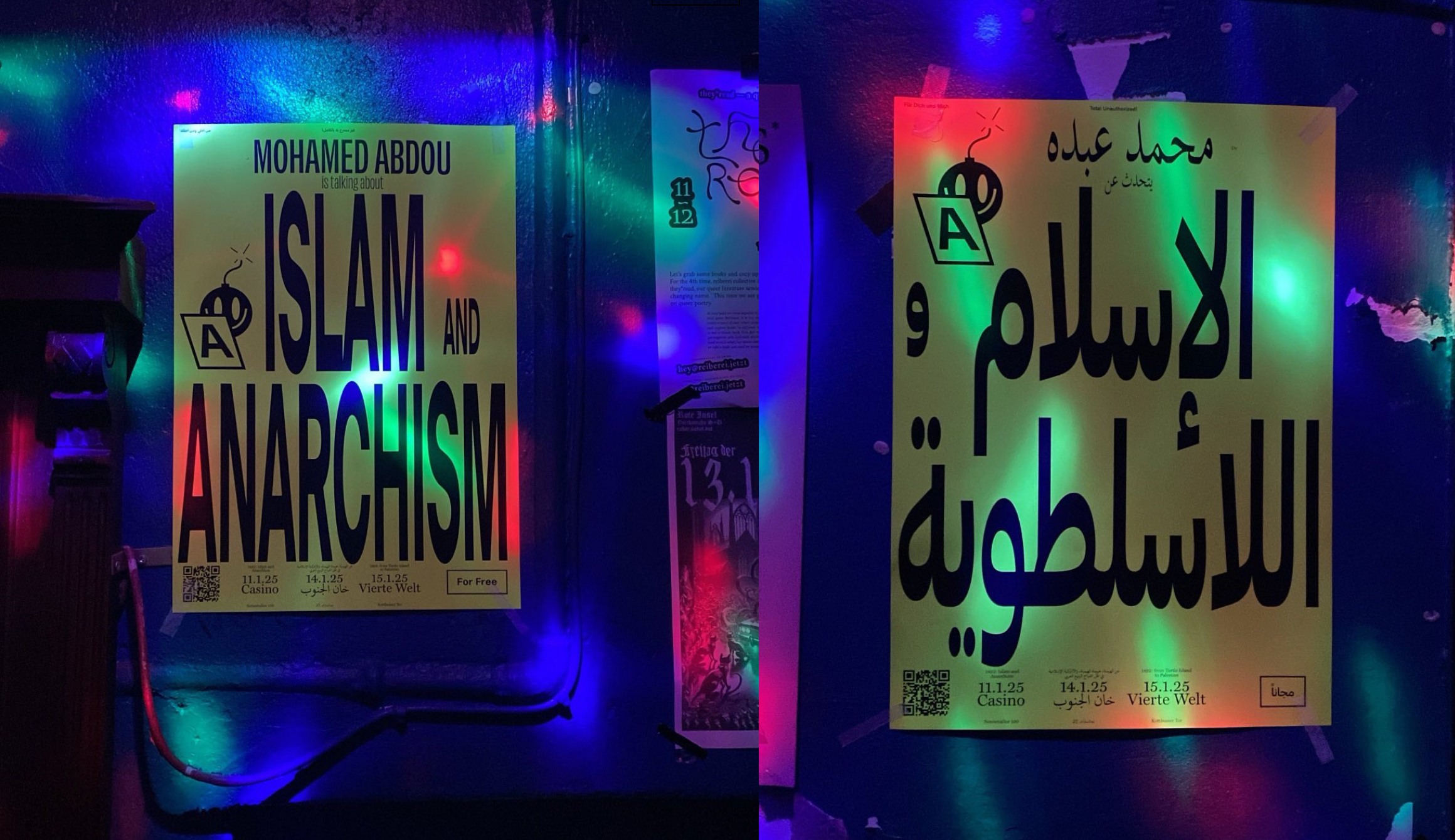
With each project, Pass on Press strives for radical imagination, from translating anti-colonial texts into zines, to designing posters and hosting lectures on “Islam and Anarchism.” Members spoke to journalist Ayesha Le Breton, to share their ethos and how interconnected struggles root their work, and why raising funds for their friend in Gaza is their driving force.
This interview has been edited for length and clarity.
Courtesy of Pass on Press
AYESHA LE BRETON: For those who are just now getting to know Pass on Press, can you explain what it is you do?
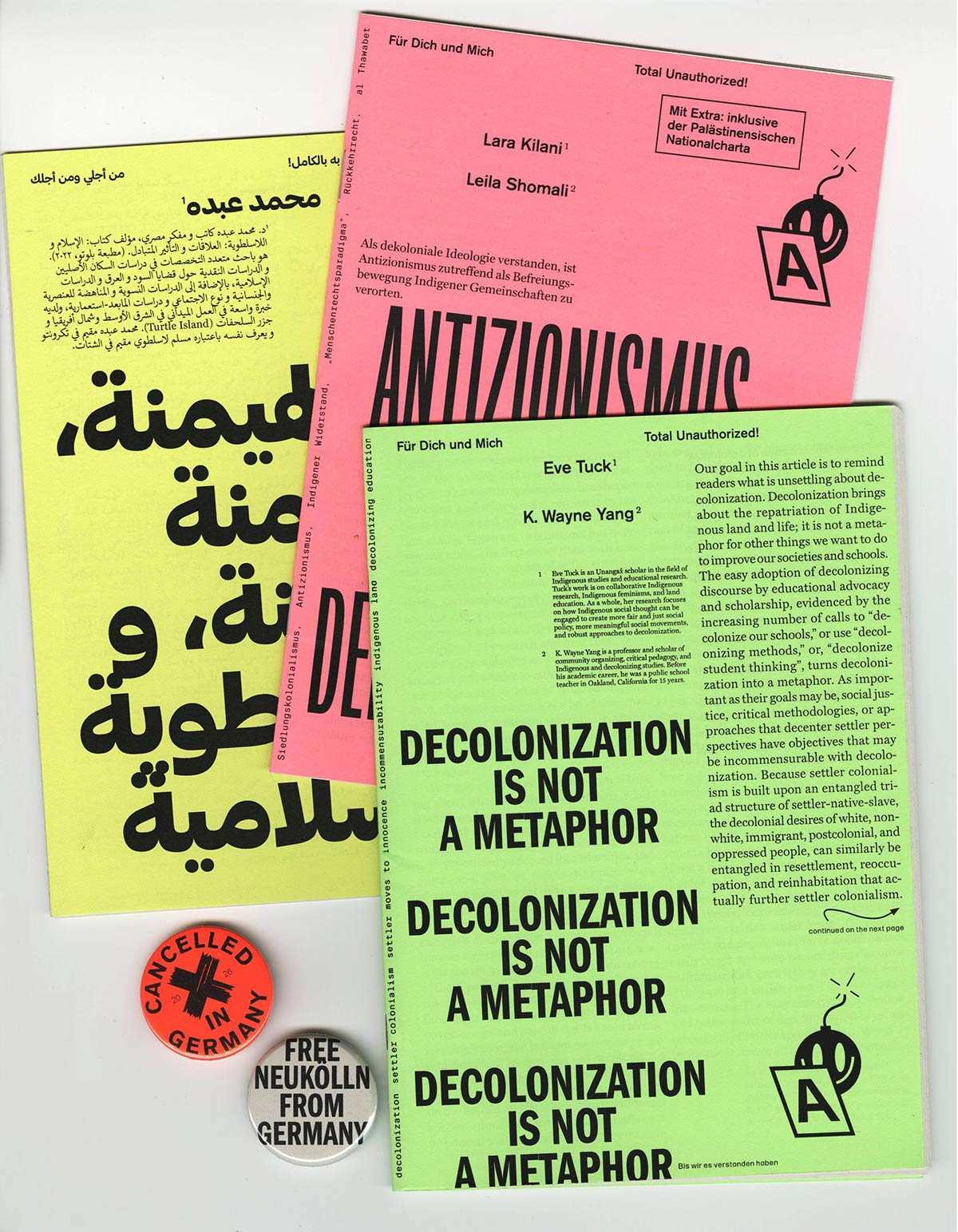
PASS ON PRESS: Pass on Press is an independent, self-organized guerrilla publishing group and front for various other projects of the radical imagination. We reprint and translate short anti- colonial texts in easily accessible zine format, make posters and art prints, as well as host lectures and skill shares relevant to current organizing in Berlin. Currently, we are working with comrades on a new series of original texts, which will highlight the voices of female political prisoners across several struggles.
While we are concerned with public education and challenging the prevailing colonial narratives in Germany, we also prioritize our ongoing obligations to materially support our friends in Gaza. A big part of our efforts are directed towards raising mutual aid funds, and we send 100 percent of what we earn from selling publications, merch and doing events directly to Gaza. We are not interested in [only] raising awareness; we are interested in raising material support and in supporting local organizing for action.
AYESHA: How did the idea for Pass on Press come about?
PASS ON PRESS: We came about pretty randomly, as the result of two of our collective members living together in 2023-2024. There were a lot of kitchen table talks happening about the repressive situation in Germany, and what skills they could concretely offer to the movement in this moment which might be different than what they had done before.
Certain sections of the German left continue to be deeply divided on the topic of Palestine, and settler colonialism in general is not a well-understood or widely discussed subject here. We were having a lot of discussions reflecting on the many frustrating conversations and experiences we were having in wider movement spaces, and the general repressive situation in Germany. [We were] thinking about [how] we could connect these realities in some way to the fundraising work that we were already doing. It did not seem sufficient to just be selling cute things some people wanted to buy, while we also had such challenging conversations and repressive dynamics in other spheres of our lives. We talked a lot about the conversations we wished we were having instead, or who we would like people to read to better understand the context.
We brought together a group of friends and comrades with similar ideas and political commitments, and together we hosted our first event series in January of 2025 with scholars Mohammed Abdou and Anna-Esther Younes, talking about Islam and Anarchism. From there, we have just continued with different strategies, always trying our best to meet our obligations to our friends in Gaza, and to one another.
AYESHA: You’re based in Berlin, Germany, home to one of the largest Palestinian populations in Europe. How does that presence and proximity to this diaspora community ground the work that you do?
PASS ON PRESS: In Germany, and especially Berlin, the targeted repression of the Palestinian community is extreme and blatant. The surveillance, harassment, and ongoing police violence targeting our Palestinian comrades and their community in general are not things we watch on TV, but see with our own eyes daily.
While each of us has differing proximities to this violence, none of our current collective members are Palestinian ourselves. Therefore, we understand our role not as to educate or speak on anyone’s behalf, but to amplify the voices of those most affected, to connect the current situation in Berlin to our own diverse contexts and historical complicities, and importantly, to be a source of concrete material support for those undergoing the most extreme oppression imaginable—Palestinians in Gaza. We are grateful to our Palestinian comrades both in Germany and Gaza for everything we continue to learn from them.
AYESHA: Germany’s government is staunchly pro-Israel, and is notorious for their crackdown on pro-Palestinian voices. What does it mean for your collective to operate, create, and educate within this context?
PASS ON PRESS: As creators of visual media, we definitely have conversations about what to produce, how and where to engage with the public about it, and what types of risks each member is willing or able to take on. We communicate with people who buy our work about the risks of wearing certain symbols or phrases openly in the street or in the context of a demonstration, if they are unaware. Like everyone organizing in this context, we have dealt with threats and attempts at intimidation.
More importantly, though, the level of repression has created a greater sense of urgency and resolve to continue this work. The last three years have been radicalizing for many people in Germany, and we see the potential of this moment for expanding political education that connects Palestine to other ongoing anti-colonial resistance movements, police and prison abolition, and the importance of neighborhood organizing more broadly. In the German state’s patterns of repression, we can also read how interconnected many of our struggles really are.
AYESHA: Your buttons/pins ended up on the iconic Michele Lamy for EIP’s latest cover. How did this happen?
PASS ON PRESS: For this connection, we have to thank photographer Matt Lambert, who lives in Berlin and has been a great supporter and fan of our buttons! Matt has spoken about how important it has been to him in certain spaces to have the visibility offered by a button, and what important interactions and conversations wearing one of our buttons have opened up.
AYESHA: You send direct aid to Gaza with all your printed matter sales. Can you tell me about some of the people you support?
PASS ON PRESS: We often provide merch for different campaigns raising money for specific families in Gaza, or legal support costs for those criminalized for their Palestine solidarity actions. But our main commitment for the last two years has been to cover the daily living costs of our friend Ibrahim’s family, who is currently displaced from Gaza in Dier al Balah.
Like so many young people in Gaza, Ibrahim is responsible for supporting many more people than just his immediate family. The money we send allows him to directly support 26 extended family members, including elders, a disabled adult, and many children. In the past, when donations were higher, and we were able to send Ibrahim more funds, he also personally organized food, water, and tent distribution actions for his neighbors.
We would love to enable him to do more of this work, but at the moment, we struggle to keep up with the survival funds for his family. Together with our wider support network who organize for Ibrahim, we’ve put together this FAQ which covers more about the family and how we try our best to meet their needs.
AYESHA: While advocating for the people of Palestine is deeply important to you, cross-movement solidarity is core to your collective. As Fannie Lou Hamer famously said, “Nobody is free until everybody is free.” How does this inform your work?
PASS ON PRESS: Absolutely. From a theory perspective, the texts we choose to publish make these cross-movement anti-colonial connections in various ways. For example, our upcoming texts will highlight anti-colonial struggles’ connections to police and prison abolition. While “No Borders” and migrant justice organizing are well established in the German context, there is much less organizing and understanding at the grassroots level around anti-colonial movements, especially when it comes to those resisting ongoing settler colonialism. Making some of these connections more explicit and accessible is something we try to contribute to the movement here.
More practically, though, when it comes to fundraising to support Ibrahim and his family, we would not have been able to maintain this work in such a sustained way without previous experience in our own local mutual aid networks and associated networks of trust that have existed for years prior. For this knowledge, we are especially indebted to our queer and disabled comrades, with whom we organize closely in our fundraising actions. Some of our collective members have been organizing for years in survival support networks around access to housing, health care, migrant rights, and other social services. Because of this, we know both how deeply our struggles are connected and also that what concrete solidarity we can offer our friends internationally is determined by how strong our local communities are organized at home.
AYESHA: Online, you’ve described your publications, such as “Decolonizing is not a metaphor” as bootleg. What makes it so? Can you talk to me about the process of putting together this project?
PASS ON PRESS: This is only half of a joke! Some of our publications, such as Eve Tuck and K Wayne Yang’s “Decolonization is not a Metaphor”, are already published texts that can also be found freely available online. While the authors are fully credited, we have used and republished these texts without requesting any permissions or engaging the authors, which is why we say they are bootleg. However, on other publications, like Mohammed Abdou’s texts, we’ve worked closely with the author both in text selection and editing footnotes for the local German context. And, our forthcoming series on female political prisoners is being edited with close collaboration between multiple groups and individual authors – so definitely not bootleg!
AYESHA: Is there a call to action you’d like to share with our readers?
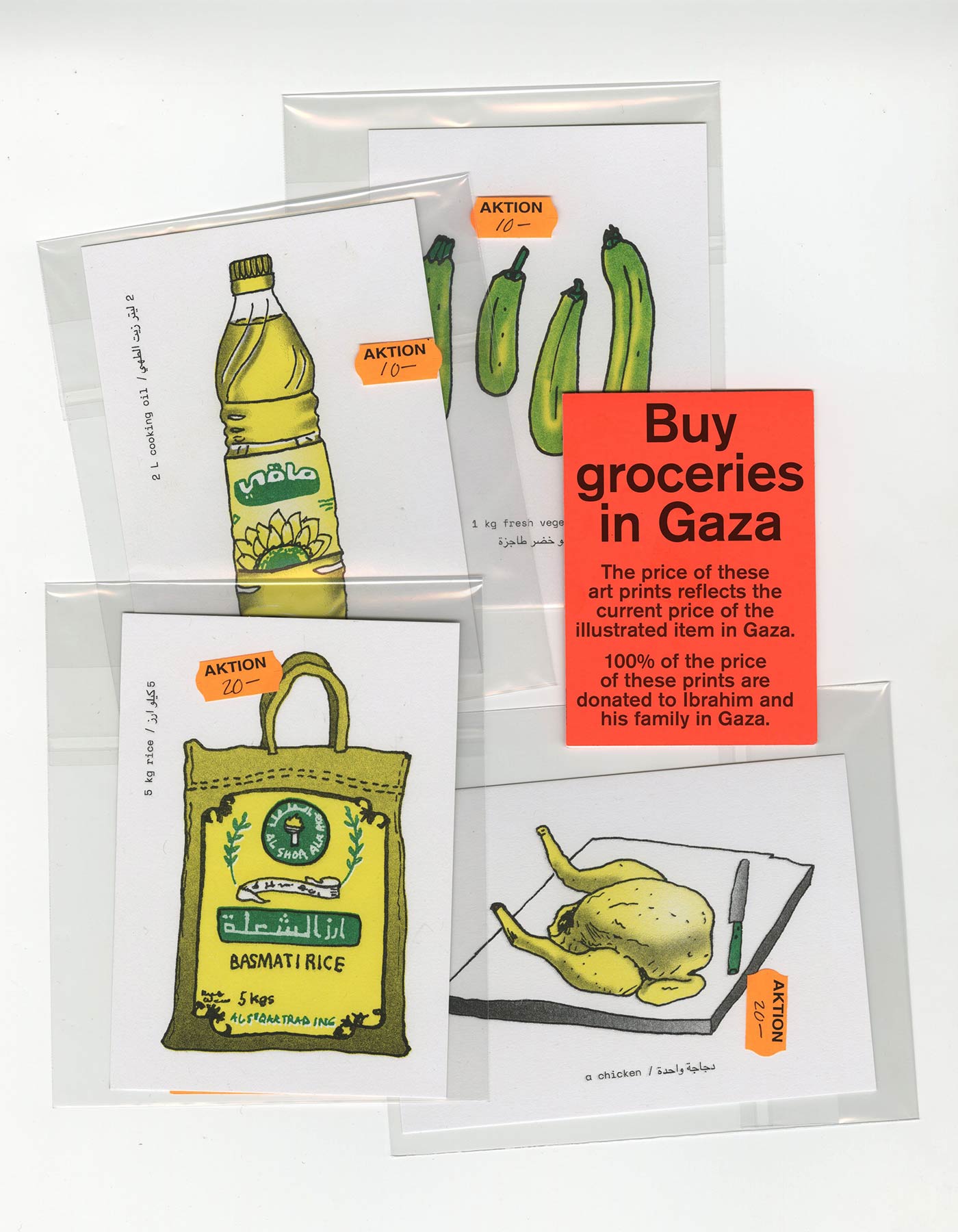
PASS ON PRESS: We are currently running a crowdfunding campaign that ends on July 12 to provide Ibrahim with the initial funds to rebuild a small grocery store in his family’s former neighborhood of Al-Nasr in Gaza city. Al-Nasr is a district near Al-Shifa Hospital, an area that used to have three grocery stores, though all were destroyed in the war. The space Ibrahim wants to rent for the store needs some repairs to become operational. It was offered to him by a man who knows Ibrahim and his family, so he will charge a very reasonable rent. Ibrahim’s goal is to provide a much-needed service to his community at the lowest possible cost. This is not just a business that will provide a reliable source of income for his family, but it will also be a necessary resource for the entire neighborhood—an element of community rebuilding.
We have already raised almost € 21,000 of our target € 30,488 towards this goal. You can find much more information about this campaign, as well as how you can support it (and even receive some rewards in return!) on the campaign website.
Courtesy of Pass on Press