
Digital & Print Membership
Yearly + Receive 8 free printed back issues
$420 Annually
Monthly + Receive 3 free printed back issues
$40 Monthly
Narrative Sovereignty in the American Wing of The Met
Don't Miss ENCODED at the MET
As artists and multicultural activists, we did not come to the Metropolitan Museum of Art’s American Wing seeking permission, instead we showed up to the work with intention, responsibility, and a commitment to truth. ENCODED: Change the Story, Change the Future exists because silence is not neutral, presence without agency is insufficient and solidarity across values-based creativity is essential for liberation.
The American Wing is often described as a celebration of American art, yet it also functions as a carefully curated archive of colonial mythology and westward expansion propaganda. Its paintings and sculptures rehearse familiar narratives: conquest framed as destiny, extraction framed as progress, whiteness framed as purity, Indigenous absence framed as inevitability. These works are not merely historical artifacts; they are instruments of narrative power. They encode ideas about belonging, legitimacy, and nationhood, ideas that continue to shape cultural consciousness and public policy today.
ENCODED intervenes in this institutional space not to negate history, but to complicate it. Using augmented reality, the exhibition overlays Indigenous artistic expression and counter-narratives directly onto famous works in the American Wing, reframing them through Indigenous epistemologies, lived experience, and historical truth. This is not an act of erasure. It is an act of expansion and an overt insistence that American art history is incomplete without Indigenous voice, presence, and critique.
At its core, ENCODED is grounded in the principle of narrative sovereignty. Narrative sovereignty asserts that communities most impacted by historical and ongoing harm such as Indigenous peoples, Afro-descendant people, Palestinians, Pacific Islanders, Trans folks and the working class all must have the authority to tell their own stories, in their own words, and within the institutions that have historically excluded or misrepresented them. This is not a symbolic gesture. It is a democratic imperative.
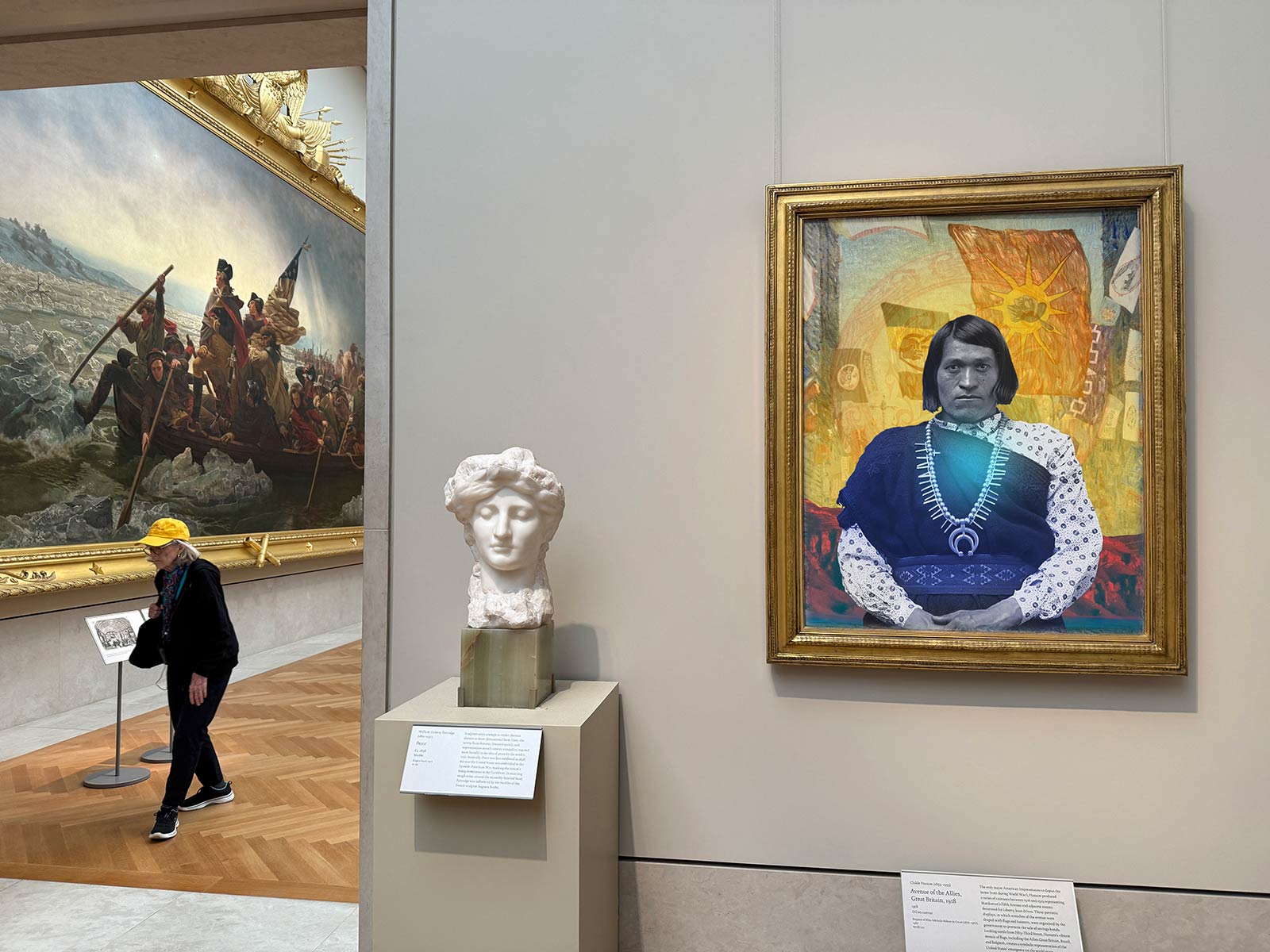
Democracy depends on access to truth. When museums present a singular, sanitized vision of history, they do not merely reflect power, they reinforce it. The American Wing has long upheld myths of “taming the West” and the so-called exhaustion of empire, narratives that obscure the violence of settler colonialism, normalize Indigenous dispossession and chattel slavery. ENCODED challenges these myths by making visible what has been omitted: resistance, survival, continuity, solidarity and accountability. For me, I also hope this intervention reflects back to museum goers and viewers the perils of authoritarianism, fascism and ongoing colonial projects such as legacy media consolidation, rapid creation of datacenters to produce AI, cutting access to healthcare, education, rights, or the current US regime’s attempt to erase history by any means necessary.
The artists participating in ENCODED are not responding nostalgically to the past. They are engaging the present. Their work examines how colonial narratives persist in contemporary systems including environmental destruction justified by extraction, racial hierarchies reinforced through cultural storytelling, and institutions that benefit from the aesthetics of inclusion while resisting structural change. These are not abstract critiques; they are lived realities and for me deep lessons that have been shaped by having formerly worked at a neocolonial conservation nonprofit ran by wealthy cis wyt men and their enablers for nearly five years.
Artistic integrity, in this context, cannot be separated from ethical responsibility. For too long, the art world has upheld a false binary between aesthetics and politics, suggesting that rigor diminishes when artists engage power directly. ENCODED rejects this premise. Integrity is not neutrality. Integrity is the willingness to tell the truth, even when it destabilizes comfort or prestige. Walking with integrity can be painful and takes courage.
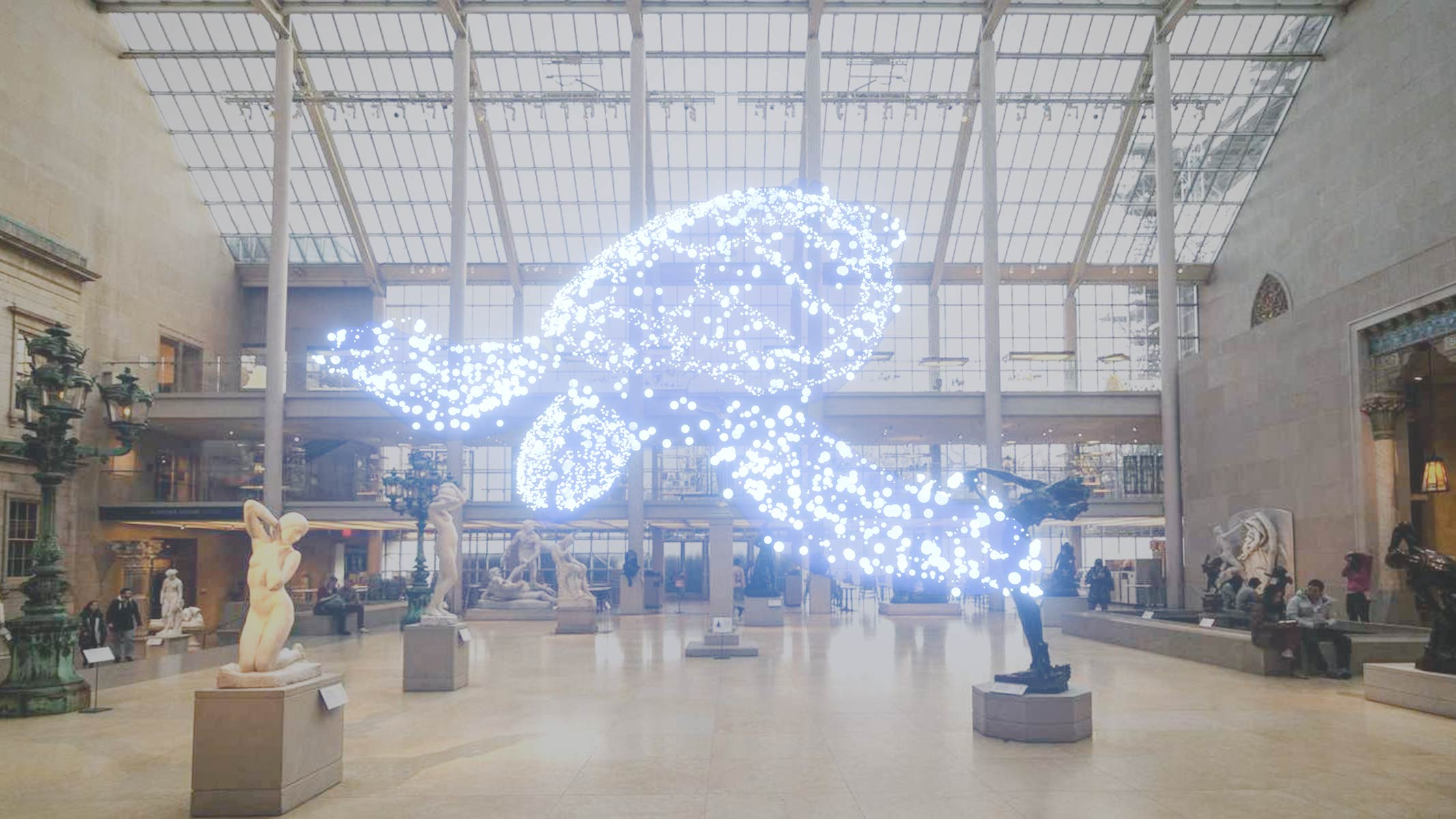
Importantly, ENCODED is not positioned as a protest staged outside the institution, nor as a request for institutional validation. It is an act of presence with agency. The project uses accessible technology to meet audiences where they are, inviting participation rather than reverence. Viewers scan QR codes and encounter layered narratives that ask them to look again, listen differently, and question inherited assumptions. Except for a few organized tours, the experience is self-guided, decentralized, and deliberately democratic. It’s also fun, and it is so special to hear the familiar sounds from the ENCODED pieces ring throughout the galleries signalling that kin is close by.
This kinship network and accessibility is central to the work. Cultural literacy should not be gated by academic language, curatorial authority, white exceptionalism or economic privilege.
By operating through personal devices, ENCODED rejects the museum’s traditional hierarchy of knowledge and affirms that interpretation is a shared civic space. The exhibition does not dictate conclusions; it creates conditions for reckoning and deep dialogue.
Solidarity is another foundational principle of the project. ENCODED brings together Indigenous artists across nations and disciplines, in relationship with Black, Brown, and allied communities who recognize that colonialism is not a single-issue structure. The logics that dispossessed Indigenous peoples are the same logics that underwrote slavery, environmental exploitation, the seizing of Palestine, forced child mining labor of cobalt in Congo and in general global empire. Working in solidarity does not collapse difference; it honors specificity while resisting division and acknowledging historic patterns of systemic oppression.
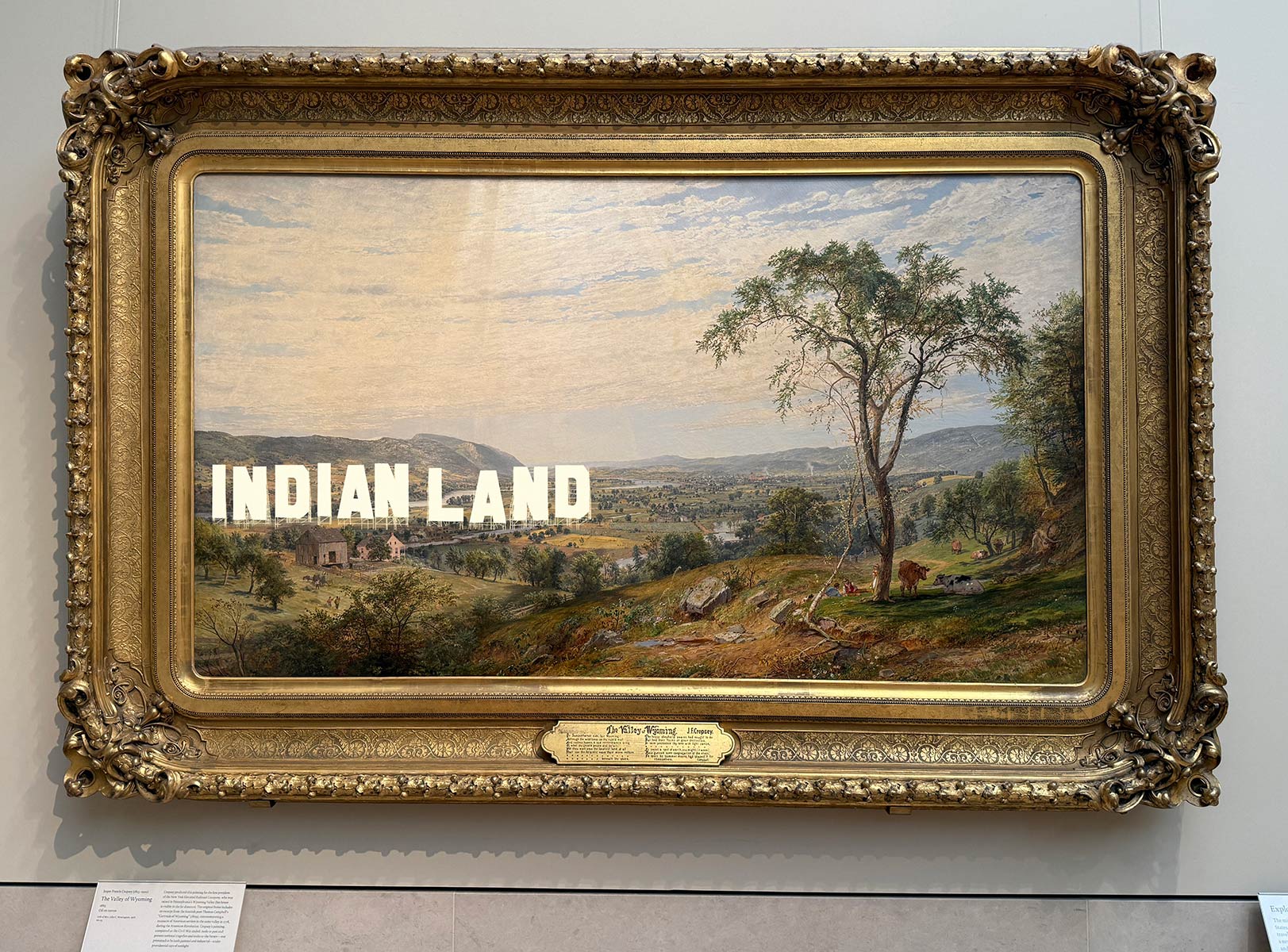
In a cultural landscape shaped by scarcity and competition, ENCODED models an alternative, one rooted in collective presence, shared resources, and mutual accountability. The project refuses the extractive norms of both empire and the contemporary art economy, offering instead a relational approach grounded in care, collaboration, and long-term impact on community.
The decision to situate ENCODED within the American Wing was deliberate. Indigenous art has too often been confined to anthropological contexts or framed as premodern, separate from the narrative of American art. ENCODED asserts what has always been true: Indigenous peoples are not peripheral to American history; we are foundational to it. Our stories do not belong on the margins, nor do they belong solely to the past or through a white gaze.
Yet presence without counter-narrative risks assimilation. ENCODED insists that visibility must be accompanied by authorship. By intervening directly within the American Wing, the project challenges the authority of colonial framing and invites institutions to reckon with their role in shaping public memory. Our hope is that eventually the Met will see this as an opportunity to engage in discussion and support its presence well into 2026.
There is risk in this work. Naming colonial propaganda within revered institutions invites discomfort, defensiveness, and critique. But risk is inseparable from integrity. Artists and cultural workers are accountable not only to institutions and audiences, but to future generations. The question is not whether institutions will change, but whether artists will continue to lead with courage when they do not.
ENCODED is an offering and a provocation. It asks what it means to inherit a cultural legacy and whether we are willing to transform it. Empire is not exhausted; it is contested. And art remains one of the most powerful sites of that contestation. When we change the story, we do change the future. Not through erasure, but through expansion. Not through dominance, but through relationship.
Ultimately, ENCODED affirms that art is not merely a reflection of society, but a tool for shaping it and that when artists from the margins claim space at the center, together and with integrity, we open pathways toward a more honest, inclusive, and democratic cultural future. Join us.
To access ENCODED review the exhibit website for instructions. While at the Met scan the QR code and click through the prompts for the self guided tour.
https://www.encodedatthemet.com
{
"article":
{
"title" : "Narrative Sovereignty in the American Wing of The Met: Don't Miss ENCODED at the MET",
"author" : "",
"category" : "",
"url" : "https://everythingispolitical.com/readings/narrative-sovereignty-in-the-american-wing-of-the-met",
"date" : "2025-12-22 12:58:00 -0500",
"img" : "https://everythingispolitical.com/uploads/Cover_EIP_Hidden_Exhibition.jpg",
"excerpt" : "As artists and multicultural activists, we did not come to the Metropolitan Museum of Art’s American Wing seeking permission, instead we showed up to the work with intention, responsibility, and a commitment to truth. ENCODED: Change the Story, Change the Future exists because silence is not neutral, presence without agency is insufficient and solidarity across values-based creativity is essential for liberation.",
"content" : "As artists and multicultural activists, we did not come to the Metropolitan Museum of Art’s American Wing seeking permission, instead we showed up to the work with intention, responsibility, and a commitment to truth. ENCODED: Change the Story, Change the Future exists because silence is not neutral, presence without agency is insufficient and solidarity across values-based creativity is essential for liberation.The American Wing is often described as a celebration of American art, yet it also functions as a carefully curated archive of colonial mythology and westward expansion propaganda. Its paintings and sculptures rehearse familiar narratives: conquest framed as destiny, extraction framed as progress, whiteness framed as purity, Indigenous absence framed as inevitability. These works are not merely historical artifacts; they are instruments of narrative power. They encode ideas about belonging, legitimacy, and nationhood, ideas that continue to shape cultural consciousness and public policy today. ENCODED intervenes in this institutional space not to negate history, but to complicate it. Using augmented reality, the exhibition overlays Indigenous artistic expression and counter-narratives directly onto famous works in the American Wing, reframing them through Indigenous epistemologies, lived experience, and historical truth. This is not an act of erasure. It is an act of expansion and an overt insistence that American art history is incomplete without Indigenous voice, presence, and critique.At its core, ENCODED is grounded in the principle of narrative sovereignty. Narrative sovereignty asserts that communities most impacted by historical and ongoing harm such as Indigenous peoples, Afro-descendant people, Palestinians, Pacific Islanders, Trans folks and the working class all must have the authority to tell their own stories, in their own words, and within the institutions that have historically excluded or misrepresented them. This is not a symbolic gesture. It is a democratic imperative.Democracy depends on access to truth. When museums present a singular, sanitized vision of history, they do not merely reflect power, they reinforce it. The American Wing has long upheld myths of “taming the West” and the so-called exhaustion of empire, narratives that obscure the violence of settler colonialism, normalize Indigenous dispossession and chattel slavery. ENCODED challenges these myths by making visible what has been omitted: resistance, survival, continuity, solidarity and accountability. For me, I also hope this intervention reflects back to museum goers and viewers the perils of authoritarianism, fascism and ongoing colonial projects such as legacy media consolidation, rapid creation of datacenters to produce AI, cutting access to healthcare, education, rights, or the current US regime’s attempt to erase history by any means necessary.The artists participating in ENCODED are not responding nostalgically to the past. They are engaging the present. Their work examines how colonial narratives persist in contemporary systems including environmental destruction justified by extraction, racial hierarchies reinforced through cultural storytelling, and institutions that benefit from the aesthetics of inclusion while resisting structural change. These are not abstract critiques; they are lived realities and for me deep lessons that have been shaped by having formerly worked at a neocolonial conservation nonprofit ran by wealthy cis wyt men and their enablers for nearly five years.Artistic integrity, in this context, cannot be separated from ethical responsibility. For too long, the art world has upheld a false binary between aesthetics and politics, suggesting that rigor diminishes when artists engage power directly. ENCODED rejects this premise. Integrity is not neutrality. Integrity is the willingness to tell the truth, even when it destabilizes comfort or prestige. Walking with integrity can be painful and takes courage.Importantly, ENCODED is not positioned as a protest staged outside the institution, nor as a request for institutional validation. It is an act of presence with agency. The project uses accessible technology to meet audiences where they are, inviting participation rather than reverence. Viewers scan QR codes and encounter layered narratives that ask them to look again, listen differently, and question inherited assumptions. Except for a few organized tours, the experience is self-guided, decentralized, and deliberately democratic. It’s also fun, and it is so special to hear the familiar sounds from the ENCODED pieces ring throughout the galleries signalling that kin is close by.This kinship network and accessibility is central to the work. Cultural literacy should not be gated by academic language, curatorial authority, white exceptionalism or economic privilege. By operating through personal devices, ENCODED rejects the museum’s traditional hierarchy of knowledge and affirms that interpretation is a shared civic space. The exhibition does not dictate conclusions; it creates conditions for reckoning and deep dialogue.Solidarity is another foundational principle of the project. ENCODED brings together Indigenous artists across nations and disciplines, in relationship with Black, Brown, and allied communities who recognize that colonialism is not a single-issue structure. The logics that dispossessed Indigenous peoples are the same logics that underwrote slavery, environmental exploitation, the seizing of Palestine, forced child mining labor of cobalt in Congo and in general global empire. Working in solidarity does not collapse difference; it honors specificity while resisting division and acknowledging historic patterns of systemic oppression.In a cultural landscape shaped by scarcity and competition, ENCODED models an alternative, one rooted in collective presence, shared resources, and mutual accountability. The project refuses the extractive norms of both empire and the contemporary art economy, offering instead a relational approach grounded in care, collaboration, and long-term impact on community.The decision to situate ENCODED within the American Wing was deliberate. Indigenous art has too often been confined to anthropological contexts or framed as premodern, separate from the narrative of American art. ENCODED asserts what has always been true: Indigenous peoples are not peripheral to American history; we are foundational to it. Our stories do not belong on the margins, nor do they belong solely to the past or through a white gaze.Yet presence without counter-narrative risks assimilation. ENCODED insists that visibility must be accompanied by authorship. By intervening directly within the American Wing, the project challenges the authority of colonial framing and invites institutions to reckon with their role in shaping public memory. Our hope is that eventually the Met will see this as an opportunity to engage in discussion and support its presence well into 2026.There is risk in this work. Naming colonial propaganda within revered institutions invites discomfort, defensiveness, and critique. But risk is inseparable from integrity. Artists and cultural workers are accountable not only to institutions and audiences, but to future generations. The question is not whether institutions will change, but whether artists will continue to lead with courage when they do not.ENCODED is an offering and a provocation. It asks what it means to inherit a cultural legacy and whether we are willing to transform it. Empire is not exhausted; it is contested. And art remains one of the most powerful sites of that contestation. When we change the story, we do change the future. Not through erasure, but through expansion. Not through dominance, but through relationship.Ultimately, ENCODED affirms that art is not merely a reflection of society, but a tool for shaping it and that when artists from the margins claim space at the center, together and with integrity, we open pathways toward a more honest, inclusive, and democratic cultural future. Join us.To access ENCODED review the exhibit website for instructions. While at the Met scan the QR code and click through the prompts for the self guided tour.https://www.encodedatthemet.com"
}
,
"relatedposts": [
{
"title" : "Trump’s attack on Venezuela: An Exemplary Punishment",
"author" : "Simón Rodriguez",
"category" : "essays",
"url" : "https://everythingispolitical.com/readings/trumps-attack-on-venezuela-an-exemplary-punishment",
"date" : "2026-01-14 10:13:00 -0500",
"img" : "https://everythingispolitical.com/uploads/Uncle_Sam_Straddles_the_Americas_Cartoon.jpg",
"excerpt" : "After four months of maritime siege in which the US military killed more than 100 people in alleged anti-drug trafficking operations and seized oil tankers, as well as the bombing of a small dock in northwestern Venezuela, Trump launched a large-scale attack and kidnapped de facto ruler Nicolás Maduro and his wife Cilia Flores, who were in Fuerte Tiuna, the country’s main military complex in Caracas.",
"content" : "After four months of maritime siege in which the US military killed more than 100 people in alleged anti-drug trafficking operations and seized oil tankers, as well as the bombing of a small dock in northwestern Venezuela, Trump launched a large-scale attack and kidnapped de facto ruler Nicolás Maduro and his wife Cilia Flores, who were in Fuerte Tiuna, the country’s main military complex in Caracas.The invaders attacked civilian targets such as the port of La Guaira, the Venezuelan Institute for Scientific Research, the Charallave airport, and electrical transmission infrastructure, as well as military installations in Caracas, Maracay, and Higuerote. The preliminary toll is around 80 dead and more than a hundred wounded. The US government claims that it suffered no casualties and that it had the support of infiltrators working for the CIA. This internal collaboration was crucial to the success of the attack.The Venezuelan military defeat has political causes, beyond US technical superiority. Chavismo has prioritized coup-proofing over military effectiveness, going so far as to have one of the highest rates of generals per capita in the world, who have been given control of various economic sectors for cronyism. Furthermore, the government lacks a military strategy for asymmetric resistance to imperialist aggression.During Chávez’s administration, in 2007, there was debate over which military model to adopt. Retired General Müller Rojas criticized the large investments in sophisticated military equipment, proposed by then-Defense Minister Raúl Isaías Baduel, proposing instead a doctrine of popular resistance and asymmetric warfare. Chávez settled the debate in Baduel’s favor, and in the following years, the Venezuelan government spent billions of dollars on arms purchases from Russia and China. This equipment proved useless in the face of the US attack, as the late Müller Rojas predicted, but it was part of the patronage system that enriched the Chavista military. Ironically, Baduel died as a political prisoner in 2021.A corrupt military may be useful for repressing workers, students, or indigenous peoples, but it can easily be bribed. Maduro himself does not seem to have had much confidence in the military, having entrusted his security largely to Cuban personnel, 32 of whom died in the US attack.Vice President Delcy Rodríguez assumed the interim presidency. She declared a state of emergency to avoid the constitutional requirement to call elections in the event of the head of state’s absence. The US government has stated that, through the continuation of the naval blockade and the threat of a second attack, it hopes to ensure that the Venezuelan government serves US interests. When asked on January 4 whether they would use this pressure to demand the release of political prisoners, Trump responded emphatically that he is interested in oil, and everything else can wait. In spite of this, the Venezuelan government announced on January 8 the unilateral release of an unspecified number of political prisoners. Human rights NGOs estimate there are around 800 political prisoners.The rights of Venezuelans have never interested Trump, as demonstrated not only by his lack of interest in democratic rights in Venezuela, but also by the racist persecution of Venezuelan immigrants in the US, stigmatized by Trump as criminals and mentally ill people allegedly sent by Maduro to “invade” the country, a fascistic discourse endorsed by the Venezuelan right-wing leader María Corina Machado. Thousands of Venezuelans have been deported to Venezuela, while hundreds have been sent to the CECOT, Latin America’s largest torture center, run by the dictatorship of El Salvador, under false accusations of belonging to the Tren de Aragua, a gang classified as a terrorist organization by Trump.Delcy Rodríguez has reportedly already reached an agreement with Trump to deliver between 30 and 50 million barrels of oil. The US government would sell the oil, establishing offshore accounts for this purpose outside the control of its own Treasury Department; part of the petrodollars generated would be used to pay debtors, and payments in kind would be made to the Venezuelan state, including equipment and supplies for oil production itself, as well as food and medicine.This policy bears similarities to the “Oil for food” program applied as part of the sanctions regime of the 1990s against Iraq. That program became a huge source of corruption in the UN. We can expect something similar or worse from Trump’s corrupt government. Chevron, which already is the main oil extractor in Venezuela, is lobbying for a privileged role in Trump’s plans for oil theft, enforced through a naval blockade and threats of new attacks, as the stock capacity on land or in ships off the Venezuelan coast reached their limit and the alternative was to stop production. On January 9, Trump met executives from Chevron, Conoco-Phillips, Exxon-Mobil, among other oil companies, to lay out the profits opportunities in Venezuela enhanced by military intervention.We are facing a new version of imperialist “gunboat diplomacy” and the methods of the “Roosevelt Corollary,” on which the US based its invasion of Latin American and Caribbean countries in the first half of the 20th century, taking control of their customs, as in the cases of the Dominican Republic, Haiti, and Nicaragua.Rodríguez’s capitulation has been interpreted by some as evidence that her rise to power was agreed with Trump, as startlingly quickly negotiations for the restoration of diplomatic relations, which were severed since 2019, have begun. For this purpose, a US delegation visited Caracas on January 9. Certainly, Chavismo’s anti-imperialism was always rather performative, it did not even nationalize the oil industry, and the US maintained an important presence through Chevron. The US remained Venezuela’s main trading partner until at least 2024.The regime is cooperating with the extortionist Trump, not resisting. The traditional right-wing opposition, which celebrated the January 3 attack (describing it as the beginning of Venezuela’s liberation), welcomes Trump’s measures. Not even Trump’s humiliation of Machado, when he declared she lacked “support” and “respect” within Venezuela, has led Venezuelan Trumpists to regain a modicum of sobriety. Their entire political strategy, after Maduro’s 2024 electoral fraud, has been solely to wait for Trump to hand them power.Trump’s priorities are different, although they could converge in the future with Machado: to distract attention from recently published documents reflecting his friendship with the criminal Jeffrey Epstein; to enhance his foreign policy based on extortion, refuting the Democratic slogan “Trump Always Chickens Out”, and to manage billions of petrodollars at the service of his business circle. And finally, in a more strategic sense, it represents the application of the new National Security doctrine, which gives priority to absolute US control of the hemisphere, expelling its imperialist competitors, China and Russia. Venezuela represented the most vulnerable point in the hemisphere for spectacular and exemplary military action. After the attack on Venezuela, threats against Colombia, Mexico, and even Greenland follow.Chavismo itself largely created its own vulnerability after years of anti-popular and anti-worker policies, such as imposing a minimum wage of less than USD$5 per month, eliminating workers’ freedom of association, persecuting indigenous peoples, defunding public health and education, and forcing the migration of 8 million Venezuelan workers, all while favoring the emergence of a new Bolivarian bourgeoisie through rampant corruption, creating new chasms of social inequality.Until 2015, Chavismo ruled with the support of electoral majorities. After its defeat in that year’s parliamentary elections, it took a dictatorial turn, relying on repression and electoral fraud, while bleeding the economy dry to pay off foreign debt, creating hellish hyperinflation. The economy contracted by around 80% between 2013 and 2021, most of this before US sanctions. The destruction was such that the export of scrap metal, obtained from the dismantling of abandoned industries, became one of Venezuela’s largest exports.It is illustrative to recall the cables from the US embassy in Caracas to the State Department, published by Wikileaks, which asked the Obama administration not to publicly confront Chávez, as this would strengthen him in the context of widespread popular rejection of the US. The current situation is different, with many Venezuelans cynically accepting US domination. Opposing imperialist intervention, on the other hand, does not save dissidents from persecution either. The presidential candidate backed by the Communist Party of Venezuela in 2024, Enrique Márquez, has been in prison for 10 months without formal charges.The humiliation to which the Venezuelan people are subjected today, under the double yoke of a dictatorship and a US siege, is brutal. The policy of aggression against Latin America and the Caribbean, the perceived sphere of US dominance, gains momentum with this attack. In the face of this we need a continental response, to defend the possibility of a free and dignified future for Venezuela and for all of Latin America and the Caribbean."
}
,
{
"title" : "A Lone Protester, Rain or Shine: One Man’s Daily Act of Dissent in Japan",
"author" : "Yumiko Sakuma",
"category" : "essays",
"url" : "https://everythingispolitical.com/readings/a-lone-protester-rain-or-shine",
"date" : "2026-01-13 10:00:00 -0500",
"img" : "https://everythingispolitical.com/uploads/Cover_EIP_Lone_Gaza_Japan.jpg",
"excerpt" : "Photographs by Chisato Hikita",
"content" : "Photographs by Chisato HikitaThe way Japan’s grassroots activism has shown up for the people of Palestine has been nothing short of extraordinary. In a country known for its low political engagement, I’ve met countless newly woken activists who not only joined the international movement but have also incorporated direct action into their daily lives through street protests, fundraising events and content creation, writing campaigns, etc. Many of them express frustration that demonstrations in Japan aren’t as large as those abroad, or that their efforts seem to yield little visible change, but their persistence and quiet stubbornness are unlike anything I’ve ever seen.One of the figures who has emerged from this movement is Yusuke Furusawa, who has taken to the streets every single day, seven days a week, for more than two years, usually for an hour or so each time. I came across him on social media and reached out while I was in Tokyo.The day we met was an excruciatingly hot Saturday in July. On my way to meet him near Shinjuku Station, a sprawling terminal of train lines, subways, and shopping complexes, he messaged to say he’d had to relocate because of a nearby Uyoku (right-wing nationalist) presence. As I exited one wing of the station, I passed a large crowd gathered around Uryu Hirano, a young hardline activist who had just lost her bid for a national council seat.Then I found Furusawa, delivering a monologue about what the Palestinian people have been enduring, about the complicity of the Japanese government, and about the tangled relationship between the U.S. military-industrial complex and the Israeli state. He stood in the middle of two opposing streams of foot traffic, turning every few seconds to address people coming from both directions, waving a large flag and holding a sign that read “Stop GAZA Genocide.”In October 2023, he had been home-bound for Covid. “I was frustrated because I wanted to go to the protests but couldn’t. Finally, feeling restless, I eventually stumbled out holding a placard, that’s how it all began. When I thought about how I’ve never really taken any actions on this issue while seeing these terrible situations unfolding every day, I just couldn’t sort out my feelings.”Furusawa makes his living as a prop maker for a broadcasting company while occasionally getting gigs as a theater actor. He wasn’t particularly political until a few years ago when he joined a local grass-roots movement to elect Satoko Kishimoto, an environmental activist and water rights activist who had lived in Belgium, to be Suginami Ward mayor against the pro-business, pro-development incumbent. Especially, he was inspired by the Hitori Gaisen, solo street demonstration, movement which was triggered by one person who decided to campaign by standing quietly on the street with a sign, which spread like a wild fire and resulted in a win by Kishimoto, a move viewed as a victory of the People, who were determined to stop the over development and gentrification.'I’m not really good at group activities, so rallies and marches aren’t really my thing. I get too tired trying too hard to chant or keep up with everyone else.” Previously, he had been suffering from depression. “This has been helpful like as a daily rehabilitation activity.”Thus, he stands alone, daily and consistently. As I watched him speak under the glaring sun, I was struck by how most people don’t even look up, or notice him, seemingly so self-absorbed or focused on where they are going. Occasionally, non-Japanese people stop and take pictures of/with him. While I was there, a mother and a kid from Turkey stopped him to thank him through a translation app on her phone. She had tears in her eyes. Furusawa said he does get yelled at a few times a day and was once even choked by a person who identified as an IDF personnel.This was a few days after July 20th, when Japan had a national council election where more than 8 million people voted for candidates from the Sansei Party, which ran on “Japanese First” platform and a far-right, nationalist political messaging. Furusawa says, a few Japanese people who walk up to him with encouraging signs tend to be ultra nationalists and conservatives. “A lot of times, these guys who say to me ‘you are great for standing against the United States,’ are far right people, which makes me feel defeated.” And there are younger ones who mock him or laugh at him.Do you have an idea as to how long you’d be doing this? I asked him. Furusawa told me about the time an Aljazeela crew came to his apartment to shoot a segment on him. When he told them, “I will stop if Israel stopped bombing Gaza,” the reporter said, “That is how Japanese people forget about the Middle East.” Furusawa thinks about this episode daily. “I realized I hadn’t understood anything at all, and I felt this helplessness like all my actions over the past four months were being erased in an instant. That’s when I made the decision to do it every day. Those words swirled around me daily.”After I came back to New York, I procrastinated writing this story. I tried writing it many times in my head, but between being disappointed in the surge of xenophobia and racism in Japan, dealing with medical issues and being scared as an immigrant, my head was not in the right place to give a proper ending to this story. Then, so called “ceasefire” was announced. I thought of him and reached out.I apologized to him for not writing a story sooner. “I didn’t know how to write the story without glorifying the protest movements.”He told me attacks by people from Israel were happening increasingly, probably like three times more, especially after the UK recognized the state of Palestine. “They come at me with anger. I’ve also met a few people from Palestine thanking me with tears for what I do. I feel l need to keep a distance from these emotions because what I am really protesting against is the illegal occupation and apartheid of Palestine and how we are not really facing it.”He hadn’t stopped his protests, still standing out there every day with a flag and a sign, delivering his monologue. He does so because, for one, he did not trust the “ceasefire,” but also because what he stands against is not just the current wave of assaults, bombing, starvation, etc.“I want to keep going until we seriously tackle the issue, not just go through the superficial motions of Palestine’s state recognition. It isn’t about just stopping the war. It is about getting people to care so that nations collectively help them. I am not talking about months, more like years because it is going to take time.”Lately, after spending an hour on anti-genocide protest, he stands with another sign for 30 minutes or so before he goes home. The sign says “Delusion of Hate.” That is because he thinks Japan’s xenophobia and hatred come from delusions. “A mix of victim mentality and inferiority complex, plus delusions inflated by conspiracy theories that don’t even exist.”That is when I realized what he is really fighting is indifference. He went on, “Some might find my style of protests noisy, annoying, or unpleasant. I want them to reject it. I want to get on their nerves, or talk to their hearts. Maybe that is how we can break through the indifference. That is going to take time, like years of time.”"
}
,
{
"title" : "Sanctions are a Tool of Empire",
"author" : "Collis Browne",
"category" : "essays",
"url" : "https://everythingispolitical.com/readings/sanctions-are-a-tool-of-empire",
"date" : "2026-01-13 08:35:00 -0500",
"img" : "https://everythingispolitical.com/uploads/Cover_EIP_Sanctions.jpg",
"excerpt" : "Sanctions & Embargoes only Hurt the People",
"content" : "Sanctions & Embargoes only Hurt the PeopleIn light of the economic collapse and ongoing social and political unrest in Venezuela and Iran, we must examine U.S. economic sanctions and how they contribute to and exacerbate these dynamics.Although framed as something much more innocuous or even righteous, sanctions are a form of economic warfare used to enforce U.S. & Western empire.What Sanctions AreSanctions block a country’s sovereign ability to act freely in a global world. They restrict trade, banking, investment, and access to global markets.Despite the myth of “free markets,” sanctions show how capitalism really works: Markets are only free when they serve power.They are usually installed against nations that show signs of independence from US and Western (capitalist) interests, such as any meaningful socialist policies, nationalizing resources or limiting foreign ownership or resources or property.Although the claim is usually around “punishing” a government for human rights abuses, There are plenty of governments that commit egregious human rights abuses that are never sanctioned because of favorable business policies towards US interests (global western capital), The US is itself guilty of grave human rights abuses both at home and abroad, so cannot claim to have any moral authority, and Many of the abuses are either exaggerated, outright fabricated, or are simply scapegoats to cover the real motives. To be clear: this does not excuse human rights abuses by any government, but sanctions are never the answer: they are never driven by a moral imperative, and are never successful in improving the materials conditions of the people of the countries affected.How Sanctions are UsedUS foreign policy uses sanctions as a key part of a familiar playbook: Claim that a government is a “dictatorship” or “threat” to democracy or security Cut the country off from trade and money Cause shortages, inflation, and unemployment People suffer — food, medicine, fuel become scarce Blame the suffering on the government, not the sanctions Further stir up unrest by covert actions on the ground agitating dissent and violence Often, provide material support for right-wing political opposition that favors US intervention and resource privatizationThe goal is pressure, chaos, and instability.The End GoalSanctions are a foundational step in a long-term campaign to destabilize a country or region by creating enough pain to force one of the following outcomes: Install a pro-U.S. government Enable or justify a coup Pave the way for military interventionAll of these are about resource extraction and unfettered access for multinational and Western corporations.Fact 1: Sanctions Don’t WorkSanctions Don’t Achieve Their Stated Political GoalsSince 1970, nearly 90% of sanctions have failed — meaning they did not force the target government to change its behavior or leadership. Report after report show that sanctions don’t produce freedom, democracy or peace, they produce suffering.Fact 2: Sanctions Punish PeopleSanctions Hurt the People, Not LeadersAcross 32 empirical studies*, sanctions were shown to: Increase poverty Increase inequality Increase mortality Worsen human rights outcomesRegional oligarchs and elites adapt, while ordinary people pay the price.Example: IraqIraq (1990s) Sanctions destroyed water, food, and healthcare systems Hundreds of thousands of civilians — many of them children — died as a direct result Saddam Hussein retained power, up until the eventual US invasionSanctions weakened the population, not the ruler.Example: VenezuelaVenezuela (2010s–present) Oil and banking sanctions collapsed imports and currency Medicine and food shortages surged Tens of thousands of excess deaths Massive emigration as millions fled the countryThe government survived. The people suffered. If anything, the sanctions contributed to the rise of the right-wing opposition against the strong socialist base of support.Example: SyriaSyria (2011–present) Sanctions began early in the conflict and intensified economic collapse They worsened shortages, unemployment, and infrastructure failure Economic destabilization deepened social fragmentation and displacementSanctions did not overthrow the government, but they amplified collapse, suffering, and long-term instability, making recovery and reconstruction nearly impossible.Example: IranIran (since 1979, and especially 2018–present) Sanctions targeted oil exports and global banking access Iran was cut off from foreign currency earnings The rial collapsed; inflation surged sharplySanctions directly restrict access to dollars and euros — forcing rapid currency devaluation, import inflation, and rising prices for basics even when goods are technically “allowed.”Inflation hits civilians first.Sanctions are a Tool of EmpireSanctions are a tool of global capitalist imperialism, and movements against US intervention must include a call against sanctions. They do not bring freedom or democracy. They enrich global financial elites, preserve imperial control, and devastate everyday people — again and again."
}
]
}