
COLLIS BROWNE: What is No Music for Genocide, and how did each of you get involved?
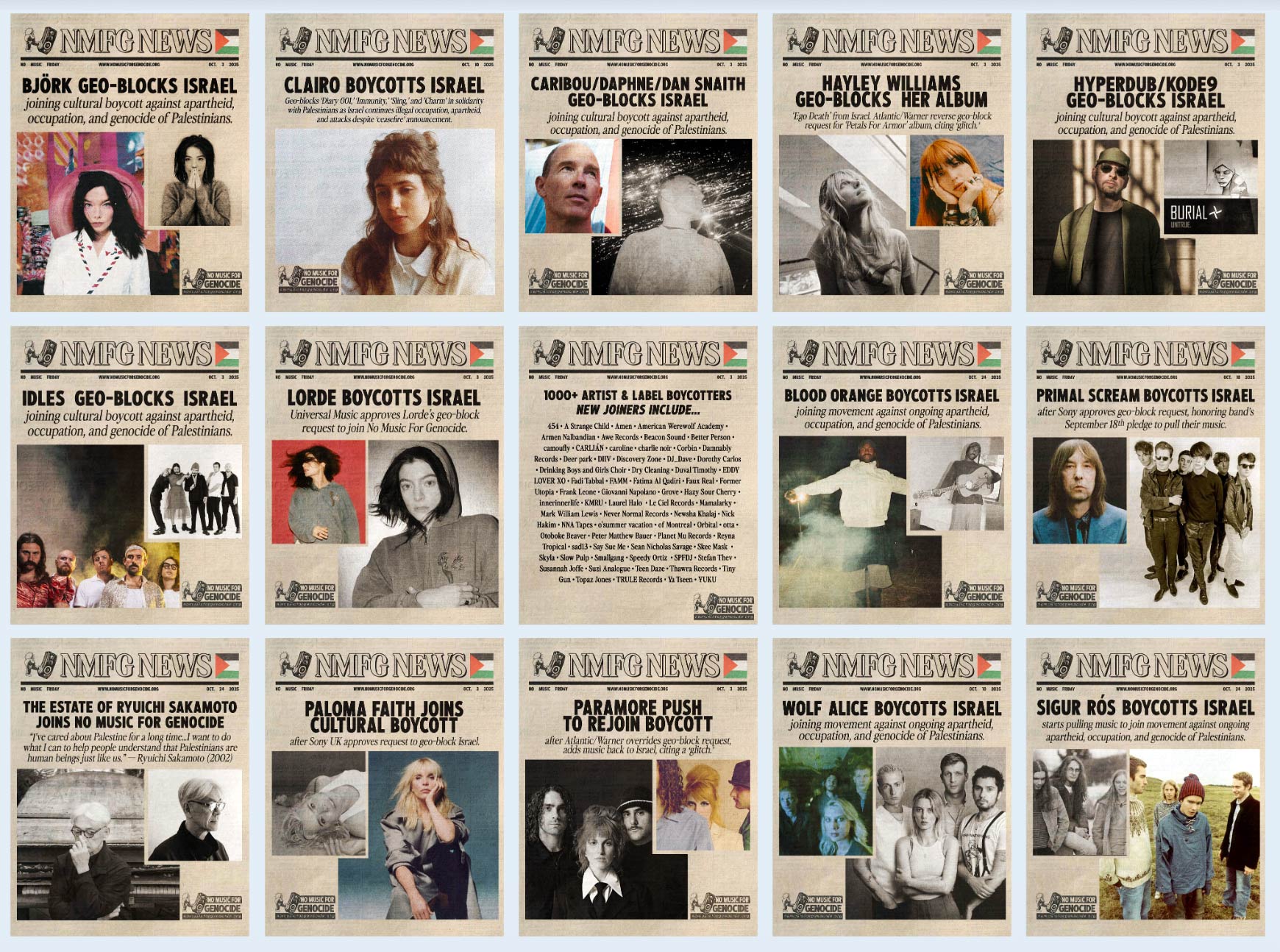
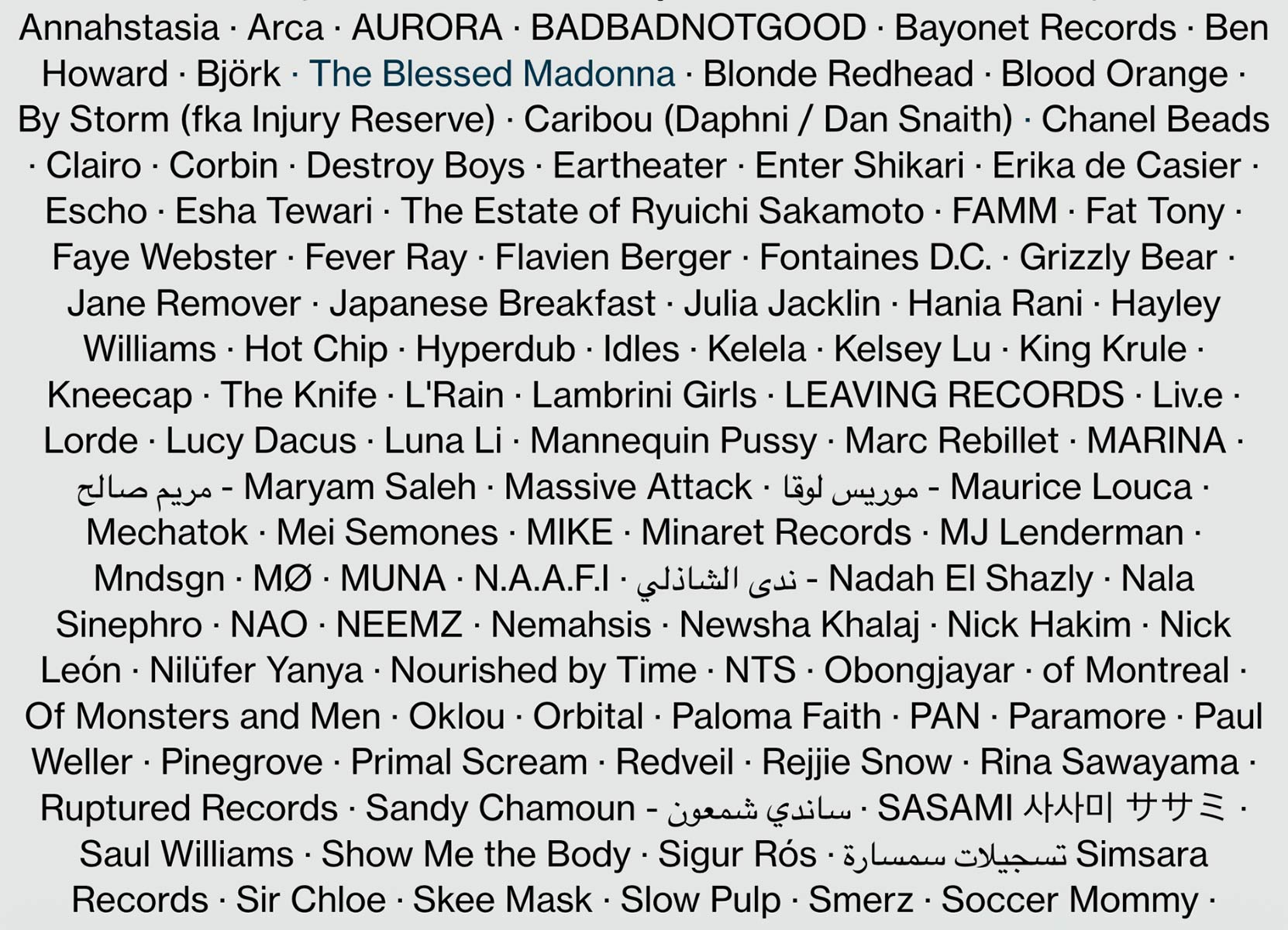
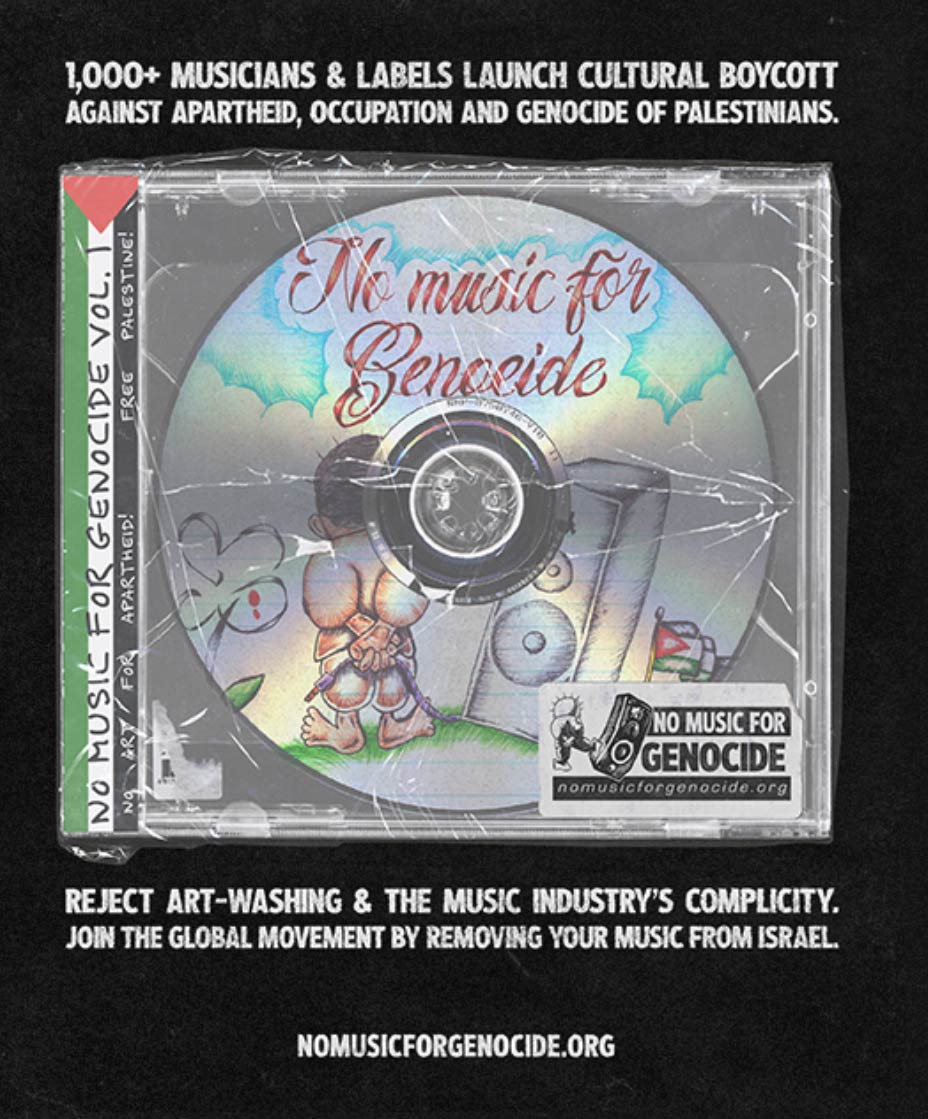
S: No Music for Genocide is a cultural boycott initiative aimed at confronting the music industry’s complicity in Israel’s genocidal war crimes. Over 1000 artists and labels from around the world have agreed to pull their music from all streaming and music platforms within apartheid Israel. Zionism cannot function without material, cultural, political, and social support embedded in the US and Europe. As much as it’s about expressing solidarity with Palestine and Palestinians, it’s also about confronting entrenched Zionism and using the influence of music and musicians to do so.
T: S and I got involved when K (who initiated the project) got in touch. Immediately, I thought, why has no one done this before? The premise was so simple. I knew it would be very effective. I was the only person based in the UK; we all have different networks.
S: At the beginning, we spent a lot of time researching every single music distributor and all the different Digital Service Providers. We needed to find out whether artists and labels could pull their music on their own, or if they needed to request it, and if they did, what the best approach would be.
COLLIS: So, the initiative is focused on artists and labels asking Digital Service Providers not to provide their content and their music, specifically in the 48 territories [referring to “Israel”: the areas of Palestine annexed by Israel in 1948]. How did it go from the beginning, and where is it going from here?
S: Initially, managers and artists connected us to other artists or even lawyers who counseled us in case we faced state repression. It felt a lot scarier when we first started. We were expecting a lot of backlash within these companies, especially the bigger labels and distributors that are not entirely but largely led by Zionists or Zionist-leaning people; we expected them to shut it down before we could even get started.
We were being as selective and careful as we possibly could be about who we were reaching out to before the initiative went public.
T: This campaign was quite artist-led. Independent labels were the ones to sign up first. But none of the labels claimed that they would email every single artist on their labels and ask them to join the boycott.
S: At the beginning, rapper/producer MIKE, who founded and runs the indie record label/collective 10k.global, was a super early adopter. He made a lot of the outreach easier than it otherwise might have been.
COLLIS: Who were some of the other artists who signed on early and brought other people along?
T: Massive Attack. They gave us a lot of legitimacy. Faye Webster was another big one. Yaeji, Arca, Lorde, Hayley Williams, Shygirl, and Paramore…
S: Hayley Williams heard about No Music for Genocide because she noticed that one of the band members of the punk/indie rock band Mannequin Pussy had posted about it on Instagram. It’s a wonderful example of the power and influence that a lot of these independent artists have. Also, the normalization, in the last couple of years, of pro-Palestinian efforts of this kind has made it more acceptable to align openly with anti-Zionist groups. We were just joining that wave.
COLLIS: What kind of negative feedback did you get?
S: Israeli embassies in the United States issued a statement of condemnation against No Music for Genocide, saying that our activities were immoral, which is quite something coming from the Israeli government. Their feelings get hurt by just about anything as they continue to bomb half the region. What was really interesting to me, especially at the beginning, was how frequently we came across two opposing justifications for not signing on. The first was: “This is really scary. This is really risky. It’s going to put my career in jeopardy. It’s going to harm my relationship with my label boss, with my distributor…” and then, on the other hand: “This is performative. This isn’t going to achieve anything. This isn’t going to stop the bombs.”
T: Also, there was concern about actual fans who are pro-Palestinian, but live in Israel.
S: And ‘48ers too [Palestinians who managed to stay in their ancestral homes when the occupation was created in 1948]. A lot of people vocalized concern about people in Israel who “don’t hate Palestinians,” which is a horrifying small number according to almost every poll you can find, but it was almost exclusively Arab artists and managers who bothered to ask about Palestinians themselves living in ‘48. That was a huge concern for us. But every Palestinian person and organization we spoke with, almost unanimously, told us, “It’s worth it. Do it. Not being able to access music is the least of our concerns.”
COLLIS: Which is a symptom of the greater struggle we’re up against: the deep dehumanization of Palestinian society within Western culture in particular. Did you see people change their minds or come around eventually?
S: We attempted to reach the Drakes and the Kendricks of the world, but that was fruitless. Before we launched, we asked major label artists to request a geo-block (a technology that restricts access to internet content, services, or products based on a user’s physical location, identified via their IP address – techtarget.com) before we went live last September. Every single one of our requests got rejected immediately. We made the decision, with the blessing of a small handful of major label artists, to go live as part of the announcement on the very first day, effectively saying that we’ve requested the geo-block. Within a week or two, pretty much every artist who had been rejected was allowed to join. That was definitely a significant moment. We were expecting much more of an uphill battle over a much more protracted period of time. I don’t know what the thinking was on the label side, but the logic seemed to be, especially with Hayley Williams and Paramore and their old label Atlantic, that this was not worth the potential PR crisis it could be, if we’re openly shutting down our own artists’ political expression. All three major labels, Sony, Universal, and Warner Records, ended up greenlighting the involvement of notable artists like Lorde and Blood Orange.
T: We had a big moment when everyone was joining, and then the ceasefire was called. At that point, we knew we’d have to shift. We had to look at how we could use our platform and the artists we were in touch with differently, and how we might join other campaigns or help with other projects. Eurovision, the biggest and most widely watched TV music program in the world, has always been very political. But the music is not taken seriously within the music industry, and I think across Europe as well. In Israel, it is taken extremely seriously. They use it to artwash and pinkwash, because it’s such an LGBTQ+ event. So, by us not taking it seriously, we were actually giving it more power.
S: Our main focus was to ask artists who signed on to No Music for Genocide to sign an open letter essentially condemning the hypocrisy of Eurovision for banning Russia for its illegal invasion of Ukraine, while celebrating Israel on stage for its third straight year… not only as it commits genocide in Gaza, but as it once again bombs Lebanon with complete impunity. It’s meant to be a powerful way for artists to communicate to their fan bases and to the public—wherever they live across the European Broadcasting Union’s reach—that this shit is wack, and that they shouldn’t tune into it.
Anyone can participate. Every fan who would have watched Eurovision and doesn’t, every contestant who would have performed and won’t, every crew member who calls in sick, every broadcaster who cancels and pulls out, signifies a real victory. Israel’s leadership openly talks about the geopolitical value of Eurovision, and as much as our industry doesn’t take it seriously, we have a responsibility through music to acknowledge that the other side does. We need to weaken that institution as much as humanly possible, for as long as Israel is allowed to participate.
It’s also important to say that we’ve always been aware that these actions are not happening in a vacuum.
No Music for Genocide intends not only to educate fans who are tuning in about what’s happening in Palestine and Lebanon, but to also inform them about the weapons manufacturers in New York City who actively work with the Israeli military.
When we put on our fundraiser in New York in November, we had a giant banner amplifying the local campaign “Demilitarize Brooklyn Navy Yard” on stage behind Smerz, Erika de Casier, and Blood Orange because the Brooklyn Navy Yard has been used to house military suppliers who are working with ICE and the Israeli military.