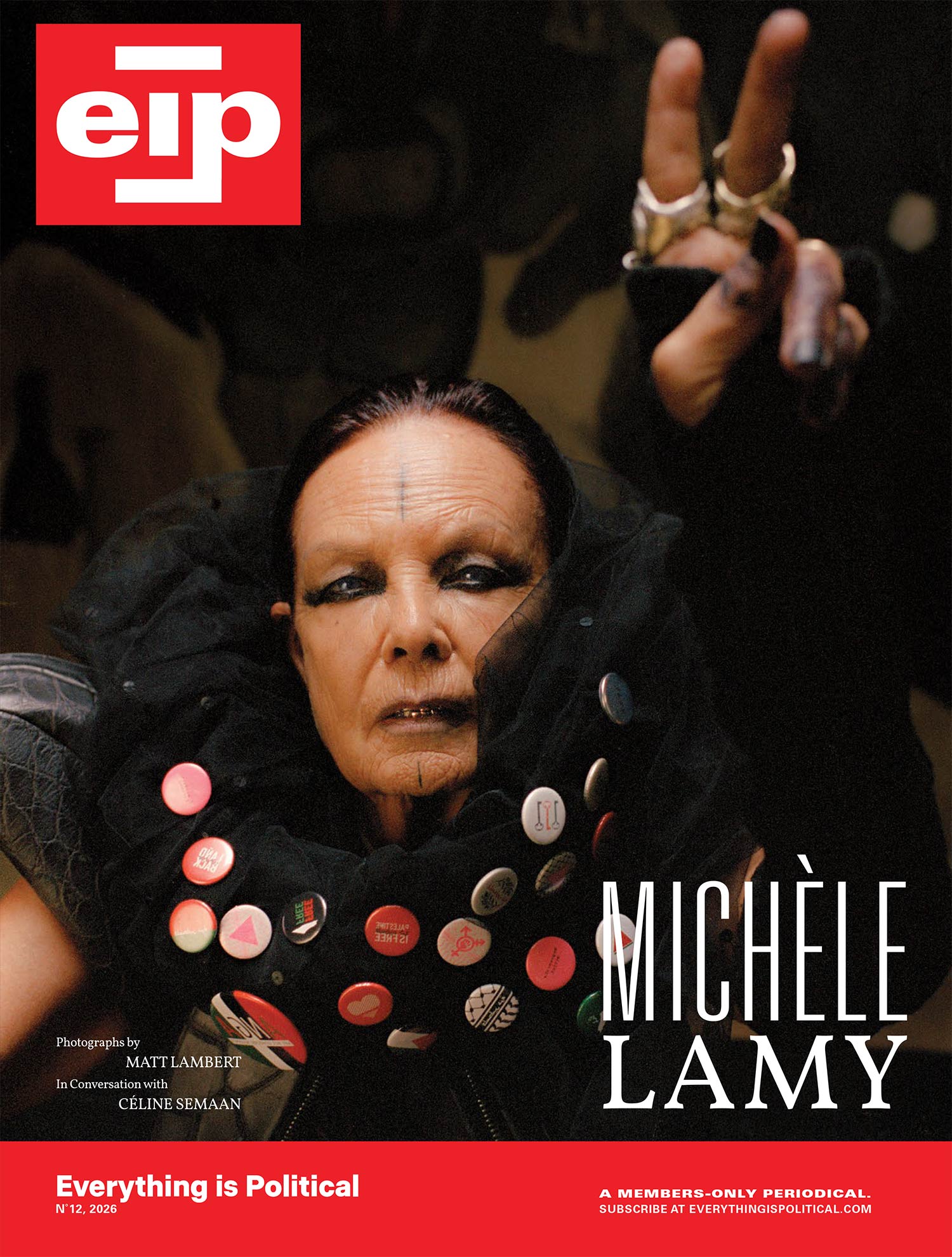

Being around Michèle Lamy feels like being in the presence of an Earth goddess—flawless, powerful, yet calm; fully herself in a way that radiates permission. This encounter would not have been possible without my dear friend and collaborator Samia Larouche of Wa Off, who simply texted Michèle and asked for an afternoon together.
What followed unfolded with a kind of effortless magic. We smoked cigarettes, tried on Rick Owens for the first time (in my case), and drifted through conversations on politics and culture alongside Michèle’s friends and guests, including the duo behind Matières Fécales, as well as architects, thinkers, and peers across art and fashion. Her latest track with Travis Scott played on loop. In the corner, a singular scented candle filled the room with something between a church and a nightclub. The night stretched on, wrapping us in a shared sense of ease, possibility, and connection—qualities Michèle seems to embody effortlessly.
After a few encounters, Samia introduced the name of photographer Matt Lambert, and from there, everything fell into place with the same quiet precision.
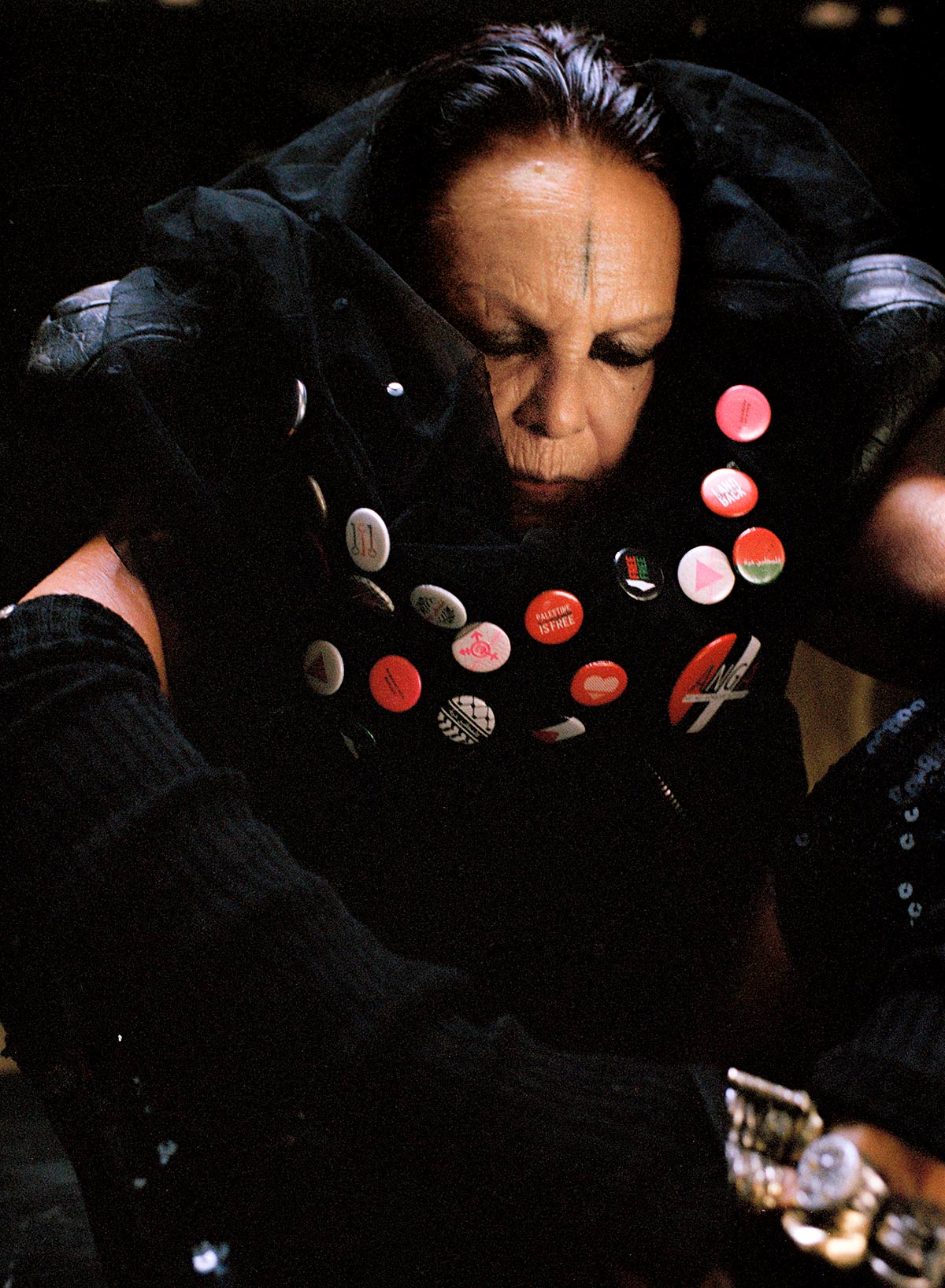
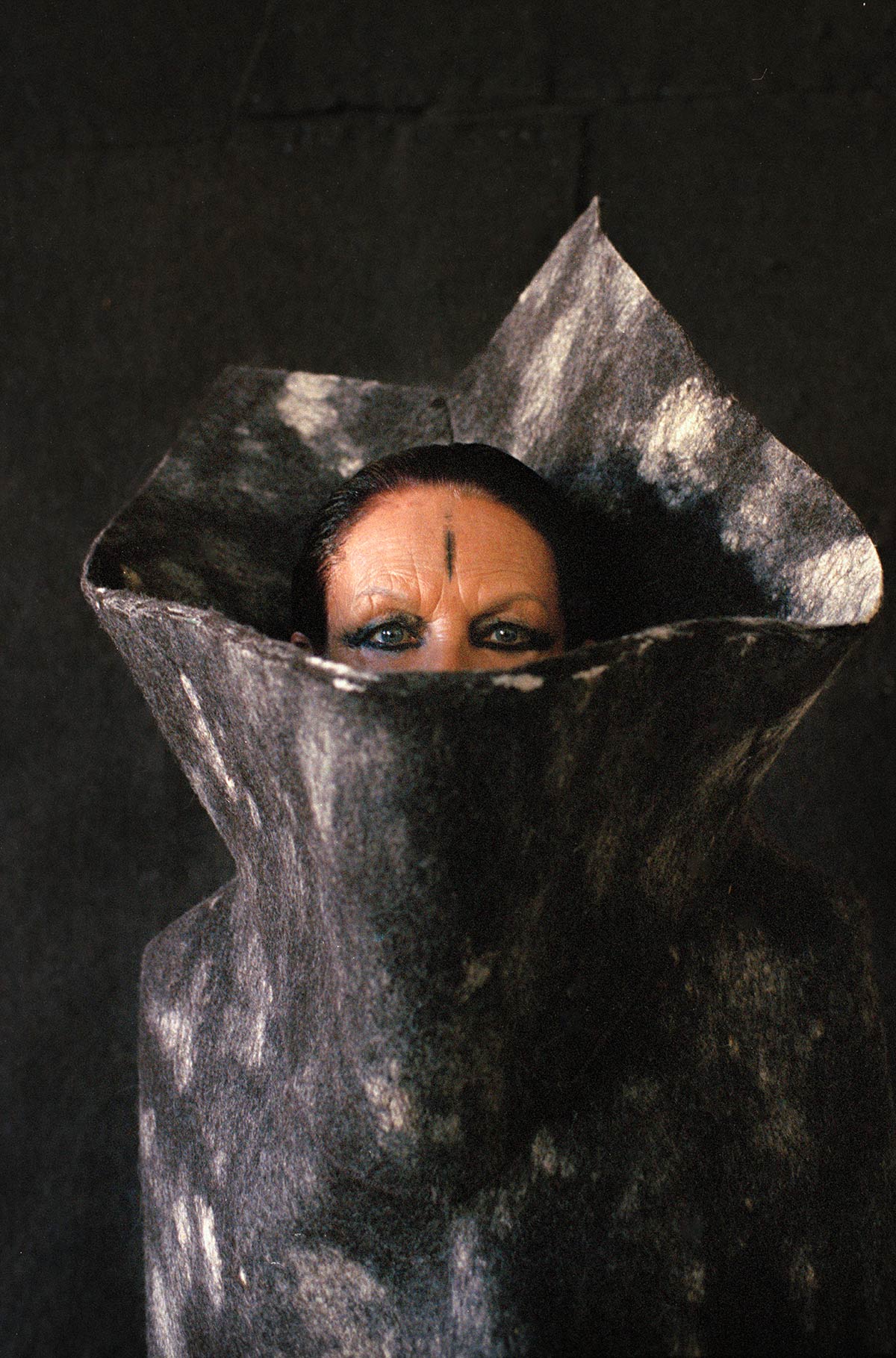
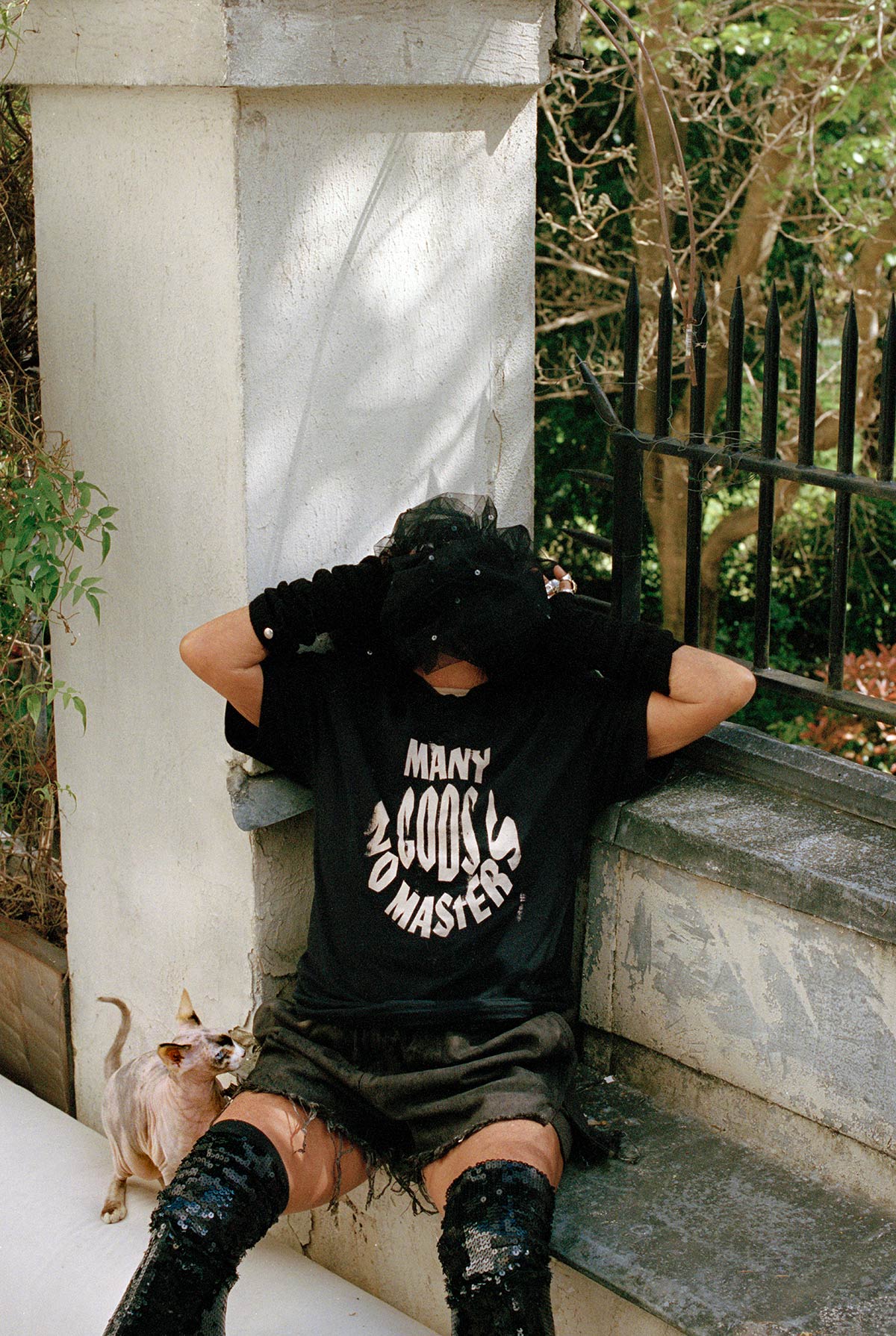
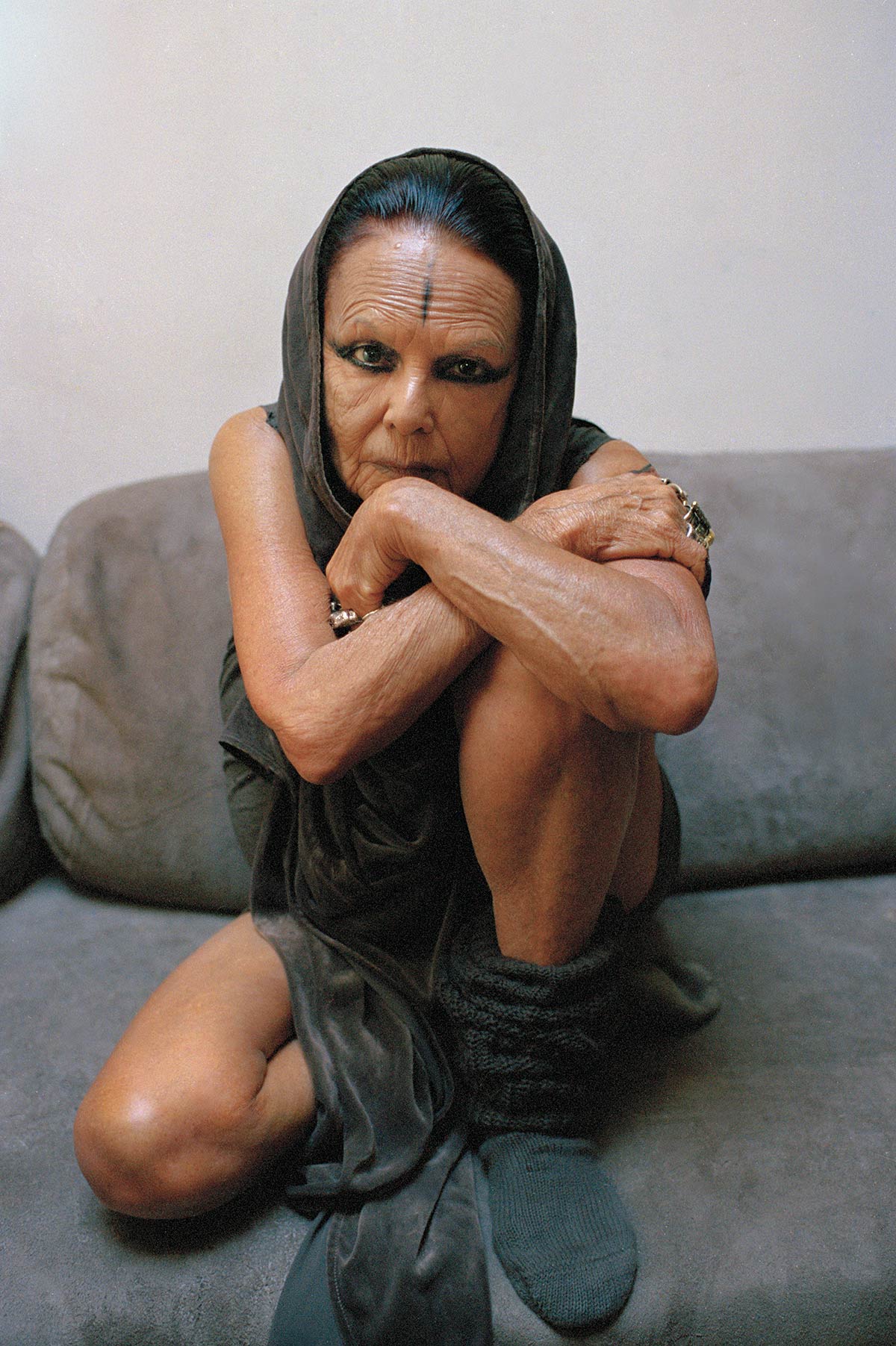
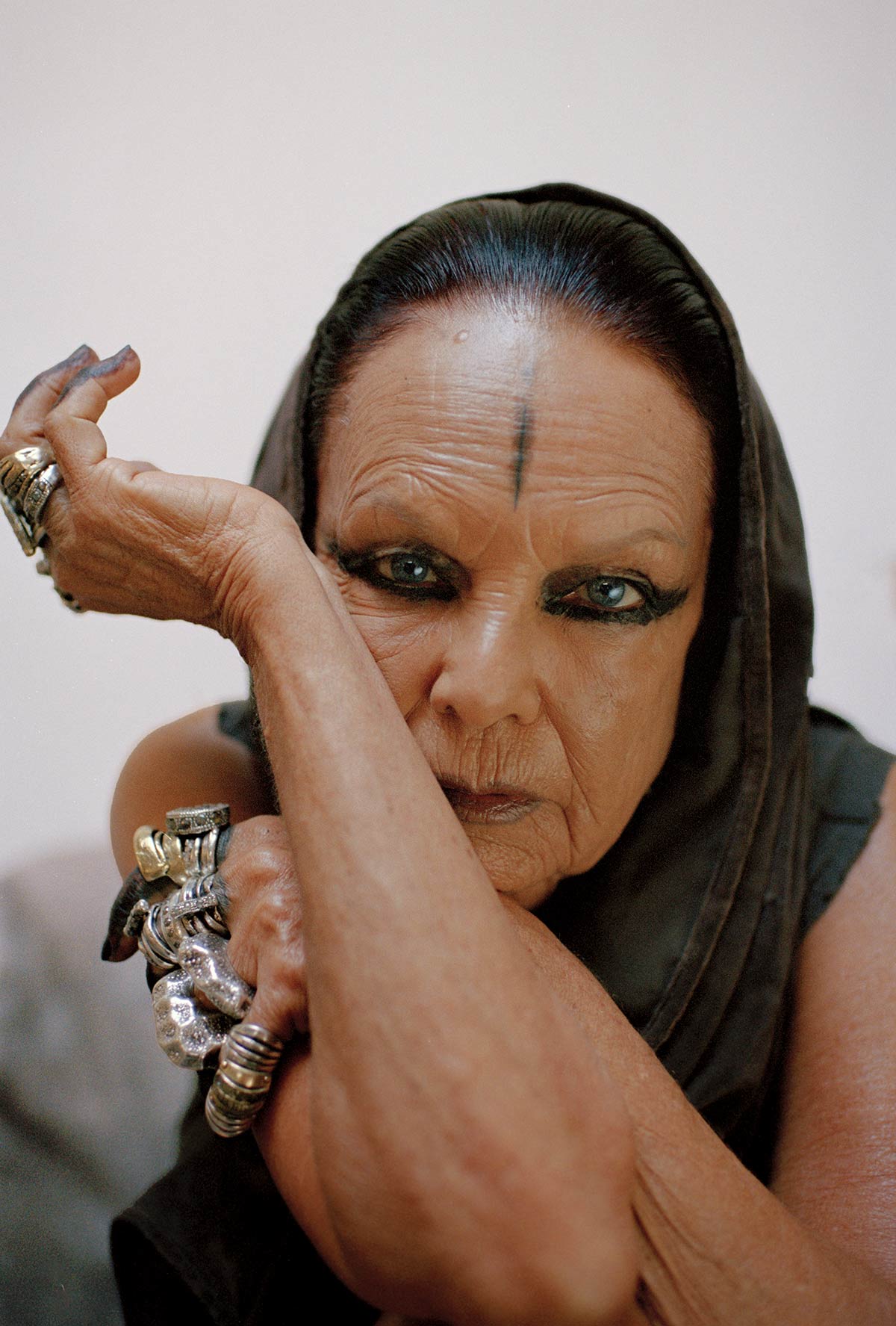
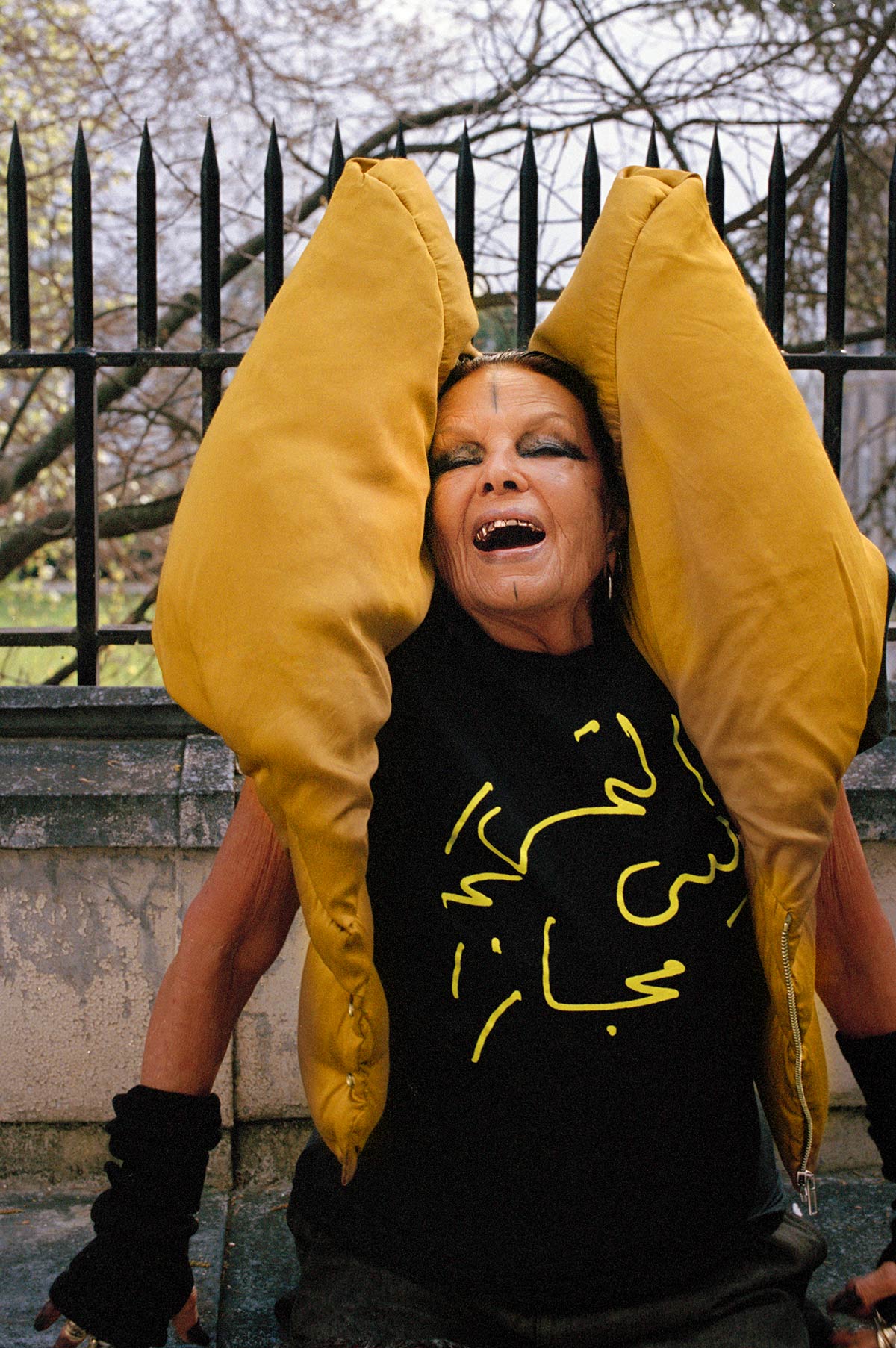
On a Sunday afternoon in Michèle’s apartment, Matt captured her in her many forms: the Earth goddess, the child, the grandmother, the resting warrior, the captain, the mother—a woman who has always embodied resistance, creativity, and, above all, freedom.
CELINE SEMAAN: Last time we met in Paris, you shared a beautiful piece on Gilles Deleuze that speaks of identity, not as something fixed, but as something in the process of becoming. This is a big theme for you, this idea of becoming—identity as a fluid construct. How has your own life and work embodied this idea of constant transformation, rather than a static, stable identity?
MICHÈLE: We have to experiment. That’s where we are now;
we are at a point where to understand what’s going on, we have to find a new way, a new configuration of the world.
There is no need to fear or hope; we have to look for new weapons. It seems that we are in a game of chess where those guys are playing, and they are playing with their rules. We cannot do this game of chess, we have to play a game of pure strategy. At this point, we must change our minds. And we already see it… it’s great in New York with Mamdani, because he does not play by those rules, he isn’t playing chess. He has a fluidity of being… what is so important, is that it changes the rules of the game.
CÉLINE: From an early age, you have represented resistance. It feels like we have ended a cycle, and we’re starting something new. What is in your imagination at the moment? The way the culture has been going is making everyone look the same, dress the same, be the same… But while everybody is trying to just blend in, you come in and you stand out in such a powerful way. Really being ourselves, being different, being in this vibration of change, of love… that is waking up, right? People ask me a lot, what do you mean, wake up? How do I wake up? And you, by being you, are the vibration and the frequency of waking up.
MICHÈLE: I think the little things count. Expressing yourself is something you have to develop. And we have to develop with everybody. Some of us need our weapons…
CÉLINE: When you say weapons, I imagine tools or the pen. This is my weapon. [Holds up a pencil.]
MICHÈLE: Yeah, but why not say the word? They use weapons. We have to function another way: pure strategy and being together at the moment we are in. We have to be all together in something.
I’m completely speechless about AI, because I don’t know how it could help us in any way. Perhaps it will, but so far I don’t know if it can be one of our tools, as you say.
CÉLINE: AI can be a mirror of distortion.
MICHÈLE: Because with that, we imagine we cannot feel, we cannot smell… we need to feel, we need to sniff each other…
CÉLINE: Yes! Sniffing each other is a big part of the world you’ve built. When you enter your world, it smells amazing. There is a smell, there is a feeling… we are reconnecting with our senses. A lot of people say wake up, but we don’t know how to wake up, and in fact, the waking up, the motion of waking up, is this reconnection with ourselves, with our feelings, with our senses. A lot of people these days talk about feeling numb from the barrage of images of war and genocide coming through our screens. Breaking out of this numbness is the key to our liberation, right? It’s the key to experience.
MICHÈLE: Yeah… we have to bring it… all the pain… we have to get joy in our heart, so we can get to something together. The truth is coming out in lots of ways… the Epstein files… the files that have been hidden until he was killed. Everybody wanted to hide them. It’s beyond anything we can understand. How could he be so perverted? We were thinking we were so free.
CÉLINE: We thought we were so free, and now, this is what being free looks like, feels like. It feels like things are falling apart, it feels like chaos…
MICHÈLE: So now we say, we should have been awake since we were 20. In May 1968 there were all those people at the time… (In May 1968, France was paralyzed by a massive, spontaneous uprising of students and workers that began as campus protests against capitalism, conservatism, and poor school conditions. It evolved into a nationwide general strike involving 10–11 million workers, nearly toppling the government of President Charles de Gaulle. - frenchly.us) The war, the Vietnam fucking war. How aggressive we were… we went to fight those people for no reason. Our story has to be redone. Being against abortion, and then after that, they wanted all the kids to be killed. I mean, how can you function like this? How can… what did we do on Earth?
CÉLINE: What you’re saying is really beautiful. I know what you’re feeling. You’re feeling very, very strongly with the world. I feel that too. I feel you, and I feel the world. Most of the time, I go into deep, deep, deep depression… I could come out with a message, or a plan, or a strategy, as you said. Recently, I saw a film called Do You Love Me by a Lebanese filmmaker (Do You Love Me (2025) is a Lebanese documentary film directed by Lana Daher, constructed entirely from archival footage to explore 70 years of Lebanese history, culture, and memory, focusing on Beirut. The 76-minute film uses found footage, home movies, and media archives to create a “love letter” to the city. - IMDb) It was presented at MoMA, but I’m very sure she’s going to be presenting it in Paris. You have to see it. Etel Adnan is in it. (Etel Adnan was a Lebanese-American poet, essayist, novelist, and visual artist, and the author of Sitt Marie Rose. In 2003, the academic journal MELUS called her “arguably the most celebrated and accomplished Arab American author writing today.” – Wikipedia) She talks about how our identities have become these weapons towards each other.
For example, in Lebanon, your religion or political party became the ways in which we fought one another. It separated us from each other. In the movie, Etel Adnan talked about identity. Identity is so powerful. It can, on the one hand, really free us if we identify with something. As you said, it can also break us as a population, because it can separate us. My identity is not the same as yours, and so on… Israel is invading Lebanon as we speak… we’ve had 30-plus years of war, of battling one another… In the movie, Etel Adnan talks about that. I feel that in watching these films, in reading the words of Ital Adnan, in listening to you, there are messages of wisdom, of hope. Yes, the world feels like it’s crumbling, and we can’t deny it. There’s something that’s falling apart. It’s unbelievable. But it must fall apart. And… we are… recreating something. Do you feel that?
MICHÈLE: We are looking for another way… It has to do with our brain, with our head… with the artist, and with expressing ourselves. I know the way. Arundhati Roy (an acclaimed Indian author and political activist, widely recognized for her debut novel The God of Small Things, which won the 1997 Booker Prize. Since her early literary success, she has dedicated much of her life to social activism, criticizing neoliberalism, imperialism, and the policies of the Indian government. - Wikipedia) says another way is possible, or something like that. I hear her marching, and that is something that is a beautiful image for us, and you really represent that… to me, and to a lot of people…
Millions of people who come across the art world, and the world that you’ve created cannot help but feel this feeling that’s being lost. It’s really a lost feeling of connection, of awakening, and of becoming. And all of these are the secret sauce of this… what we are looking at right now when we’re saying that we need to change, we need to imagine something that doesn’t exist, we need to as we can, using old tools, new tools, as you say, because… what happened in Hungary is a step forward. (On April 12, 2026, Hungary experienced a historic political shift, as voters ended Prime Minister Viktor Orbán’s 16-year rule in a landslide election. Former party insider Péter Magyar and his Tisza Party won, driven by campaigns against corruption and cronyism. - atlanticcouncil.org) There is this desire to change. We need to embrace… and to resist as much as possible.