
As queer and trans people are under attack in the United States–identified as “extremists” by the FBI as part of a mass far-right campaign to erase us, many are turning to underground networks of support and resistance. Queer and trans people are fighting for their survival, and as they have done for centuries, witches, folk magic practitioners, and pagans are utilizing their magic to protect and defend their communities under attack using spells for protection, herbal sachets for passing, and community solidarity as sacred practice.
Over the past year, queer protest magic has proliferated online, as has a deep dive into the histories of queer protective magic throughout time. “I have a big handful of queer and trans clients,” Italian-American folk magic practitioner Frankie Anne Castanea said, “that are seeking out protective magics or magics that are a little bit more intensive, or magics to pass and those are all very rooted into historical folk magic, specifically voodoo and conjure tend to have a lot of workings for trans and queer folks.”
Castanea has written a literal book on protest magic: Spells for Change: A Guide for Modern Witches published in April 2022. Better known online as the Chaotic Witch Aunt, they are the godparent of modern queer protest magic, publishing a piece on their blog about Protective Magic for Protesting Practitioners, which has been continually updated with workings, safety information, and resources as needed including not only protest safety but intentional practices for identity and healing in the face of queerphobic, xenophobic, and racist violence.
Ancestral magic
Castanea’s ancestors would’ve known protest magic well, having lived in Italy (while some immigrated out of the country) during the rise and fall of Mussolini. In much the same way, Castanea wrote in their June blog post, “we are seeing our friends and neighbors disappear at the hands of masked men, our queer elders and community members living at the hands of threats of violence, murder, and hate crimes.”
Folk magic, Castanea argues, is a form of protection and communal justice to keep us safe and fight systems of Christian nationalism that attempt to erase us, and a way to reconnect with ancestral practices of resistance and survival. At its heart, ancestral magic is decolonial and directly counter to the rising tide of Christian nationalism across the United States.
“To me,” Castanea said, “ancestral magic is rooted into practices that have previously been lost by assimilation and to White supremacy. It’s having awareness for the ancestors we come from. Ancestral magic is reconnection and rooting into community spaces and learning from community spaces.” This rejection of assimilation and religious settler colonialism also encompasses current efforts to silence, erase, and punish queer and trans people for existing, especially with the Supreme Court hearing a case this past week to overturn Colorado’s ban on conversion therapy for minors. To be queer is to reject compulsory heteronormativity and cisgender expectations and expressions.
This work is also connected to the veneration and celebration of queer ancestors. Castanea recommends everyone connect with queer ancestors, from their families to their friends to queer historical icons. “It can be members of your family that were queer,” Castanea said. “It can be queer community leaders and people who have passed who made huge movements for us, Marsha P Johnson, and anyone who was involved in the Stonewall rides. All of those are our queer ancestors, and when we lean into learning from them or connecting with them, or listening and learning about their stories, we’re also participating in like ancestral veneration that leans into folk magic.”
Queer and trans folk magic provides rich ways in which to connect with queer ancestors whose names we might know and those who we may not. One of the best examples is the work of Loki, a Filipino trans man, and his husband Robin, a transmasculine nonbinary Italian American, who founded The Trickster’s Apothecary in 2021. “You hit queer elderhood a lot younger than most people hit elderhood,” Robin explained, “so making sure that people have someone to call in their spiritual practice who understands, feels comforting, feels that same righteous rage” is at the core of what the Tricker’s Apothecary does by creating candles of queer ancestors.
The creators of secular saint candles are often hesitant or unwilling to create saint candles with specific religious connotations, nervous about how religion and spirituality are often viewed by both community members and far right leaders as at odds with queer and trans identity. But there is great potential, Robin said, in recognizing and venerating trans ancestors. In fact, Castanea published their new book Ancestral Magic: A Modern Witch’s Guide to Folk Traditions & Reconnection this past November.
The inherent queerness of folk magic and witchcraft
While Castanea argues that queer folk magic speaks specifically to their communities, there is something inherently queer about all folk magic, witchcraft and paganism that exists on the fringes. “The witch is a kind of other,” they said, “an other figure against the state or the system.” This is not to say that affirming and welcoming Christian communities do not exist, nor that some magical traditions are gender essentialist (especially Dianic communities) and have been harmful and exclusionary to queer and trans people.
“Queerness is just so intrinsically rooted into everything,” Castanea said. “Even though people try really hard to pretend its not, it’s rooted in nature. It’s rooted into folk magic. A lot of folk magic centered on sex workers and strippers often included queer folks. There have always been magical remedies or ways for trans folks or queer folk magic that is rooted in protection of queerness and making sure we survive.” Folk magic itself exists in a liminal space, a religious other that queers the material cultures we engage with.
Maybe this is what draws many queer and trans people to folk magic, witchcraft and paganism. “I think of queerness as this in between space, as this liminal space as actively kind of queering narratives or querying societal norms, is very potent when we’re talking about folk magic and necessity,” Castanea said. For Castanea, being queer and showing up as queer and trans is itself an act of protest, just as practicing folk magic, witchcraft, and paganism is an act of rebellion during a time where far-right forces in the United States continue to demonize both communities.
In order to practice queer and trans resistance magic, however, practitioners need to understand how accusations of witchcraft and Satanism (rooted in Christian nationalism themselves) have been used to target, ostracize and incarcerate queer and trans people. The United States is currently witnessing a queer Satanic panic, where queerness is falsely conflated with witchcraft–as seen in Indiana Lt. Gov Micah Beckwith’s posts this past May and June. Queer communities and witchcraft are once again associated with Satanic Ritual Abuse, a term that rose to prominence in the 1980s during the HIV/AIDS crisis as conservative Christians stirred moral and spiritual panic surrounding the Satanic Temple.
Just as LGBTQ+ people are falsely accused of grooming children, Satanists and witches, pagans, and folk magical practitioners were once accused of ritual abuse of children in a “Pagan Conquest,” which Beckwith described as “ritual child sacrifice–with glitter and hashtags.” Queer and trans protest magic is rooted in histories where magic itself and our connections to it have been demonized; reclaiming magical roots itself reclaims and heals these histories.
As a result of increasing violence against queer and trans communities and folk magic and witchcraft communities as well, “ actively sitting in a liminal space is a protest in itself,” Castanea said. “I think that actively participating in queer community and building resilience and joy and forming communal mutual aid networks based on that experience is also a protest in itself, and there are so many different ways to incorporate folk magic in that. And I would even argue that folk magic is community and mutual aid.”
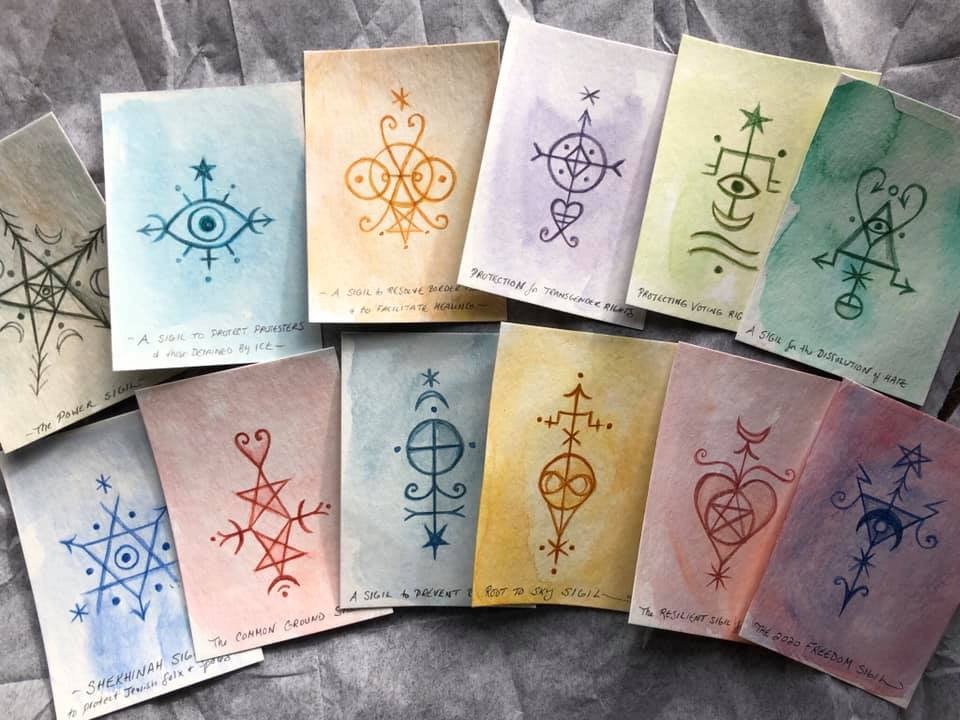
Papers inscribed with sigils, created by and with Laura Tempest Zakroff. Photo courtesy of Zakroff.
The power of protest magic
Protesting in the streets and civil disobedience against the police and ICE is critical, especially for white protestors who have more privilege and protection because of white supremacy, but it’s not a form of rebellion accessible to all people. Especially for disabled individuals, Black and indigenous people of color, and many others who are not physically able to engage in this form of protest or who face intense violence from the police, state-sanctioned officials, and other fringe and private militia groups, risk more deadly violence if they engage in this protest.
For Castanea, there is folk magic specifically devoted to keeping people safe during this, especially found in the PaganPunk Community Grimoire Project, a resource created by gay hedge priest Ron Padrón. The Project provides free 1-2 page zines with histories, rituals, and spells that people can easily access online, including one by Padrón about Queer Ancestors, another by M. Belanger to restore equity and justice in the United States, and finally a recipe and ritual for lip balm protection magic by Vittorio Benetti.
As Benetti wrote in the zine, his cargo pants act like a hidden backpack, full of non-magical things like a coin wallet and spare keys and magical ones, like crystals and sigils. “In my ongoing exploration of urban, street, and punk witchcraft, I was looking for something protective, easy to carry, versatile enough for multiple uses, and that could be hidden in plain sight whether I’m on the street or at the office.” The protective lip balm he created was a covert but powerful form of protective magic while out in public and while protesting.
But for people who cannot go out in the streets to do this work, “protest, especially coming from a place of privilege, a place of whiteness, is finding and being in community spaces and being a good ally when I can for Black, indigenous people of color and queer Black indigenous people of color. It’s ensuring that my spaces are safe and accessible for them.” Queer protest magic doesn’t necessarily have to be what many consider traditional magic–spells, rituals, and sachets–rather, it is collective action inspired by historical solidarity with queer ancestors and the queer and trans people that are today fighting for their lives.
,%20by%20Laura%20Tempest%20Zakroff.%20Photo%20courtesy%20of%20Zakroff.jpg)
A Sigil to Protect Protesters (ICE Sigil), by Laura Tempest Zakroff. Photo courtesy of Zakroff.
“It’s ensuring that I am making sure that their voices are the first voices heard,” Castanea said, “and it’s also building community spaces for people to just be themselves. It’s forming mutual aid networks. It’s ensuring that you’re like checking in with your trans and queer friends and relatives. It’s making sure that they know that if they need a place to crash, your house is there. We often think of community and protest as two separate things, but for me, community is protest. Mutual aid is a form of protest and a form of protest magic.”
Protest magic at its heart has always been about fighting systemic abuse and violence, and in times of increasingly state-sanctioned and led violence against queer, immigrant, disabled, and BIPOC individuals and communities, protest magic has reemerged as a vital tool not just for queer people but for all peoples who are marginalized, discriminated against, and harmed.
“Protest magic isn’t just rooted in being an Italian American,” Castanea continued, “but anyone who experiences or has ever historically experienced marginalization or discrimination, including queer folks, Black and indigenous people of color. There have always been spells and folk magics and practices that are rooted into survival.”
So as we near Trans Day of Visibility, Castanea invites queer and trans people–and all people–to engage in folk magic themselves, to not be afraid that they will do it wrong, make mistakes, or be excluded, or that practicing folk magic will invalidate their cultural or religious past or roots or challenge any interfaith identity or practice.
Rather, Castanea urges people to find their own local communities–on social media, at local botanicas and metaphysical shops, at magical workshops and circles–and ethical teachers who cite their sources, and more than anything, that in the true spirit of queer and trans folk magic, people not “be afraid to fuck around and find out.”