

As Israeli military violence in Gaza–named a genocide by a UN commission of inquiry this year–goes into its third year, a look back at our contributors’ work of documenting, commemorating, counteracting, and moving towards a liberated future. We share a selection of their exemplary and important work.
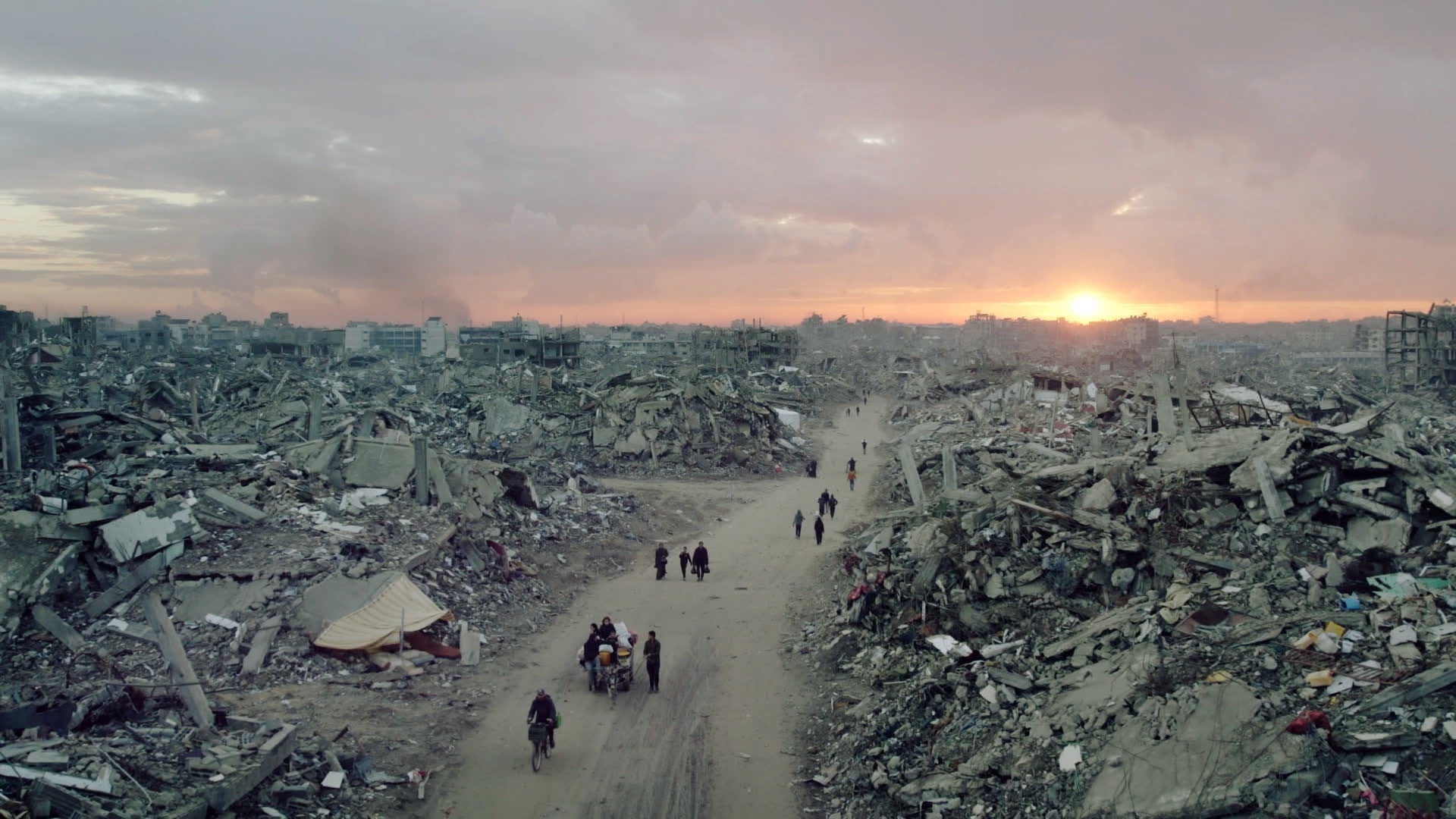
Image courtesy of Watermelon Pictures
When Hind Khoudary spoke to this magazine for its first issue, she was sitting on the roof of a colleague’s house in Deir al Balah to escape the heat of rooms with no electricity. Khoudary had moved home from Istanbul in August 2023 and started reporting on the second or third day of Israel’s attacks on Gaza. She learned that an Israeli strike had destroyed the house her father built before his death in 2012 from, of all things, an Instagram reel that happened to appear on her phone.
“I never imagined that a fifteen second video would really change people’s thinking,” Khoudary told us. For three years, much of the world has understood Gaza through videos of that length, because Israel has continued to bar foreign journalists from the Strip. By late September, the Committee to Protect Journalists had confirmed that Israel killed at least 189 Palestinian journalists and media workers in Gaza; Gaza’s own media office puts the number above 260. We publish this on the anniversary in memory of those reporters and of the more than 74,000 Palestinians Israel has killed in Gaza, according to the Gaza Health Ministry.
Since our first issue, our contributors have been recording details for us, commemorating and reliving traumas no one should ever have to go through, let alone remember. On June 4, 2025, Mosab Abu Toha logged a single day in Gaza, hour by hour, noting drones that exploded above al Aqsa Hospital at 9:27, 9:43, and 10:05 that morning. That day, an Israeli strike on tents at a school shelter near Khan Younis killed fourteen people, ten of the dead from the Abu Hadayid family. Hassan Herzallaj wrote about the rats that roam the tent camps of Mawasi at night. We also published photographs from Gaza by Mahmood Bassam.
Many of the families Israel has destroyed in Gaza first lost a home in the 1948 Nakba, when Zionist forces expelled some 750,000 Palestinians and erased more than 500 Palestinian communities.
Israel has also destroyed the places where Palestinians in Gaza studied, trained, and made things, a practice Sarah Sinno examined under the name urbicide. Jwan Zreiq documented the destruction of nearly every school in Gaza, along with all twelve of its universities, then described 168 new doctors who graduated in front of the ruins of al Shifa hospital, calling themselves the Humanity Cohort. Paola Arrigoni profiled Osama Ayoub, who founded Gaza Boxing Women in 2016; the project’s gym, the first for women in Gaza, opened in 2022. By the time she wrote, only rubble remained of it. The artist Lara Salous built an installation around a traditional Majdalawi loom and her interviews with Hussam Zaqout, a Gazan weaver whose new workshop Israeli airstrikes destroyed. Susan Abulhawa led a writing workshop in Gaza where one story followed a woman deciding whether to burn her late brother’s bed frame for cooking fuel.
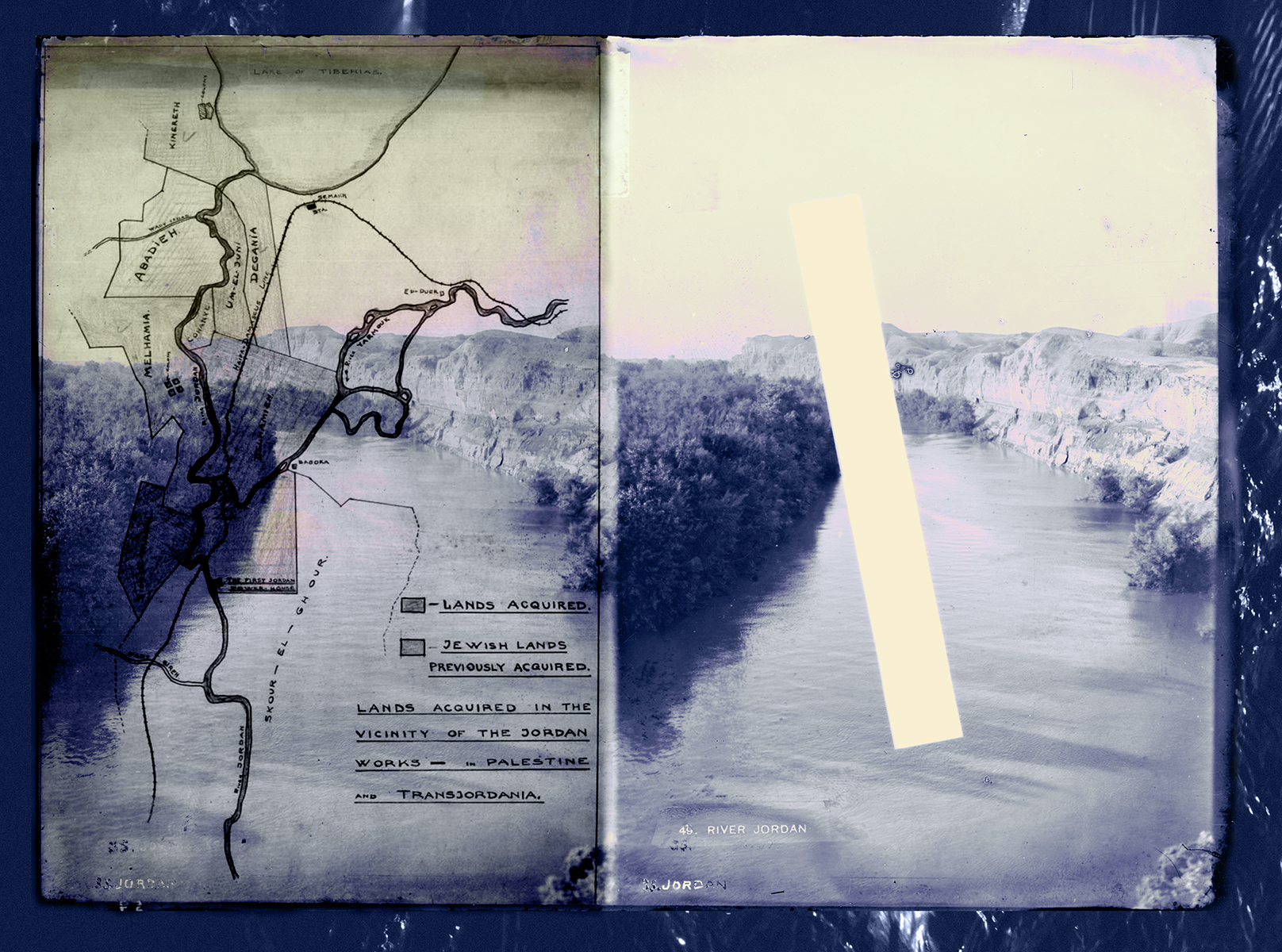
Art by Kamee Abrahamian
The ceasefire that took effect on October 10, 2025 ended the heaviest bombing, and by the standards of the previous two years it brought a kind of calm. Even so, Israeli forces have killed more than 1,400 Palestinians during the so-called truce, according to the health ministry–about four people a day. Israel now holds more than half of the Strip, an outcome our editors warned against in an analysis of Israel’s plan to seize Gaza. This year, Israeli authorities moved to expel dozens of international aid groups from Gaza, including Doctors Without Borders. The trauma surgeon Feroze Sidhwa told us in our conversation about American Doctor that hospitals’ ability to give care was “actually worse now than it was during the worst of the bombing.” Sara Lynn Younes has traced the same methods in Lebanon and its leveled border villages.
American news outlets covered Gaza less after the ceasefire; Fairness and Accuracy in Reporting calculated that Gaza appeared in 1.5 percent of national stories during the following three months, the lowest three month average of the war. Public opinion moved the other way, in America and abroad, as Joi Lee reported from Seoul. In February, Gallup reported that for the first time since 2001, Americans no longer sympathized more with Israelis than with Palestinians. Two months later, 40 of the 47 senators who caucus with Democrats voted to block a sale of bulldozers to Israel, and the Senate let the sale stand. Andy Burnham apologized for Labour’s early handling of the war before becoming prime minister in July, and in September his government announced a ban on settlement goods while confirming that Britain would keep exporting F-35 parts that reach Israel. The European Union could not agree to suspend its trade agreement with Israel.
American voters and British ministers have moved some distance toward Palestinians, as have several European governments. None of that movement has changed what Israel can do and is still doing in Gaza. Israeli forces continue to kill Palestinians there with arms from Washington and parts from London. Independent foreign reporters still cannot enter the Strip, and Israel has spent the year trying to force out the aid groups it deregistered. Everything Is Political calls on the United States, Britain, and the European Union to end all weapons sales to Israel, F-35 parts included. Those governments must also force Israel to open Gaza to journalists and aid groups, then secure Israel’s full withdrawal so Palestinians can rebuild Gaza on Palestinian terms.
Many of the families Israel has destroyed in Gaza first lost a home in the 1948 Nakba, when Zionist forces expelled some 750,000 Palestinians and erased more than 500 Palestinian communities. About seven in ten Palestinians in Gaza are refugees from that expulsion or descendants of refugees, by the UN’s count, and Jwan Zreiq has written about the memories of exile that Palestinian families hand down to children born long after the Nakba. The taking of Palestinian land has continued in the West Bank, where the UN counted an average of six settler attacks a day by June of this year, the highest rate on record, and where Israel has never defined its borders, as Sarah Sinno argued in an essay on the idea of Greater Israel.
Everything Is Political remembers these losses by joining Palestinians in demanding an end to the occupation, the return of stolen land, and the right of refugees to go home.
Selections from Everything Is Political
-
Dispatch from Gaza: Hind Khoudary, Hind Khoudary
-
Dispatches from Gaza, Mahmood Bassam
-
What Goes Unseen In Gaza’s Camps, Hassan Herzallaj
-
Dispatch from Gaza, June 4, 2025, Mosab Abu Toha
-
Urbicide as a Weapon: How Israel Destroys Land, Memory, & Heritage, Sarah Sinno
-
What Water Carries Beyond the Nakba: On Fugitive Knowledge and Palestine, Jwan Zreiq
-
Scholasticide in Gaza: On the Systematic Destruction of Palestinian Education, Jwan Zreiq
-
On Holding a Writing Workshop in Gaza Amidst Genocide, susan abulhawa and Céline Semaan
-
DO NO HARM: A Conversation with AMERICAN DOCTOR’s Poh Si Teng and Dr. Feroze Sidhwa, Jill Damatac and Hanna Aqvilin
-
Parallels between Lebanon and Gaza, Sara Lynn Younes
-
“Greater Israel”: A Not So Hidden Ambition, Sarah Sinno
-
Israel’s Environmental Degradation in Palestine, Lebanon, and Syria, EIP Editors
-
Legalized Occupation: Dissecting Israel’s Plan to Seize Gaza, EIP Editors
-
Joy Is Resistance: Collective Survival in the Aftermath of Catastrophe, Tala Sammar and Tanya Habjouqa
-
A Genocidal Shade of Grey: The Visual Language of Colonial Violence, Sara Lynn Younes
-
Weaving Palestinian Heritage with Lara Salous’ Wool Woman, Ayesha Le Breton
-
The Palestinian Ring: Boxing, women, and bombings in Gaza, Paola Arrigoni
-
From Seoul to Gaza: How a Grassroots Coalition Is Rewriting the Politics of Solidarity, Joi Lee
Sources for the current figures: Al Jazeera, Oct 7 2026, CPJ’s journalist casualty tracker, AP via PBS, FAIR, Gallup, Al Jazeera on the Senate vote, Al Jazeera on Burnham’s apology, Novara on the UK settlement ban, Ynet on F-35 parts, Anadolu on the EU, MSF on the aid group ban, The New Arab on the aid group ban, UNRWA, and Reuters via Arab News on West Bank settler attacks.