

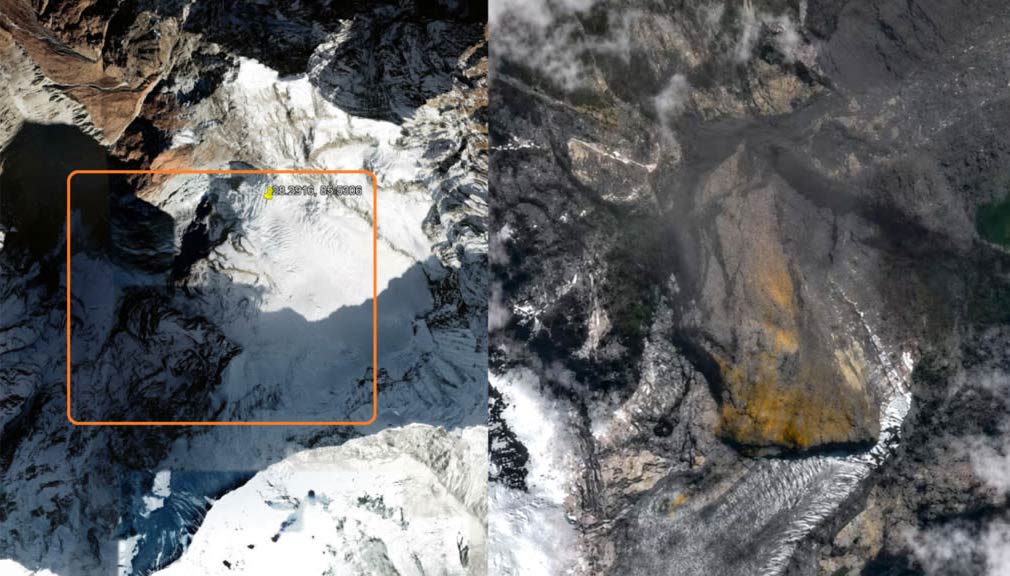
At 8:37 on Wednesday morning, August 26, 2026, the U.S. Geological Survey recorded a magnitude 5.2 event near the Nepal–Tibet border. For an hour, seismologists logged it as an earthquake. By day’s end, scientists at Kathmandu’s International Centre for Integrated Mountain Development, or ICIMOD, concluded something else: the bedrock under a glacier in Langtang National Park had collapsed, and a section of ice two thousand feet across had fallen seven thousand feet into the Lhende Khola, a tributary of the Trishuli River. Anjana Raja, a Bay Area tourist in Rasuwa that morning, told CBS News “it looked like a tsunami, but dark black.”
Along one stretch of the Trishuli, the water rose twenty-seven feet in thirty minutes. Permafrost–defined as soil that stays frozen below zero degrees Celsius for at least two years–holds these mountains together: ice, frozen into the fractures of the bedrock, binds the rock mass. According to ICIMOD’s glaciologists, decades of warming have thawed that ice. Meltwater now seeps into the joints, refreezes, and pries the cracks wider until, as on August 26, the slope fails. By Sunday, August 31, Nepal’s disaster agency counted 788 dead and 2,502 missing; rescuers had brought out more than 8,100 people. The missing include Mount Kailash pilgrims, seventy-three Indian workers from the Trishuli One project, and up to a hundred Americans. President Trump said the United States would send Nepal “any help”: 3.6 million dollars, which only covers up to three months of food for around ten thousand households. From its emergency fund, the United Nations released two million dollars, which only provides three months’ worth of water, medical kits, and shelter.
Nepal produces less than a tenth of one percent of the world’s greenhouse gases. The World Bank puts a Nepali’s carbon dioxide emissions at 0.54 metric tons a year, against 13.62 for an American and 9.32 for a Chinese citizen. How did a country that has been amongst the lowest emitters of greenhouse gases for two centuries come to be the one digging itself out of climate catastrophe?
In 1815, British officers drafted the Treaty of Sugauli, taking a third of Nepal’s territory, rice lowlands included (a tremendous source of revenue for Nepal at the time), pushing the population into the mountains and depriving them of their economic lifeblood. A clause in that treaty deepened the imperial exploitation, giving the East India Company permission to recruit Nepali soldiers. Over 150 years, those recruited soldiers’ pay became Nepal’s largest source of foreign money. It also established a pernicious tradition of sending working-age Nepali men abroad for labor. As a result, Nepal built little and entered the 1950s with almost no factories, roads, or power plants. To build, Nepal borrowed for decades from the World Bank, the Asian Development Bank, and the International Monetary Fund, institutions that target nations working to recover from imperial extraction. As of today, repayment comes from overseas Nepali labor: per the World Bank, remittances made up 26 percent of Nepal’s economy in 2024. The country owes these lending institutions 11.97 billion dollars.
This debt’s stranglehold is now manifesting in Nepal as social unrest and lack of climate change resilience. In September 2025 the government banned social media; enraged, the young marched, many in school uniforms, and police fired live rounds into the crowds. The platforms were where the young had been organizing: against the shortage of work at home, against politicians’ children spending unexplained money. In just two weeks, protesters burned parliament, the prime minister resigned, and seventy-four Nepalis died. Nepal’s youth unemployment stands at over 20 percent, per the World Bank, the resonating effect of British overreach that began in 1815. The only option for many is still overseas labor, which exacerbates the lack of domestic economic infrastructure. In May 2025, 405,610 Nepalis took first-time permits to work abroad. Labor as an exported product is still the economy’s pillar: the country has no jobs for the young, so the young go. Then, the wages the workers send back service the loans from the World Bank, the ADB, and the Fund, rather than shoring up the country’s economic infrastructure.
Since fiscal 2023-24, per the Kathmandu Post, the government has allocated more of its money to debt payments than to the capital budget, which ripples out to affect the country’s climate catastrophe resilience, or lack thereof. Researchers who study these mountains prescribe satellite radar that reads slope movement, sensors on ice, observation stations with backup power, communication lines that survive the first surge of any landslides, mudslides, or avalanches, hazard maps, marked evacuation routes, and settlement sites above the run-out zones. Particularly for Nepal, the draining of mountain lakes that could collapse and flood towns below, as in August 26, was necessary, but delayed in implementation, thanks to the UN funding body’s bureaucracy and policy shifts from the US. Nepal did have a warning system for monsoons: a chain of gauges on the river capable only of measuring rising water over a span of hours, completely inadequate for the enormous downward surge of water that obliterated all gauges in minutes in last week’s flash flood. Several weather stations stopped transmitting or were washed away in the flood, and Nepal does not have radar on its mountain slopes.
China, the United States, and India, three of earth’s five largest economies, emit half the world’s carbon dioxide, per the Global Carbon Atlas. That the smallest emitters suffer worst is a well known fact. What can these three countries do, beyond paltry aid?
All three governments signed the Paris Agreement in 2016; none honored it. The United States left Paris in 2019 and again in 2026, then quit the board of the loss-and-damage fund it pledged 17.5 million dollars to. The US also gave notice this year on the 1992 United Nations Framework Convention on Climate Change. China and India are both graded by Climate Action Tracker as “highly-insufficient” in their climate plans; after American rollbacks, the Tracker also dropped the United States to “critically insufficient”. At COP28, China, the US, and India endorsed tripling renewables, doubling efficiency, and cutting methane by 2030; per Climate Action Tracker, those steps would cut the planet’s warming rate by a third in a decade. Each of these three nations could, and should, write their pledges into domestic laws and enforce them. Whether the increasing manifestations of climate change in their own countries can move the legislative needle remains to be seen.
The United States, the World Bank’s largest shareholder, could push its executive board to write off Nepal’s debt. Under the Heavily Indebted Poor Countries program, the Bank and the IMF canceled 76 billion dollars for thirty-seven countries; Nepal’s amount is relatively small. The Bank already lets forty-five small states pause payments for two years after a disaster; oddly, Nepal is not on the list. What the country now pays the banks could go to satellite radar over the slopes, to ice sensors, and to stations with backup power.
There is also the question of climate refugees. As of today, no country recognizes the climate catastrophe-displaced people as an official category. The 1951 Refugee Convention covers political persecution. The US had one such instrument that could have been used to aid Nepali climate refugees: Temporary Protected Status. The administration, deeming Nepal as no longer environmentally unsafe, terminated Nepal’s designation eleven days before last week’s flooding collapse. Congress could write a climate change refugee category into law, extended to anyone driven by climate disaster from a country emitting under a ton of carbon a person–a legislated right no administration could cancel. Similarly, China has proposed nothing for the people its emissions displace.
On Friday, outside a Kathmandu government hospital, Sunil Acharya, a climate specialist with the nonprofit Recourse, said the countries that caused the crisis “need to urgently compensate for the damage.” Words like “compensation” and “restitution” are not discussed in climate agreements, and no official in Washington or Beijing used it this past week. Nepal will now be forced to borrow, on even more onerous terms, more money to repair what American, Chinese, and Indian pollution have done, and continues to do. This country is hardly alone in its struggle of predatory institutional debt, exported labor, remittances, and lack of economic or climate change resilience: there are several countries that emit even less greenhouse gases that also suffer similarly, or worse. How many more domestic climate change-driven catastrophes will there be in the US, China, and India–wildfires, droughts, flooding–before these nations are moved to act in the world’s greater interest?