
CÉLINE SEMAAN: Thank you so much for taking the time to speak with me. I know the situation in Lebanon is really stressful. How has it been for you as creatives? Can you tell me a little bit about how your life has been since the Israeli occupation of Lebanon started again?
NASRI SAYEGH: Exhausting. It’s been nonstop. I don’t call myself an artist, even if you do… The people working on the battlefield, in the bakeries, they are all also artists, because resistance is an art form. We call on a lot of talent, inspiration, focus, and determination in order to resist. We need a lot of creativity to fight oppression. With Ahmed, I’m lucky to have a fight mate, a soul mate, a dream mate with whom I can share coquelicot (French for poppy, often featured in their photography), with whom I can cry.
AHMED AMER: For me, art is a way to express, to be loud, maybe to be heard, to be an activist. It’s our way of supporting and creating change. I was outside of Lebanon for one week to see my close friend… it was a nightmare to be on the phone with my family, trying to convince them to leave the south, to go to my place in Beirut.
CÉLINE: When you sent me your artwork and the beautiful images, I couldn’t help but feel and know how miraculous it is that our creative spirit is not going to be thwarted in spite of occupation. How did you two meet?
NASRI: I was a witness and a participant in the thawra (the revolution in Beirut in October 2019 that became a massive civil uprising protesting the country’s economic corruption), and one day there was Matbakh al-Balad (a volunteer-driven community that prepares and distributes food to anyone in need)… There was this beautiful “flower” cooking. I took a picture of this man, Ahmed, and sent him the image on Instagram. We met because I was admiring his beauty and activism. I saw him stirring a pot for the people in need, or for all of us, because the matbakh was for everybody during the thawra. We had never met before. It was the beautiful beginning of a love, work, dream affair.
AHMED: That admiration got my attention, and I started to follow Nasri’s work, posts, stories, and music, especially the music. A nice relationship started. I found someone to talk to about feelings, intimacy, love… about my relationship with the city, about myself, and my high level of sensitivity. I felt I could share with this man.
CÉLINE: So, Nasri, you’re a multidisciplinary artist… You’re an actor, a photographer, a poet, a DJ… In your collaboration with Ahmed, are you using all of these skills? And, Ahmed, you’re a designer, an artist, a visionary. How are you using your skills in your work with Nasri?
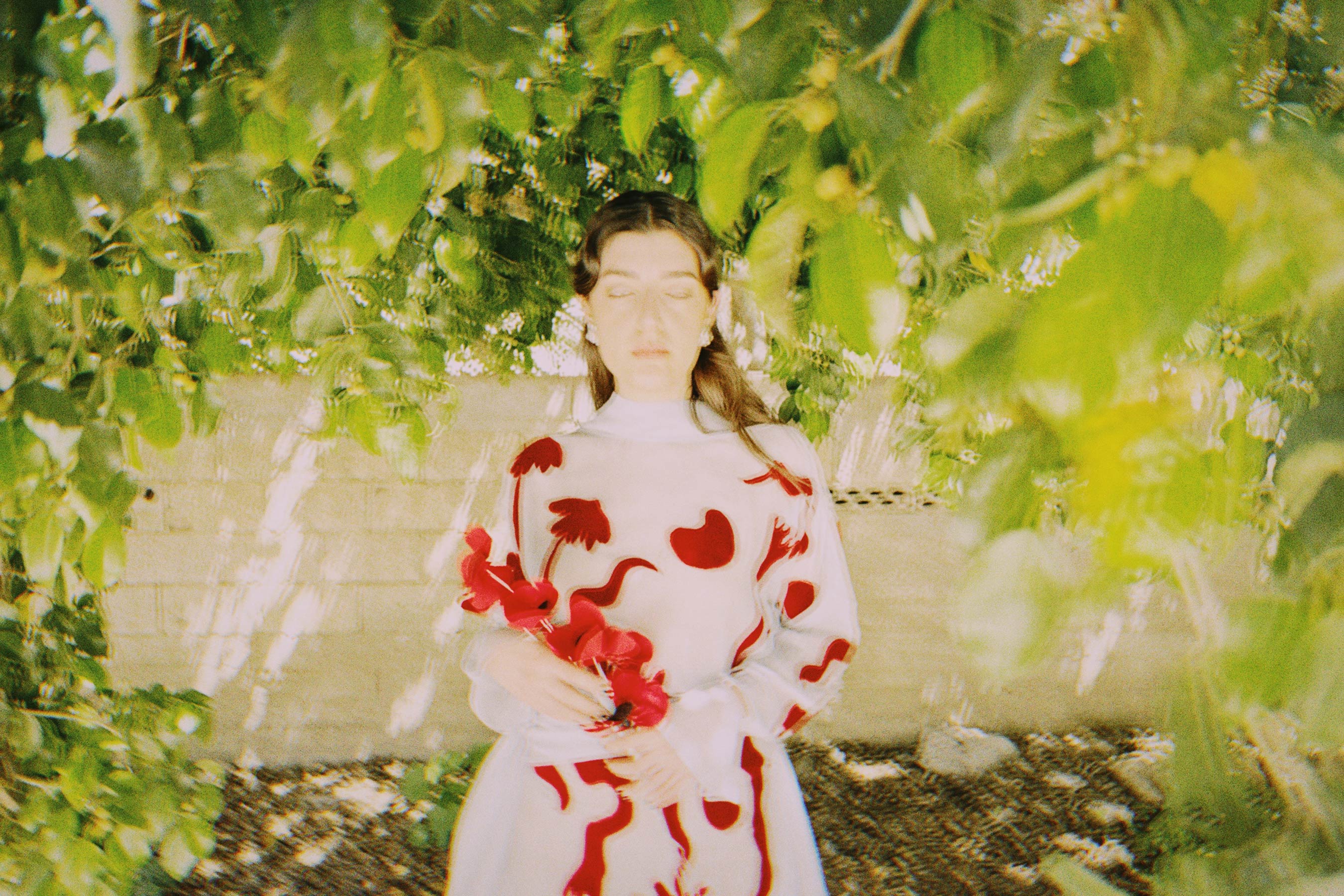
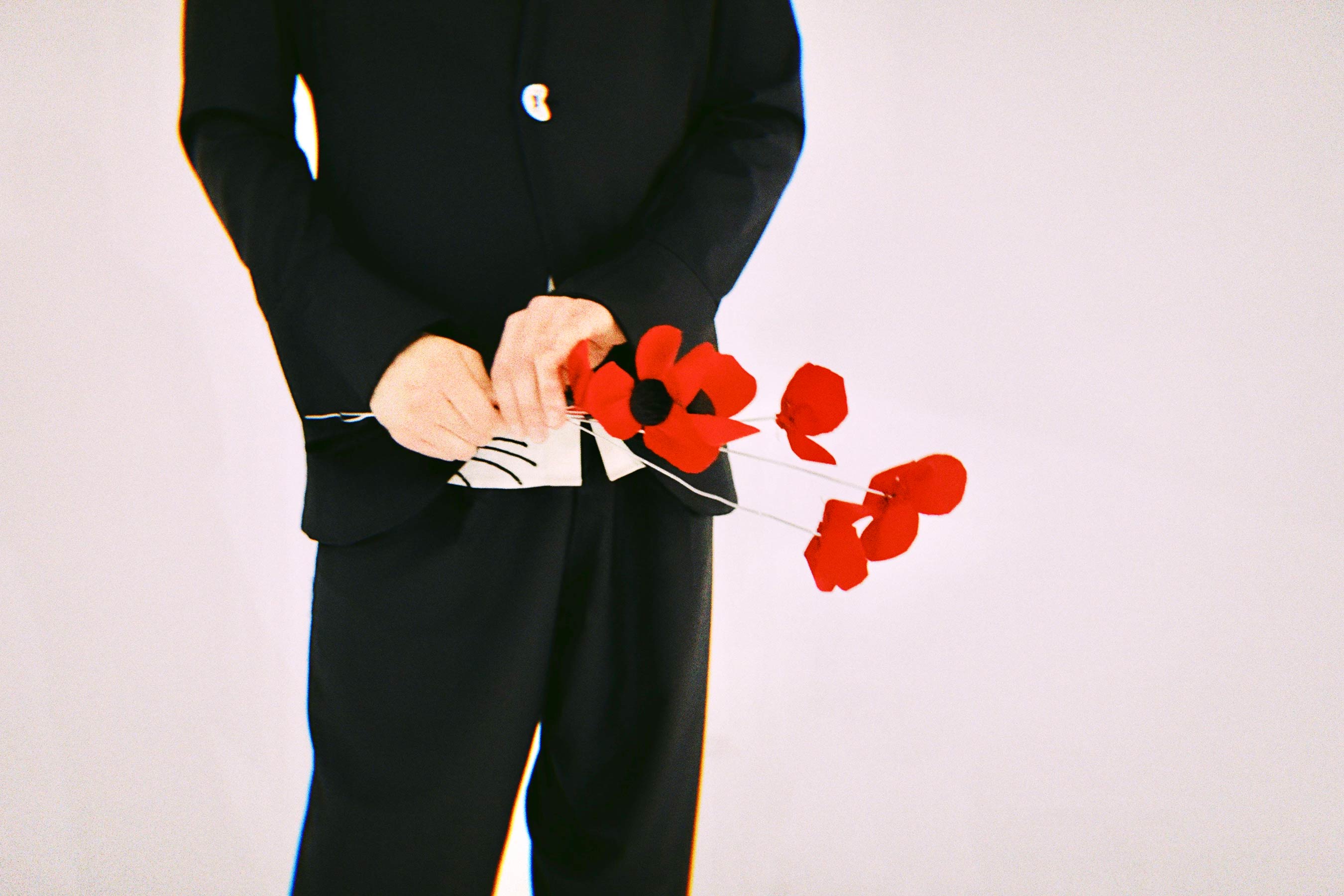
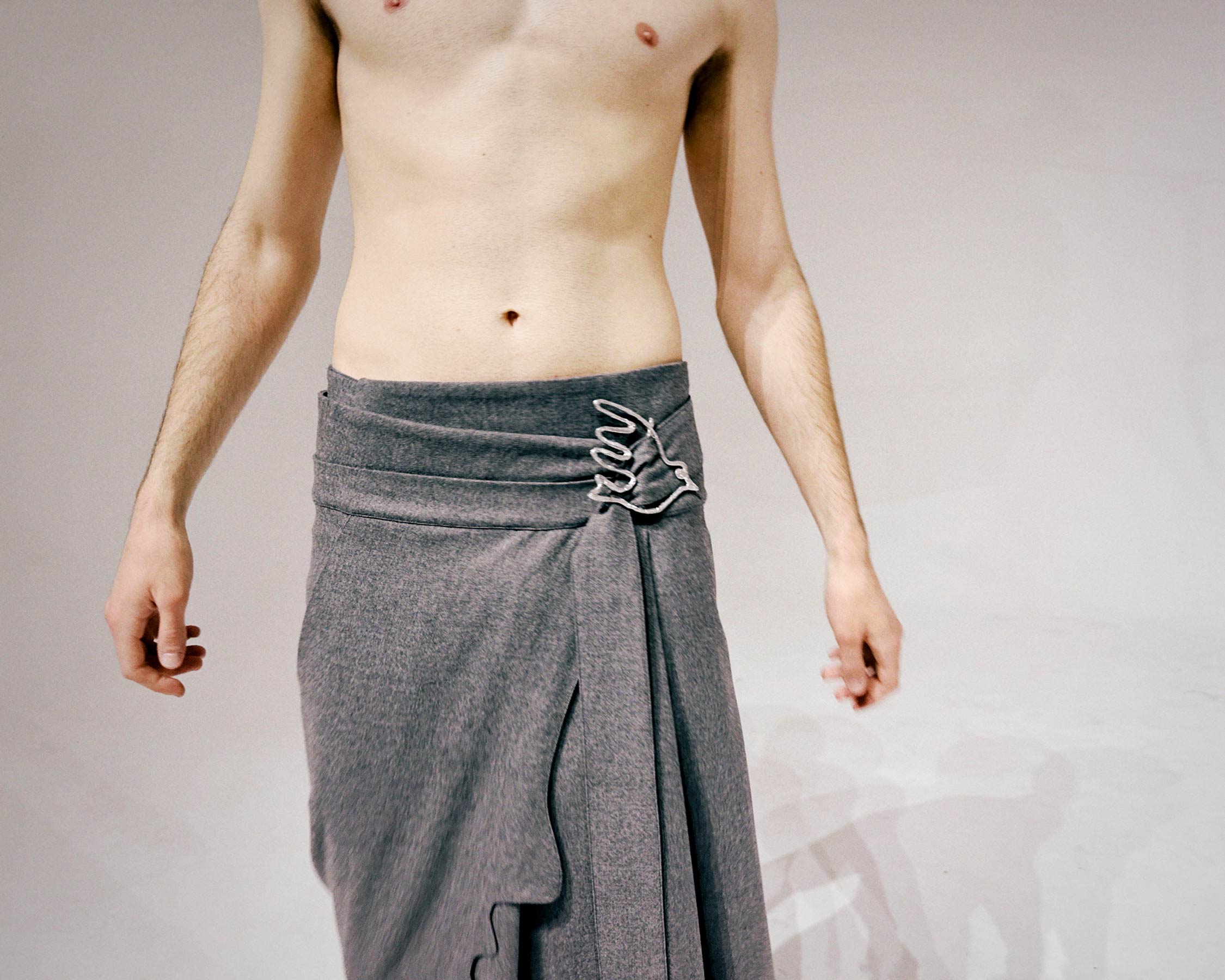
AHMED: I love Nasri’s music because I love his way of expressing himself. I love his images; I love everything… He never sent me a portfolio or proposal. I just believed in his energy, so we decided to do this work. It’s more about trusting the creative process and our vision. That’s the most important thing in this collab. I trust him. For example, the flower, the cochlear coil, the poppy flower… he suggested we do it in a very minimal way, to do a pin of the coquelicot. I’m now using it in my accessories line.
NASRI: It’s all about love… It’s as simple as that. What you see in the images is quite intimate. We don’t explain things; we express them, which is a very rare quality. I’m lucky to have this in my life. Since 2019, we’ve been together. We found ourselves walking through Beirut, walking over shards of glass, after the blast in August 2020 (a massive explosion in the Port of Beirut that occurred after tons of unsafely stored ammonium nitrate caught fire and detonated). I took a few pictures of him, and they’re quite intimate. We couldn’t recognize our faces. It wasn’t about art. It was just a portrait of us back then.
CÉLINE: What does the coquelicot mean to you?
AHMED: The coquelicot, or the Shaqa’iq al-Nu’man in Arabic, is a flower that in the south symbolizes the blood of the martyrs (the persecution and execution of early Christians did not destroy the faith, but instead caused the church to grow). It has a beautiful, very bright red color, and it’s fragile but strong at the same time. The collection started before the war, in January. I was planning to do the collection. I was working on it, and it was about the bittersweet aspect of life… And then the war started again, and I felt like our culture was being erased. So I started to focus on this element, the flower, the coquelicot, and added it to my collection. I told Nasri the story of the flower.
NASRI: It’s the unbearable lightness of being or surviving, and the unbearable beauty of flowers. So beautiful, so delicate, so powerful. The red of the coquelicot is inimitable; it’s always moving, there’s something velvety. When you watch the coquelicot, it says everything about what we are doing. We are all coquelicot. They’re ephemeral but so powerful and beautiful. I go back to our love, our anger. I go back to our blood boiling as we’re being obliterated, but we continue more fiercely than ever.
AHMED: We try to do things, but we don’t know if it’s helping, if it’s changing anything. I’m feeling a bit desperate, but I don’t want to say it, because it’s not my way of thinking. It won’t help me to move forward.
NASRI: The night of the shoot, I took 2000 pictures. And that’s just the tip of the iceberg of what we’ve done together, or of what we’re going to do. When we meet, there’s a spark… very few words, even if we’re very talkative… We talk about many things, but when it comes to what we call work or creation, it just unfolds; it happens. It’s very delicate, and it’s not that comfortable.
AHMED: When we meet, it’s very poetic, it’s very intimate, it’s love.
NASRI: With the models—I don’t like to call them models—with Christophe and Christy, they were like, what are we doing, but in a very nice way. I’m a shy photographer. I don’t know how to take pictures… I know how to take pictures of people, but I get shy. It makes me feel very vulnerable… Christophe and Christy were embracing that moment of unbearable lightness…
AHMED: We were all shy, but we were in the moment, we were feeling it. I saw Nasri playing around, jumping, going outside. Nasri was using the whole space. Yes, I felt the love. I could feel how Nasri was enjoying this shoot. It was a very special shoot, and I told you, Nasri, that I’ve never felt someone who touched my soul, who expressed how I feel. It comes from the collective layers of things we share and the voice we both need to express.
NASRI: It comes from our incurable love and desire for this land, not from a nationalistic perspective at all, but from a thirst for justice, beauty, and style. There’s something in the soil; it’s not mine, but it is. There’s something very sensual about it.
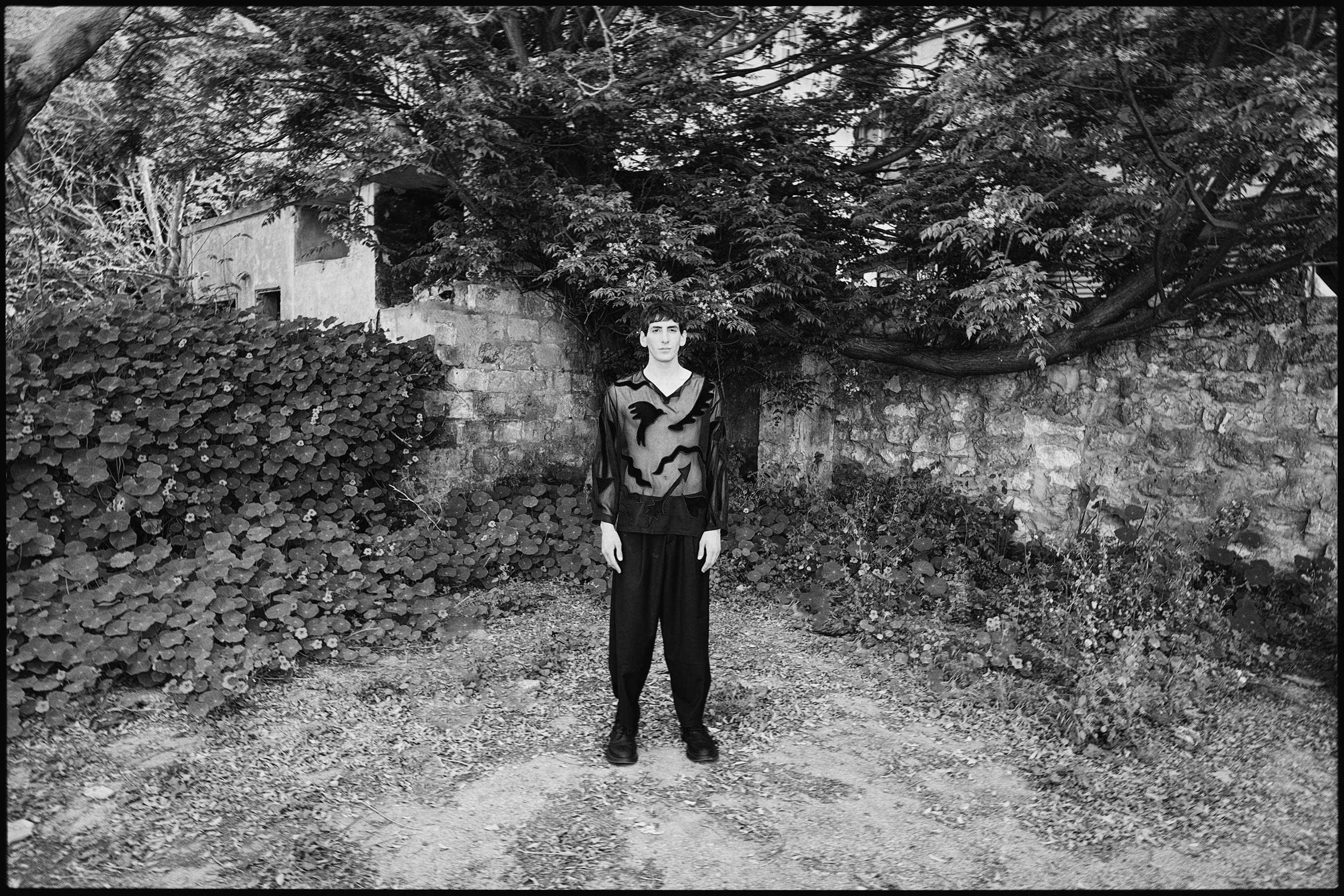
CÉLINE: I want to explore the importance of adorning ourselves, of showing up as our best selves. It’s very deeply ingrained in our culture as Lebanese people. We use fashion as a ritual. What do you think about fashion and the importance of adorning ourselves in today’s climate, where on an everyday basis, an occupying force wants to erase us?
NASRI: More than fucking ever, we need to adorn ourselves. To adorn yourself is to express yourself, is to protect yourself, is to express something. To decorate yourself is to make yourself beautiful, and this is the time to do so.
AHMED: I forget the word fashion, I forget the whole thing related to this industry, which I don’t like. I go into what I’m creating—the feel of the fabric, the feel of colors…
NASRI: Ahmed draws as he breathes, and always beautifully. It goes back to this need, this concern, this anger, this love, because they’re all interlinked. Ahmed creates all the time; we create all the time. We cannot help but do this.
AHMED: I can’t live a day without sketching. It’s my power. It’s the way I exist. I breathe through sketching. Doing art and creating is not a project; it’s how I live, and honestly, it’s not poetic… It’s easier to express through sketching, to sit by myself, designing, creating… It has a different energy, it has a different perspective, a different vision. I need this in my life, to express, to feel, to feel myself.
NASRI: I often say that everything I do now—I’m almost 48—I owe to my inner kid, to little Nasri. In 1982, when I was young, there was an Israeli invasion in Beirut. I don’t call the Israeli military monsters, because I like monsters. Monsters are beautiful, fascinating, and intriguing. I started playing with threads when I was a little boy, and this little boy is still here. I think that Ahmed also has the same syndrome. We allow ourselves to be open to our sadness, and we transform it into something we want to repair. I really remember little Nasri; my inner kid is often present. I thank him for making things, and for staying alert and alive and vibrant and in love. I won’t apologize for using the word love so much, because it’s all about love.
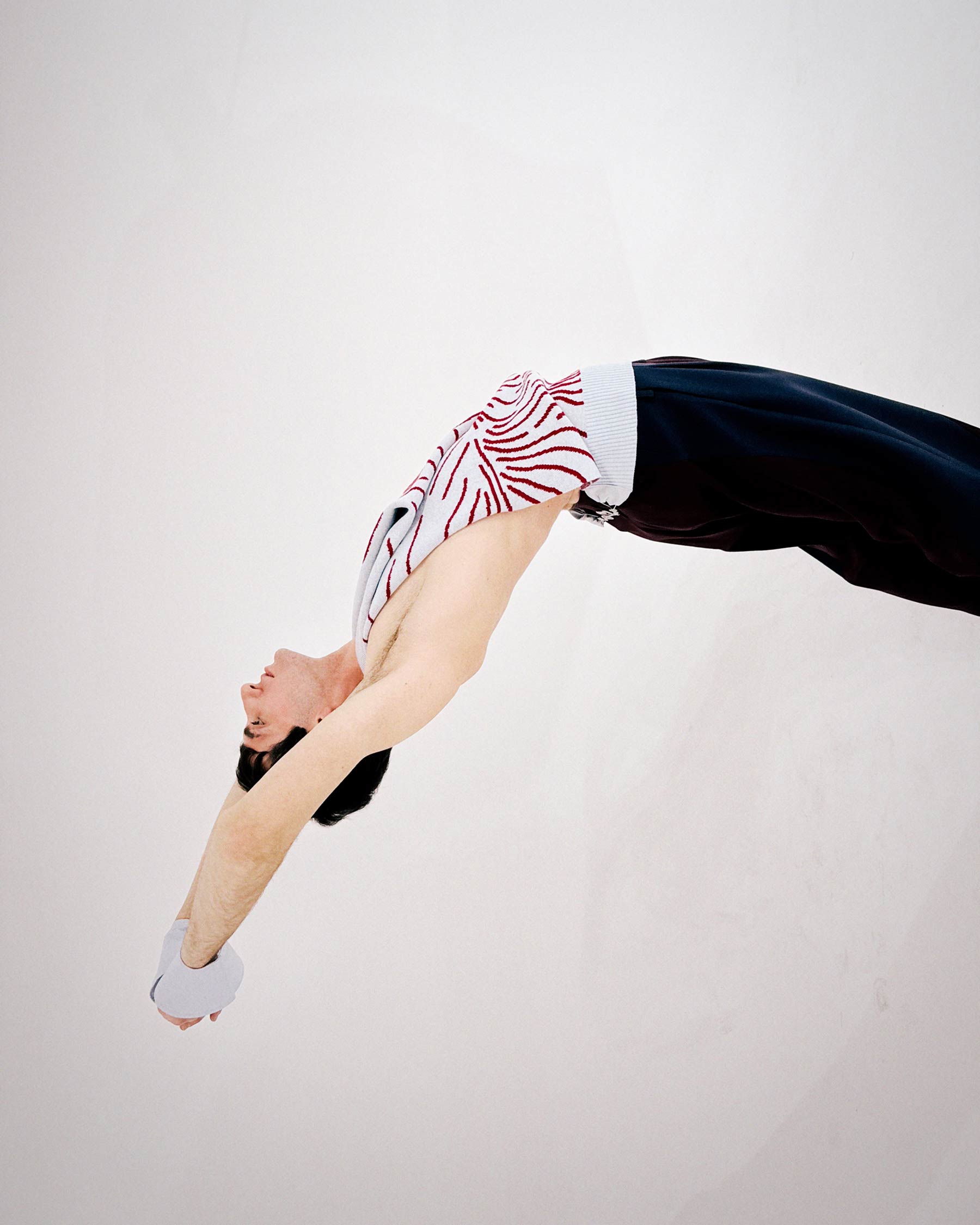
CÉLINE: I also feel like I am working with a broken childhood and the broken child within me. Most of the pain I feel as an adult is healed when I deal with the broken child within me. We cannot comprehend what happened to us when we were children—and continues to happen to us as adults… I want to end the interview with this idea that people watch us from the outside and don’t understand. It’s almost like people want to watch us suffer. They want to watch us crying; they want to watch us broken, but we refuse to indulge them. We keep showing up with art, fashion, beauty, love, and anger—but with a lot more love than anger. I refuse to show up broken. I refuse to give them what they want. Because of that, there is a lot of judgment against me personally. If we are showing a collection, it’s almost like, “How are you making this collection when your world is falling apart? How are you finding it in yourself?” It’s a backhanded compliment. “Why aren’t you broken? We’re watching your people burn. Why aren’t you crying and broken?”
AHMED: I’m broken, and I’m expressing how I’m broken. I want to express this, and I want to show my vulnerability. I don’t want to hide behind something strong, behind something steady. I’m this fragile human now. That’s also my strength. I can share my broken side, and this will help others to share theirs as well. I know most of us are broken, and most of us have had disappointments. Why not share this together? Why not talk about these things? Why not build an emotional culture? I think we need more emotions in our lives. We need more sensitivity. I think it’s not about being strong. Sensitivity is really important because people can relate to it, even if they don’t know or live our experience.
NASRI: It’s also related to the depth of our roots; we’re very rooted to this soil. That makes us stronger in love, stronger in all things. I’m broken, yet I smile. I’m broken, yet I laugh. I’m broken, yet I adorn myself. I’m broken, yet I’m beautiful. What’s more beautiful than the laughter of the people from Gaza? Their olive trees are decimated, uprooted, but they’ll never uproot our smiles, our beauty. We are showing up adorned and adored.
AHMED: I’ve lived my whole life in the south with the same thing happening since the day I was born in 1993. We’re living the same wars, with the same enemy occupying our land. Nothing has changed. My way of living is creating.
CÉLINE: Thank you for this healing conversation. Even though it sounds absurd that we continue to find beauty despite bombs, ongoing war, and occupation, this is how we live; this is our life. People don’t understand it, but I think by showing them these images… they’re just so beautiful.