
The same week I began my PhD, I traveled to Berlin for Soft Power Festival to unveil Memory as Archive, a large-scale mural made from photographs of the Lebanese Civil War placed alongside images from my own family archive: photographs of my mother, my father, myself as a child, ordinary family gatherings and ordinary moments that were never intended to become historical evidence. The photographs were found in a shoebox among the debris of our home after it was bombed in 1984 shortly following a special family gathering. My grandmother returned after the fire had subsided to recover the few belongings that remained. I had been thinking about the work as an exercise in looking backward in the rearview mirror of my life, a way of bringing the intimacy of personal memory into conversation with the present situation of ongoing war and Israeli occupation. The images through which a country and a war enter collective memory, but standing in front of the finished mural in Berlin, I was struck by something I hadn’t anticipated. I could no longer tell, emotionally or visually, where the past ended and the present began. Seeing my giant mother holding me and my sister made me really emotional. I was fighting through tears for the entire show.
There are children playing on the remains of war, families gathered around hospital beds, smoke rising over landscapes, parents holding their children close. There are also birthdays, dinners, cars, sunglasses, dresses, vacations and all of the unremarkable evidence of a life being lived while history is happening around it. Looking at these photographs now, as Lebanon is once again living through bombardment, displacement and the destruction of homes and villages, the images will not to stay where I had placed them in time. What I thought I was assembling as an archive of the past began to look disturbingly like an archive of the present. I found myself unable to identify whether these images were taken today, or thirty years ago. Perhaps this is what an archive can reveal when we allow it to exist outside the chronology of history books and display it outside of institutions. It shows us that history does not disappear simply because time has passed; it settles into families, landscapes, political structures, bodies and imaginations, sometimes becoming so embedded in the architecture of the present that we stop recognizing it as inheritance. This week, during my first sessions of my PhD program, we read the haunting text by Korean scholar Cho G.M describing a powerful metaphor she uses, yanggongju, in Korean folklore. It describes the ghost, the trauma, stories untold within a culture. In installing the mural, it felt like working with ghosts, those who were immortalized in Magnum Photos, generously given to me for this installation, the ones I had collected from my own archives, coexisting to tell us their story. While we believe we are responding to what is happening now, often, we are moving through memories, fears, borders, categories and unresolved histories that began long before us.
“During the same period in which this scholarly work was being produced, the arts community of diasporic Koreans took up the subject of the yanggongju and militarized prostitution, particularly in film and fiction. Many of these works were partly autobiographical and questioned the writer’s or filmmaker’s own family history and uncertain relationship to the yanggongju.” Cho, G. M. (2008). Haunting the Korean diaspora : Shame, secrecy, and the forgotten war. University of Minnesota Press.
This perspective has followed me into the beginning of my doctoral research, where I am interested in ancestral practices of imagination and world-building, and particularly in what communities that have survived colonialism, displacement, war and ecological rupture already know about constructing possible futures. I began with imagination, because I wanted to understand how we create what does not yet exist and not be limited to being a space of constant criticism, but I am increasingly realizing that the question of the future cannot be separated from the question of memory. Before we can ask ourselves what kind of world we are capable of imagining, we may first have to understand the world that has been imagined for us, the histories we have inherited, the stories through which we learned who we are, and perhaps most importantly, the stories that were absent.
Another text that has given me a layer of depth when it comes to archives and intergenerational work is the text by David Scott, where he shares a series of deep interviews across different generations, in his text: “The Temporality of Generations: Dialogue, Tradition, Criticism”,
I quote:
“What interests me is the prospect of a way of practicing a relation to the past in the present that disposesses criticism of its presumption of sovereign distance from its worlds of engagement by taking the critic to always be generationally located in various intellectual traditions.”
An archive is never the totality of what happened. It is a selection of what survived and how we understand it based on our own socio-political context, of what someone photographed, what someone wrote down, what an institution deemed worthy of collecting, what a newspaper decided to publish—and as we can attest, how they decided to word it, matters. What a family carried when they fled, what a grandmother repeated so that her grandchildren could tell the story themselves out loud, and what another grandmother ner said out loud. This is why archives are inherently political. They do not simply preserve history; they participate to construct the boundaries of what future generations will understand history to have been.
I know this intimately, because much of my relationship to Lebanon has always existed between memory and archive in a constant violent interruption of everyday life, affecting both my memory and my body holding said memory. I was born into war and displacement before I had the language to understand either, which means that some of what I call memory is almost certainly more complicated: a photograph I have looked at hundreds of times, a story told by my mother, a fragment inherited from my father, an image whose edges have blurred into my own recollection. Eventually, it becomes impossible to distinguish between what we remember ourselves and what has been remembered into us. During the Soft Power Festival, I met Kurdish artist Havîn Al-Sîndy who was speaking on the same panel I was, exploring language and power. Havîn is a biologist who has studied trauma, and how trauma transforms our cells, memories and organs. Her focus is on organ theft, primarily during Saddam Hussein’s regime where he was harvesting kidneys from Kurdish communities, against their will and forced to give their organs to the regime, only to sell them back to Europeans. In discussing with Havîn, she mentioned that as a biologist, she observed that once memory is spoken out loud, it transforms on a cellular level. Once I heard this, I immediately asked: “Well, does this mean memory is fiction?” She nodded.

One of my favorite texts this past week is Zoe Todd’s “An Indigenous Feminist’s Take On The Ontological Turn:‘Ontology’ Is Just Another Word For Colonialism”, and I quote her here:
“The dispossession wrought by centuries of stop-start chaotic colonial invasion and imposition of European laws and languages is ongoing.” Perhaps here lies my obsession with memory, never as an objective recording device, but as a portal towards the past. It is a living archive, constantly rearranged by the present. We return to the same event at twenty, forty, sixty and find something different waiting for us there, not because the event has changed but because we have. A generation inherits the archive of another generation and reads it from an entirely different political moment. This is where memory becomes difficult, and therefore politically important as it is the artifact of history providing a blueprint for the present, or at least a lesson or an explanation.
The more I think about the archive, the more I wonder whether our obsession with establishing a singular account of history is itself part of the problem. Perhaps history is less like a line and more like a mosaic, made from fragments that do not always agree with one another and whose meaning changes depending on how closely we are standing to them. Up close we see individual lives, memories, injuries, contradictions; from farther away we begin to see structures, repetitions and relationships that no single fragment could reveal on its own.
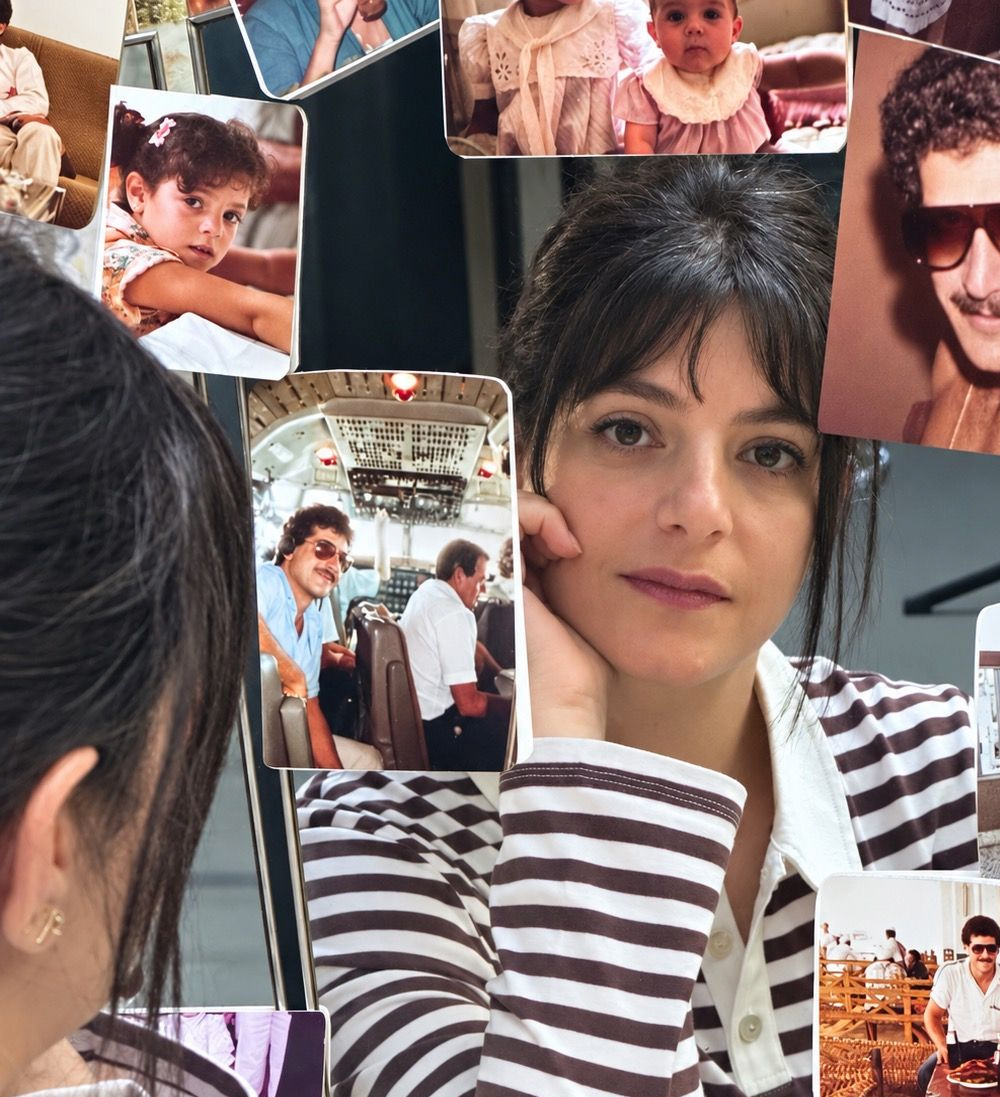
This is what I was unknowingly constructing in Berlin responding to the curators who had invited me to visualize in a mural my memoir A Woman is a School. The public archive of war sits beside the private archive of the family because neither is sufficient on its own. The war photograph can show us destruction, but it cannot tell us everything that was destroyed. For that we need the family photograph. We need the birthday, the kitchen, the ridiculous sunglasses, the child climbing onto furniture, the mother holding her daughters. The historical archive tells us that a war happened; the intimate archive tells us what a war interrupts.
And somewhere inside this mosaic is the question I am carrying into my PhD: What happens when we look backward not to remain captive to history, but to understand what we have inherited—and how that inheritance shapes what we are able to imagine for the future? Because perhaps the most consequential inheritance is not memory itself, but imagination. We inherit ideas about what is possible alongside ideas about what has happened. We inherit borders and enemies, hierarchies and identities, stories of belonging and stories of exclusion, ways of understanding power that can become so familiar we mistake them for the natural order of things. A society can continue reproducing the architecture of an old war long after the people who fought it are gone because the architecture has migrated into institutions, language, culture and imagination.
If that is true, then looking backward becomes an essential part of designing possible futures. The past contains a blueprint for what should come next, with that I invite awareness to offer us the possibility of recognizing what we have inherited before we reproduce things unconsciously. We can examine the archive and ask not only What happened? but: What possibilities did it make unimaginable? And which forms of knowledge, care and survival did our ancestors develop that we might need again?
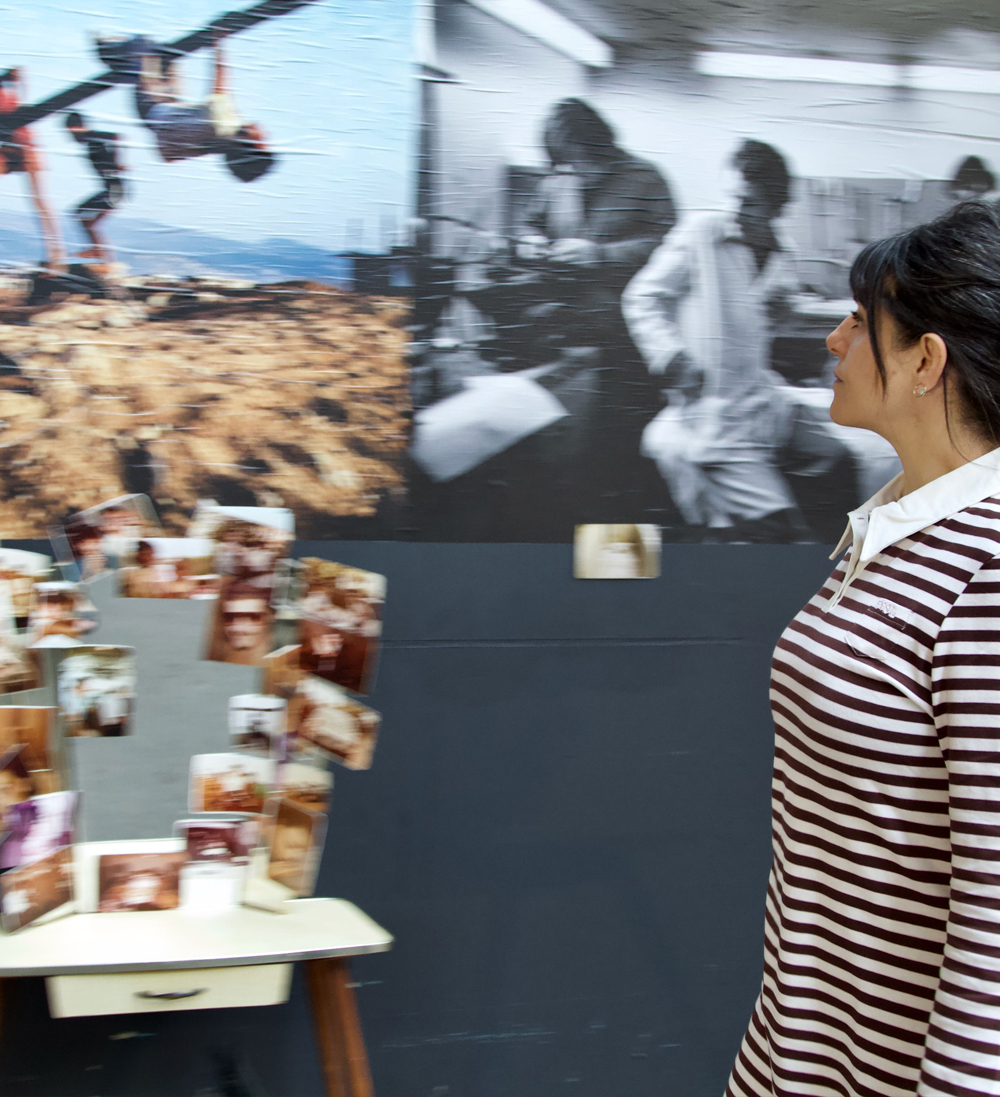
At the center of Memory as Archive is a mirror surrounded by photographs from my family. I originally understood it as a way of bringing the viewer into the work, bridging the distance between the person observing the archive and the lives contained within it. But standing before it now, I understand the mirror differently. Everything surrounding it is fixed: a photograph has already been taken, a moment has already passed, a war has already happened. The mirror is the only image in the installation that has not yet been determined. It changes with every person who stands before it.
Maybe that is where the future lives in an archive somewhere beyond the past, carried in the present through the person looking at it.
Gratitude to Magnum Photos who generously worked with me on this mural, particularly Isabella Howard.