
Author Elena Dudum on how Abdelrahman ElGendy’s HUNA, like all revolutions, is driven by a love deeper than love for the self.
I came across Abdelrahman ElGendy in a thumbnail. A small headshot cramped amongst other headshots of writers who had won the 2024 Courage to Write grant with The De Groot Foundation. In the winter of 2024, I clung to victories that were not mine. I searched for spaces that were openly supporting work by outspoken Arab writers. No, no, no. Not outspoken: unafraid. Those who didn’t care if they rubbed readers the wrong way or lost opportunities that were within arm’s length. I was searching for writers who saw past the facade of structures and systems and thus the illusion of safety. I did not know at the time that the writer I was looking for, the writing I desperately needed to find refuge in, would be found in that small thumbnail.
To read ElGendy’s poetic debut memoir is to recognize, achingly, the gaps between who you think you may be and who you actually are. There has already been so much praise for Huna, and rightfully so. Not only does it deftly carry the reader through six grueling years in prison (three alongside his baba), but it lays bare the cruel paradox of loving your country and people while fighting the foundations of the regime that tyrannizes them. ElGendy—this brilliant, hungry boy, and soon this miraculous man—grows up before the reader behind bars, passing his time by teaching himself engineering so not to fall behind in his university studies, while also tutoring other prisoners in English and Arabic. As readers, we sit alongside ElGendy as he pontificates well past lights out with cellmates who quickly become soulmates, their conversations circling the poets and singers of the Arab world: Mostafa Ibrahim, duo Ahmed Fouad Negm and Sheikh Imam, Aly Talibab, and Rim Banna.
Anger is not what ElGendy leaves me with. What he offers instead is love.
Whenever I put the book down, I’d find myself hours later thinking about ElGendy, trapped in his cell. Depending on when I folded the page for a reading break, he may have been surrounded by his contraband books, letters, perhaps even a smuggled radio whose shoddy signal, if finangled just right, might give way to a Taylor Swift song. I wondered if his mama would be able to visit soon, what she might sneak into a pair of rolled socks, small treasures that kept ElGendy going long after visitation hours. I couldn’t shake the image of his baba, reading the newspaper and taking long naps to pass the days away. I worried about his health, his blood pressure, as if he were my own father. I kept returning to this book, to read just one more chapter, because if I didn’t return to ElGendy and his story, it felt possible he’d remain locked up in prison. I needed to see him free.
As a Palestinian born and raised in America, I have heard too many times, from well-meaning white people, that the Arab world is simply ‘a mess.’ As if that mess arrived on its own, unconnected to the governments that armed, funded, and excused its dictators. As if it has nothing to do with the countries that call themselves the Free World. Ultimately, when I finished reading Huna, I was angry. Here was this miracle of a boy, and then a man, who grew up in prison and earned an engineering degree, but more than that, taught himself what it means to remain human beneath the weight of contradictions: to love your people and your world even as it tries to spit you out. Nothing about him was a mess. Despite the unbearable circumstances, the injustice, the absurdity of bureaucracy, ElGendy proves himself unbreakable. Between chapters, we see intimate letters written from his time in prison to family and friends, and through them, we glimpse a man staying whole while the hands of the regime endlessly work to tear him apart. And now, just days after a National Book Award longlist nomination, I know ElGendy is still in exile: forced from Cairo, and then forced from the US after ICE made clear his arrest was only a matter of time.
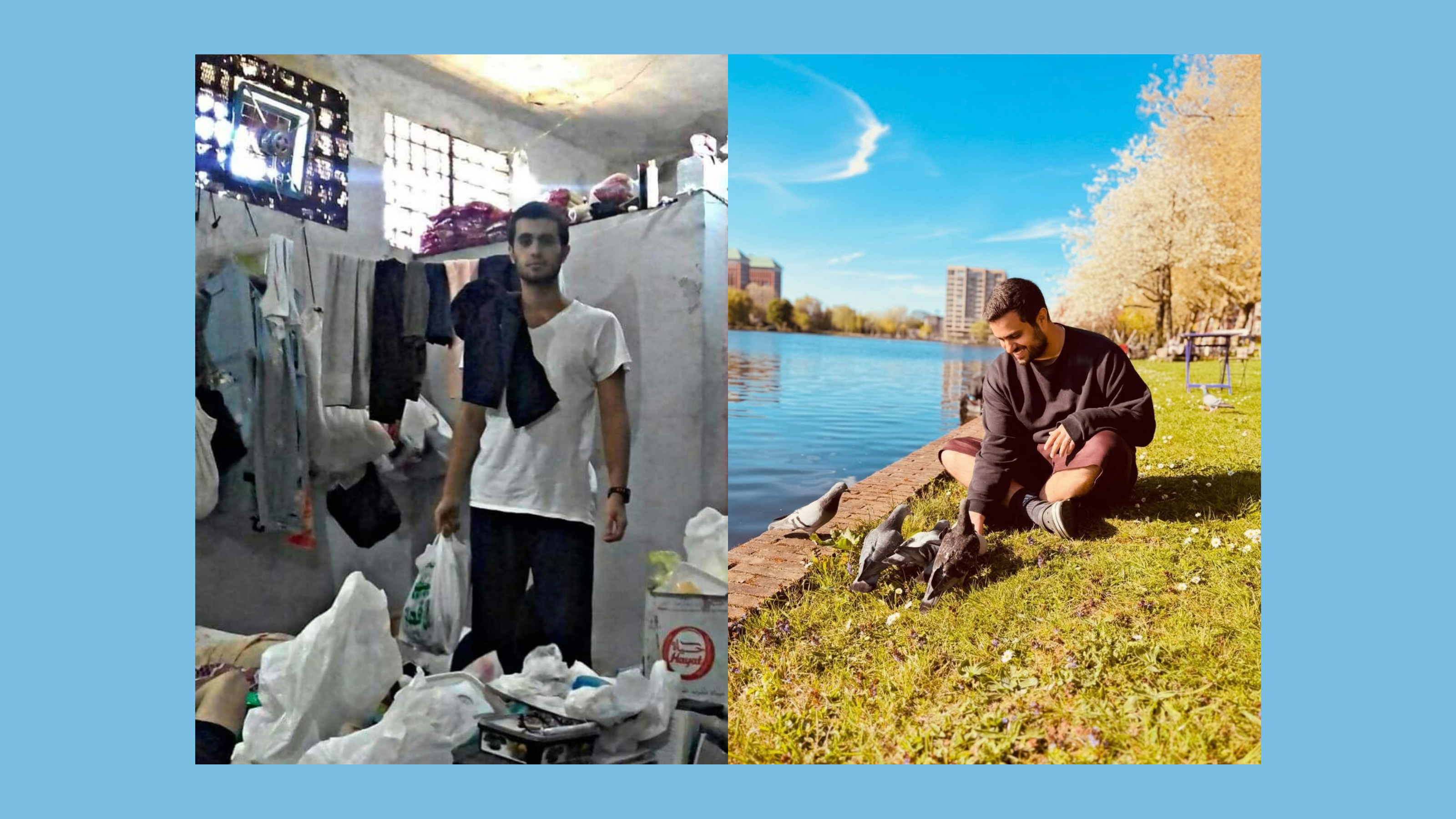
L-R: ElGendy in prison; ElGendy today
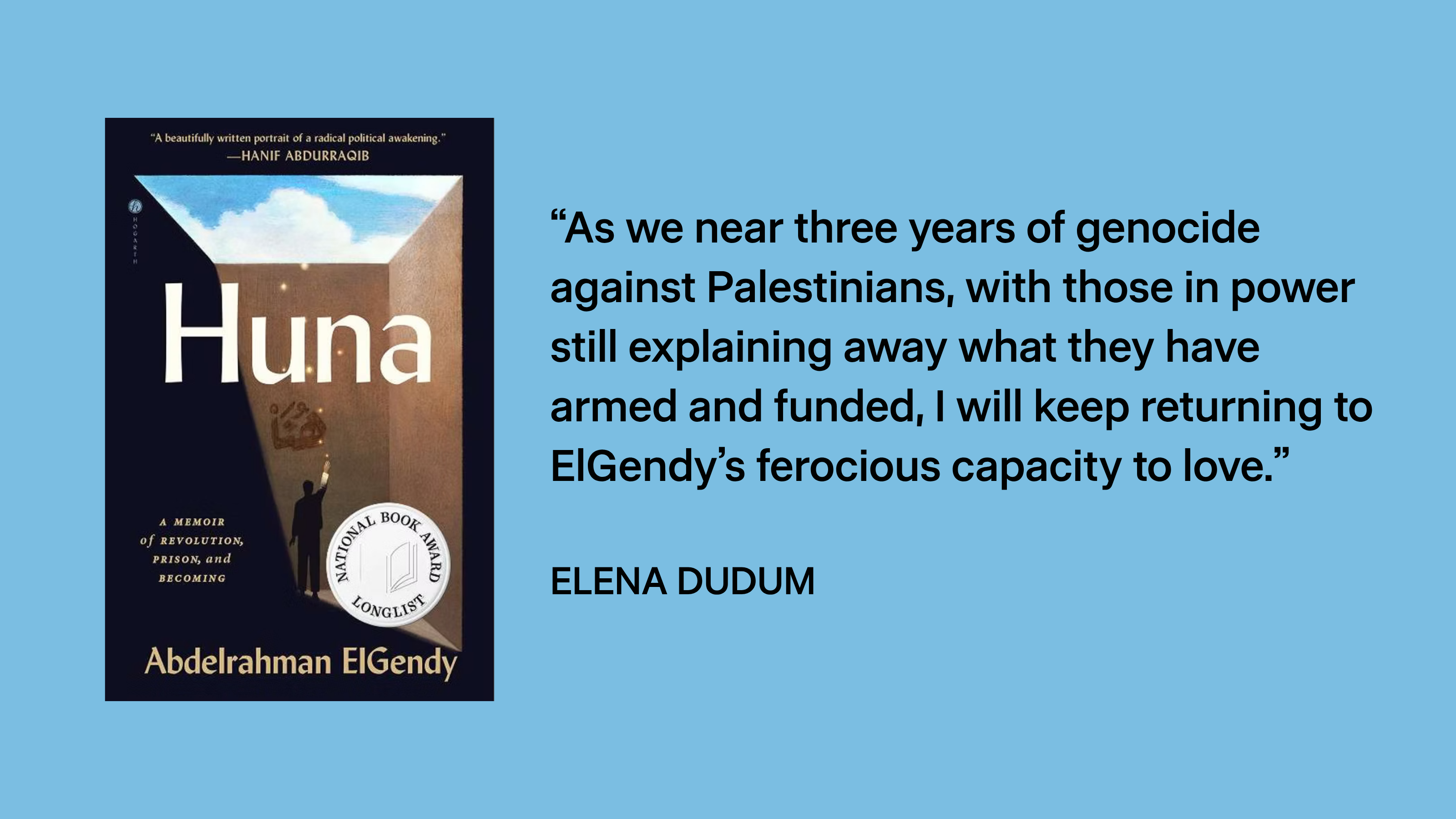
Even so, anger is not what ElGendy leaves me with. What he offers, instead, is love. And unlike the vague notion of hope, love is neither soft nor fleeting. It is the very foundation of the revolution. Or perhaps, it is the revolution: love for the father in the cell beside him, even when impossible, to look him in the eye; for the mother and younger siblings waiting for visitation rights, for cellmates who become family, for a country that keeps refusing to love him back. As we near three years of genocide against Palestinians, with those in power still explaining away what they have armed and funded, I will keep returning to ElGendy’s ferocious capacity to love.
Rage alone cannot hold us. Staying tender, crying with laughter, pressing one’s face hard enough against the small sliver of a window to glimpse the sky, smiling for a camera you are not meant to smile for—ElGendy’s heart is not a consolation. It is the refusal to submit, and it is the antidote we need.
HUNA is out now with Penguin/Hogarth.
Elena Dudum is a Palestinian-American writer whose work has appeared in The Atlantic, TIME, Cosmopolitan, and Bon Appétit, among others. Her debut memoir, They Told Me Back Home Would Be Beautiful, is forthcoming with One Signal/Atria in October 2026.