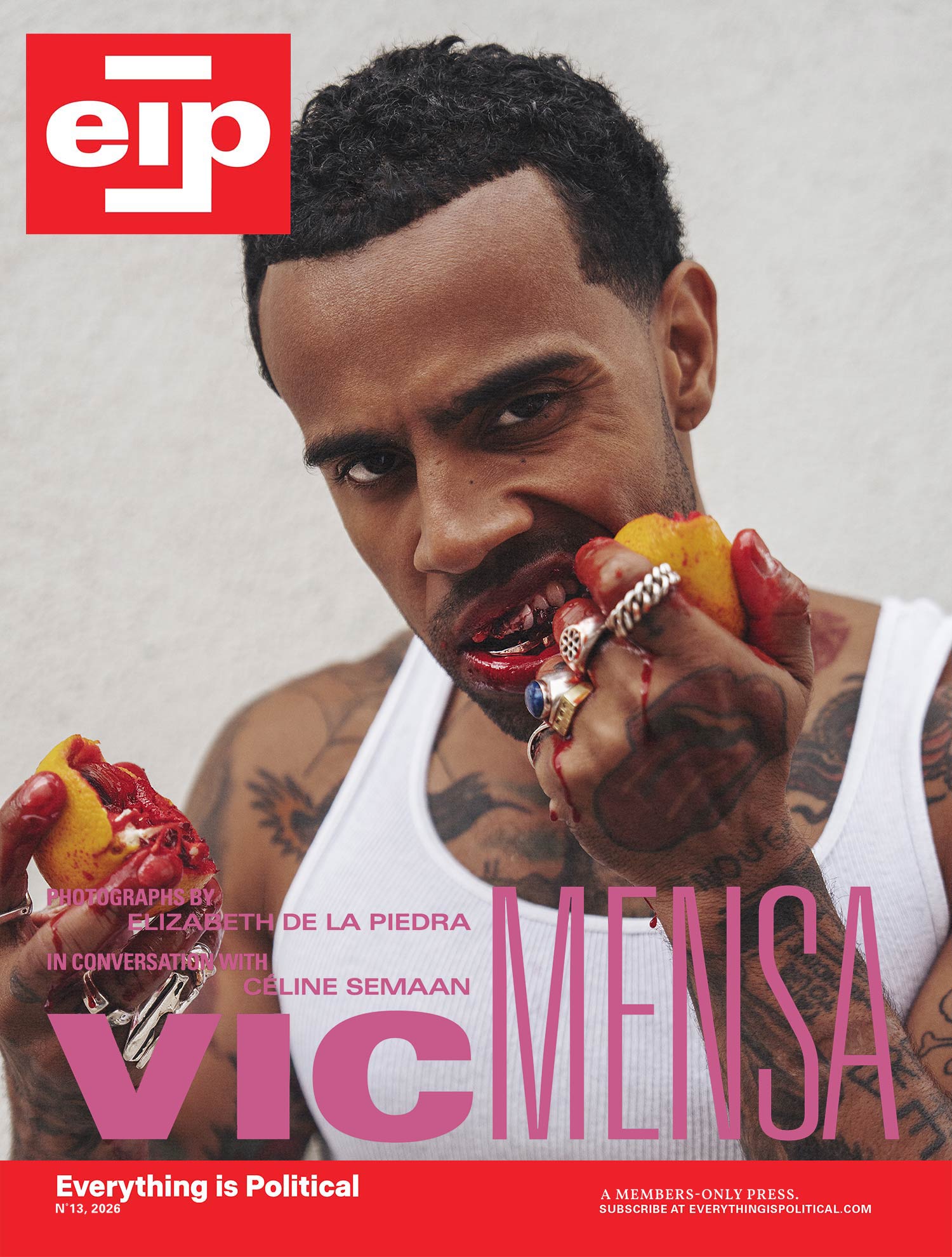

When artist and writer Molly Crabapple set out to research the Eastern European Jewish Labor Bund–the revolutionary, socialist, and unapologetically anti-Zionist movement that swept through Eastern Europe from the late 1800s until 1945–she found herself captivated by its central tenet: doikayt, or “hereness.” It is the concept that Jews have a legitimate right to social equality where they already live and do not need to emigrate to a Jewish state. It was a conviction so foundational that the Bund’s rallying cry became “Here where we live is our country.” That phrase is also the title of Crabapple’s sweeping historical book of the movement, now a New York Times bestseller.
“I always felt that when the Bundists said, ‘Here where we live is our country,’ there’s an implied ‘motherfucker’ at the end,” Crabapple chuckles, speaking with renowned Palestinian scholar and author Tareq Baconi. “Like, here where we live is our country, whether you fucking like it or not.”
In this conversation, Crabapple and Baconi explore why her book has struck such a nerve right now, what the Bund can teach us about collective action today, and how the act of imagining the lives of those we’ve lost opens up new ways of remembering them.
This interview has been edited for length and clarity.
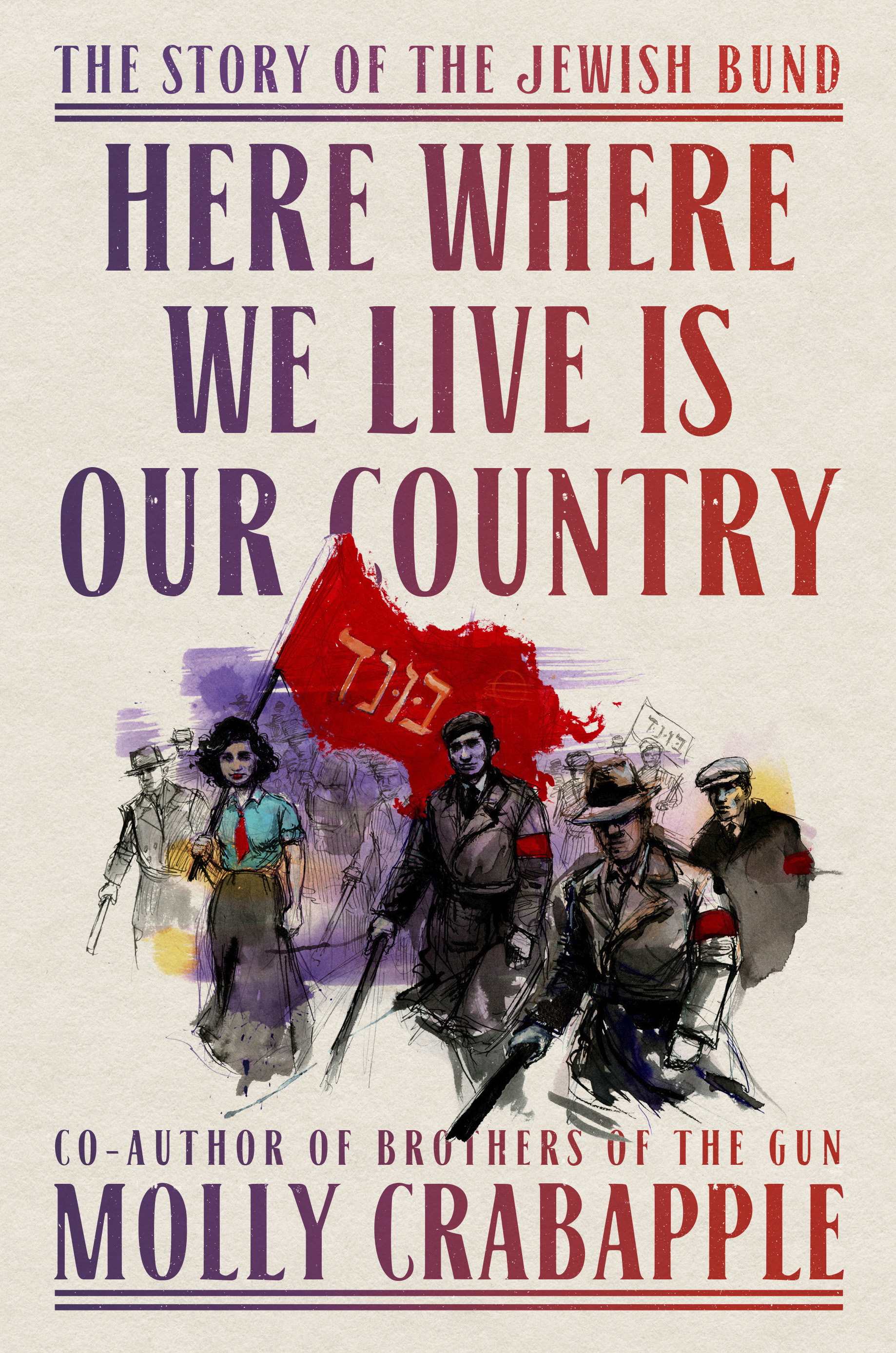
Courtesy of Molly Crabapple
TAREQ BACONI: I want to start by saying I love this book. I think it’s politically very resonant, powerful, and really important at this moment in our time. I know you’ve been working on this for years. So what does this moment feel like for you?
MOLLY CRABAPPLE: Thank you. Tareq. I’m over the moon, honestly. When you research a book like this, it’s very lonely. You’re spending all of this time in archives. reading stuff that often is very boring and trying to find that one bit of detail, one depiction that you can take and put in your book. To finally have my book out in the world and have it resonate with so many different types of people—my heart is so full.
[Earlier in April], Eman Abdelhadi and I did an event at Pilsen Books in Chicago. It was standing room only. We had people of so many different ages. We had people who I think were in their 80s. We had people who were like 19 years old. We had people who were really into socialist organizing. And then we had people who were hipster art girls who liked my memoir, Drawing Blood.
TAREQ: Is this something you would have expected? This cross-section of age, politics, and geography?
MOLLY: I wanted to write a book that was rigorous about history, but that would be read by people who didn’t usually read those types of books. I feel like reading about history is everyone’s birthright.
I think a lot of times with Jewish history, there’s a tendency to section it off into its own little box. But Jewish history belongs to world history! Just like Black history or Palestinian history or Puerto Rican history—the world is interwoven. I didn’t want my book just to be for Jewish readers.
TAREQ: I agree with you, and I want to talk about the book in its internationalist framing. But the first question I wanted to ask you was specifically about Jewish history. You’re bringing up the history of [the Bund]—this revolutionary, socialist, internationalist movement. You’re bringing up a movement that’s anti-Zionist at a time when Zionism is, paradoxically, both at its weakest in terms of its ideology and at its strongest militarily and in terms of the devastation it continues to cause. So the resurrection of this Jewish history has incredible resonance today. What do you think the Bund is showing us today about this paradox that Zionism finds itself in?
MOLLY: One of the things that all fascist movements strive to do—and Zionism is very much a fascist movement, as it is now—is that they try to present themselves as inevitable. They try to present themselves as hegemonic, and they try to present themselves as the only possible way things could’ve been in the past, or will be in the future. Right now, anyone with a decent heart looks at the live-streamed genocide of Gaza and looks at the unspeakable violence and destruction that Israel is unleashing and is disgusted. And anyone who starts to do a little bit of research will realize that this psychopathic violence of the Zionist state is not an anomaly. Zionism is a form of ethno-nationalism, and all ethno-nationalist ideologies rely on mass murder at the end, whether they’re in Serbia or whether they are Zionists inflicting it on Palestine or Lebanon.
The greatest crime that Israel and Zionism have committed is the destruction of human life. But another thing that it’s always been extremely invested in is colonizing Jewish history—in pretending that, in between the destruction of the Second Temple and 1948, there’s only ashes and hell, and that Zionism is the only possible answer. That to be a Zionist is to be a Jew, and to not be a Zionist is to be a traitor. I think that one of the reasons that my book is hitting such a nerve amongst Jewish people is that, for a long time, many Jewish people have had a void of thinking about who their ancestors were and what their actual history is. What my book has done is it’s given them back their ancestors.
TAREQ: We’re also living in a global reality of American decline, but also at the time of American extreme power, both internationally and domestically. I think it has resonances with the Russian Empire and with some of the things that you’ve been playing with in your book. I wonder how you think about the struggle for anti-fascism today. What does a Bundist politics look like today when we’re thinking about some of these interconnected struggles, whether it’s capitalism, the never-ending wars, anti-immigrant politics, and so on?
MOLLY: One of the things I always return to with the Bund is how they made this irresistible counterculture in Poland that did not just appeal to people who were graduate-student-pilled, theory heads. They appealed to people from every walk of life. Maybe you were a bro that really liked soccer; the Bund had something for you. Maybe you’re into theater, maybe you wanted to just go to cool dances and pick up hot chicks. They made this world that was so appealing, and that was so effective. And they also confronted this sort of polycrisis of life in Poland, which was impoverished, racist, and violent. They tried everything. They had an electoral program. They ran people, and won, for city council. They had militant unions, and they often used general strikes as a tool to fight back against state repression. They had this very rich, thick social life with sports clubs, summer camps. and youth movement, women’s movement, theaters, newspapers–a full world.
They also believed in armed self-defense. I read the memoirs of Bernard Goldstein, who was the head of their militia. He has this weariness of an older man who’s seen so much violence and done so much violence in his life. He doesn’t glorify it, but neither does he shun it. He puts it in its place as a tragic necessity.
I also think about the fact that the Bund was very rooted in place—not just in Poland or Russia writ large, but like, their blocks. I read about the Bund’s block-by-block organizing on Krochmalna Street, for instance, which was a really rough street in Warsaw. And when I think about some of the more successful efforts in self-defense against fascism, I think about those block-by-block organizations in Minneapolis. They were able to figure out who’s an immigrant who needs food in their house because they can’t go anywhere. Or which way does the street go, so people can bring their cars and blockade ICE out of an area? How will neighborhood groups communicate with each other on Signal threads? This is a very intimate local knowledge that you need to have.
I think about how if you want to fight back, you need to really know the place you’re in.
TAREQ: Yeah, absolutely. And you know, when I first read your book, and I saw the title of it, I thought that was such a revolutionary title because you can read it on many levels, but it is really a call to belonging and a refusal to assimilate, to be moved, and to be told you don’t belong. How did you come to this title?
MOLLY: It’s actually a famous Bundist slogan. It comes from an election poster when they were running for the Constituent Assembly in Kyiv in 1918. It has like this guy screaming on the cover in that old school Soviet constructivist style. So often, what the Bund is talking about is “hereness.” And often that’s not an easy thing to say in Eastern Europe. They were saying it in defiance of this highly racist society that wanted nothing but to kick them out, a society that racialized Jews and saw them as these eternal, poisonous foreigners.
It really reminded me of the Palestinian concept of “sumud,” of steadfastness, because everything in Eastern Europe was trying to uproot Jews, and these Bundist communities were saying, “No, this is our land. This is our country, these are our streets, and we’ll fight for them.”
TAREQ: Absolutely. One of my favorite bits in your book is when you describe the meetings between the Bundists and the [Russian socialists] Leninists–when the Leninists are coming in talking about internationalism and the Bundists are also talking about internationalism, but wanting to hold on to the particularities of their Jewishness. That often gets lost in our conversations today. How do you hold that tension: of the particular and the collective? How do you think about it today in terms of nationalism, in terms of organizing?
MOLLY: I think in some ways, I have a really good model of what this looks like. When I think about the campaign of Zoran Mamdani, I think about how he was able to speak to everyone from conservative Bengali mosques in Queens to really hot trans girls at Three Dollar Bill. He did not demand that anyone change anything about themselves. And he spoke to each of these communities as they were. He also spoke to them both as workers and as people who needed the city to work for them. Yes, these are people who are very different, who speak very different languages, who have very different ethos, who worship in different ways, who dress in different ways, who have different customs. But they’re also all working people who are trying to survive in this brutal meat grinder of a city.
In the case of the Bund, there was this idea that, if you were a Jew or another national minority in the Russian Empire at the turn of the century, you should change your name to something that was Russian, speak Russian and not Yiddish, and assimilate into the dominant culture. That’s how you would be a good revolutionary. And the Bund was like, “No, actually, we can have a multicultural society where people speak different languages, dress differently, and have different cultures—and yet you can all be socialists fighting together.”
TAREQ: There’s something that you’ve talked about in the book that I thought I found very powerful, which is when you’re met with the line, “Oh, well, you know, this is all well and good, but the Bundists were killed.” You very correctly and astutely say, “Well, actually, they were defeated. It’s not that they failed; it’s that they were defeated.” I wonder if you wanted to expand a bit on this. What does defeat look like? Especially at a moment of such reductive imperialism and fascism, it’s really scary. I think about this in the context of Palestine all the time. How do you hold on to a struggle in view of genocide?
MOLLY: Every day, I get hundreds of messages from Zionists with the most violent gloating about the deaths of Bundists in the Holocaust. I think, in general, for Jews at large, maybe in an unexamined way, we’ve absorbed the fact that, because the Bundists were murdered, they’ve failed. That their ideology was bullshit. Even when I was writing this book, I had this hidden hope that I could figure out some way that Jews could have done something to have saved themselves collectively. And the more I researched, the more I realized that that was actually a ridiculous idea. The Nazi war machine was the most brutally effective war machine of its time. It was a war machine that had pushed the Red Army to the gates of Moscow. It would probably have taken England if America hadn’t entered the war.
The idea that Jews, a small minority, could have stopped the Nazi war machine–how inane was that? So I started thinking, why did the Jewish community in Palestine end up safe? It was not safe because of its own military abilities. They were safe because [Palestine] was occupied by Britain. And the British military was able to stop [German general] Erwin Rommel at El Alamein in Egypt. And if the British military had not stopped Rommel at El Alamein, then the Nazis would have ruled over Palestine, and the Jews in Palestine would have been murdered by the Nazis. So it was really contingency that saved the Jewish community in Palestine. And I became revolted with the idea of basing your ethics and your political imagination on historical contingency.
The truth was also that the Bund was defeated not just by the Nazi war machine, but also by the racism of so many Polish people. Their humanism was defeated by a Western world that was indifferent to the plight of Jewish refugees, as they have been so indifferent to so many refugees. And I think that when groups or countries that are powerful display this extreme hypocrisy about universalist ideals, it creates an opening for violent supremacist ideologies to come in, like Zionism. They promise strength. They promise the victimized the opportunity to become strong. And if the world does not want these violent supremacist ideologies to emerge, then the only thing that prevents us from that barbarism is this universalist human solidarity.
TAREQ: I’m dying to ask you a couple of questions about your process and your work in the archives. You’re clearly a scholar who’s managed to delve into the archives and completely hold on to your humanity and your politics in the writing. Your voice is very present in the book, and it’s a way to dispel this notion of the so-called “objective scholar”–this colonial mentality that the scholar is removed from their politics. I wonder how you’ve thought about this?
MOLLY: I’m not an academic, and when I was starting this, I didn’t have the methodology that a historian would have. I was just like, ”I’m going to read everything and see what comes out of it.” I was going to read every book in all the languages that I could read, which, at that point, was French, Spanish, and English. Then, I was like, I need to speak to the Bundists in their own language. If I were writing a book about the Bund and I refused to learn Yiddish, I would be a jackass.
So I took two summers with the YIVO, a Yiddish summer program, which is a very rigorous program. where very grouchy, older people will make you learn to read it. No corners will be cut there. I read so many Yiddish books. I read letters. I read newspaper archives, some of which are text-searchable in Yiddish, but most of them are not. I had my friend Sophie Hurwitz literally sit and twirl the microfilm and take photos of every single article that had certain words in it because I wanted to be able to read those articles later. I found this Bundist anti-Zionist tract called “What can we learn from the events in Palestine” that was not digitized, I think, partly because it’s so anti-Zionist. I read a lot of memoirs, including a lot of self-published family memoirs, like [Bundist revolutionary] Sophia Dubnow-Erlich’s. Her memoir was published not by a big house; it was translated and published by her son as a gift to their family.
I also made really sure to read books by Bundist enemies. You cannot take a political movement’s word for things. You need to see what people who disagreed with them said. So I read Bolshevik stuff. I read the Warsaw Yiddish Zionist Daily Haynt, which was very critical of the Bund in the ‘20s. They were like, “The Bund was an Arab party, not a Jewish one.” [Laughs]
I spoke to a lot of people, elderly descendants of the Bundists like Irena Klepfisz, a pioneering lesbian poet, and the union leader Mark Erlich, who was the grandson of Henryk Erlich, the Bund’s leader in interwar Poland.
I even did kind of crazy things. I went to Ponar Forest, which is the forest where the Lithuanians murdered the entire Jewish population of Vilna and buried them in these massive pits. It was where Pati Kremer, one of the main characters of my story, was murdered. In biographical dictionaries, they said that Patty Kramer, before she died, led the women who were around her in singing the Bund’s anthem, the “Di Shvue.” She said, “Let’s sing ‘Di Shvue,’ so death wouldn’t be so terrible.” I went there, and there are these giant pits. They’re so big. You can’t even figure out which would have been the one where she was murdered. So I just went to one, and I played “Di Shvue” on my phone, and I laid flowers for her. I visited people’s graves, and I took like graveyard dust, and I would burn candles in front of it. I probably did an insane amount of work.
TAREQ: That’s incredible. I think part of what’s made this history so accessible is that you’ve brought all of your humanity into it. That’s what makes the characters relatable. But also, that’s what makes you present in the book. You’re sort of crossing time in a way, bringing us back that history to our present. So the final question I want to put to you is that often scholars, when they go to the archives, they’re thinking about being loyal to what the archives are saying and what they’re not saying. I’m thinking about Saidiya Hartman, where she talks about this idea of allowing yourself to imagine and read between the lines. In her case, it’s imagining all of the souls who perished as a result of American slavery and racism—imagining their lives. You do that with some of your revolutionary characters. I wonder what that felt like for you, giving yourself permission to imagine?
MOLLY: Saidiya Hartman is a huge influence for me. Her book, Wayward Lives, Beautiful Experiments: Intimate Histories of Social Upheaval, was revelatory for me. I’ve given it to so many friends. And yeah, it gave me that permission. A lot of times, what I would even try to do is imagine being in people’s bodies. I remember I was taking a train from Daugavpils to Riga in Latvia. And I knew that Sofia had smuggled pamphlets on this train. I knew that [Bundist leader] Vladimir Medem had ridden this train. I thought of the Latvian sunlight in the summer, and it has this different quality, maybe it’s because it’s so far north.
Vladimir Medem was blond. I tried to imagine what it would look like when your eyelids are half closed, like if you’re looking through your lashes—what that would look like if my eyelashes were blond and the sunlight was hitting them.