
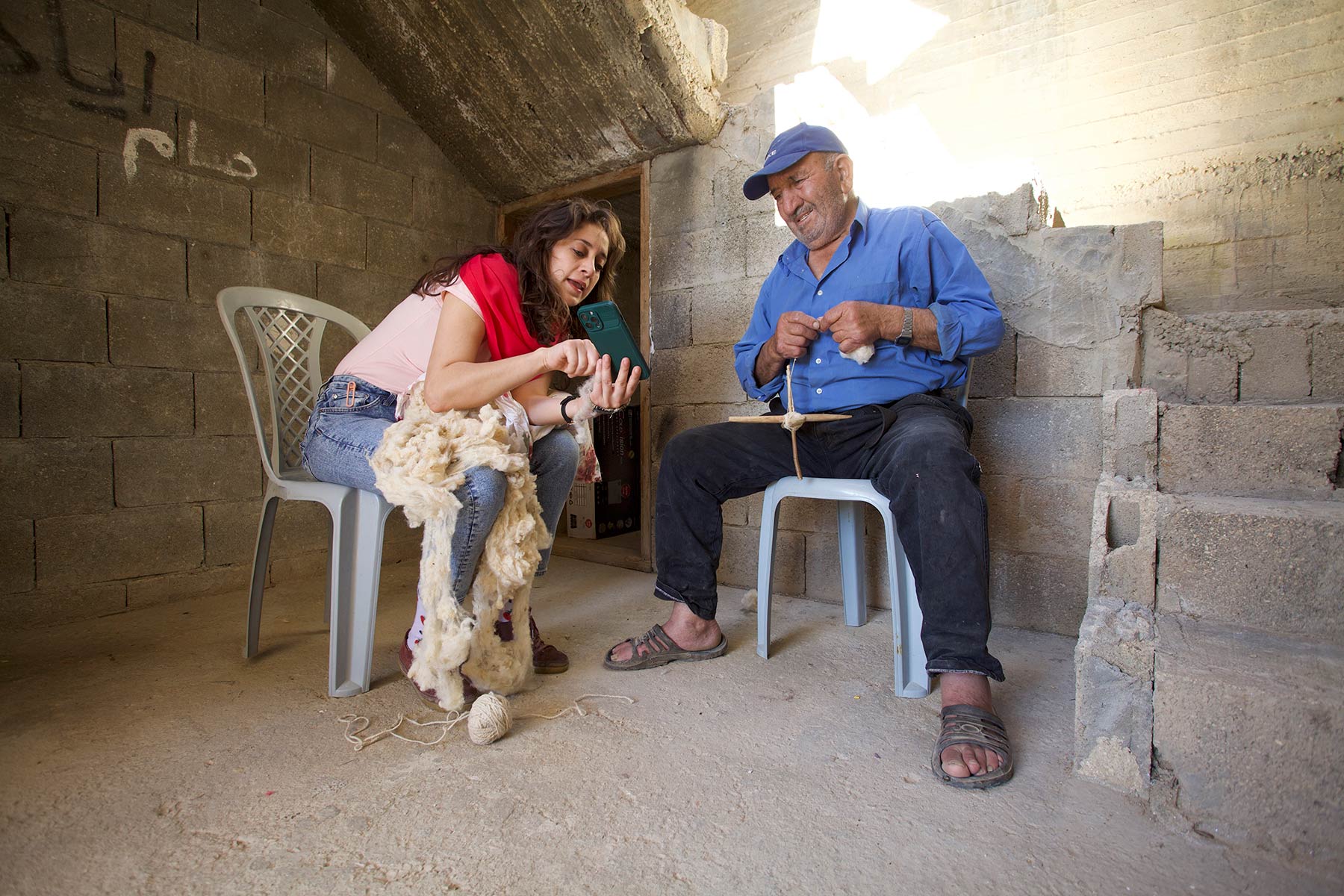
Lara Salous with shepherd Rajeh Al-Essa at his house in Mughayer village where he shows her how to use the Palestinian traditional drop spindle (Ghazzale). Photo Credit: Raof Haj Yahya
To Lara Salous, the disappearing art of wool weaving needs a revival. “The loom is a tool that’s now endangered in Palestine,” says the 37-year-old Palestinian artist and designer, who called me from her studio, nestled in Ramallah Al-balad, the old city, in the occupied West Bank. She’d spent the morning packing art frames, throws, and short stools that customers in Norway and Canada ordered from her home decor brand: Wool Woman.
“It’s more of a network rather than a company that controls everything,” Salous explains of Wool Woman. Behind the brand is a delicate, sometimes precarious, web that connects Salous to shepherds and wool spinners in Palestine—too often at the mercy of Israel’s siege of the area. Abu Saddam Traifat, a Palestinian Bedouin shepherd who Salous sourced her wool from, for instance, spent years tending to his Indigenous flock of Awassi sheep in al-Auja, Jericho, washing his harvest of wool in the vital water spring. All his sheep are now gone, as are the majority of Palestinians in the area, because Israeli settlers, accompanied by the Israeli army and police, stole all his sheep in the middle of the night.
This, Salous explains, is just one case of how Israeli control and violence affect the area. “In al-Mughayer, a village near Ramallah, I interviewed three shepherds,” she says. “When I visited them the last time, it was just after the settlers burned 30 houses, including one of the shepherd’s homes.”
Recent reports by Al Jazeera confirm that Israeli settlers have annexed the entirety of al-Auja spring, forcing out and blocking water access to Bedouin herding communities like Traifat’s, who have resided in the surrounding areas since before 1967. Throughout 2025, settler violence against Palestinians soared to record devastation across the West Bank. In October alone, there were over 260 violent attacks, leading to deaths, injuries, property damage, and stolen livestock. As Israel’s genocide on Gaza and occupied Palestine rages on, Salous’s Wool Woman feels more crucial than ever to archive and celebrate Palestinian culture and identity.
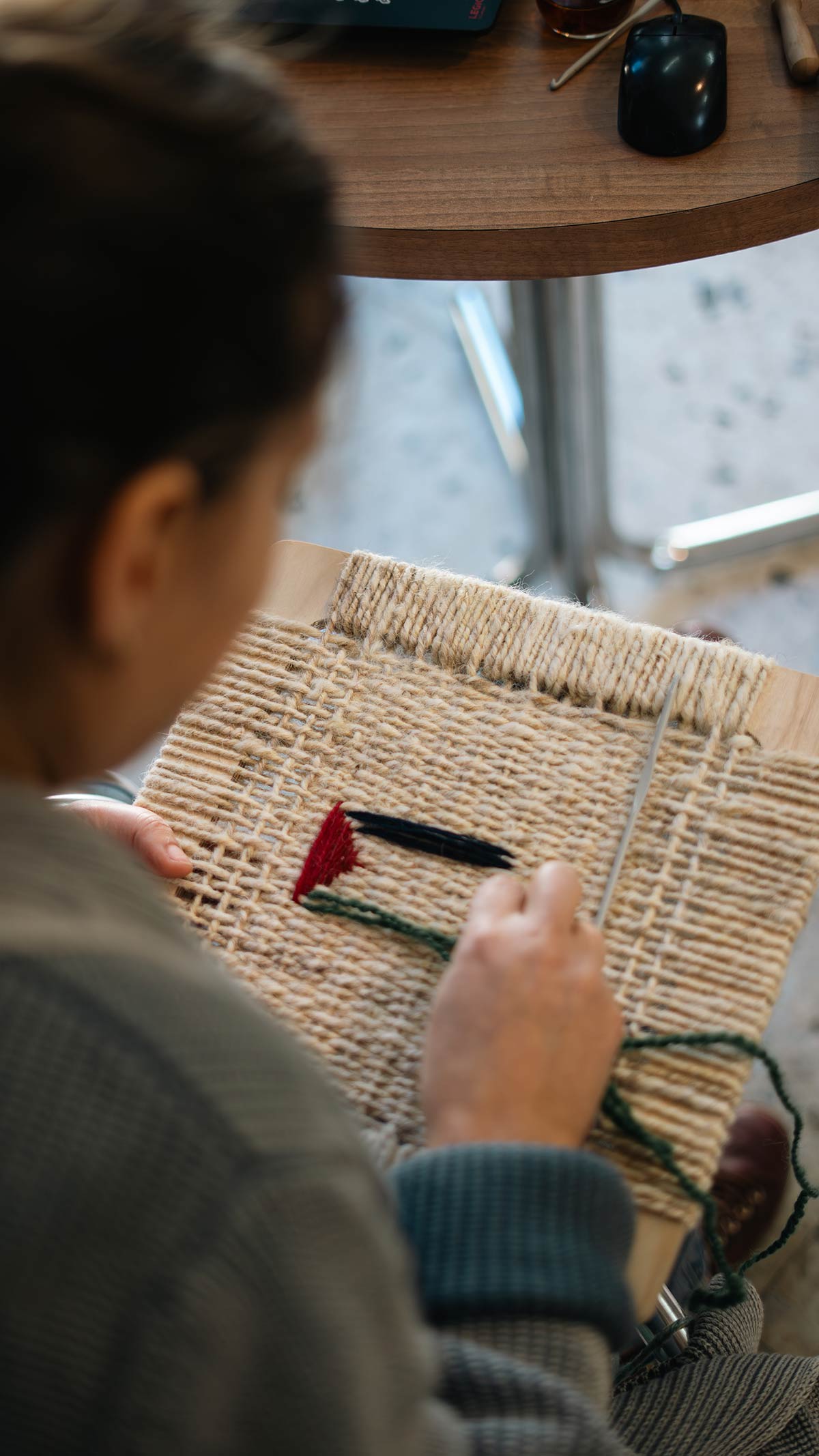
Lara embroidering the Palestinian flag with wool on a woven frame. Photo Credit: Mahmoud Abdat
Salous traces Wool Woman’s inspiration back to October 2020. At the time, she was teaching an architecture and design course at her alma mater, Birzeit University, near Ramallah, and participating in a workshop investigating historical, cultural, and personal ties to the making of Palestinian rugs. It was on a field trip to visit Bedouin communities in Khan al-Ahmar, whose rug industry was once integral to the area’s economic livelihood, that Salous was struck by the absence of rugs and the wool used to make them. She learned that shortly after Al Naqba, the tribe fled harassment in the hills south of Hebron, leaving their homes and belongings, including the livestock and wool. But even in their new location, Israel encroached upon the Bedouin community’s lives, limiting where they could graze and raise their sheep, eventually making wool production nearly impossible.
“Something started to spark in my mind; I began questioning what was happening to this industry or to this craft,” Salous remembers. “The [Bedouin women] showed us one [rug] that they preserved in a wooden box, which is used for celebrations or weddings.” I asked them, “Why don’t you make them anymore? They said, ‘It’s so hard to maintain a living from sheep because we are in a daily struggle with the Israeli settlers.’”
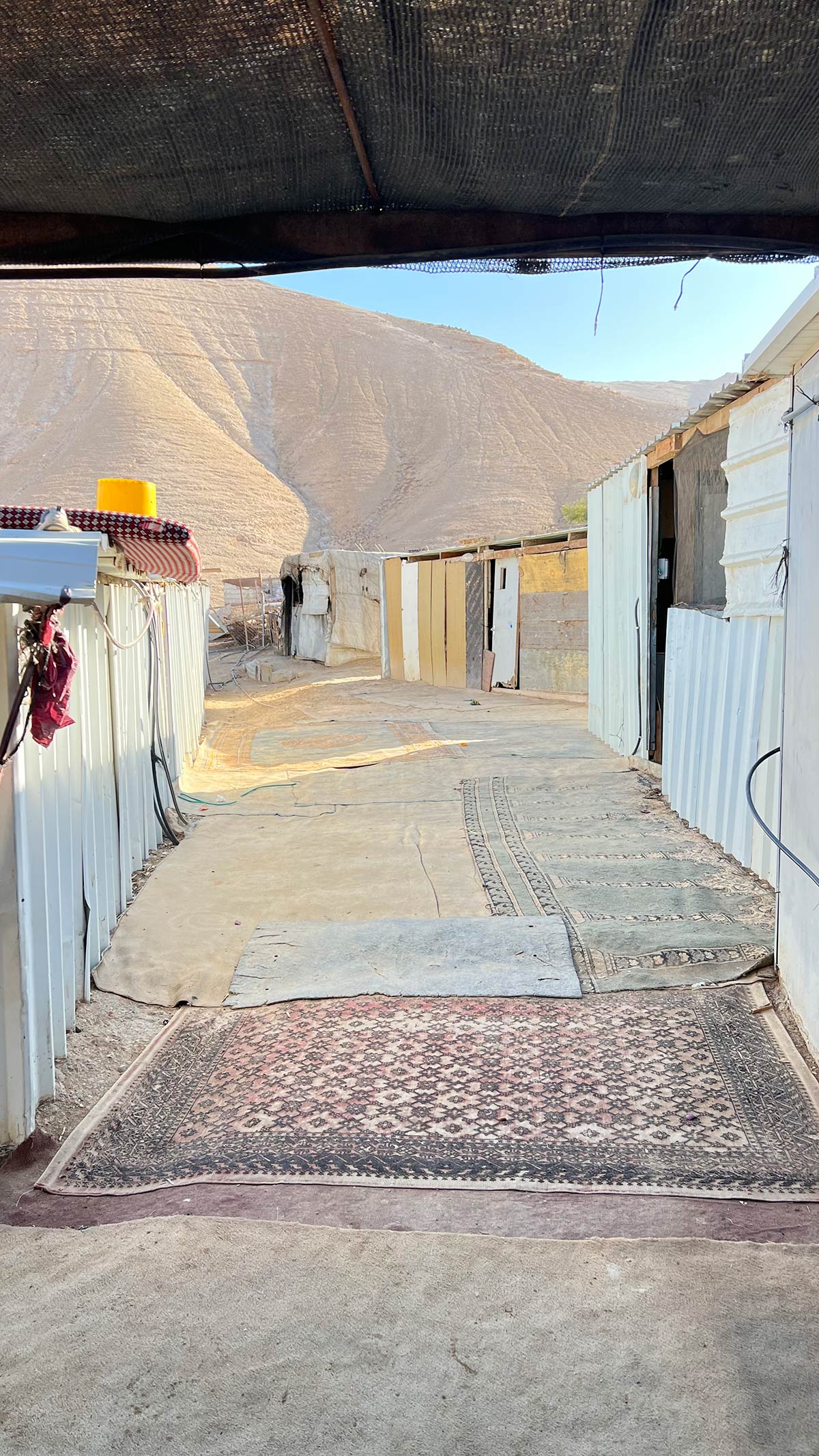
Houses in Khan al Ahmar where Lara visits the woman she purchases wool from. Photo Credit: Lara Salous
Witnessing remnants of the fading practice, Salous felt a renewed sense of purpose in working with these artisans. Through word of mouth and returning to Bedouin communities in Khan al-Ahmar, Salous began interviewing, photographing, and filming the shepherds, descendants of weavers, and searching for wool spinners. “I’m collecting oral history and trying to capture images and short videos, because you can never find anything in the archives,” Salous explains. “We invited one woman to weave at the university. I then started to ask around about women who are still spinning [wool]. It took me a lot of time, to be honest.” Years of field research and building relationships culminated in the evolving network that now makes Wool Woman possible.
Using her interior design background, Salous started to integrate wool into furniture designs. Since most Bedouin weavers are either displaced or long deceased, she is mostly self-taught and dyes the material herself. Experimentation and play are at the center of her process. She conjures thoughtful motifs of Palestinian identity and liberation, including olive trees, poppies, and watermelon slices. She incorporates bold teal and maroon stripes and abstract color blocking that take shape on rocking chairs, room dividers, throws, curtains, and benches, among other pieces.
“Sometimes I do some design sketches on paper, [or] I just design on the spot while mixing the colors because you can do more when you have these rich textures and tones in your hand,” explains Salous. The first products she sold were stools and chairs created with carpenters in Ramallah—the carpenters crafted the wooden structures while Salous wove the seats and backs.
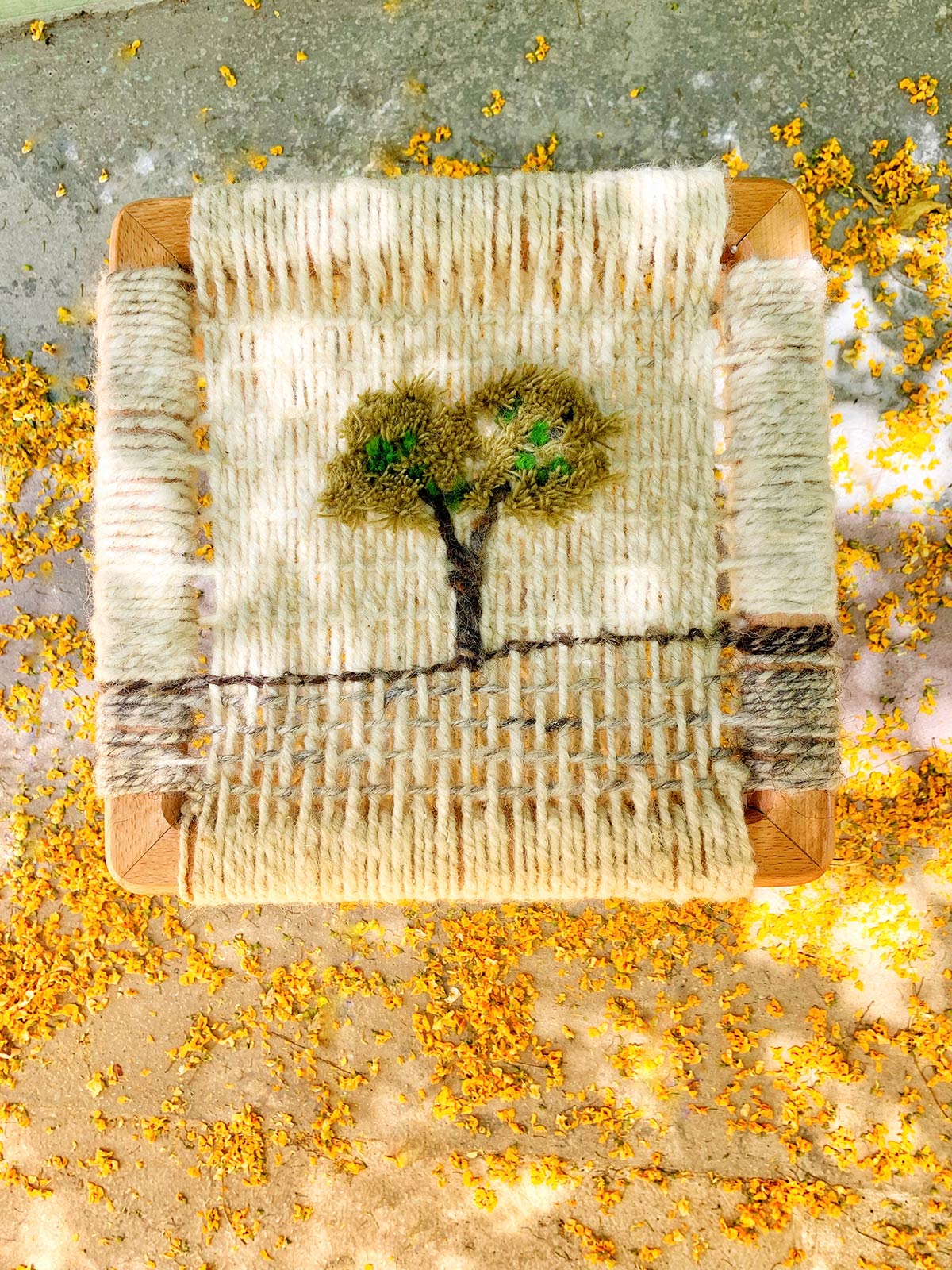
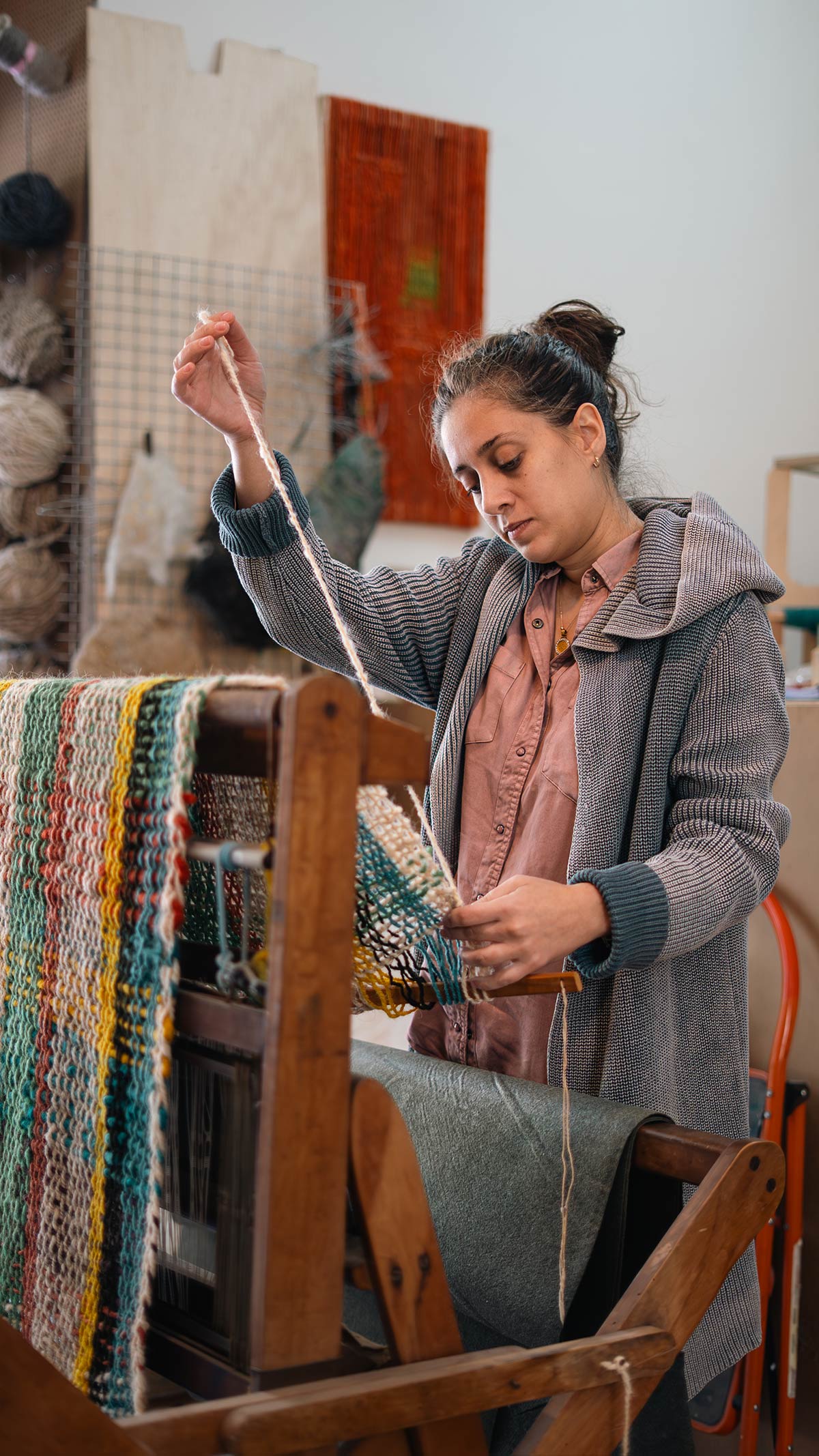
LEFT: Lara’s woven olive tree design on a stool inspired by the Palestinian landscape. Photo Credit: Lara Salous RIGHT: Lara finalizing a wool throw she wove on the loom. Photo Credit: Mahmoud Abdat
“The kick start for me was at a gallery here called Living Cultures, but now it’s closed. People started to come, and they purchased them [the stools and chairs],” she recalls. “From there, I built on other designs. It was very interactive with the local community because people started to ask me for bigger chairs or higher stools or chairs with a big back.”
Community is core to the designer’s craft revival. “It’s something that we inherited, and we need to pass it from hand to hand,” Salous explains. Through Wool Woman and the Palestinian Centre for Architectural Conservation, Salous has developed intergenerational weaving workshops for children and their parents, and any adults who wish to participate. Together, they create natural dyes with flower petals and integrate Palestinian traditional tile design into simple weavings. Her impact on attendees extends far beyond the triannual sessions. Salous beams when she explains that some students have taken on the practice as their own.
“I’m so happy that one of the students purchased a professional loom that she now has at home. Another one who was very excited; he wanted to work with me,” she says.
Running Wool Woman is not without its challenges. As the shepherds and women Salous sources from remain under constant threat of theft, violence, and land siege—their livelihoods at stake—Wool Woman has encountered supply chain delays and Salous has had to pause visits to her collaborators’ communities. “It’s not safe at all,” she shares. “I keep sourcing from one shepherd, but it’s very dangerous now, especially recently, now that the Israeli settlers built another settlement on the top of their mountain [in al-Mughayer].” She keeps up with orders as best she can, holding onto a stock of wool that is already processed and spun, and dyeing the material herself.
“To be honest, it’s exhausting,” she admits. Local demand has expectedly dwindled throughout the genocide, making it impossible for Wool Woman to afford employees and increasingly difficult to make a profit. But as Salous recounts these hardships with vulnerability, her commitment to preserving Palestinian weaving echoes. “I’m alone on the business side, but I keep supporting these women by purchasing wool from them,” she says. “[I’m] trying to take this material into other shapes and other possibilities.”
Lately, Wool Woman has found creative refuge by collaborating with fellow Palestinian artists. “With architects, interior designers, and fashion designers, these are the best projects I ever had because you feel that you are integrating more into your community,” shares Salous. Nöl Collective, the popular fashion label that celebrates weavers and embroiderers across Palestine, recently commissioned braiding from Wool Woman for a pair of trousers. And it was through their founder that Salous connected with Hussam Zaqout, one of the last surviving Gazan weavers and the inspiration for her latest art installation, If Only We Could Bury Our City. Guided by their shared purpose of preserving Palestinian heritage, Salous presents a towering traditional Majdalwi Fabric loom and intimate interviews with Zaqout, who narrates his intergenerational connection to the ancient profession.
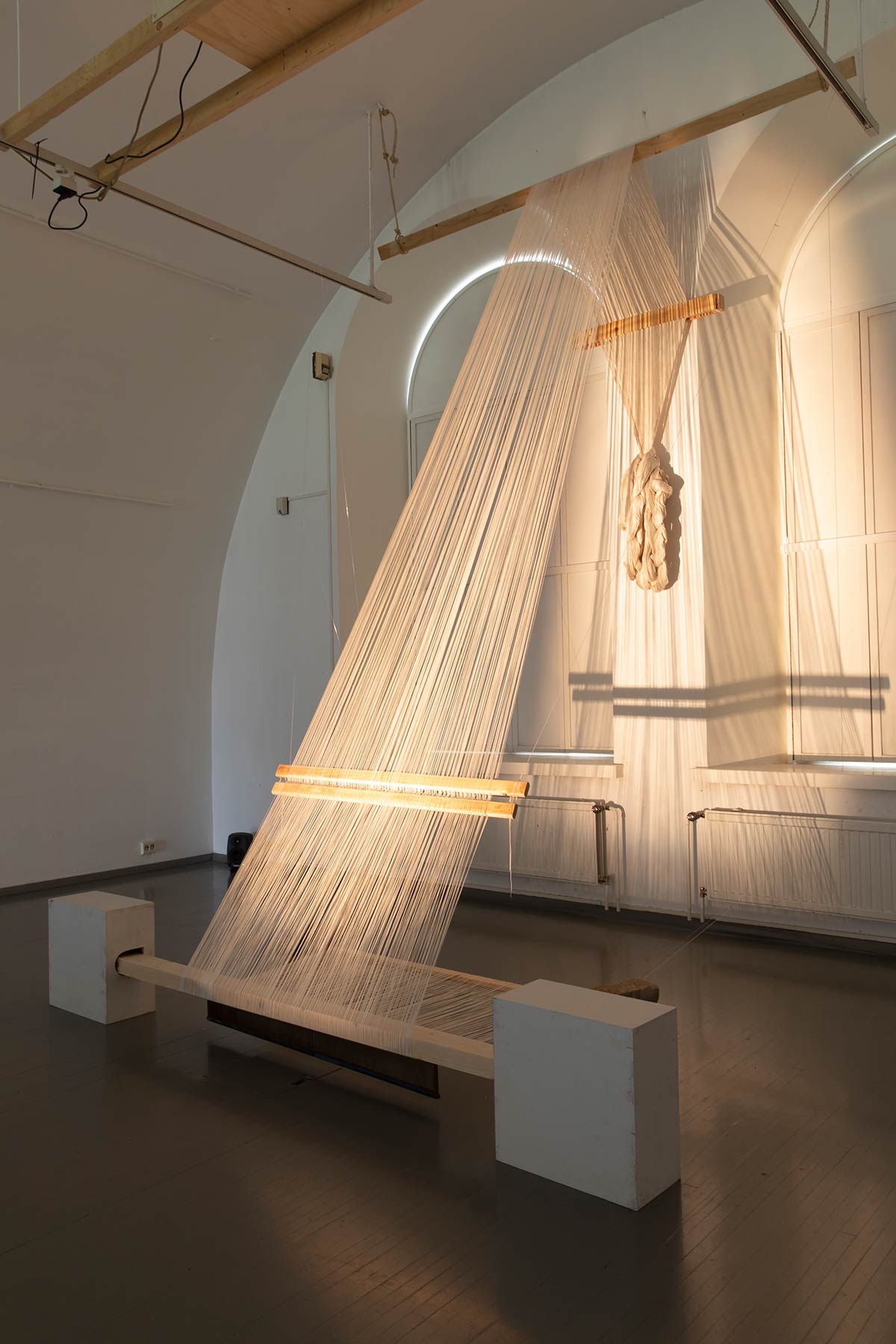
Multimedia installation of ‘If Only We Could Bury Our City,’ made from Lara’s research and interviews with Hussam Zaqout. Photo Credit: Elis Hannikainen
For Zaqout, Israel’s genocidal onslaught is tangible. “Just one month before the war, I had set up a new workshop, added additional tools and equipment to expand my work. I also had parts of a weaving loom that existed in the city of al-Majdal before the occupation,” he recalls. “Unfortunately, all of this was destroyed during the airstrikes on the city.” By March 2024, Zaqout made the difficult and expensive decision to evacuate Gaza to Cairo. Through fundraising, he and some of his family reached Cairo safely, where he has been rebuilding his weaving center.
Facing profound loss and a need for hope, for Zaqout, contributing to Salous’s art felt imperative. He shares, “It was a mix of pride, gratitude, and responsibility: for my personal experience and the craft I inherited from my father, to be an inspiration for an artwork of this significance. [It] makes me feel that the voice of my family, the voice of Palestine, and the memory of my hometown, al-Majdal, are still present and not forgotten, despite all the loss and displacement we have endured.”
In the wake of destruction, clinging to and sharing memories has become a form of resistance and a means of survival. Salous delicately entwines oral histories, like Zaqout’s, and material politics into thoughtful art and design, holding a rare space for Palestinian identity, culture, and history to flourish. “One story could say a lot about [the] shared realities that Palestinians face since the Nakba. Through meeting Husam and other Palestinian weavers, I bring back memories to a wider audience,” says Salous. “Our cities are being erased, but we still hold them in our bodies and memories.”
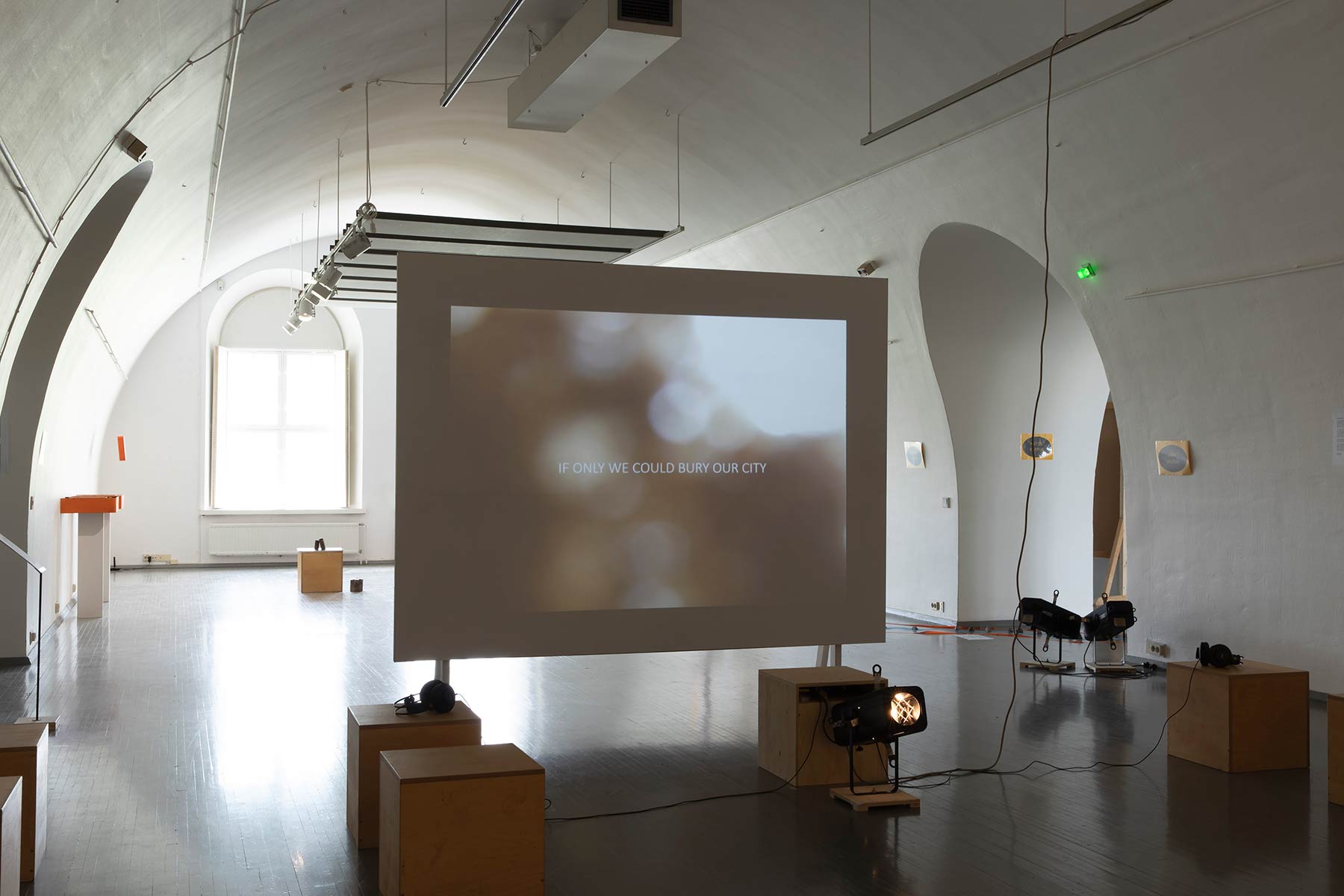
Multimedia installation of ‘If Only We Could Bury Our City,’ made from Lara’s research and interviews with Hussam Zaqout. Photo Credit: Elis Hannikainen