
What did you dream of last? Do you remember it? If you reach deep inside yourself, what do you truly yearn for - individually, collectively, for humanity as a whole, for the worlds in and around us? In any room, I love asking two questions:
What if? And why not?
Muslim Futures began exactly in this crack.
It started in that moment of refusing to only be a response to violence, a target in someone’s script. It began in that moment of insisting that Muslim life, Muslim joy, Muslim grief, Muslim knowledge, Muslim art and Muslim futurity are not side-notes to ‘European’ histories and existence, but engines of it. That we have the right to imagine, to design, to shape the worlds to come.
But let me tell you, where that crack came from.
I come from youth spaces and community centers, from Friday nights in backyard mosques that smell like tea and belonging, from organizing bus trips and dialogue circles and late night check-ins, from those intimate spaces where young Muslims gather because we need to hold each other, together.
For years, in those spaces, we were mostly invited to political stages to respond, to explain ourselves, to react to questions that were never really ours:
Are you integrated? You are not integrated and never will be.\ Do you distance yourself? Distance yourself.\ Are you a risk? You are a risk.
Are you grateful enough, quiet enough, are you enough? I also wondered, why didn’t they confront us directly with the question of why we dare to exist at all.
Enough.
So much of our work is about answering questions handed to us from the outside, questions that pull us into the present crises, the next scandal, the next attack, the next policy that would harm us, our bodies, our organizations, our ways to be. The endless demand to react, to prove, to explain why we exist, why we are hurt, why we resist. And at some point I realized:
If all our energy goes into reacting to the realities and narratives of others, then when, and where, and how are we supposed to ask our own questions? When do we get to ask: What if? And why not?
Yet I know - and Kübra Gümüşay articulates this with such clarity - how absurd it can feel to talk about ‘just futures’ when the present is screaming. When we live in the heart of extraction and destruction, in countries whose wealth is built on colonization, war, arms exports, environmental devastation. When genocide is live-streamed and normalized.
How do we speak of justice then? How do we imagine futures when, for so many, mere survival already feels utopian?
Precisely because of this, we cannot sacrifice the arena of imagination. Our privileges, our relative safety, our access to rooms and platforms and institutions are not only ours. They are a responsibility. They are a right that others have upon us.
We are already ancestors of someone’s world. The question is only: what kind of ancestors will we choose to be?
adrienne maree brown writes that we are in a struggle of imagination - that people are killed because in somebody’s imagination they are dangerous. That imagination is so respected, so protected, that those who kill in the name of their ‘fear’ rarely face consequences. We are living inside some else’s nightmare disguised as order.
Saidiya Hartmann says that policing our imagination is a form of oppression. Everything we are told, day in and day out, what is possible or impossible, where we can go and where we cannot, is deeply political. It is narrowing the field of what we are allowed to desire and who we desire to become. Critical Futures thinking is one way of refusing that trap. It is the practice and discipline and tenderness of imaging multiple futures: not only predicting what is likely, but naming what is desirable, just, beautiful, still possible if we dare to reorient ourselves.
.jpg)
Ziauddin Sardar teaches us that our futures can be colonized long before they arrive, that used futures can seduce us into running behind someone else’s vision of the world.
Ruha Benjamin captures the double movement of this work with such breathtaking precision: remember to imagine and craft the worlds you cannot live without, just as you dismantle the ones you cannot live within.
This is the work: naming what must be undone, and practicing - in community, in art, in pedagogy, in our intimate relations - the textures, infrastructures and feelings of the worlds we actually want to inhabit. The dismantling and the dreaming must happen together.
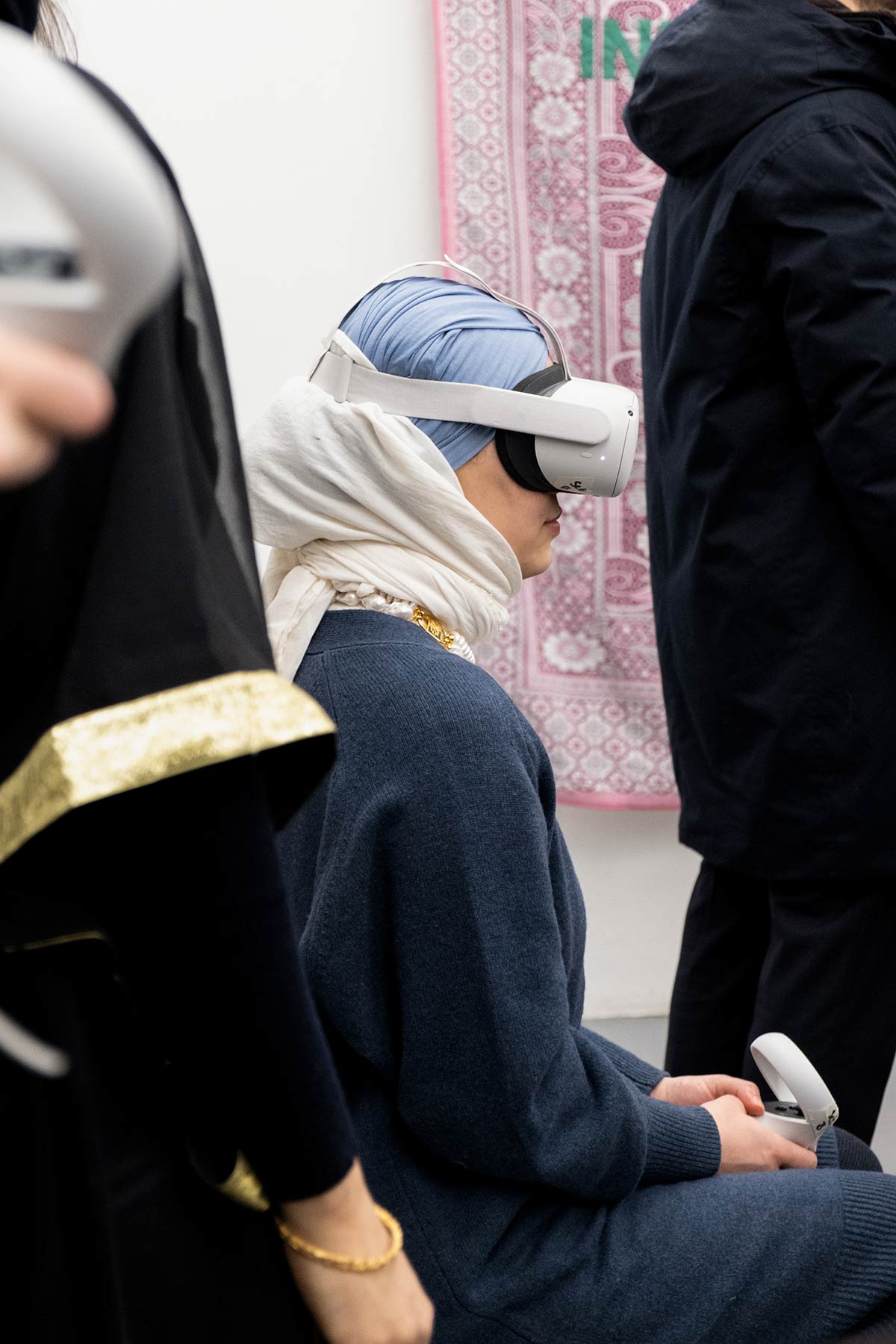
Within Muslim Futures, this double gesture took shape through the work of nine futurists - artists, educators, community organizers and cultural practitioners - who over two years created installations, films, photographs, performances and sound works that expanded the archive of what is think- and imaginable. Incubated and supported by SUPERRR Lab, their work was exhibited publicly in Berlin in January 2024, and now traveled to the Netherlands, where a new cohort of futurists, lead by Sara Bolghiran and Yasmin Ismail, have translated the practice into their own context with their own wounds and their own longings.
What I remember most from those two years is not the panels or the programming mostly, but the many tears and laughters. Often in the same breath, through the same body.
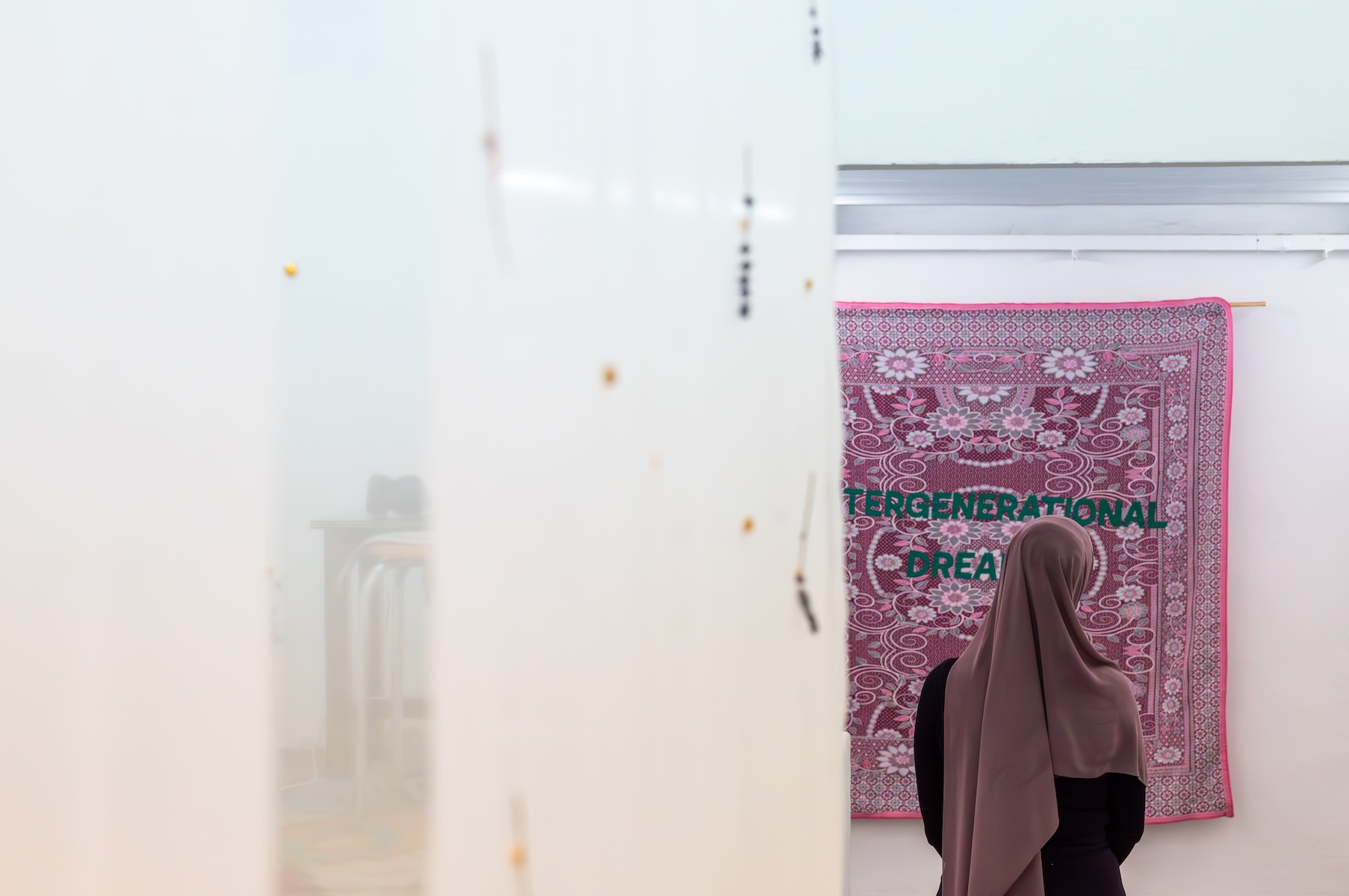
Visitors who stood in front of an installation and saw themselves - their lives, their longings, their complexity - reflected back without deficit, without suspicion, without the usual framing. For many it was, as they told us afterward, the first time.
The first time something had interrupted the story they had been told about themselves and what they are allowed to become. That interruption is, I believe, what repair can feel like in a body before it becomes policy, before it becomes law, or even before it has a name. Embodied. In and with these gestures, we dismantle by refusing silence, erasure, and the narrow scripts handed to Muslims. We dreamed by creating spaces, performances, provocations and tenderness that allow something new to emerge.
Neuroscience shows us that remembering the past and imagining the future activate the same neural network, what researchers call the Default Mode Network. We do not imagine from nowhere, we imagine from an archive. Our future visions are assembled from the materials we have gathered: our own memories, yes, but also the stories we have been told, the images we have absorbed, the worlds we have been allowed or denied to see. Which means: if we want to imagine otherwise, we have to feed the archive in different ways. Every image of safety, justice, tenderness, collective power that we allow in becomes a reference point, a place inside us that whispers:
I have felt this before. I know this is possible.
I write here as someone who is, in a very real way, a product of earlier Muslim Futures. Decades ago, young Muslims in Germany asked: What if we created our own spaces? What if our needs, our complexities, our joy were centered? And because they dared to imagine, I had spaces in which to grow.
I am here because someone dreamed me into being.
So when people ask: what does imagination have to do with the real struggles we face?
I want to gently turn the question around: What becomes of our struggles if we imagine?\ What becomes of art with imagination? What becomes of activism with desire? What becomes of community with a horizon of joy?
Who are you, when no one is watching?
Muslim Futures was born from the idea of bringing together what supposedly does not fit together. A vision born in the past and translated into the present. A manifestation of longing. It draws on entanglements, between here and there, me and you, the seen and unseen. It is a manifesto that claims pasts, presents and futures, and lovingly destroys, builds and carries forward, all at the same time, with a force that feels like an embrace.
I take your hand. You are safe here.
My closing wish is simple and demanding: may you leave this reading with at least one image, one feeling, one sentence about the future that you are unwilling to give up. May you practice being good ancestors. May you refuse the smallness that oppression assigns to your imagination. May you dream boldly enough that someone, someday, will live differently because of your courage now.
If we remember who we could be, we become a memory: drawn from an archive of resistance, carried forward, already being remembered.