

In January, the Department of Justice released a 3,000,000-document drop of Epstein files which mentioned among others Les Wexner, the billionaire behind Victoria’s Secret and Abercrombie & Fitch among other brands. Although Wexner was already labelled a co-conspirator with Epstein by the FBI, this newest file drop raises questions about how Wexner–and by connection Epstein–were connected to clothing marketed towards young girls. In the aftermath, a whole generation of women are deconstructing how a pedophile was actively part of the marketing that eroticized and idealized prepubescent girls’ bodies as the ideal.
It is a reckoning with how American girlhood was shaped by men like Wexner and Epstein that informed not only the clothing that was marketed and sold to us but also the body shame that came with it, along with purity culture enforced by the very Christian leaders whose writings Epstein sent to his own victims.
.png)
Birthday letter to Jeffrey Epstein attributed to Donald Trump. The text is censored due to potential copyright concerns (authorship of this work is disputed), though the rest of the piece is composed of simple shape and thus falls into the public domain.
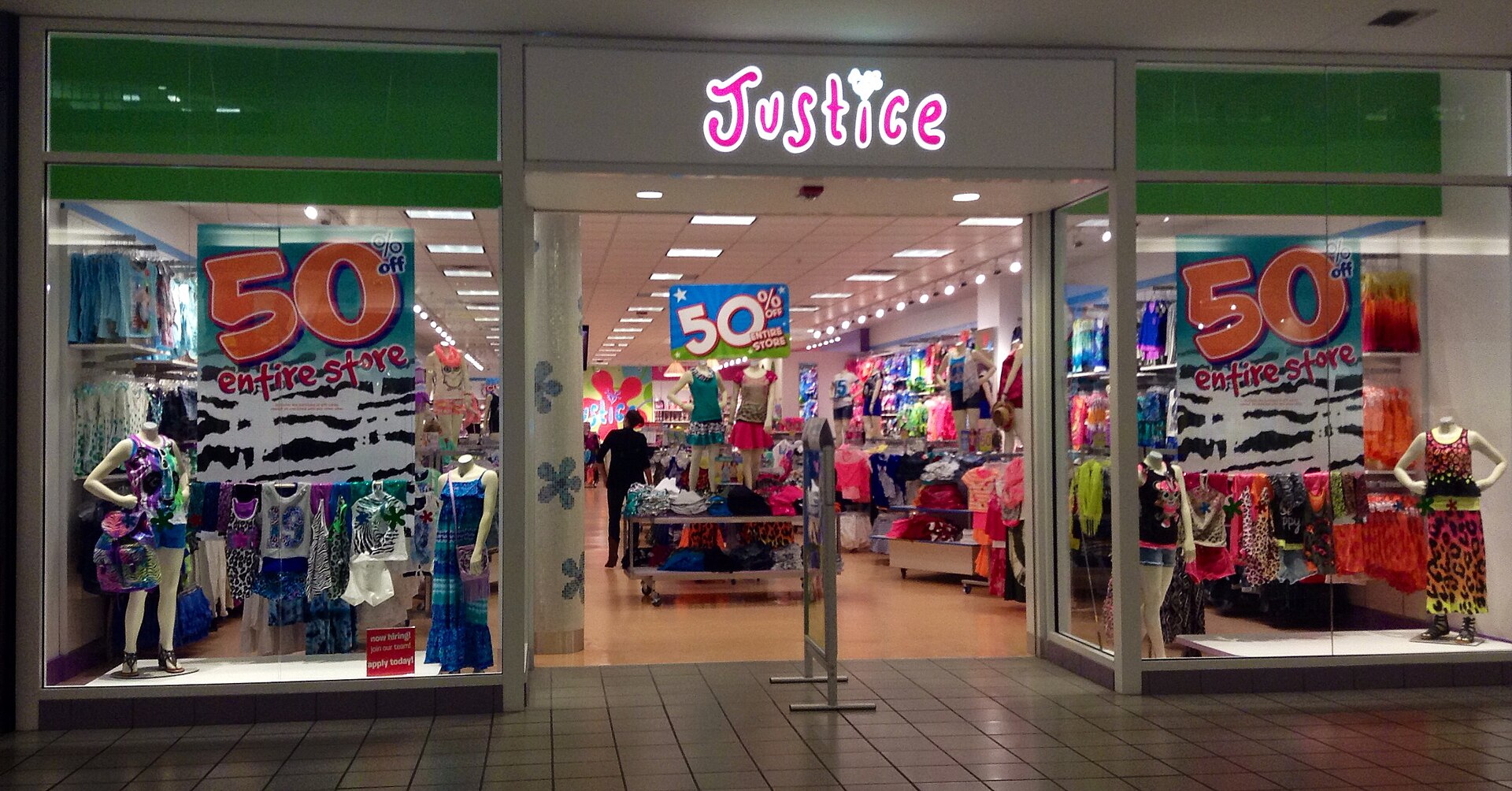
Wexner was the creator of L Brands, the retail company behind Victoria’s Secret, Bath & Body Works, and Abercrombie & Fitch, and owned TOO, Inc., the parent company of Justice and other brands marketed directly towards young girls. This past Friday, Wexner participated in a deposition to House Democrats about revelations from this latest file drop, claiming that he was “duped by a world-class con man.”
Wexner notes that Epstein became his financial advisor back in the 1980s and at one point, served as his power of attorney. In this same deposition, Wexner revealed that he cut ties with Epstein after he discovered that Epstein stole over $100 million from him.
Wexner called the accusations that he was part of Epstein’s sex trafficking “outrageous untrue statements and hurtful rumor, innuendo, and speculation,” claiming that his relationship with Epstein was strictly business. He also denied Epstein victim Virginia Giuffre’s claim that he was one of the men that Epstein trafficked her to. Wexner similarly denied knowing Maria Farmer, who accused Epstein of sexually assaulting her in 1996. Farmer claimed that after she was assaulted, Wexner’s security staff kept her on the property until a parent could pick her up, but Wexner said that “I never met her, didn’t know she was here, didn’t know she was abused.”
But House Democrats repeatedly questioned how Wexner could not have known that this sex trafficking was happening and that it was fueled by his own money. The Democrats cast doubt on his story, arguing that “there would be no Epstein Island, no plane, no money to traffic women and girls without the support of Les Wexner.”

While Victoria’s Secret sexualization of infantilized women is not new–we have known for years that the modelling industry behind Victoria’s Secret not only targeted children but sold people an ideal of beauty conflated with girlhood, this new file drop reveals that this was intentional by Wexner and others that sold us a form of girlhood that enabled predators.
It’s no mistake that President Trump, another person mentioned over 38,000 times in the Epstein files, also owned Miss Teen USA pageants. In fact, in the deposition, Wexner said the only time that Jeffrey Epstein and Donald Trump would have interacted would have been at a Victoria’s Secret fashion show. Both attended fashion shows.
But this latest Epstein file release is a wide scale realization that Wexner wasn’t the only one grooming a generation–think of what came out about producer Dan Schneider (who was also named in the Epstein files) after the release of the 2024 docuseries Quiet on Set: The Dark Side of Kids TV. Schneider oversaw the rampant, calculated sexualization of young actors.
As children who watched Schneider shows and wore Wexner’s clothes, we are reckoning with the ways that many of us were exploited as children within a system marketing sexualized girlhood to us. Artist Sam Rueter put words to many people’s emotions following the latest Epstein file drop: “women in America are in deep grieving. Not because we are surprised or overcome with disbelief … but because we have to reckon with the cruel proof of our entire lives being a commodified, fetishized version of girlhood: and we are meeting, all at once, the children we were and could not protect.”
In the aftermath, how can you reckon with and reject pedophilic beauty standards in the aftermath of the Epstein file drop?
1. Do not spend money or support brands that sexualize children or infantilized models.
While at first glance, this includes for many of us Victoria’s Secret, Abercrombie & Fitch, and other brands owned by Wexner, this also includes brands that market sexualized clothing or content to children. This month, the babycare brand Frida Baby came under fire for using phrases suggesting sexual innuendo on their baby products. The packaging had the phrases “I get turned on quickly,” “How about a quickie,” and “This is the closest your husband’s gonna get to a threesome.” Other brands like Balenciaga and Fashion Nova have also come under fire, but a number of other brands and fashion corporations are to blame–according to a 2011 study, ⅓ of all children’s clothing for girls is sexualized; “tween” stores like Abercrombie Kids, the study finds, are most to blame.
In a capitalist society, sadly our most powerful tool is choosing where we spend our money, so it’s important to boycott and call out brands that sexualize children and market infantilized models.
2. Do not consume and boycott any media sensualizing or sexualizing children by avoiding AI, social media platforms, and other content.
Sadly in the age of AI, a number of digital platforms have been shown to generate and share sexualized images of minors, and according to the National Center on Sexual Exploitation (NCOSE), a number of online platforms including Instagram, Roblox, GitHub, eBay, Discord, X, Reddit, Spotify, and Snapchat fail to protect children from sexual content, putting them at risk for grooming and sexual exploitation. Avoid AI for this reason (among many others, including environmental impact) but also if you can, boycott social media platforms and call your representatives to urge the government to require these platforms to take actionable steps to protect children.
This also applies to what may be some of your favorite Classic movies, television shows, or music, but know that by watching the movie, show, or consuming the content, you not only give your consent but also support its continued existence on streaming platforms. This is also a timely reflection given what has come out in the past three years about children on Nickelodeon; what once seemed innocent, at most odd, is revealed to be intimately connected to abusive behavior and sexualizing children.
This also goes for new content, like the new season of America’s Next Top Model.
3. Do not dress up as sexy babies, or sexualized children.
While the Spirit Halloween costume section was full of sexy babies in the early 2000s, I hope it’s clear that any costumes that sexualizes children or infantilized adults contribute to the perception that sexualizing children is acceptable or funny. This is a simple step that you and others can take next Halloween when choosing your costume, or when engaging in kink and BDSM cultures.
And if you are buying clothing for your children or those of friends and family, do not buy them clothing that sexualizes them. This includes snarky sayings like “lady’s man” on a baby’s smock or “heartbreaker” on a baby’s bib. While some people may brush it off, especially if the child can’t read, studies have shown.) that children may begin to view their bodies as sexual objects and may be treated differently, including being targeted by sexual predators.
4. Do not police other people’s bodies, period.
This may be harder for people who were raised in systems where unshaved armpits or unplucked eyebrows are seen as unkempt (spoiler alert, this is connected to transphobic, racist beauty standards), but pedophilic beauty standards are built not only on a beauty standard that idealizes not just a hairless body but also a small, underdeveloped one. Commenting on other’s bodies, even if it’s not meant to criticize their appearance, can contribute to body image issues, and at the root of pedophilic beauty standards are the very eating disorders glorified in the early 2000s.
This beauty ideal (perpetuated not only by companies like Victoria’s Secret but by magazines, music corporations, and media companies that glorified baby-ified women) not only aided and abetted the development of eating disorders but also severe body dysphoria that persists to this day. I distinctly remember friends of mine that experienced amenorrhea, or the absence of regular periods, because of eating disorders. Without vital nutrients, their periods stopped coming regularly, and with it, the development of their bodies—stunting their growth. Many of them remain small or underdeveloped because of childhood eating disorders.
The same marketing and cultural influencers that encouraged us that skinniness was not acceptable but necessary also enabled young girls to stop getting their periods, the one thing that many cultures identify as their transition to womanhood. To be clear, a child getting a period does not make them an adult.
5. Start with your own beauty routine.
Do you dislike shaving or waxing your legs, armpits or other parts of your body? Do you dread expensive, medically unnecessary skincare routines and Botox meant to glorify perpetually young bodies? Good news–you don’t have to do these things.
While our American beauty standards are rooted in the model of a young girl, they are not absolute and they only change when people pressure corporations that have marketed these standards to us in order to sell their products. If you can (for cultural and sensory reasons, not everyone is able to), take the first step and reject the urge to shave, wax, pluck, or inject.
As someone with autism, I admit that shaving my legs and armpits is a sensory issue informed by pedophilic beauty standards, but it’s still a practice that helps me feel at home in my body. None of these suggestions are asking you to reject what makes you feel at home in your body. Some of the body care processes that pedophilic culture has coopted are ones that help to affirm our genders–practices that affirm who we are and how we feel at home in our bodies should never be challenged, but these steps encourage us to think about what has informed not only our view of what is an attractive woman (often modelled after young girls) but also what a woman is.
6. Reject transphobic, racist beauty standards. Consume brands that showcase models of diverse body and beauty types.
Because the urge to wax, shave, and pluck our hair is not only rooted in pedophilia, it’s also rooted in White supremacist transphobia that essentializes the beautiful body as inherently thin, White and visually binary. Pedophilic culture is sexist culture is purity culture is racist culture is transphobic culture. Gender essentialism is the bedrock of sexist beauty standards that seek to make adult women feel bad about our bodies. Fighting transphobia goes hand in hand with fighting gender essentialist beauty standards and by extension, pedophilic ones too!
In a capitalist economy, much of our power is defined by money. Use that to your advantage! Along with not supporting brands that sexualize children and infantilize adults, seek out brands that showcase and celebrate adult bodies. Some great ones include WRAY, SmartGlamour, Lucy & Yak, and Modcloth that purposefully create clothing for and highlight models of diverse body types.
7. Encourage and embody body neutrality.
In this same vein, embody body neutrality by refusing to assign value judgement to your body and others’ bodies. Body positivity is great, but it still assigns a value judgement to bodies–for many fat people like me, celebrating our bodies much less feeling beautiful in them is rare because of thinness culture (especially in the age of Ozempic), but assigning our bodies value judgements still exacerbates the problem. Bodies are bodies that help us to stay alive. Need helpful starting steps? Check out Jessi Kneeland’s 2022 book Body Neutrality: A Revolution to Overcoming Body Image Issues.
8. Finally, reject new-age purity culture.
Although the Purity Culture Movement of the late 1990s and early 2000s is already facing a public reckoning, other Christian groups are trying to rebrand purity culture for the next generation. Back in 2022, I wrote about how modern social media influencers like Girl Defined are rebranding purity culture for a new generation, and I have even argued that modern anti-trans legislation is a new form of purity culture policing queer bodies. Take note of where purity culture continues to exist and call it out!
And importantly, fight school districts, religious institutions, and public spaces that enforce sexist clothing rules like the ones we all remember from childhood. The fact that young girls were told that we would distract not just our male classmates but also teachers is deeply upsetting and shifts blame onto children and victims rather than adults and predators.
This is a deeply upsetting reckoning but one that we have to undertake personally and communally. I hope that these recommendations are helpful first steps to move towards unpacking the very beauty standards and sexualization that groomed a whole generation of girls and women.