
Courtesy of the authors.
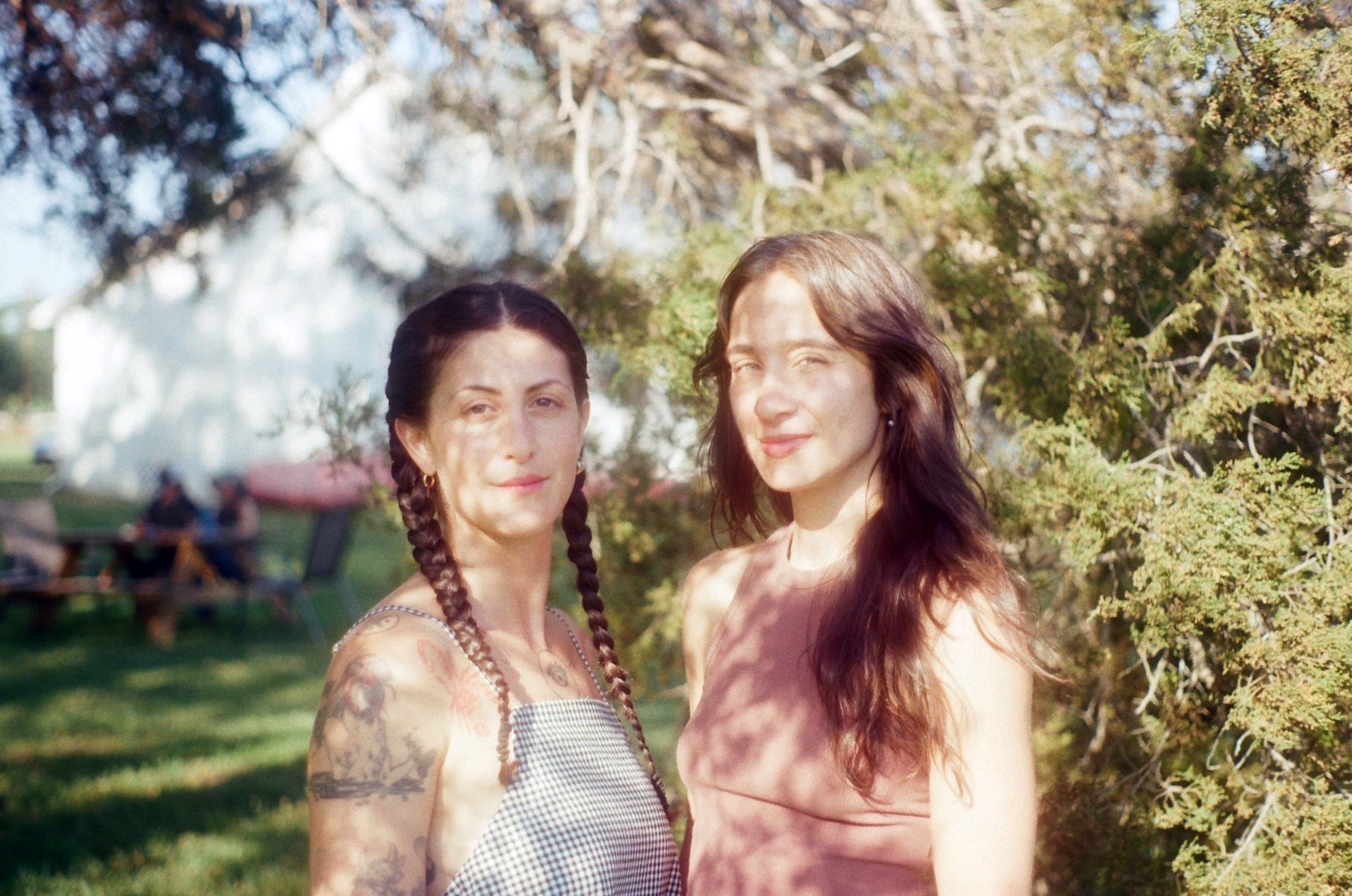
Across the global art world, explorations of motherhood, care, domestic labor, feminist practice, and SWANA (Southwest Asia and North Africa) futurism are increasingly coming into view. Major exhibitions and cultural conversations have begun to take caregiving seriously as a creative and political force, while SWANA artists are gaining long-overdue recognition for work shaped by migration, memory, resistance, and imagination. Yet the particular ways SWANA caregivers make worlds and futures possible —through kinship, ritual, storytelling, mutual responsibility, and the daily labor of keeping one another alive—remain largely unnamed or even siloed. That’s what Armenian filmmakers and artists Emily Mkrtichian and Kamee Abrahamian aim to confront head-on with Cazimi Studios, a collaborative devoted to interdisciplinary storytelling and radical, care-centered production of arts and media works.
What’s more, Mkrtichian and Abrahamian are paving the way for new artists to deepen and explore the depths of motherhood in the SWANA region and reach towards futures that have not yet been allowed to exist. Under Cazimi, the two creatives have just launched their inaugural Portals fellowship, a multi-year collaborative media arts project bringing together artists across disciplines to explore storytelling, care, and collective worldbuilding in the SWANA region. The recipients of the fellowship—which includes Morehshin Allahyari (Artist and Assistant Professor of Digital Media Art at Stanford University); Jude Chehab (Filmmaker); Gilda Davidian (Artist); Aroussiak Gabrielian (Artist and Associate Professor of Landscape Architecture + Urbanism, USC); Lara Sarkissian (Electronic Musician and Sound Artist); and Oraib Toukan (Artist and Educator)—will weave together the speculative imaginaries of caregivers from the region and its global diasporas. Through film, sound, visual art, and writing, the project reclaims generative, narrative space for caregivers as protagonists: agents of imagination, survival, and futurity. The fellowship consists of two years of mentorship, a week-long residency in Armenia, artist stipends and grants for the production of new work, and will culminate in an exhibition launching in 2027.
Above all, Portals recognizes caregiving as a bulwark against the erosion of ancestral knowledge systems and communal infrastructures of survival. It insists on care as both subject and methodology, and foregrounds interdependence over individual authorship, creating space for layered narratives in which grief, resistance, and possibility coexist.
In this conversation, Mkrtichian and Abrahamian explore why speculative storytelling can shed more light on the truth than reality, and why the coexistence of caregiving and creative practice is, in itself, a political one.
This interview has been edited for length and clarity.
KAMEE ABRAHAMIAN: What have you learned about collaboration and caregiving from our friendship?
EMILY MKRTICHIAN: Well, we basically met making a short film together in your house when your kid was only one. So if anything was a lesson in collaboration and care and how they can co-exist, that was it.
Because I was able to watch you parent for so many years before I became a caregiver, I had a lot more awareness of what it meant to have a lot of demands on your time and your attention. But not viewing that as a constraint and trying to bring that piece of your life into the way that you create work.
First and foremost, care is not a constraint on creative work and collaboration. It’s actually a creative practice. And within our friendship, I learned so much about how a real collaboration can allow space for each person’s joy and excitement and ideas to really take shape in a fluid environment. When we’re both focused on what excites us and lights us up, and how we can move towards that together.
KAMEE: I actually remember when you were kind of at the height of your sleepless nights. In the beginning, when you had just become a mother, I remember you would talk to me a lot about how you felt like your brain was broken.
And I remember encouraging you to just lean into it, because there really is no other way but through.
I feel like that has been one of the most beautiful things about our friendship and creative collaboration. It’s all about leaning in. What if the thing that feels most challenging is actually the most resourceful and generative aspect of our practice and our friendship? Which I think in a lot of ways is the basis of not just our friendship, but of Cazimi.
EMILY: Similarly, you taught me so much about caregiving before I fully understood the physical and temporal realities of raising a child. What does care mean to you within your own family and in the way you work with collaborators and community?
KAMEE: When [my kid] Saana was younger, it was like wherever I go, my kid is basically probably coming with me, and y’all have to deal with that.
I think a lot of mothers will relate to this. If you’re the only parent in your friend group or in your creative community and your priorities start to shift, you start to feel really isolated.
In the beginning, I had no choice. I either was going to stop creating or I was going to have to find a way through. Now that Saana’s a little bit older, I feel like I’m finally getting back to myself. I’m able to integrate and synthesize all of these different parts of myself.
KAMEE: In fact, is there a moment for you when you first realized that we were not just reaching for some of the same questions, but looking in a similar direction?
EMILY: I think it was connecting over speculative fiction when we were writing our first film, Transmission. I can very clearly remember the writing process and how easy it was to do with you. All of our references were the same, and any reference you gave me, I was so excited about and would have something to give back to you.
I think that interest in speculative realities and what they could do for our imaginations was the basis for a lot of questions we’re still asking. Adding this dimension of care into that and caretaking and parenting—whether we’re parenting our kids or parenting our parents or parenting ourselves. For me, I think we’re both reaching towards the future in a speculative sense from a deeply rooted past and drawing on ancestral information and wisdom that we know exists in our bodies and that we want to bring into the future.
KAMEE: I have total amnesia during the Transmission years. I was so underslept.
But I do remember feeling really alone. I was the only mother on our creative team. I felt isolated in my experience, and that was really hard for me.
After that, I was like, I really want to work with other caregivers because it can be pretty crazy-making to feel that way.
One of my favorite memories is when we got in my car in Armenia before [my kid] Alik was born and just took to the road. That whole summer I felt like I was finally back in my body. I felt reborn in a lot of ways.
And I think it wasn’t necessarily the moment I realized we were asking the same questions. It was the moment I realized that we were really moving in the same direction on parallel paths.
EMILY: What has motherhood complicated about your relationship to art? What has motherhood clarified?
KAMEE: Everything and everything. I think what people don’t realize about caregivers who are also creatives is that it’s just harder. I’m just gonna say it. It’s harder.
I don’t have the luxury of waking up on my own time in the morning and rolling out of bed and making a coffee in silence. I’ve been waking up at 6 AM for almost ten years, if you count pregnancy.
So time and energy. Physical energy, capacity, uninterrupted time, time to daydream and sit in quiet.
But you adapt. You get really efficient.
What it has clarified is that now my creative work is life-giving work. It is grounded in this deep sense of transmission. What are the stories I am choosing to bring into the world, and how is that going to impact this world that my child is going to live in?
I think everyone could be asking that question.
EMILY: I really believe that the worlds we create in our imaginations are precursors to the possibilities we might be able to see in the real world. What being a mother has clarified for me is who the work is for.
It’s not for the industrial machine to consume.
Making creative work is an extension of my everyday life and my personal history in my actual physical body. My child is an extension of my actual physical body. The ideas that come out of my body are an extension of me.
KAMEE: How has becoming a caregiver changed the kinds of stories you want to tell?
EMILY: We both witnessed this conflict that was a persecution of our culture, and the feeling of having absolutely no agency, no power, no control.
If you allow yourself to live in that space, there’s no hope for you in the world.
I think the particular skill set that we have is that the only way we can claim back that agency and power without denying the realities of the world is through the creation of new worlds.
I was working a lot in documentary, and there was this hope that if we could bring injustices to light, then the world would see them and do something about it.
But most of the time the world turns a blind eye.
It became really clear to me that I needed to make work that was more internal. I needed to create worlds instead of reflecting only the brutal realities of the world. I needed to create imaginative, fictional spaces based on our stories and culture in order to imagine joy instead of reflecting pain.
We worked hard to create spaces where caregiving and creative work could coexist. Why do spaces like this feel necessary, and what might they make possible?
KAMEE: Because those two things coexist within ourselves. So to be expected to separate them feels like a dissection. It feels violent.
Creating spaces where those things can coexist is a way for us to create spaces where we’re saying: you can show up as your full self here. Even if it’s messy and complicated and imperfect.
EMILY: There’s traditionally been either a full exclusion of caregivers from the art world or a demand that they separate that part of themselves out and show up as an individual auteur maker who is not encumbered by these domestic things.
Institutionally, there was this implicit demand that you must bifurcate those parts of yourself.
For me, the well where the love comes from—the energy that allows you to create life and care for someone else—is the same well where my creative energy comes from. It’s erotic, it’s creative, it’s life-giving.
They’re completely interconnected, and to try to dissect them actually makes you a worse artist.
KAMEE: Let’s talk a little about the Portals fellowship. When we were selecting artists for this fellowship, the applications felt like a body of work I’d always dreamed of encountering. What excites you about this cohort and their work?
EMILY: It was such a privilege.
We created this call for proposals based on the kind of work we were aching to see in the world and that we wanted to make ourselves. We had faith that there had to be other people wrestling with these same ideas.
To have so many proposals come back addressing these core themes of what it means to be from this region, to be from a lineage of displacement, to grow up in a particular community and care for those around you—I was absolutely in tears reading them.
It was a reminder that the world we want to live in isn’t just us thinking about it. There are lots of people who desire the same things we desire, who are struggling with and finding joy in the same things that we are.
It’s a matter of creating spaces where we can come together around these ideas and put this kind of work into the world together.
What were we unwilling to compromise on when designing this fellowship?
KAMEE: Rest.
I think it is the thing we were not willing to compromise on because, as caregivers, you’re not really given opportunities to rest.
You need to dream to create. If you don’t have time to rest, you don’t have time to dream.
When we were designing the program, at the forefront was: We’re prioritizing rest. We’re prioritizing flexibility. We’re making everything optional. We are keeping access needs at the forefront. We are not going to make this about being overly productive. To that end, what are you hoping the fellows teach us?
EMILY: There’s just so much collective knowledge in this fellowship. We’re all coming from different backgrounds and cultures. Some diaspora, some local. Multiple languages.
I’m interested in the connective threads. Investigating lineages.
Investigating our parents and our care of them. The act of birthing. The way land interacts with the body and how displacement from that land might physically affect us.
KAMEE: It creates a rupture.
EMILY: It creates a rupture that we carry. How do we document those kinds of non-physical ruptures?
I’m interested in how other fellows are experiencing care as part of their practice. I don’t get to be in spaces very often where people speak like that.
KAMEE: What happens when we all lean in together?
EMILY: Yeah. What happens when we all lean into that?
KAMEE: We could move a fucking mountain. What worlds are SWANA caregivers already building that often go unseen?
EMILY: I believe there are relational networks of care that exist in SWANA communities that are often dismissed as unnecessary or confined to the domestic realm.
But there is a model there for how we could exist in larger political spaces in a more fair, just, and loving way.
KAMEE: When I spend time in SWANA villages, it feels like everybody feels responsible for each other. Everybody is jumping at the opportunity to care for each other.
It’s their way of being.
There is a foundational ethic of care and relationality, a web of care, where we are all accountable to each other.
Not to romanticize it—there are problematic gendered aspects of care in SWANA communities that we can talk about—but ultimately, I feel much more at home in communities that share that ethic of care. Responsibility to each other. Shared responsibility.
EMILY: There’s less of an emphasis on the individual. It really is a collective understanding of history, of your body, of your choices.
KAMEE: Even in your home or small community, if you are really putting into practice ways of being that are life-facing, it becomes a microcosm. That’s why I’m really excited to bring this Portals cohort together.
EMILY: What portal are you standing in front of right now?
KAMEE: Going to Armenia for the Portals residency feels like stepping through a portal.
Every time I go to Armenia, I feel like I’ve gone through one because the way of life there is so different than it is in the West.
EMILY: I feel like you’re traversing that portal all the time.
For me, becoming a parent, becoming an educator, and starting a project like this, where I’m more in a facilitation role, has been a portal into decentering only my own creative desires.
It feels really important for my work to be enmeshed in a creative community that I can lift up in equal measure to my own ability to make work.
A lot of the sparks for that were in our first creative collaboration. And this project feels like a continuation of that.