
Digital & Print Membership
Yearly + Receive 8 free printed back issues
$420 Annually
Monthly + Receive 3 free printed back issues
$40 Monthly
NorBlack NorWhite

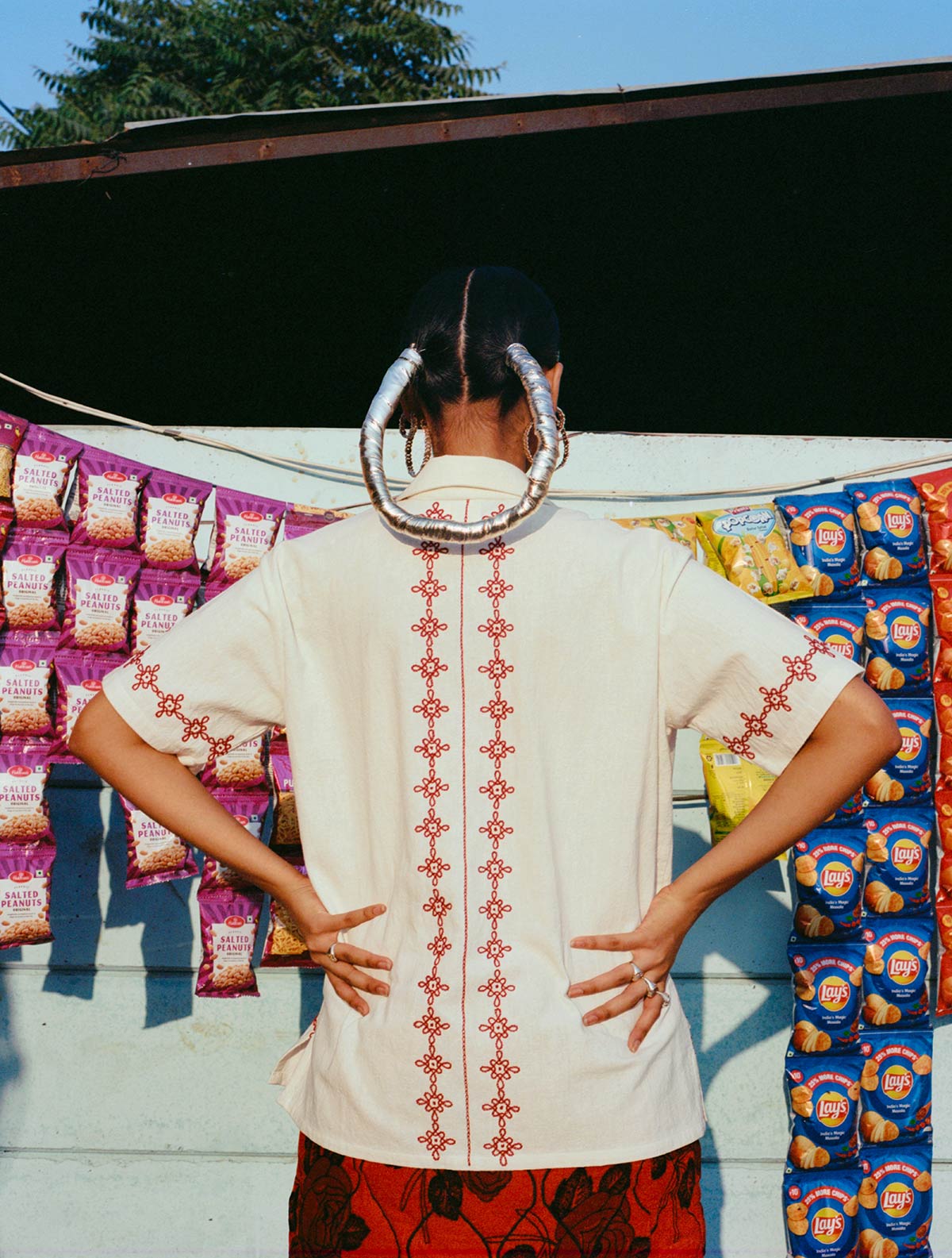
Photography courtesy of NorBlack NorWhite
CELINE SEMAAN: With your fashion brand, NorBlack NorWhite, you have redefined what sustainability means and have put at its heart the artisans and people of the Global South. What inspired you when you first started, and how has your company evolved?
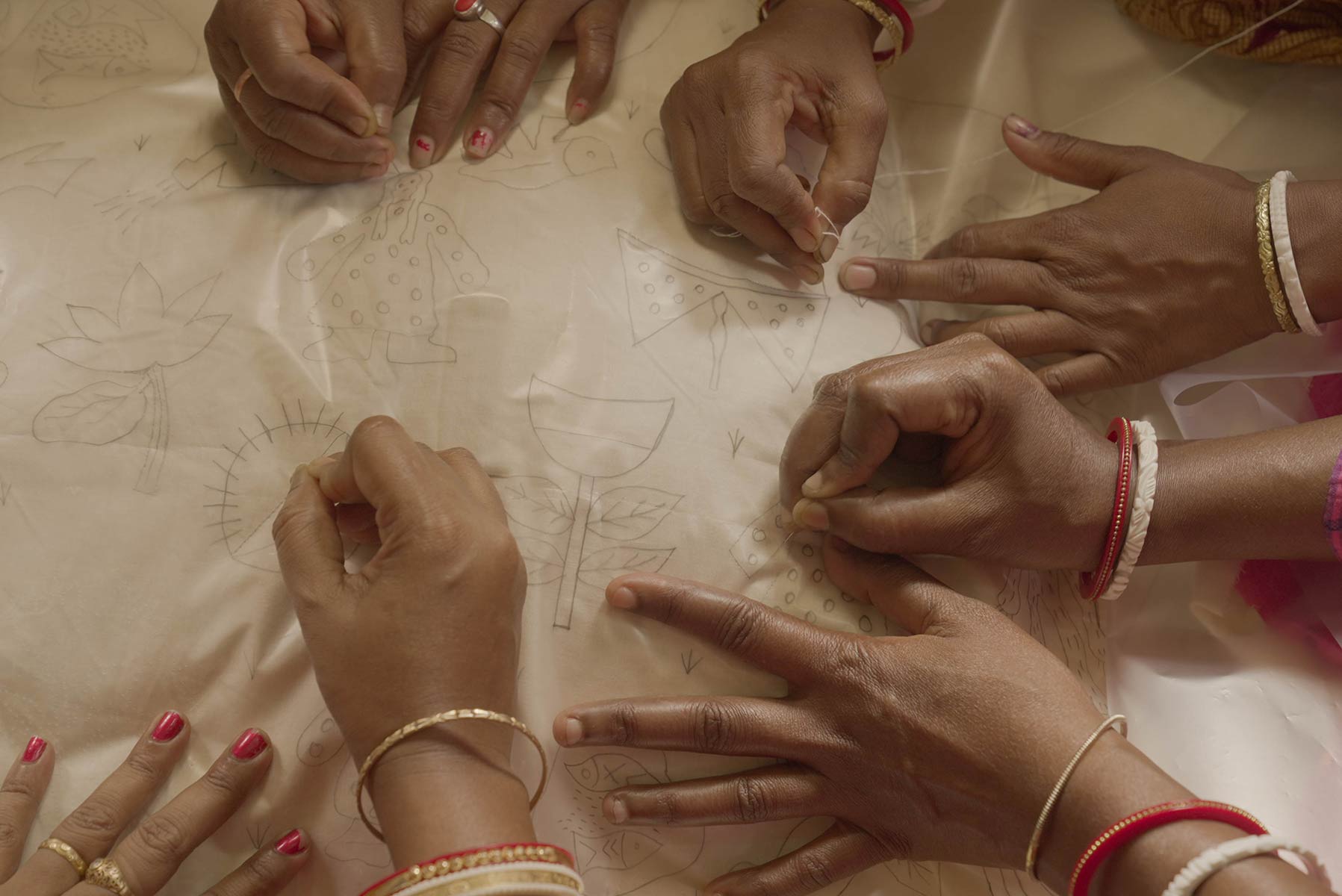
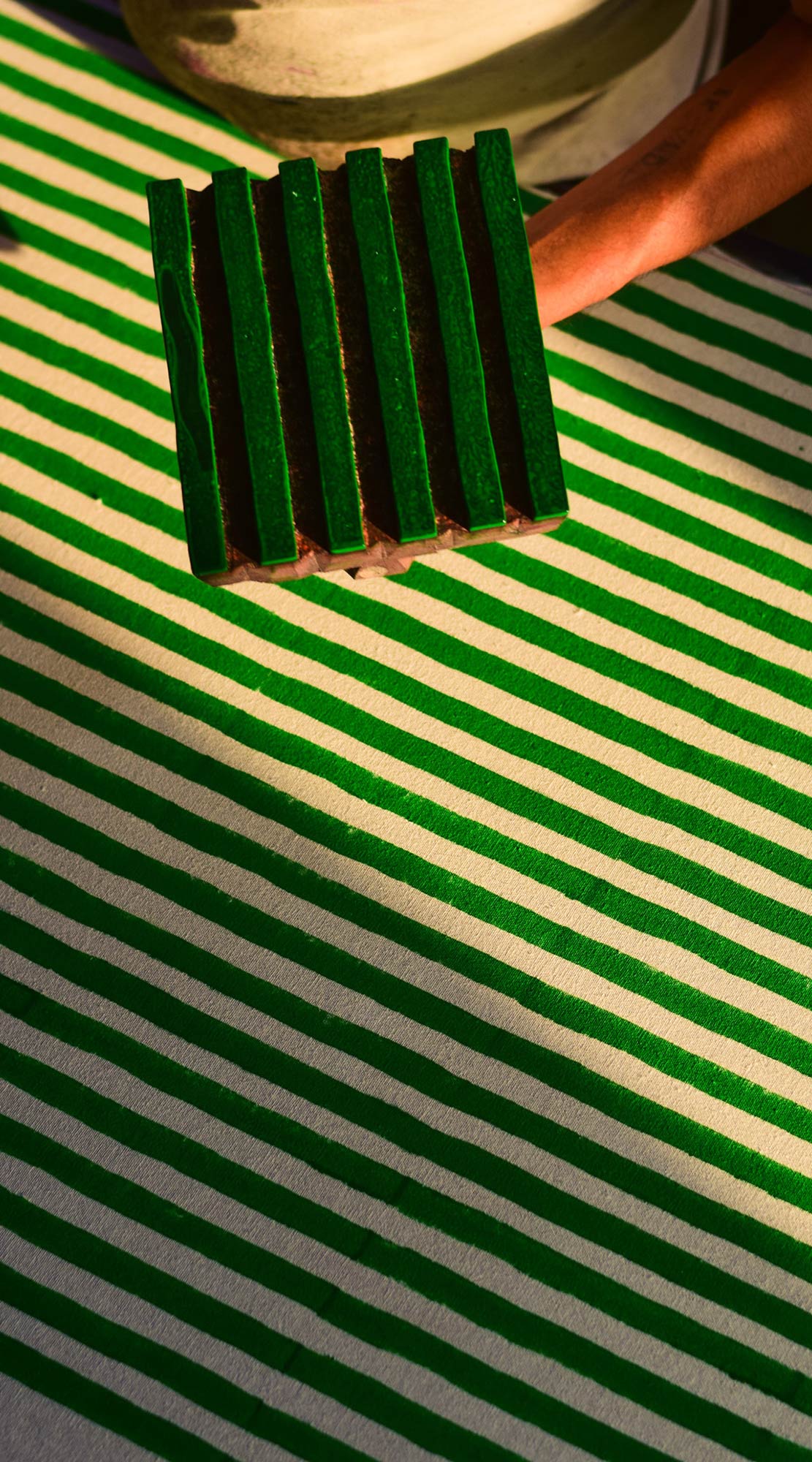
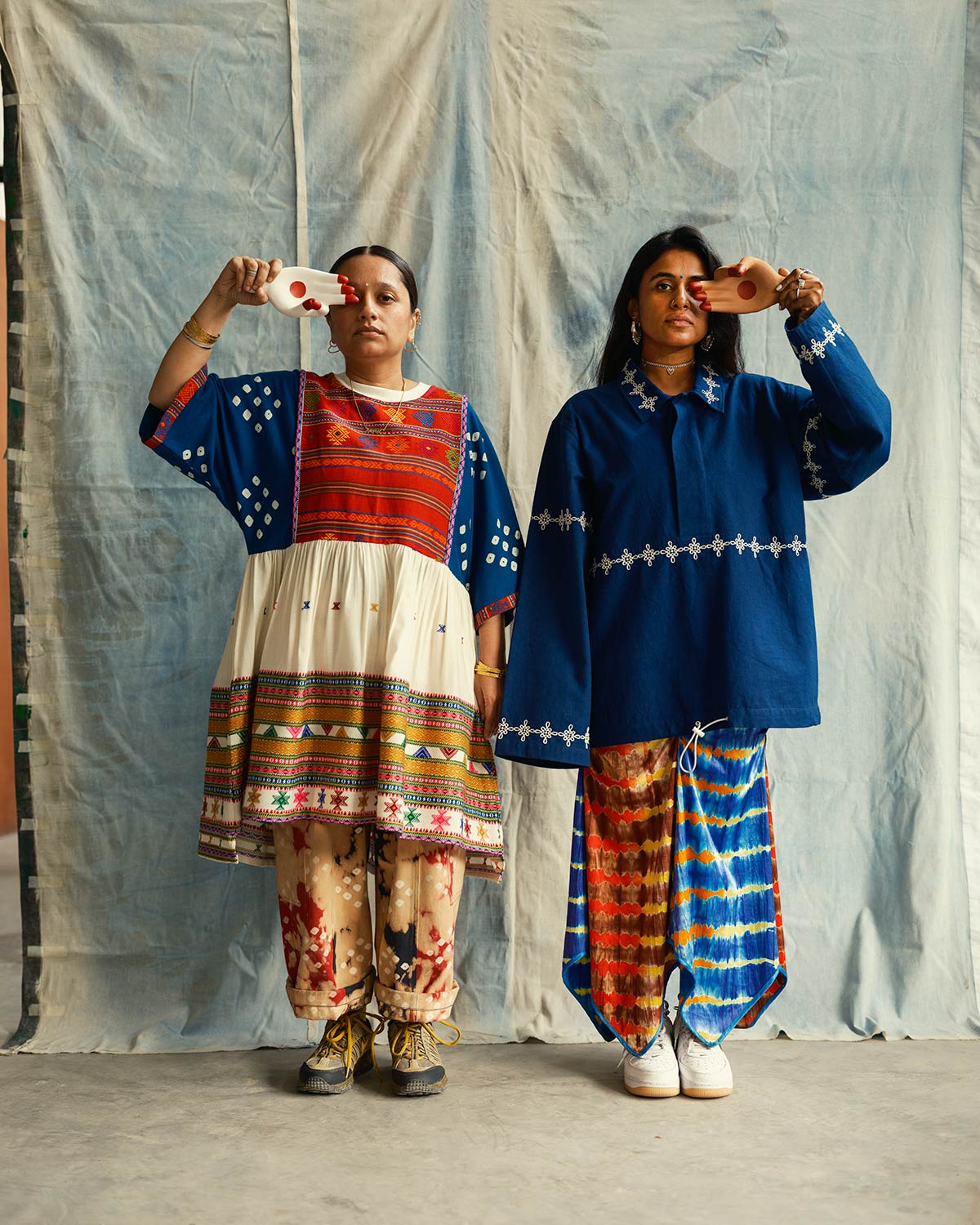
MRIGA KAPADIYA: We started our business in 2010. My good friend and business partner, Amrit, and I traveled to certain regions in India to learn more about textiles. We ended up in Kutch, Gujarat, in northern India. There, we found a library of indigenous tie-dyed textiles called Bandhani. We asked to meet the library’s founder, who introduced us to one of the families still keeping the art alive in that region. The Khatris are a sprawling family of around 50 tie-dye artisans. The men are the dyers, and the women are the tyers. Their tie-dyed fabrics were familiar to us because many of my mom’s shawls and sarees are made from that fabric. There was a specific fabric with tiny ties that fascinated us. We learned that the smaller the ties and the closer they are together, the more expensive the fabric is. It’s a status symbol, a representation of luxury.
The first fabric we developed was with that family, and is why we ultimately started NorBlack NorWhite. The first design we created had diamond shapes that went from large to small. The family hadn’t seen this kind of design before, and were initially confused, but also excited, because the fabric looked really beautiful. We ended up staying for a week, and they welcomed us into their household. It was a life-changing experience. When we went back to Bombay, we met our tailor, Mohammed G, who is still our tailor 15 years later. Neither Amrit nor I had a background in fashion, so we worked intuitively, learning from the ground up. Growing up in Toronto as immigrants inspired us to share our vision with people who might never get to travel in India.
NorBlack NorWhite is about exploring the gray space, the space in between. The Global South is represented in a certain way. It isn’t black or white. Nothing is black or white; you need to dig a bit deeper. You must have a lived experience. You must ask questions, and you need to be there and be present in order to have that experience and understand the nuances of every situation and its context. We are exploring the gray space, the Global South, ourselves as immigrants, and ourselves as diaspora. We went back to India 15 years ago, when it wasn’t particularly cool to move back to your ancestral lands. I grew up watching Michael Jackson videos. His song “Black or White” and the accompanying video with the mash-up of different cultures was a powerful visual for me. That song and the video informed our name. It started as an art project, and then we built a business, almost by accident.
CELINE: Back when you started, 15 years ago, “Made in India” translated as cheap, child labor. There was a lot of misinformation about the label “Made in India” and NorBlack NorWhite. You transformed what “Made in India” means. And you really championed the idea of making things in India. Did you notice the misinformation about the “Made in India” label?
MRIGA: The landscape has changed so immensely, but we understood 15 years ago how people looked at us. We noticed that only the aesthetic of the Global North was highly regarded. But we also learned that so many of the large fashion houses produce their things in India and never claim that, because they complete the last 10% of the finishing back in Italy or France. One hundred years ago, those things were produced fully in France and Italy, in the ateliers with the craftspeople of that region. Because it’s too expensive now, people produce in India, but never acknowledge that fact. It’s so frustrating when you’re in it, and you see it. A huge part of our work is about celebrating and making sure people are aware of the breadth of Indian art and craft, and how incredible it is, and how it is redefining the meaning of luxury.
When hundreds of hours are being poured into a piece of fabric, it is art, and it is luxurious. But if it’s not being showcased during Paris Fashion Week, it’s not celebrated. We are endeavoring to put India and the arts and crafts of India at the forefront. We work to make sure people know it is made in India and also work to elevate what that actually means. Smaller groups of people working with ancestral knowledge and talent that gets passed down generation after generation is priceless to me. There isn’t one lane of sustainability for us. We are interested in cultural sustainability, in raising the idea of what this culture means to us. It’s a very personal experience. We’re not speaking on behalf of everybody. Everyone has their own relationship with India, with the diaspora, with being an immigrant. For us, it’s about creating a space for what we relate to in the culture and for what we love about the culture and how we see it, and how we’re bringing our cultures together and mashing up our worlds.
Of course, we’re working with specific fabrics and certain types of hand processes and hand techniques; we’re not mass producing. Greenwashing is frustrating. What is being used as a marketing term as opposed to being a methodology? For us, it’s really about cultural sustainability, about uplifting the value of being made in India, the value of the silk trade, the textile trade from the Global South. A lot of brands and fashion houses use the silhouettes of India, and then neutralize them with their colorways. They call it contemporary and raise the price by 1000s of dollars. The Global South is finally being celebrated and commercialized in a very different way now because people are ready.
CELINE: There needs to be a redefinition of what luxury means. Right now, luxury means status. It means that you identify with the colonial values of superiority. What you are proposing as an alternative idea of luxury comes with a whole other paradigm. Can you talk to me a little bit about what luxury means to you?
MRIGA: Luxury is expressed by how much knowledge is being passed on through a craft, a skill that you can’t learn in just a few months or years. These are arts, crafts, and skills that are created and passed down over generations by word-of-mouth and through lived experience. To me, that is legitimately priceless, and priceless is luxury. It is luxurious to experience the hands of somebody else, and the time it takes people to create a piece of art, as well as the amount of time it has taken for that knowledge to be passed down. People feel like they can study something for one year, three months, six months and then call themselves experts in a field. I feel like the sacredness of time has been stripped away. Time and luxury are correlated. Luxury involves passing down knowledge and the time and care that is required to produce a piece.
CELINE: NorBlack NorWhite is one of the most successful sustainable brands that exists. Tell me about how your collaboration with Nike came about.
MRIGA: Nike approached us two or three years ago. They were interested in our work and excited about us as women founders. We started building a relationship, and then they asked us to produce a collection with them. It was the first collaboration for them with anyone representing India. We worked within the Nike design framework, so there were definitely parameters to work within. For us, it was exciting as a platform. I grew up playing sports. It was a big part of my life, and it has become a big part of how I see the world… through play. It was an opportunity to bring our worlds together and give our representation of what it feels like to be a strong, resilient athlete in India.
Nike loved our perspective on how navigating India as a woman feels like playing a sport every day. So many things get thrown your way, and in the maze that is India, especially in the big cities, it feels like you’re running a marathon, and sometimes it feels like a relay. It feels like an athletic experience just to navigate India… and then navigating India as women, designing and creating and producing, and then also running a business. All of it feels like you have to have an athletic mindset, and so we aligned on that idea.
It was a beautiful experience to get to bring the collection to life by shooting our campaign in Jaipur. We hired professional athletes, cricket players, runners, and wrestlers from India, mixed with some of our friends and models. It was a nice ensemble of 12 women we felt were a great representation of the power of sport, and NorBlack NorWhite. Young people in India were so excited. They saw us as an underdog brand that was working with one of the largest brands in the world. It was an example of how things can happen in mysterious ways. It was never a goal of ours to work with Nike. But the way it unfolded was beautiful. A lot of people learned about us through the collaboration.
CELINE: Was there any backlash?
MRIGA: There are always going to be people who have no clue because they’ve never done any of this. We have learned over the last 15 years that as long as we feel good about what we’re doing and the way we’re doing it, we’re fine. We check in with our peers and our mentors to make sure that we are staying true to our ideals. We try to stay focused on how this collaboration opened doors for us and other people, rather than the negative noise in the background. There’s always going to be a backlash, but that’s part of the game.
CELINE: My last question is about your furniture collection and the way you put it together. And there’s a homeware collection that’s going to come out at some point. Tell me how all that came about?
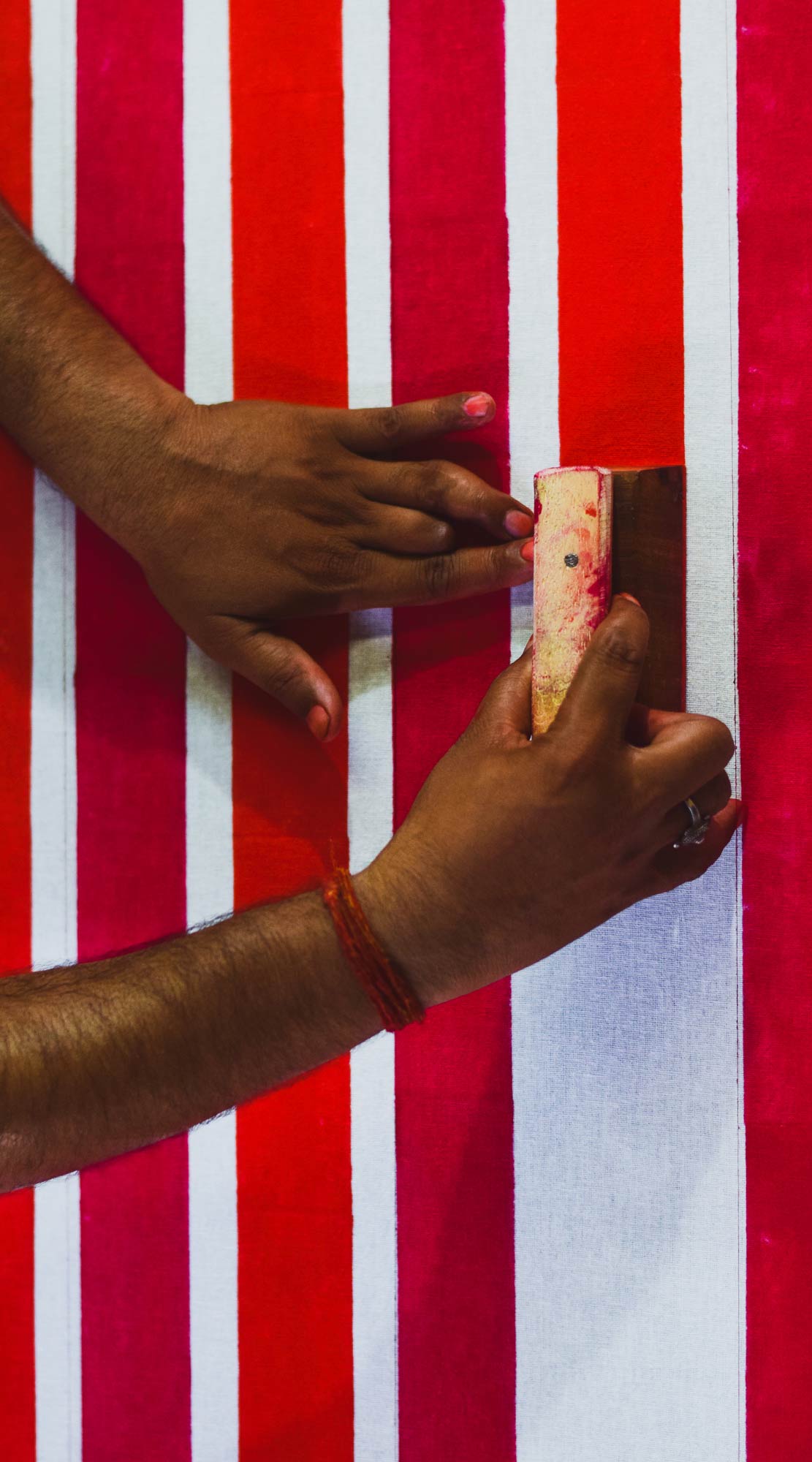
MRIGA: The furniture collection was a project that came about through Vogue India. They asked us to contribute by playing with the idea of architecture and fashion in India. And so we created gradient covers for chairs. When we attend a gathering or a wedding in India, there are always big bows or silk or satin draped chair covers. They’re always really fun and have a specific aesthetic. So we thought about how we could design something like that. We’re not interested in designing chair covers for weddings, but by taking that idea out of that space and then putting it into a different context, into more of an art space, is what inspired us. We’ve been creating tapestries and lamp covers and building this chair project, and so there’s going to be a lot more to come from that. It’s exciting for us because we get to use everything we’ve learned for the last 15 years in a different form. We’re evolving as we grow and live. And we want to contribute everything we’ve learned in a form that feels more relatable to us. We never wanted to create a brand. It’s always been an art project, a platform for us to play and create. We’re entering a new chapter where we can play with something as simple as a chair and make it really beautiful, and talk about what that represents. We’re exploring how cultures connect, and the designs that weave through that make us feel at home while continuing to play with the aesthetic elements of the object or item of clothing.
{
"article":
{
"title" : "NorBlack NorWhite",
"author" : "Mriga Kapadiya, Céline Semaan",
"category" : "interviews",
"url" : "https://everythingispolitical.com/readings/norblack-norwhite",
"date" : "2026-02-13 08:40:00 -0500",
"img" : "https://everythingispolitical.com/uploads/Mriga-Bharat-Sikka-2.jpg",
"excerpt" : "",
"content" : "Photography courtesy of NorBlack NorWhiteCELINE SEMAAN: With your fashion brand, NorBlack NorWhite, you have redefined what sustainability means and have put at its heart the artisans and people of the Global South. What inspired you when you first started, and how has your company evolved?MRIGA KAPADIYA: We started our business in 2010. My good friend and business partner, Amrit, and I traveled to certain regions in India to learn more about textiles. We ended up in Kutch, Gujarat, in northern India. There, we found a library of indigenous tie-dyed textiles called Bandhani. We asked to meet the library’s founder, who introduced us to one of the families still keeping the art alive in that region. The Khatris are a sprawling family of around 50 tie-dye artisans. The men are the dyers, and the women are the tyers. Their tie-dyed fabrics were familiar to us because many of my mom’s shawls and sarees are made from that fabric. There was a specific fabric with tiny ties that fascinated us. We learned that the smaller the ties and the closer they are together, the more expensive the fabric is. It’s a status symbol, a representation of luxury. The first fabric we developed was with that family, and is why we ultimately started NorBlack NorWhite. The first design we created had diamond shapes that went from large to small. The family hadn’t seen this kind of design before, and were initially confused, but also excited, because the fabric looked really beautiful. We ended up staying for a week, and they welcomed us into their household. It was a life-changing experience. When we went back to Bombay, we met our tailor, Mohammed G, who is still our tailor 15 years later. Neither Amrit nor I had a background in fashion, so we worked intuitively, learning from the ground up. Growing up in Toronto as immigrants inspired us to share our vision with people who might never get to travel in India. NorBlack NorWhite is about exploring the gray space, the space in between. The Global South is represented in a certain way. It isn’t black or white. Nothing is black or white; you need to dig a bit deeper. You must have a lived experience. You must ask questions, and you need to be there and be present in order to have that experience and understand the nuances of every situation and its context. We are exploring the gray space, the Global South, ourselves as immigrants, and ourselves as diaspora. We went back to India 15 years ago, when it wasn’t particularly cool to move back to your ancestral lands. I grew up watching Michael Jackson videos. His song “Black or White” and the accompanying video with the mash-up of different cultures was a powerful visual for me. That song and the video informed our name. It started as an art project, and then we built a business, almost by accident. CELINE: Back when you started, 15 years ago, “Made in India” translated as cheap, child labor. There was a lot of misinformation about the label “Made in India” and NorBlack NorWhite. You transformed what “Made in India” means. And you really championed the idea of making things in India. Did you notice the misinformation about the “Made in India” label?MRIGA: The landscape has changed so immensely, but we understood 15 years ago how people looked at us. We noticed that only the aesthetic of the Global North was highly regarded. But we also learned that so many of the large fashion houses produce their things in India and never claim that, because they complete the last 10% of the finishing back in Italy or France. One hundred years ago, those things were produced fully in France and Italy, in the ateliers with the craftspeople of that region. Because it’s too expensive now, people produce in India, but never acknowledge that fact. It’s so frustrating when you’re in it, and you see it. A huge part of our work is about celebrating and making sure people are aware of the breadth of Indian art and craft, and how incredible it is, and how it is redefining the meaning of luxury. When hundreds of hours are being poured into a piece of fabric, it is art, and it is luxurious. But if it’s not being showcased during Paris Fashion Week, it’s not celebrated. We are endeavoring to put India and the arts and crafts of India at the forefront. We work to make sure people know it is made in India and also work to elevate what that actually means. Smaller groups of people working with ancestral knowledge and talent that gets passed down generation after generation is priceless to me. There isn’t one lane of sustainability for us. We are interested in cultural sustainability, in raising the idea of what this culture means to us. It’s a very personal experience. We’re not speaking on behalf of everybody. Everyone has their own relationship with India, with the diaspora, with being an immigrant. For us, it’s about creating a space for what we relate to in the culture and for what we love about the culture and how we see it, and how we’re bringing our cultures together and mashing up our worlds. Of course, we’re working with specific fabrics and certain types of hand processes and hand techniques; we’re not mass producing. Greenwashing is frustrating. What is being used as a marketing term as opposed to being a methodology? For us, it’s really about cultural sustainability, about uplifting the value of being made in India, the value of the silk trade, the textile trade from the Global South. A lot of brands and fashion houses use the silhouettes of India, and then neutralize them with their colorways. They call it contemporary and raise the price by 1000s of dollars. The Global South is finally being celebrated and commercialized in a very different way now because people are ready. CELINE: There needs to be a redefinition of what luxury means. Right now, luxury means status. It means that you identify with the colonial values of superiority. What you are proposing as an alternative idea of luxury comes with a whole other paradigm. Can you talk to me a little bit about what luxury means to you?MRIGA: Luxury is expressed by how much knowledge is being passed on through a craft, a skill that you can’t learn in just a few months or years. These are arts, crafts, and skills that are created and passed down over generations by word-of-mouth and through lived experience. To me, that is legitimately priceless, and priceless is luxury. It is luxurious to experience the hands of somebody else, and the time it takes people to create a piece of art, as well as the amount of time it has taken for that knowledge to be passed down. People feel like they can study something for one year, three months, six months and then call themselves experts in a field. I feel like the sacredness of time has been stripped away. Time and luxury are correlated. Luxury involves passing down knowledge and the time and care that is required to produce a piece. CELINE: NorBlack NorWhite is one of the most successful sustainable brands that exists. Tell me about how your collaboration with Nike came about. MRIGA: Nike approached us two or three years ago. They were interested in our work and excited about us as women founders. We started building a relationship, and then they asked us to produce a collection with them. It was the first collaboration for them with anyone representing India. We worked within the Nike design framework, so there were definitely parameters to work within. For us, it was exciting as a platform. I grew up playing sports. It was a big part of my life, and it has become a big part of how I see the world… through play. It was an opportunity to bring our worlds together and give our representation of what it feels like to be a strong, resilient athlete in India. Nike loved our perspective on how navigating India as a woman feels like playing a sport every day. So many things get thrown your way, and in the maze that is India, especially in the big cities, it feels like you’re running a marathon, and sometimes it feels like a relay. It feels like an athletic experience just to navigate India… and then navigating India as women, designing and creating and producing, and then also running a business. All of it feels like you have to have an athletic mindset, and so we aligned on that idea. It was a beautiful experience to get to bring the collection to life by shooting our campaign in Jaipur. We hired professional athletes, cricket players, runners, and wrestlers from India, mixed with some of our friends and models. It was a nice ensemble of 12 women we felt were a great representation of the power of sport, and NorBlack NorWhite. Young people in India were so excited. They saw us as an underdog brand that was working with one of the largest brands in the world. It was an example of how things can happen in mysterious ways. It was never a goal of ours to work with Nike. But the way it unfolded was beautiful. A lot of people learned about us through the collaboration. CELINE: Was there any backlash?MRIGA: There are always going to be people who have no clue because they’ve never done any of this. We have learned over the last 15 years that as long as we feel good about what we’re doing and the way we’re doing it, we’re fine. We check in with our peers and our mentors to make sure that we are staying true to our ideals. We try to stay focused on how this collaboration opened doors for us and other people, rather than the negative noise in the background. There’s always going to be a backlash, but that’s part of the game. CELINE: My last question is about your furniture collection and the way you put it together. And there’s a homeware collection that’s going to come out at some point. Tell me how all that came about?MRIGA: The furniture collection was a project that came about through Vogue India. They asked us to contribute by playing with the idea of architecture and fashion in India. And so we created gradient covers for chairs. When we attend a gathering or a wedding in India, there are always big bows or silk or satin draped chair covers. They’re always really fun and have a specific aesthetic. So we thought about how we could design something like that. We’re not interested in designing chair covers for weddings, but by taking that idea out of that space and then putting it into a different context, into more of an art space, is what inspired us. We’ve been creating tapestries and lamp covers and building this chair project, and so there’s going to be a lot more to come from that. It’s exciting for us because we get to use everything we’ve learned for the last 15 years in a different form. We’re evolving as we grow and live. And we want to contribute everything we’ve learned in a form that feels more relatable to us. We never wanted to create a brand. It’s always been an art project, a platform for us to play and create. We’re entering a new chapter where we can play with something as simple as a chair and make it really beautiful, and talk about what that represents. We’re exploring how cultures connect, and the designs that weave through that make us feel at home while continuing to play with the aesthetic elements of the object or item of clothing. "
}
,
"relatedposts": [
{
"title" : "Yasmine Hamdan: I Remember, I Forget",
"author" : "Yasmine Hamdan, Céline Semaan",
"category" : "essays, interviews",
"url" : "https://everythingispolitical.com/readings/yasmine-hamdan-i-remember-i-forget",
"date" : "2026-03-16 13:32:00 -0400",
"img" : "https://everythingispolitical.com/uploads/20251215_Film01_0043.jpg",
"excerpt" : "",
"content" : "CÉLINE: I’ve been such a fan of yours since I was a teenager. I saw you one time singing in bare feet. It was the Soap Kills [Lebanese band fronted by Hamdan] era, and it was in Beirut. I remember my mind being blown. Your music blends the traditional and the contemporary. How do you see this as a form of political resistance in a world that tries to flatten Arab identity?YASMINE: There was never a strategy, but there was a necessity for me to do something that resembles me. I’m inspired by Arabic music from the past. I compose based on what inspires me, what I’m in touch with. And of course, the political came with the choice of singing in Arabic. When I started singing in Arabic, it was not at all a trend. In the beginning, with Soap Kills, when I was not involved in writing the songs, everybody liked us because we sang in English. The minute I started singing in Arabic, we got mixed reactions. Of course, there was an underground energy to it. And there were a lot of people interested in us because they felt that this was echoing something interesting for them, but radio and newspapers were not interested or unnerved by us. I had the desire to re-appropriate the language. I needed to be sincere with it, but I didn’t know the codes, and I was not ready to learn any rules. I wanted to be extremely free to present something vulnerable or mixed, not pure. I was in the middle of an identity crisis, and it was my own journey that I was exploring through music. Maybe this is what spoke to a lot of people…CÉLINE: It spoke to me, for sure. And the fact that it was in Arabic, also for me, was very powerful. YASMINE: This is when I decided to sing professionally, when I felt there was something political behind singing in Arabic. I was rejecting the rules, the formatting, and the codes. I wanted to experiment with something different. And the fact that I was a woman… I was finding a place for me. I didn’t feel that I belonged to one place. I didn’t feel at home in Lebanon, but I didn’t feel at home anywhere else. I didn’t know what home was, but at the same time, I had emotions I was trying to express. In Europe, to sing in Arabic was subversive because the audiences wanted you to stick to the image they had of an Arabic woman singing in Arabic. CÉLINE: You broke the mold and spoke to a generation that, like you, did not feel at home in Lebanon, did not feel at home outside of Lebanon, and had a mix of emotions. Do you think that because you’re an Arab woman, everything you do is political, whether you sing in English, French, or Arabic?YASMINE: I don’t know. I think you are political when you make choices, when you are in your kitchen, and you decide not to waste water or food. It’s a choice to live artistically, and art is political in general. I see the world through particular lenses, and it’s important to make choices that are aligned with who you want to be, with your desires and ethical views. CÉLINE: Your 2025 album, I remember I forget, seems to be a culmination of all your other albums. When I’m in New York, I forget myself, forget where I come from. I have to work hard to remember and struggle with feeling lost. So I listen to music, I listen to Arabic, I listen to things that are from my culture. And then when I go to Lebanon, everything comes back to me, but the sense of running never leaves me. In the video for the title track, “I remember I forget,” your character is constantly running. It really resonated with me. Tell me more about it. YASMINE: This song was difficult for me to write. I was obsessing about it for two years. When I say songs, I’m talking about the music; the lyrics come after. Then one day, I had the opportunity to record some Tuareg musicians (the Tuareg people inhabit a vast area in the Sahara – Wikipedia), and they did something completely different on another song. I took some of what they did and mixed, looped, cut, and reversed, and then the lyrics came. We all struggle with the world, with what we see, and what to do with that. What do you do with violence? Do you let it infiltrate you, and does it transform into inner violence? How do you keep yourself? How do you protect yourself and your soul?Coming from Lebanon… it’s been quite difficult. And then you see Palestine. It’s brutal. I wanted to talk about it, my feelings of alienation and despair, but also… hope. There’s something playful about the music, and I had a lot of fun working on it. I wanted to find a counter-balance to the normalization of violence we see today. In the video, I imagined a character who would be running from obstacles. I wanted to talk about this survival mechanism. I also wanted to have something playful in the video, a character who echoed Super Mario. I ultimately wrote and directed the video myself. My partner, Elia Suleiman (Palestinian film director and actor, best known for the film Divine Intervention, which won the Jury Prize at Cannes in 2002 – Wikipedia), would offer two or three words of feedback and put me on the right track. I wanted to talk about things that burden my eyes and heart, but I wanted to keep it comic. I wanted to talk about the militarization of the world… and the climate crisis. I also wanted to talk about what we have been living through recently, with us witnessing these wars in our homeland and globally, with the fact that I sometimes feel a bit schizophrenic. I live a nice life in Paris, but I also feel like I’m living in a time of war. It’s very confusing. Every time I think I’m stronger, I collapse. And then every time, I collapse, I forget that I collapsed the last time and the time before, and that I managed to rise up and continue. CÉLINE: You’re literally narrating my life. You don’t feel at home in Lebanon. You don’t feel at home anywhere else. I also don’t feel at home. How does displacement and the idea of “home” inform your music and performance? How do you find home?YASMINE: I’ve been living in Paris in the same apartment for about 20 years, so I can say that this is my bed, my room, my partner, my cat, my books, my instruments, my couch. This is home for me because I have a relationship with the space. But at the same time, I find myself in many places. Also, music is home, a beautiful book that inspires me, that opens my heart, is home… It depends on how you want to define home. I go to Mexico City, and I start wishing that I could live there forever. Then, when I leave, I’m so happy to go back home. I have this romantic idea of myself living in nature somewhere with the animals. And then when COVID happened, I felt that I could be in many places. I could travel a lot… I’m very privileged in reality. And this is what I need to always remember, because when we see the world the way it is, when you see the suffering… it’s inconceivable. It’s not even possible to imagine it. We are very lucky. I don’t try to find home… it’s not important. CÉLINE: You’re literally singing my life with your words! You feel very deeply. You’re very aware. You are seeing it all. You are witnessing it. You are living it in your bones. But you are not there. You are not in Gaza. You are not in Lebanon back in the day. But you are processing all this… Tell me a little bit about that processing…YASMINE: I’m very sensitive to people’s energy, and this is a problem sometimes, because you cannot live your life this way. I’ve been trying to work on this, but at the same time, I have access to a lot of emotions. I also try to improve the way I interact with these emotions. I do a lot of work on myself on many levels. I also feel very grateful that I have music. I have this tool, and I can transform experiences. The Port of Beirut explosion on August 4, 2020 [triggered by the ignition of 2,750 tons of ammonium nitrate, resulting in hundreds of fatalities, 7,000 injuries, and approximately 300,000 displaced individuals, alongside property damage estimated at US$15 billion], was very painful… I had never experienced that kind of grief. My reaction was an accumulation of experiences, and I’m grateful that I was able to transform that experience, that I was able to work with people in a creative way, to transcend it, and to present it to the world. I was able to transform it into something that I felt could be beautiful. I think we all suffer. We all have periods when we deal better with suffering. We all have periods when we’re completely lost, and that’s okay. I was lost, and I accepted it. I had no idea what I wanted, honestly, and when I started working on the (latest) record, I didn’t want to have any strategy. I disappeared from social media for five years. I needed to reconnect, to rewire things… it’s okay to stop sometimes, and it’s okay not to be productive, and it’s okay to be vulnerable. CÉLINE: As you know, we work for collective liberation. How do you imagine the role of Arab art and music in movements for collective liberation?YASMINE: I don’t know because I’ve always felt like I live on the margins. It has to do with my childhood. I had a ruptured childhood; we lived off and on in Lebanon and other cities. I never lived in a community. I was never aware of social codes, and my parents didn’t teach me. So, when I arrived in Lebanon in the beginning, I suffered a lot because I felt that I was either rejected or seen as a bit exotic because I had no idea how things should function. I always felt a bit like an outsider. I’m really interested in collectives, in the energy of communicating and bringing things together. But I’ve never really understood how it works. When I perform, the energy I get from the audience and that I give is real. It’s a relationship. I find my influences in many places; I don’t necessarily find them only in Arabic music. But I do think that we need to get organized. It’s a learning process, to gather, to organize… so for me, it’s important, and especially today, when you look at the world, and you see how scary it is. It’s terrifying because so much evil is organizing and I feel that. I don’t know how to do it yet. I finished a big part of the album before October 7, 2023, and when October 7 happened, when everything we are seeing in Palestine started, I felt like I was breaking once again. I felt like the experience of the Beirut explosion was happening again. I lost interest in this record, and I didn’t work on it for a few months. The first time I listened to it again, I was scared that it would not echo what we are living today, because there’s a before and an after, for sure. Time is important when you are working on something, because when you give it the time it needs, when you are not forcing, when you are respecting the movement, it can take many shapes. I was repairing myself. I was taking care of myself. What I cared for was to be aligned. I hope it will touch people and that it will give back. I wanted to do something that I would be proud of. I didn’t want to rush things. I didn’t want to make compromises. I didn’t want to scare myself with the thought of failing or of being disappointed. When you present a work to the outside world, you have all these fears. CÉLINE: The world has been transformed by Palestine… the world has undergone a rapid change, a rapid transformation. People think it’s not fast enough. We should be ending this genocide once and for all. There has been a change, though, there has been a massive change on a global level that is going to take time for people to process. And I think that this album is helping us process…I want to add something about Lebanon. Now, we are an invisible cause, because it’s not clear to the public what Lebanon went through. It’s not even clear to us. There’s so much murkiness around the Civil War… In the West, people don’t understand. There is censorship when it comes to the region overall. How do you navigate censorship?YASMINE: When I do interviews with French journalists, I see what they project on me… Sometimes, when they are not political enough, I’m ashamed because I don’t recognize this portrayal of who I am. This is one of the reasons I wanted to stop music at one point… the way journalists portray me in Western media. I sometimes I feel totally reduced, like it harms my soul. I see the censorship. I see the fear in the journalists. I see how most of it is crystallized around Palestine and around Israel and Lebanon and the region. I went to one demonstration, and they caught us. Then I had a fine. I found a way not to pay the fine, but I was very angry… and it was an accumulation of anger. Angry for Lebanon, angry for my parents, for all my friends, and some of my family who were exploded in the Port of Beirut incident. And I’m angry about this, and I’m angry with Lebanese people, and I’m angry that nobody unites…When I was a teenager, I was full of dreams, and I was also full of insecurities and doubts. And when I started, people were really brutal. There were people who came to the concerts, and the energy was huge, but there were a lot of people who resisted. I always felt somehow marginalized… stigmatized. When I started doing music, I felt there was a lot of resistance. I carried this with me throughout my journey. I do have a relationship to Lebanon through this. I had to fight for myself. I had to fight to not abide by the rules and not do it the traditional way… So I felt that there was something bitter for me there, even though Lebanon gave me so much, and the people there gave me so much. And my inspiration in everything I do comes from Lebanon. I was in Lebanon the summer of 2021, and I came back to Paris after a month and a half there… I was destroyed, but then I was able to write my first words for the song and for this album… it opened a door for me. Lebanon, whatever happens, has something to give you. So yes, we have a very complex relationship to Lebanon, to Lebanese people. I hear there’s so much racism, so much manipulation… politicians condoning Marine Le Pen [president of the far-right French National Rally party from 2011 to 2021, daughter of its founder under the name National Front]. They manage to separate people, separate the struggles… We don’t have one enemy, one precise enemy, like the Palestinians. We are very complex. We have the same enemy, but we also have other enemies. They have one enemy. We have hundreds of enemies. CÉLINE: I always say Palestine and Lebanon are sister nations. We share one enemy. But Lebanon has its own enemies and problems. I talk a lot about that in my book, A Woman Is a School, about the internalized colonialism that Lebanese people face. Colonialism in Lebanon has been rejected because there was an illusion of independence. We were never sovereign. Yes, we had a flag, we had a song, but no, we were not sovereign. We host one of the largest US Embassies in the world, in Lebanon. We are under US imperial control. "
}
,
{
"title" : "Rahma Zein is Defying Journalism",
"author" : "Rahma Zein, Céline Semaan",
"category" : "interviews",
"url" : "https://everythingispolitical.com/readings/rahma-zein-defying-journalism",
"date" : "2026-03-16 12:32:00 -0400",
"img" : "https://everythingispolitical.com/uploads/251110_EIP_Rahma_Zein_0033.jpg",
"excerpt" : "",
"content" : "RAHMA ZEIN: I was always a field journalist. That was my main occupation. I tried to leave it because it was becoming stressful… that was at a time when media was very orthodox. Whatever channel you’re working for, you’re going to be following that agenda. But now in the age of social media, everyone is their own journalist. When I was a field journalist, I saw media bias… you’re seeing other journalists who are pouring in from other countries, and you’re seeing their work ethic, and their values. They report about you, not with you in a way. So, you’re being talked about as if you’re a species in a jungle. “Look how they behave. ” You have to understand that your words carry responsibility. The dehumanization process was something you could see happening in regards to the Palestinian cause. After years of watching your people being dehumanized in this way, you see how this affects communication between your people in the region as well as in the West. Many US citizens didn’t realize where their tax money was going; many US citizens didn’t realize the extent of Israel’s interference. So instead of reporting on us being uncivilized, on us eating with our hands, on the state of our women, report on the interference of a foreign entity in our internal politics. This frustration led to a boiling point where I couldn’t take it anymore, and I used my old school field reporting tricks to find my way to the border. It was October 20, 2023, and I didn’t know that she (CNN reporter, Clarissa Ward) would be there [at the Rafah Border Crossing, the sole crossing point between Egypt and Palestine’s Gaza Strip]. It was actually a UN conference, surprisingly enough, and António Guterres, the Secretary-General of the United Nations, was there. You don’t see the whole video, but I was screaming at everyone [Zein accused Ward of biased reporting legitimizing the ongoing Israeli invasion of the Gaza Strip]. When I went up to talk to Guterres, he said essentially that there was nothing they could do. You could tell that the man was just so ill-equipped, a manager who didn’t have the authority to be a manager. A puppet, basically, which is what I said. The UN is inadequate. They are mouthpieces… That was the boiling point that got me to scream the way I screamed. CELINE: The video went viral. People shared your video because you spoke from the heart on behalf of all of us who wanted to say what you said to the people in power and the people who are responsible for the harmful narrative. What was it like to interact with them? What was their reaction when you were there?RAHMA: I was staying overnight in a tent about 3 miles from the border. Other journalists were there, but CNN’s Clarissa Ward was not. You cannot walk in with brushed hair on the second day to report when you weren’t even in the field. I was there the night before, and at around 2:33 am I got woken up by the bombing. My tent was shaking; the bombings were relentless. I was a field journalist. I’d been to Libya. I’d seen dead bodies, I’d experienced shootings, I’d experienced bombings, but nothing like what I was experiencing that night. I was so shaken; each bomb was a family, a building, and another family… waiting to be next. I got out of the tent and looked around. There were aid workers there, but they were used to bombs, so they were snoring away. I kept on walking around… the heartbreak of it, the fact that it was so close and no one could do anything. The feeling of helplessness. Later, when I approached Clarissa, she rolled her eyes at me and walked away, and the cameras caught it. Her cameraman was feeling guilty and said to me, “I served in Gaza. ” I was like, “That’s even worse… you have even more of a responsibility. ” He’s the one who got her to come back and talk. She was never planning on talking to me, ever. Words carry weight. Messages carry weight. Speaking out carries weight. Man is born on earth with free will. You can choose to be a good person, or you can choose to be an egotistical individual…CELINE: How has journalism changed in the past three years, and how has the Global South’s perspective on journalism impacted the Global North’s perspective on journalism?RAHMA: That’s a very interesting question, because I’ve seen it through different generations. My grandparents were journalists, and my mother was a journalist. I’ve seen it from the ultra-orthodox perspective, how journalism ought to be, to how journalism is today. I remember sitting at the dinner table with my grandparents discussing what the role of a journalist was—a storyteller, impartial. Were you supposed to show the footage, and as a field journalist, just say this is what’s happening behind me and leave?There are so many aspects to it. Old school journalism. You wait for the newspaper, you wait for the TV program, and what you watch is what is approved, be it here or in the West. I was covering the Mitt Romney/Obama election in 2012, and we were going on tour. You see how media is done; they feel they are in a bubble. You’re not part of the world, you’re either dictating it or you are impartial to it. There’s no bridge between you and the world. And this is how US politics and its foreign agenda has been able to be so hard and cool. There is a lack of connection between what the US is doing abroad and their internal politics. Journalism, at one point, turned into merely propaganda. I’m taking away from the story of the other in order to then justify an action against them politically. But this is the case in most countries when you’re going to raise a certain price, and you know that people aren’t going to take it well, you write a specific news story that gets the crowd going. In a way, there’s no more journalism because you decide, as an audience, who you’re going to listen to. Because of the growth of the atrocities around the world and what we are now aware of because of globalization, which is actually Westernization, people are waking up to their responsibility to be their own journalist. As a journalist, my mother believes that you should be impartial. This is the footage. This is the subject. This is what’s happening. You analyze based on your own experience, your own prejudice. I feel you have a responsibility not to preach, not to teach, but to at least explain this footage in the context of history. I’m not just going to show you subject and action. I’m going to show you what happened that led to subject and action. What’s the story? A beginning, middle and end. I can’t just come in the present and tell you this is what it is without giving you a backdrop, because everything is a threat, and therefore, this is where I take away my impartiality. I’m still making it about the story and the subject, but I have a responsibility to tell you how this man came to be and how this action came to be. That is what I believe journalism ought to be. I believe that people now have their own responsibility. Everyone is a journalist. This is why I loathe the word activist, because it compartmentalizes you. It can be seen in a negative light. These words are so dangerous because they are easily manipulated and hijacked, and a certain meaning is normalized. Normalization doesn’t make something right. Every single individual has a responsibility to care for the world. It is not up to the activist; it’s not up to the politician. It is not up to the journalist. It is not up to the teacher. You can work your nine-to-five job and do something actively to make this world a better place. CELINE: I know you were a part of the era of citizen journalism, back in 2010, during the Arab Spring. With citizen journalism, how do we figure out what’s true and what’s made up. RAHMA: We have, as people, a responsibility to listen, to read and come up with our own understanding, our own conclusion. And there is also a responsibility not to tear each other down. You need to ask yourself, are you venting, or are you actually wanting to create change? For us to have been silent about Iraq and now this is happening in Palestine, for us to have the world on fire around us and not be active participants anymore is no longer an option, and it is really up to every single individual. I have a friend who said to me that it was very hard for him to look at what was happening in the world. I said that it was hard because he was not doing something about it. It’s not so hard if you don’t have an unhealthy relationship with the world where you’re too attached to it. You respect it, you understand it, you get its value, and you also understand that bad and good is a very Western thing. People don’t want to know what’s happening in the world because they think they’re helpless to do anything about it. And it starts with understanding that you’re not helpless. You have to know that there is something for every single one of us to do, and that resistance comes in different forms. You will use diplomacy. I will shout. This person will take action. It’s okay, as long as we’re heading towards the same path. CELINE: Absolutely, it resonates deeply with me, what you’re saying. How can you center yourself in a way that’s not harmful, but productive? I want to highlight the work you’ve done recently. You met with people who had been imprisoned by the Israelis. How did you manage to meet them? And what was it like for you?RAHMA: It was very inspiring. Some of the Palestinian hostages I’ve had conversations with have been in Israeli jails for over 20 years, in horrific circumstances. I cannot imagine lasting two days in that kind of environment where there is a person whose sole purpose is to break you. They are well-versed in psychological warfare. When I was in Rafah, they opened up the border so aid could be made available, and families would rejoice. Then they would bomb the crossing. Just absolute, pure evil. One of the prisoners I spoke with spent 20 years digging a tunnel, and he managed to escape for five days. I asked him if it was worth it. He said he would have done it even if he were out for only an hour, because it showed them (the Israelis) that they were nothing. I can think of nothing more cowardly than someone who shoots a child in the head. (“Foreign doctors who have volunteered in Gaza say they have treated more than 100 children shot in the head or chest, clear evidence, they argue, that Israel is deliberately targeting minors. ” - Al Jazeera) So the fact that you should fear that does not even make sense. How can you fear someone who’s able to kill a child? You don’t fear a person like that. You’re disgusted, you find a way to fight a person like that. Another prisoner I spoke with, interestingly enough, was a Palestinian Jew. We were doing the interview, and I said to him, “How do you not break? I’m breaking listening to you. ” And he said, “Because our humanity is the very opposite of their inhumanity. That’s how you stay sane. You remind yourself that you’re human. ”CELINE: From a journalistic point of view to a human point of view. What’s your relationship to perfectionism, and how do you break away from perfectionism as a journalist, as a human, as a woman, as an Arab woman?RAHMA: My mother told me early on that once you start speaking to appease people or to appease an audience or to get a pat on the back, then you shut up. Not that I don’t like a pat on the back. Are you kidding me? I love it, but you have to check yourself. You have to constantly say to yourself, Am I saying this to be a hero, because someone is going to like me, or am I saying this because it’s actually strategic and it’s going to help, even though it’s going to make this person not like me?My grandmother was everything, and it’s opposite. She is detached, and at the same time, very attached to her identity. For you to question yourself means you’re confident and happy in your skin, for you to admit that you’re wrong, or for you to realize a different perspective is a good thing. Why can’t we have these healthy conversations with ourselves? Don’t take yourself so seriously. CELINE: You’ve been categorized as too loud by some Arab men, and somehow, you seem to trigger Arab men, or men in general. How do you reconcile what you do with the idea that you may ruffle some feathers?RAHMA: Criticism for being too loud or too emotional came from the tokens, the ones who want to assimilate. They are the ones from the School of Appeasement, and they need to realize that we’ve tried appeasement. We’ve tried appeasement, to sit at the dinner table and be quiet and be accepted. But now it is time to make our own dinner table. When these men criticize me, I tell them to self-reflect and be proud of their identity. "
}
,
{
"title" : "Astrology is Political: A Look at 2026 Through Chani Nicholas’ Lens",
"author" : "Chani Nicholas, Céline Semaan",
"category" : "interviews",
"url" : "https://everythingispolitical.com/readings/astrology-is-political-chani-nicholas",
"date" : "2026-03-16 12:02:00 -0400",
"img" : "https://everythingispolitical.com/uploads/251120_EIP_Chani_Nicholas_0077-final.jpg",
"excerpt" : "",
"content" : "CHANI NICHOLAS: When I was 12, I had a reading from an astrologer, and I fell in love with it. I’ve been studying it ever since. I had a lot of astrologers, psychics, and healers in my life when I was young. It became a very important part of my life, and it felt like something that took hold of me from a really young age. CÉLINE SEMAAN: As an astrologer, what radicalized you? How do you feel astrology is connected to advocacy or politics? Did something happen in your life that made you feel like “this is unfair, I want to speak out”?CHANI: I had the good fortune of being educated by feminists. I had the good fortune of reading Black feminist thinkers. I had the good fortune of reading Chicana feminists. I had the good fortune of reading Indigenous feminists from the world over. I had the good fortune of being queer. I had the good fortune of being raised in a counterculture. I have the good fortune of having a very clear understanding of injustice, and that’s for a lot of different reasons. I’ve always been concerned with injustice, and that’s partly from some of my own personal experiences—being a woman, being Jewish. I understood from growing up in my family what it is to be othered. So, all of these things together, but mostly my education and being introduced to a multi-tiered feminist approach to the world, were the greatest gifts I could have had at a very young age. There’s a gift in wanting to decolonize and wanting to understand how power works in the world. CÉLINE: I love how you’re saying that it’s a good fortune, everything that you’ve described. Often, when we are introduced to these things, they’re tainted by the idea of being underserved or marginalized. We don’t always look at our lives in this way. That I’m so lucky to have come from a certain culture, or lucky to have had a certain upbringing and education. Is there a book you read or some other thing you experienced in your youth that made you feel more emboldened to do what you’re doing today?CHANI: There are so many teachers and professors I had who were devoted to the practice of teaching and of building out curriculum and educational experiences. What happens in a truly transformative classroom is that everybody’s stuff comes into the room. All the power dynamics and the emotional dynamics come into the room. Only an incredibly skilled facilitator can bring about alchemy. In the course of my life, I had the opportunity to be a part of two experimental and incredibly transformative educational institutions. I have such deep reverence for the curation of material that all the professors I worked with put together. To learn something actually demands that you change. Unless we are building that skill alongside taking in the information, it’s not actually going to produce any kind of real shift in the person or the world. The professors I had were just as important as the people they were getting us to read. And then, of course, my classmates, and what we helped to pull out of each other. One of the programs was called Assaulted Women’s and Children’s Counselor Advocate. It wouldn’t be named that now, but that was decades ago. It was basically Feminism 101. I just recently finished my bachelor’s at the California Institute of Integral Studies. CÉLINE: A lot of people perceive your platform to be about consulting the oracle or understanding a bigger perspective, but you’ve always included political education as part of your work. When you are looking at the planets and their positions and the influences they have on planet Earth, and you look at these patterns in relationship to the rise and fall of empires, or moments of collective awakening, do you see throughout our history how astrology and politics are intertwined?CHANI: Yes, always. Throughout history, if one empire took over another, they would be like, “Where are your astrology texts? Where are your medical texts? Where are your scientific texts?” Science, medicine, astronomy, and astrology were all intertwined. All empires in the ancient world, most of them that I know of, consulted astrologers, worked with astrologers, and wanted the astrological knowledge of competing empires. There’s no way we can look at astrology as a mirror of human potential, human design, human capacity, humans in general, and not look at it politically. It makes zero sense to me because politics is just people concentrated into a system. Every single major astrological moment has a precursor. When you look back in history, you can see that something is going to happen in February 2026. The last time Neptune and Saturn were conjunct—although not in the sign of Aries, which is where they will be at the end of February—we witnessed the fall of the Berlin Wall. Something will be eroded during the February 2026 conjunction. Maybe it’ll be the GOP. I don’t know, but we can feel it. It’s impossible to look at astrology and not be political. So many people want me to shut up and talk about astrology without ever mentioning politics, which is impossible. The horoscope can only be understood within the context of the person’s life. You have to contextualize the person, the place, the time, the thing. Otherwise, you don’t understand it and are looking at it through a keyhole. CÉLINE: Yes, the idea of apolitical astrology, or fashion, or beauty, or music, or anything is a false concept. 2025 was a “9” year (2+0+2+5 = 9), a year of endings and closures. It was also the Year of the Snake in the Chinese Zodiac. In your opinion, what has ended culturally? Or what are we no longer going to be thinking or doing? I don’t know if you can explain from an astrological perspective what has happened since 2020, but it feels like information is growing rapidly, and people are accessing it in a way that’s making them more aware. It’s creating an acceleration in what we call the revolution, the uprising. How do you see that in looking back at 2025, from the perspective you have?CHANI: The reputation of Israel as a democracy, as a place of human rights, has been fundamentally disrupted. We have to keep leaning into that because Israel, the genocide, and all of its components are one of the arms of the global capitalist system. It’s about nothing but money and land grabs. That is the greatest conspiracy. Naomi Klein, in her book, Doppelganger: a Trip into the Mirror World wrote: “…if no one ever taught you how capitalism works, and instead told you it was all about freedom and sunshine and Big Macs and playing by the rules to get the life you deserve, then it’s easy to see how you might confuse it with another c-word: conspiracy. ”Capitalism is the conspiracy. There’s this fixation on finding the problem. But there’s only one problem. And the problem is the money. If we follow the money, every war, every genocide, every point of human suffering that is man-made comes from that. Besides just being human, all points of systemic human suffering are about a very few people getting rich off our suffering, off violence inflicted on us, and off using us. I hope that since 2020, that is what has eroded. Saturn and Pluto came together at the very top of 2020. And that conjunction is a marker of pandemics, disease, and the overhaul of a structure. It’s a marker of exposing something deeper about our structures. This time has been a harrowing journey that has resulted in more fascism, because we have never gotten to the root of the problem. Which is that all major corporations are the welfare queens of the world. They are stealing our life force, our money, our future, our children’s futures, the Earth’s future. It just goes on and on, but it’s a simple thing that has been contorted. They love to deflect with racism and anti-trans hate, and bigotry, and xenophobia, and Islamophobia, and all the things that separate us. CÉLINE: Ultimately, the playbook is to divide and conquer, which has been in place since the Roman Empire. It’s been ingrained in popular culture that Israel is an ally to the United States, equal to the United States in their values regarding human rights. However, we’ve seen this past year how Israel’s image has shifted in an irreparable way, in a way that I don’t think can be salvaged. Now we’re seeing the Zionist project for what it is. From an astrological point of view, what happened? Is it a planet specifically, or a position? Is there something that has shifted? It’s like a veil has been lifted. CHANI: October 2023 was host to a set of eclipses near the South Node in Libra. These were the same eclipses that Netanyahu was born under, and that the Nakba happened under. They happen every 20 years, so it’s not the only time it’s happened since the Nakba, or since his actions have been unleashed on the world. But it was so wild to see that repetition. That’s what eclipses do. Eclipses reveal the shadows; they reveal what’s been obscured. Palestine, Palestinians, the history, the land, has been so obscured, hidden in plain sight for most of the world. Obviously not from people of that region, but for most of the world. And as an American Jew, I have been the recipient of the indoctrination. My grandparents were recipients of the indoctrination. For all of us, this is the time to reckon with the shadows in our family histories, and with the legacy we’ve been handed. We should have been grappling with it the whole time, but again, we’re living in a system of indoctrination. It is being peeled back and ripped away in such an intense way. CÉLINE: Were you raised with Zionist indoctrination? Was there a moment when you questioned it? I know that many of my Jewish American peers have had a moment of breaking away from the education that was imposed on them, so they could find their way out of the programming without losing their culture or their ties. CHANI: Zionism is actually an erasure of Palestinian Jewish identity, of Moroccan Jewish identity, of Ashkenazi Jewish identity. You were not allowed to speak Yiddish or the language of your culture once Israel became a state. You’re supposed to give up your identity and become Israeli, which is a false thing. If you were actually from that land and Jewish, you were Palestinian!If you’re regionally of that land, you’re not Israeli, you don’t speak Hebrew. You speak Arabic. You speak a local dialect. Israel as a state robbed Jews of their identity, of their cultural heritage, and of their indigeneity. You weren’t allowed to carry your traditions because to be a settler, a colonist, you had to take on the identity of the State, which is not an organic thing to do. It’s not real. It’s all fabricated. I didn’t grow up with a ton of Zionism. My grandmother felt very deeply about Israel. I don’t even remember hearing the word Palestine until I was in my 30s. I traveled to the land, I stayed in a kibbutz in the south, and I thought, this is one of the most painful, brutal places I’ve ever been in my life. Something is so deeply wrong with this place. My grandmother demanded that I go. I was there living with Moroccan Jews and Arab Jews, and they told me about a time before the State that their grandparents and parents remembered. I left that place and never wanted to go back. And I didn’t know why. And then I started learning… I don’t remember how I came into contact with the information. Probably, through CODEPINK (a feminist grassroots organization working to end U. S. warfare and imperialism, support peace and human rights initiatives, and redirect resources into healthcare, education, green jobs and other life-affirming programs – codepink. org), JVP (Jewish Voice for Peace), and radicalized Jews, anti-Zionist Jews, who were from there, who were born there, and were then living in America. They said that it’s not what our parents or our people tell us it is. It is something else. In the Jewish community, in a lot of diasporic communities, there’s a feeling of uprootedness, and so when you come into community, you want to feel connected. Zionism was often the elephant in the room, that I didn’t always know how to deal with. Now I feel unequivocally clear about it. CÉLINE: What do you see for 2026?CHANI: 2025 was a game-changing year. Planets were entering new signs, but then they were going back into their old signs. In 2026, they’re settling into their new signs. So, 2026 is a continuation of everything new that happened in 2025. The things that happened alongside the extreme fascism, the groundswell of opposition to it, and of a deep understanding that we need to contend with all of the things that we have been trying to push to the side. We have to deal with it now. Zohran’s win shows us that we’re actually ready for real, literal change. However we move towards a politics of solidarity; however we started moving towards that in 2025; however we saw that it was the winning solution, we have to double, triple, quadruple down on that. And not look at the odds that we’re up against. No one thought at the beginning of 2025 that Mamdani was going to win in the way he did. We know that that is what wins, and we have to move full force, every cell of our being, towards what will win against fascism right now. And that is our only option. CÉLINE: It’s a year of integrity. I feel like he won because he has integrity. Everybody is looking for integrity in people and in politics, and doubling down on that. So, 2026 is a year of the politics of solidarity? I think that’s so important to talk about, because we’ve seen a lot of division, a lot of takedowns, a lot of backstabbing, especially in progressive circles. Sadly, we don’t have what the right has, which is the solidarity of crooks and mean people. They stand with each other no matter what. We don’t have that in progressive circles. CHANI: Everything new that took place in 2025 gets fully, deeply entrenched in 2026 and beyond. We need a socialist, populist plan because that is what won. Trump forgot who he was when Mamdani stepped into the room. That is the power of being in your integrity. Integrity can rearrange our known reality. That is the thing that changed. That is the thing that won. That is the thing that moved the most powerful city in one of the most powerful nations in the world. We now have a young, Muslim, pro-Palestinian, Socialist mayor. That just says to me, this is what we need. CÉLINE: We have elections in 2026. It’s a year of change, isn’t it? In a year of political and power dynamic change. CHANI: The walls are coming down. "
}
]
}