

Imagine you’re at a coffee shop working on a book review, and a man approaches and pours a scalding hot americano on your head. The police (and probably an ambulance) arrive and ask for an account of what happened. And then, inexplicably, the only witness tells them that “the hot coffee found this patron’s head, officer.” You might conclude, even without evidence, that this witness’s bizarre account was meant to cover for the coffee attacker’s crime.
This is often what it feels like to read the mainstream American press’s coverage of Israel’s assaults on Gaza. It’s felt this way for a long time. In July 2014, the New York Times published a story under the headline “Missile at Beachside Gaza Café Finds Patrons Poised for World Cup.” I was one of many readers at the time attempting the search-and-rescue mission to locate the actual sequence of events on this punishing linguistic terrain. As constructed, the headline suggested that a vagrant missile had itself been lounging at the café before its ill-fated rendezvous with “patrons.”
In reality, the Israeli military had bombed the Fun Time Beach Cafe in Khan Yunis during the 2014 Operation Defensive Edge, killing 9 people, including two children. Times editors are very good at English, and headlines are powerful editorial tools that reflect editorial standards. So how do these mutant constructions come to be, one might wonder, in an enterprise devoted to the placement of words in logical sequence?
In his critique of center-left media’s coverage of Gaza during the Biden years, How To Sell A Genocide: The Media’s Complicity in the Destruction of Gaza, the media critic Adam Johnson lends empirical rigor to the charge of media bias. Analyzing 12,000 news articles and 5,000 television segments, Johnson locates the failures of the American commercial press using an analysis of language—its manipulation and weaponization—as a compass.
Johnson co-hosts the popular podcast “Citations Needed,” which focuses on “the media, power, PR, and the history of bullshit.” With co-host Nima Shirazi, the show has for years unpacked the use of euphemism, editorial double standards, half-truths, and demonstrable lies in the commercial press’s treatment of labor strikes, policing, privatization, and other issues. But the Gaza case is in many ways singular, according to Johnson, amounting to “the most consequential media scandal of the 21st century.”
Underlying that claim is the reality that the genocide began under a Democratic president. It was thus justified with a different PR toolkit than President Donald Trump’s open call to let Israel “finish the job” of bombing, starving, and ethnically cleansing Gaza. Naked incitement of this sort doesn’t appeal to Democratic constituencies. The highly-educated and liberal partisans who get their news from sources like the New York Times, in other words, could not have either supported it or — perhaps more often — passively accepted it as a fait accompli, otherwise.
Johnson’s characteristic venom for euphemism, familiar to “Citations Needed” listeners, is woven throughout the book. He summarizes calls for a “pause in hostilities” to let some aid into Gaza — which marked the frontier of acceptable elite opinion at the time — as “Make Sure Palestinian Children Are Being Bombed on 600 Calories A Day.”
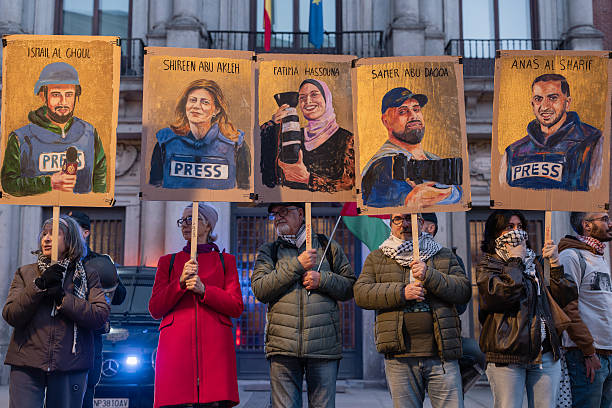
But the body of evidence holding up this commentary is damning on its own. In the first 100 days after October 7th, the civilian death toll in Gaza had exceeded that of the latter by at least a factor of 20. Johnson nonetheless finds that the use of emotive words and phrases in straight news reporting was applied with almost exclusive sympathy for one side.
The term “massacre,” for example, was used to describe Palestinians killing Israelis a combined 344 times during this period, and zero times to describe Israelis killing Palestinians. Moreover, “Savage” and “barbaric” are charged words to use in objective reporting, more so given their colonial history. “Barbaric” was nonetheless used 14 times to describe the killing of Israelis versus zero times for Palestinians. The term “savage” was used 16 times to zero, respectively. And the term “slaughter” was used 120 times for the killing of Israelis and only once for Palestinians.
How one would personally describe either the October 7th attacks, or any of the IDF’s attacks, is besides the point. What’s notable is how western commercial outlets invented editorial double standards in real time to justify fundamentally disparate treatment.
Take for example the explanation offered by Nancy Waugh, the CBC’s Senior Manager of Journalistic Standards. Explaining why terms like “brutal” would not apply to Israel, Waugh says that the deadly result of bombs “dropped from thousands of feet and artillery shells lofted into Gaza from kilometers away are unseen by those who caused them and the source unseen by those [who] suffer and die.” It’s worth taking this standard to its logical limit, which is that there is no amount of carpet bombing that could be described by CBC as brutal, no matter how many civilians are killed. It functions as a permanent, infinitely redeemable moral pardon that can only apply to the Israeli military.
One might still question whether this sort of analysis proves journalistic bias. But it is through language that elite opinion shapers have always adjudicated personhood—or at least conveyed the verdict. In mainstream reportage, Israel has “children.” Gaza has “Palestinians under the age of 18” or “minors.” Israelis are killed. Palestinians merely “have died.” Two million Palestinians forced out of their homes are not expelled or even forcibly displaced, but are, rather, “on the move.” In each of these, language does not just describe reality but also distributes agency, legitimacy, and ultimately humanity.
On the issue of Palestine, there is cross-ideological elite consensus about who is regarded as human and who is not. The consensus is betrayed every time a member of Congress ascribes the right to self defense exclusively to Israelis, deliberately withholding it from Palestinians in the same breath. It’s conveyed when news anchors and editors and university administrators who don’t speak Arabic purport to know what various Arabic protest slogans secretly mean, and when our corporate media air hours of Gaza coverage that feature virtually no Palestinian or Arab guests. People get to speak for themselves. Unpeople do not.
Liberal editorial boards did not outright state that most Palestinians deserved to die due to the October 7th Hamas-led attacks in Israel. They gently noted that the civilian death toll was computed by the “Hamas-run” ministry of health, which “does not distinguish between civilians and combatants,” one of many weasel phrases that functionally casts doubt on the civilian status of any Palestinian. (The more popular but equally vacuous “human shields” canard has the same effect.)
But the center-left professional press, for all its double standards, is rarely described by media critics as bigoted. These outlets would never describe foreign nations as shitholes, as President Donald Trump infamously did. But if you’re Palestinian or Lebanese, they may describe your neighborhood as a “stronghold” of one or another Islamist group, which, as Johnson says, “serves no other purpose than to posthumously conscript the dead men, women, and children buried under rubble as… militants who, either directly or indirectly, had it coming.”
In one of Johnson’s more absurd revelations, he notes that the Times variously referred to every one of Gaza’s pre-war population centers — Gaza City, Khan Yunis, Jabaliya, Rafah, and Beit Lahiya—as a Hamas stronghold. If every major city where people live is a military stronghold, then where do the non-militants live? Where do the children live? The logical implication is that virtually everyone in Gaza is guilty by association, that schools and hospitals and mosques and churches and libraries are part of some elaborate military infrastructure, a lie debunked time and time again.
But what’s left unsaid is often just as telling. In chapter three, Johnson simply prints an exhaustive list of the Times’s Gaza headlines over a one month period, alongside its coverage of Russia’s invasion of Ukraine. In the latter, the Times makes good use of the active voice and simple declarative sentences, and Russia is almost always named as an actor ( e.g.”Russia Batters Key Cities in Wider Attack,”). When it came to Israel’s bombing and starvation of Gaza’s population, however, a markedly different standard applied:
-
“An Explosion, Then ‘Too Many Bodies’ to Count”
-
“BLAST KILLS HUNDREDS AT GAZA HOSPITAL”
-
“Despite Promises, Aid For Gaza Is Still Stuck At Border With Egypt”
-
“Taps Run Dry and Food Grows Scarce in Gaza”
Every one of these headlines could have described a non-military event, like a drought or gas explosion. But the actor holding up aid, drying the taps, scarce-ing the food, and blasting the hospitals was, in each of these cases, the Israeli government. In Johnson’s telling, outlets couldn’t say as much because of novel attribution standards that would’ve required the IDF to confirm its own alleged war crimes. In the case of CNN, reporting various attacks required “positive confirmation and GPS coordinate location” from Israeli officials.
One might wonder whether any of these revelations will inspire fairer treatment of Palestinians and other victims of U.S.-Israeli violence. A look at the past doesn’t inspire faith.
What are the best known media scandals of the 21st century? One might think of NBC anchor Brian Williams’s meme-worthy embellishments about reporting from Iraq, or Jayson Blair, the New York Times reporter who was found to have plagiarized extensively. Perhaps more consequentially, the national press helped sell the central lie on which the Iraq War was sold to the public, namely that Saddam Hussein possessed imminently-threatening weapons of mass destruction.
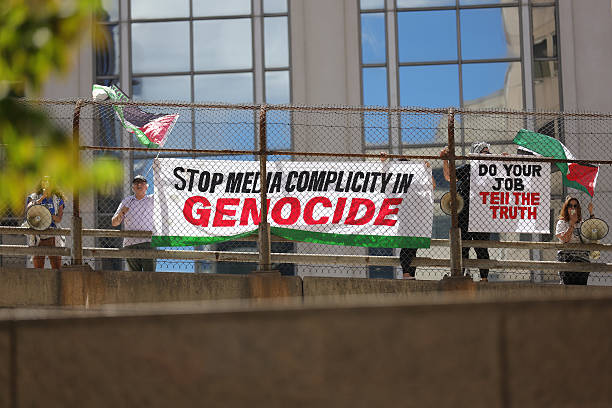
The Iraq case was a blow to the American press’s reputation, but we are in an entirely different age. Scandals that would have once garnered weeks of coverage might amount to a flicker on our algorithmically-curated screens. Public faith in the press to report the news “fully, accurately and fairly” hit the lowest point on record last year, according to a poll that Gallup has run annually since 1972. Since 2003, the year of the Iraq invasion, this measure of trust dropped by 50 percent, while the proportion of Americans who said they have “no trust at all” more than tripled.
Some news organizations at the time issued mea culpas, admitting that accounts about WMDs were not independently verified, and that sketchy sources with a clear agenda could have been vetted further. Those of us who believe in a free and accountable press should demand a lot more than that.