

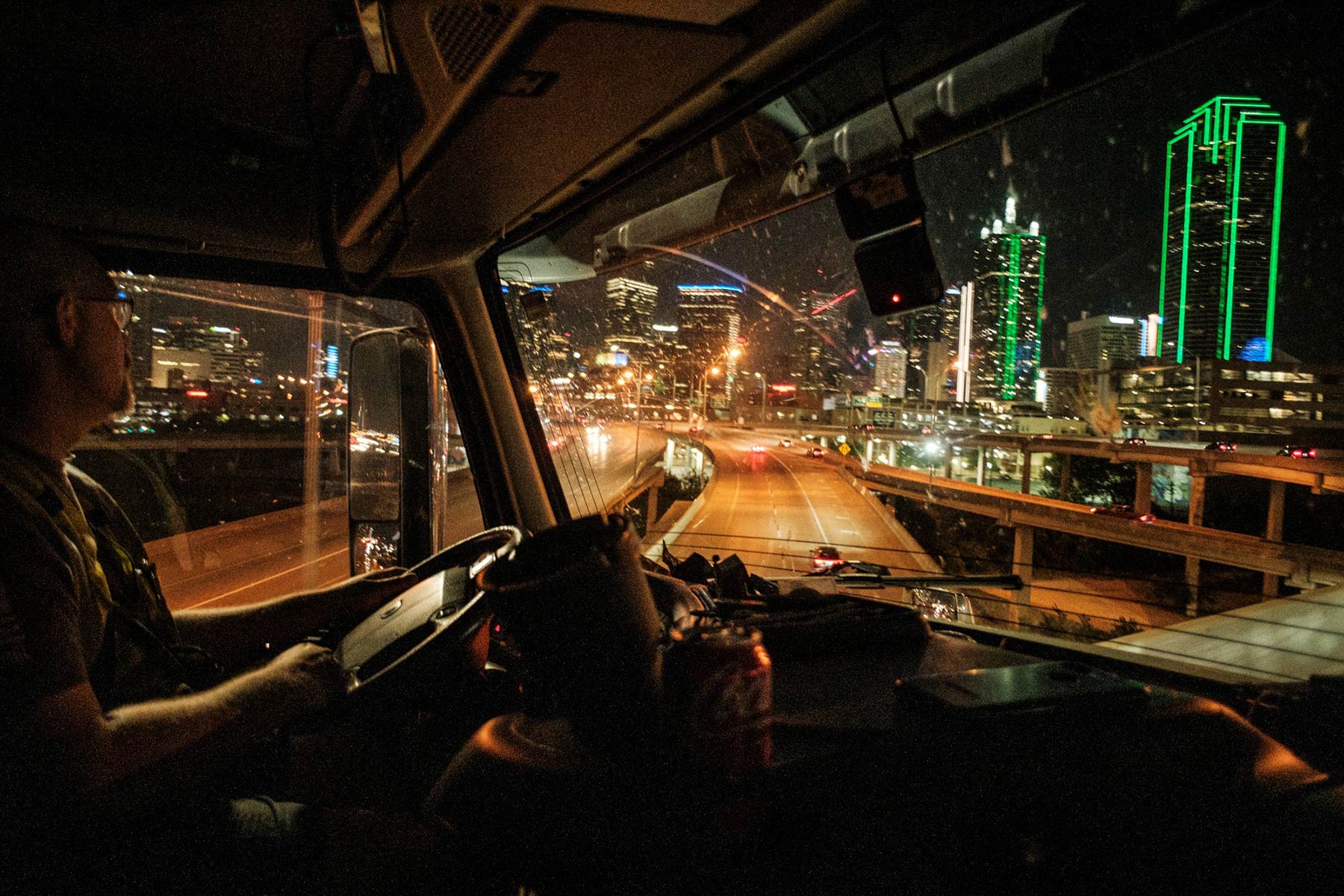
Jason Baker drives through Dallas, Texas while en route to Houston in June of 2022. Dallas is the current epicenter of autonomous truck testing and deployment, due to its strategic location and ability to reach most of the lower continental 48 states within a 24-hour period, with an autonomous truck. Currently, the routes in the Sunbelt between Atlanta and LA are the prime targets for autonomous trucks, before they push farther north into the manufacturing hubs in the Rust Belt. Despite industry claims of safety being the chief concern, autonomous truck lanes are targeting the highest density and most profitable freight lanes in the United States, which are also the most highly congested and with the most people.
In May 2022, I found myself sitting in the right seat of an eighteen-wheeler, riding along with Will Cook, a lifelong trucker and unflinching advocate for truckers’ rights in the era of AI and, in particular, autonomous trucks.
We were somewhere on I-90, driving through South Dakota or Wyoming, on our way to drop off the first few deliveries in Montana, when he told me about a “game” he liked to play.
“Sometimes when I get bored, I count the lost wages of every truck I see if it became autonomous,” Cook said.
I didn’t join in on the game. I didn’t need to count to know that the numbers and economic impact would add up immediately. Every eighteen-wheeler passing us by represented a mortgage paid, groceries bought, a family, and a loss to a community’s tax base—a way to get to America’s middle class without a college degree.
Autonomous trucking advancements have had their ebbs and flows over the last few years, but now it’s hitting its stride. Capturing roughly 178 billion dollars of annual trucking wages by 2035, according to estimates by McKinsey, is the entire foundation of the autonomous trucks arms race. It’s happening faster than many realize. Mass production starts in 2027.
Cook is one of the first independent truckers in America to start rallying other drivers around this issue. Back in 2019, Cook created a non-profit organization called America Without Drivers to raise awareness about the job losses and safety concerns tied to autonomous semi-trucks. It’s an issue that permeates every corner of the American lived experience: This ride alone took me from southern Indiana all the way across the continent to Seattle and down to Sacramento, a tour to the best and worst of America and a front-row seat to working-class identity and political economy.
Over the last four years, I’ve traveled 25,000 miles, through 27 states, documenting what truckers have gone through since the rise of autonomous trucks. Their stories paint a stark portrait of what we all have to lose in this new age of automation.
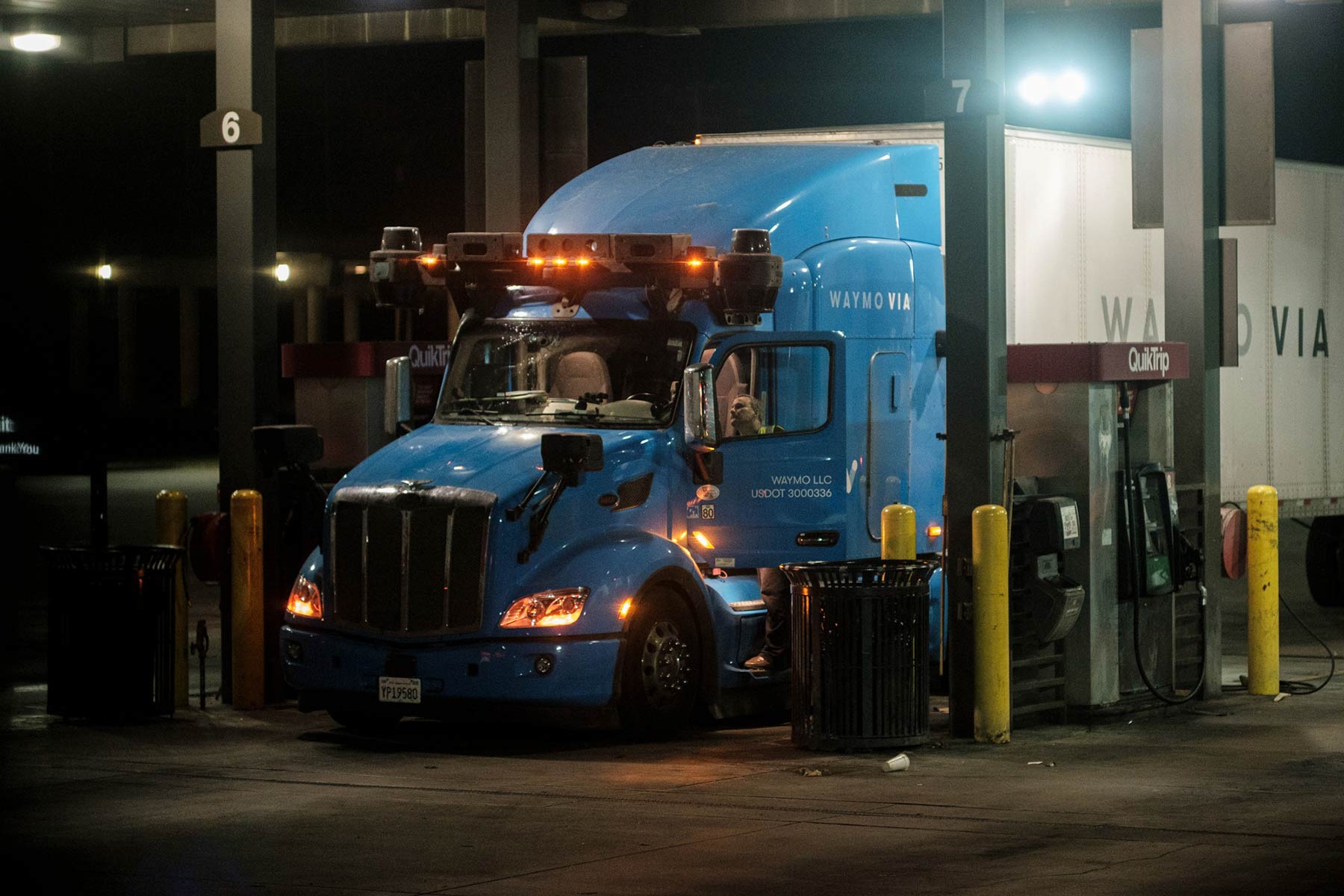
A Waymo Via autonomous truck gets serviced by a safety driver at a QuikTrip Truck Stop just south of Dallas, Texas on Sunday, June 26, 2022. Autonomous trucks are targeting long-haul and line-haul trucking markets. Estimates have stated that these machines will be able to lower current operating costs between 30 to 45 percent and more than double a truck’s utilization rate, which means that 1,000 driverless trucks will be able to do the work of between 2,000-3,000 truck drivers. With an industry average of roughly 60,000 per year, 1,000 autonomous trucks will displace at least 100,000,000 dollars worth of compensation annually.
Trucking is much more than just a job for many, especially within the remnants of the “old guard.” Truckers often see themselves as the last of the cowboys. To truckers, the Wild West never ended. It just shifted— an entire ecosystem of transient and nomadic societies; of bullhaullers, Walmart drivers, and hotshots; of bedbuggers, and chicken coops stationed alongside our interstates, with roosting DOT officers inside. But that’s only a few tribes relegated to operating between the lines, in a no-man’s land of federal interstates. The job has been a sweatshop on wheels for many. For others, trucking offered a sense of autonomy and accomplishment. It provided an opportunity for a job well done without the possibility of being micromanaged.
“Trucking, to me, was a sense of freedom,” explained Cook. “A way that I knew you had to sacrifice some home time. But instead of going into a factory or into a field, that was just where you go in and work and go through the motions. It wasn’t really the money. It was the freedom and the traveling. And the trucks.”
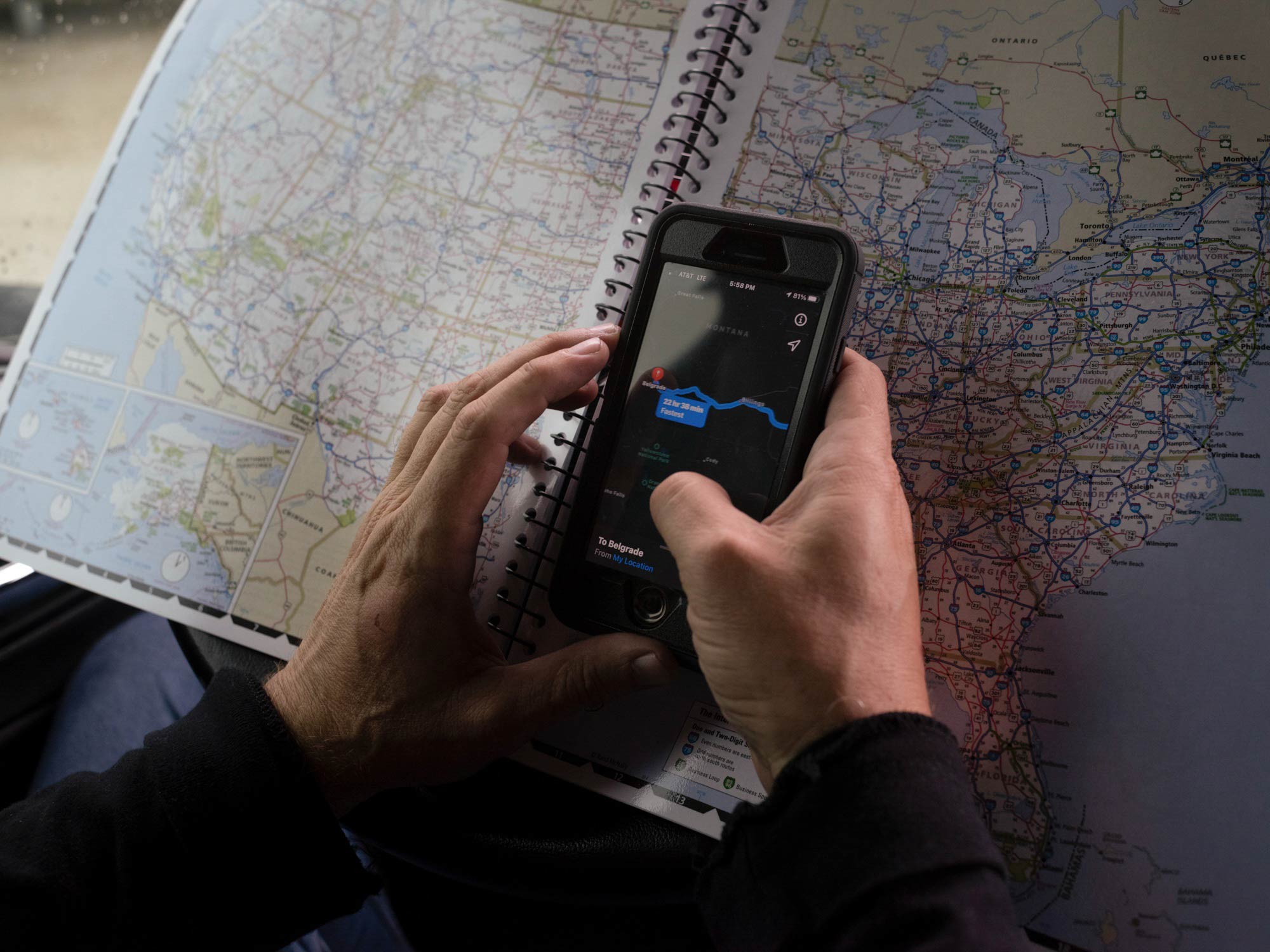
Cook checks his route against a physical map before departing from Southern Indiana to Montana, Washington, and California. Career truckers often pride themselves on not needing GPS and navigation technologies to navigate, due to the design of the American interstate and highway systems. Cell phones and navigation apps thoroughly deskilled drivers, which lowered the barriers to entry into the profession and contributed to economic forces that lowered their wages. Those technologies also gave shippers the ability to track loads in real time across the U.S., which in turn created a new problem of shippers harassing drivers for status updates on their deliveries.
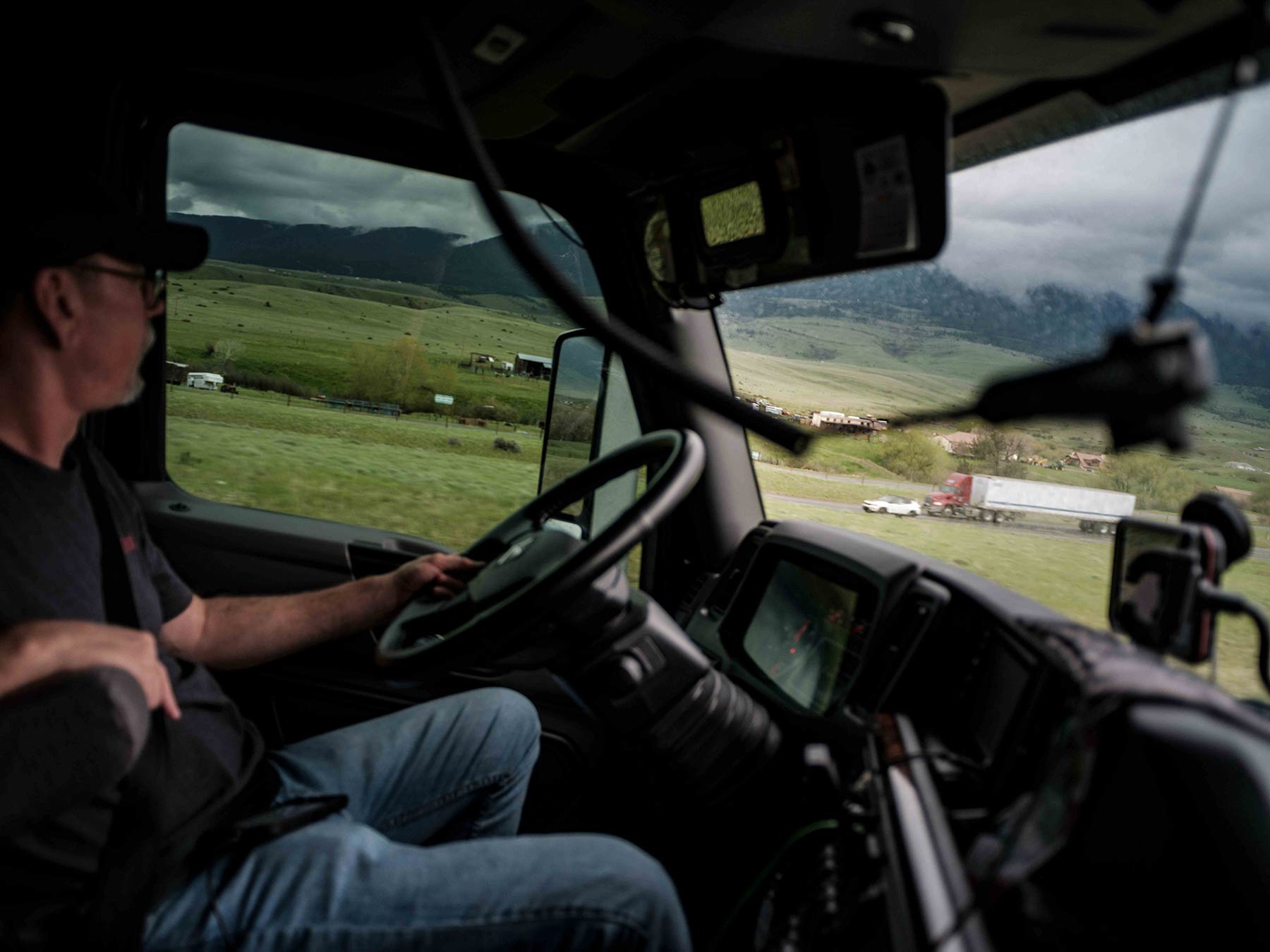
Cook enjoys the scenery on his way to his first drop-off locations in Montana. The northwest and the Rocky Mountains are his favorite regions to drive through, despite the challenges that the terrain and weather can create. Cook has over 4 million miles of experience and got his start as a truck driver in the Army.
But in the last few decades, that sense of freedom and independence has consistently eroded due to the application of new technologies that have either de-skilled labor or unethically surveilled drivers. The engine’s electronic control modules after the 1990’s enabled remote surveillance by the government, insurance companies, and company micromanagers. Newer high-tech engines are also harder to work on due to the tools and software needed to fix them, in addition to warranty restrictions. There are AI-powered driver-facing cameras, with company policies so restrictive that even taking a drink of water while driving can be grounds for punishment. Then there are the financial costs of environmental regulations for small businesses. In short, that screwed over the little guys and helped larger trucking businesses gain market share.
Truckers have very good reason to be wary of change. To dive further into that, in 2023, I spent about a week hanging out with one company based in Indiana, Simpson Trucking and Other Things. They could be best described as an artisanal, neo-Luddite trucking company.
The owner, Jimmy Simpson, deliberately operates fleets of trucks made before 1999. Many of them were often literally pulled out of Midwestern pastures and restored. But Simpson isn’t doing this out of mere nostalgia. Under current federal regulations, older engines are exempt from using Electronic Logging Devices (ELDs) and are permitted to use traditional paper logs. Riding in a pre-99 rig feels like stepping back in time, but it is also a deliberate stance. It is a refusal to hand over control to alienating software and a demand to maintain agency over how the work is done.
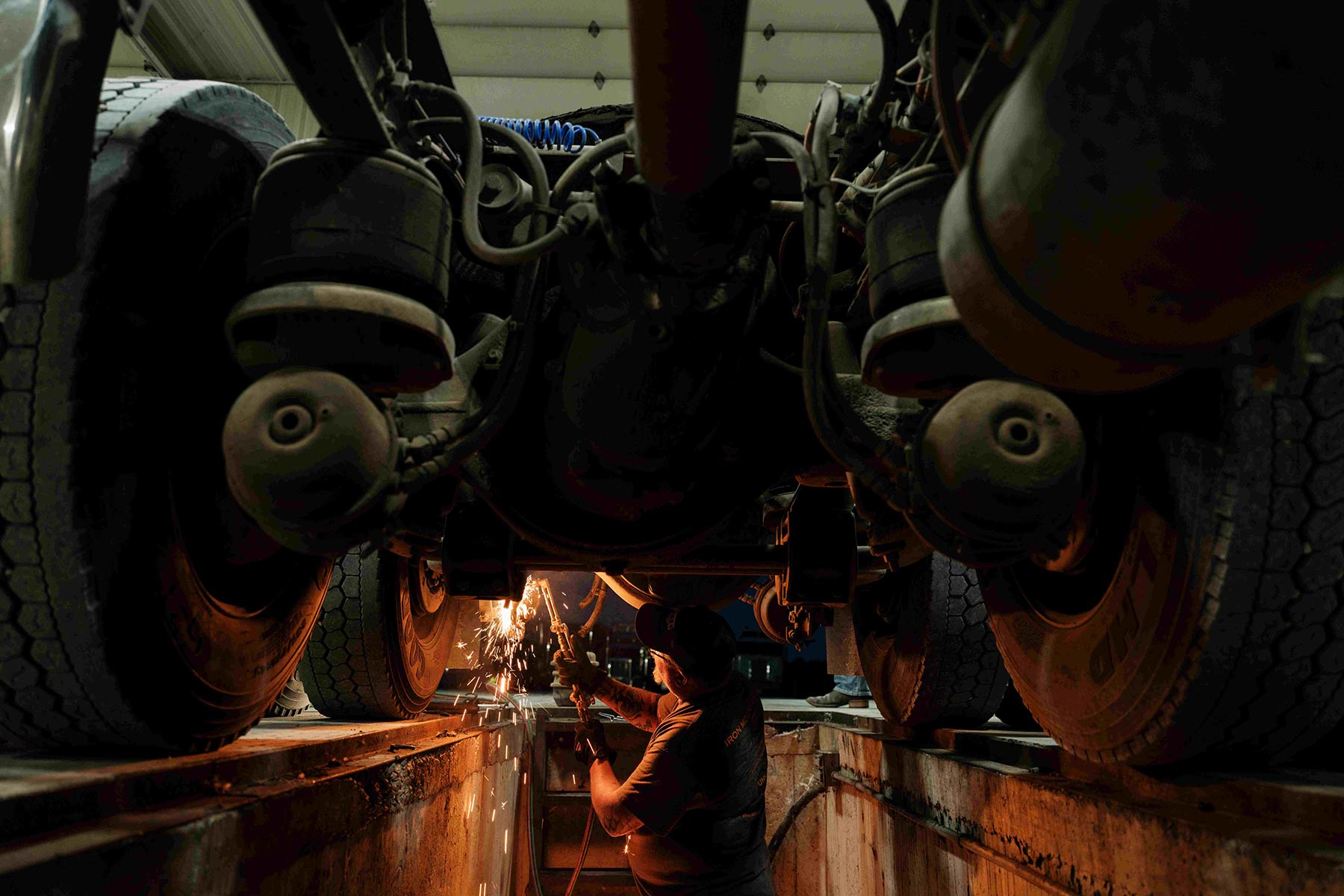
Jimmy Simpson replaces the parking brake chamber assembly on a 1996 Kenworth at his shop near Atlanta, Indiana. Simpson runs a fleet of mostly pre-99 vehicles. The company typically does local runs, and their drivers are home nearly every night. Simpson has been trucking since 1991. He was a former ABF union driver before starting his company, Simpson Trucking and Other Things. Jimmy is known for sleeping only 4 hours a night and lives in his shop.
The feeling felt all too familiar to me: My time spent with Simpson felt like being back in my tactical airlift unit in the military. Drivers had CB handles or callsigns like Hammer, Cadillac, and Grandpa. They customized their own trucks to compete in truck shows, shared experiences and crude jokes, along with other stories and traumas either incurred or witnessed on the road. All of that bound them into some sort of fellow diesel-driven unit. Usually, Jimmy and his wife, Heather, had dinner waiting for them at the end of their shift. For Jimmy in particular, trucking isn’t just a job. It’s his life and identity. He is far from alone in this industry. Trucking demands a level of dedication that’s seldom found elsewhere. These are the types of people who will not go quietly.
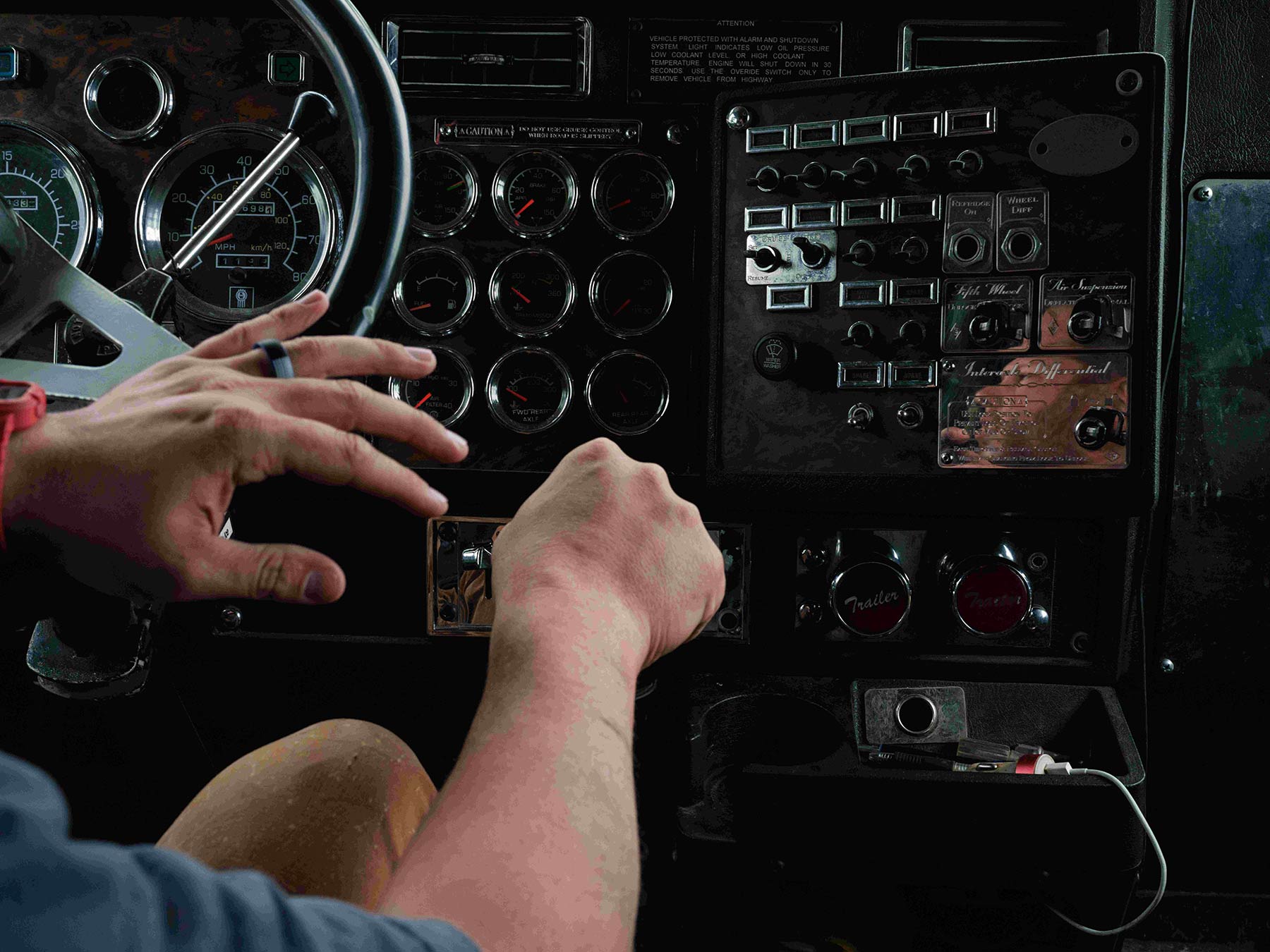
Travis Hershey moves trailers to temporary storage to help prepare for the “Friends of Simpsonville Truck Show” in Atlanta, Indiana. Hershey drives a 1996 Kenworth W-900L, which requires a lot of skill to be able to operate the thirteen to eighteen-speed manual transmissions. In exchange for the steeper learning curve, truckers gain a lot of control over how the vehicle behaves, which can give them some important advantages in poor winter weather conditions.
But you won’t find anything resembling that in the sales pitches from the tech industry to justify why guys like Jimmy shouldn’t exist. In the battle for the future of the highway, corporate rhetoric relies almost entirely on what isn’t being said and the questions that aren’t being asked. Nowhere was this ever more apparent than at the 2024 Mid-America Trucking Show (MATS), where the alleged autonomous trucking industry leader, Aurora Innovation, gave a presentation at the largest trucker-focused trade show in America.
”We aren’t taking anyone’s job, we’re only adding to the workforce,” said Brian Jones, a Senior Safety Specialist, during the presentation. “We’re trying to make truckers’ jobs better!” he added later, attempting to paint a sort of tech utopia, where autonomous trucks handle the “boring” highway miles, while humans take over localized, short-haul deliveries, which typically pay much less.
But if you look past the public relations smoke and mirrors, a vastly different story emerges.
Aurora claims that their driverless trucks will more than double the current asset utilization rate. This means that every 1,000 autonomous trucks will be able to do the work of more than 2,000 drivers.
In 2024, The Chamber of Progress, The Steer Group, and Fourth Economy issued a report stating that every 1,000 autonomous trucks will create 190 jobs managing and building the vehicles. But only job gains were mentioned, not losses. Just going off of Aurora’s 2,000 figure, the rough napkin math suggests a deficit of at least 1,800 jobs per 1,000 autonomous trucks. At an average annual trucker income of $55,000, that’s a loss of at least $100,000,000 worth of paid work being siphoned away from our communities and tax bases. S&P Global reported that Aurora intends to have 12,000 autonomous trucks by 2030. And despite having several serious competitors, like Plus and Torc Robotics, who enjoy support from tech monopolies like Amazon and Google, in 2021, Aurora went so far as to even compare their invention to the monopolization of advertising by Facebook and Google, who now dominate 70 percent of the digital advertising market. Tech and auto executives know their narratives to the public cannot withstand scrutiny. The real answers to those questions will hurt their bottom line or undermine the unit economics of their invention entirely. The numbers don’t work if a driver or safety observer remains behind the seat.
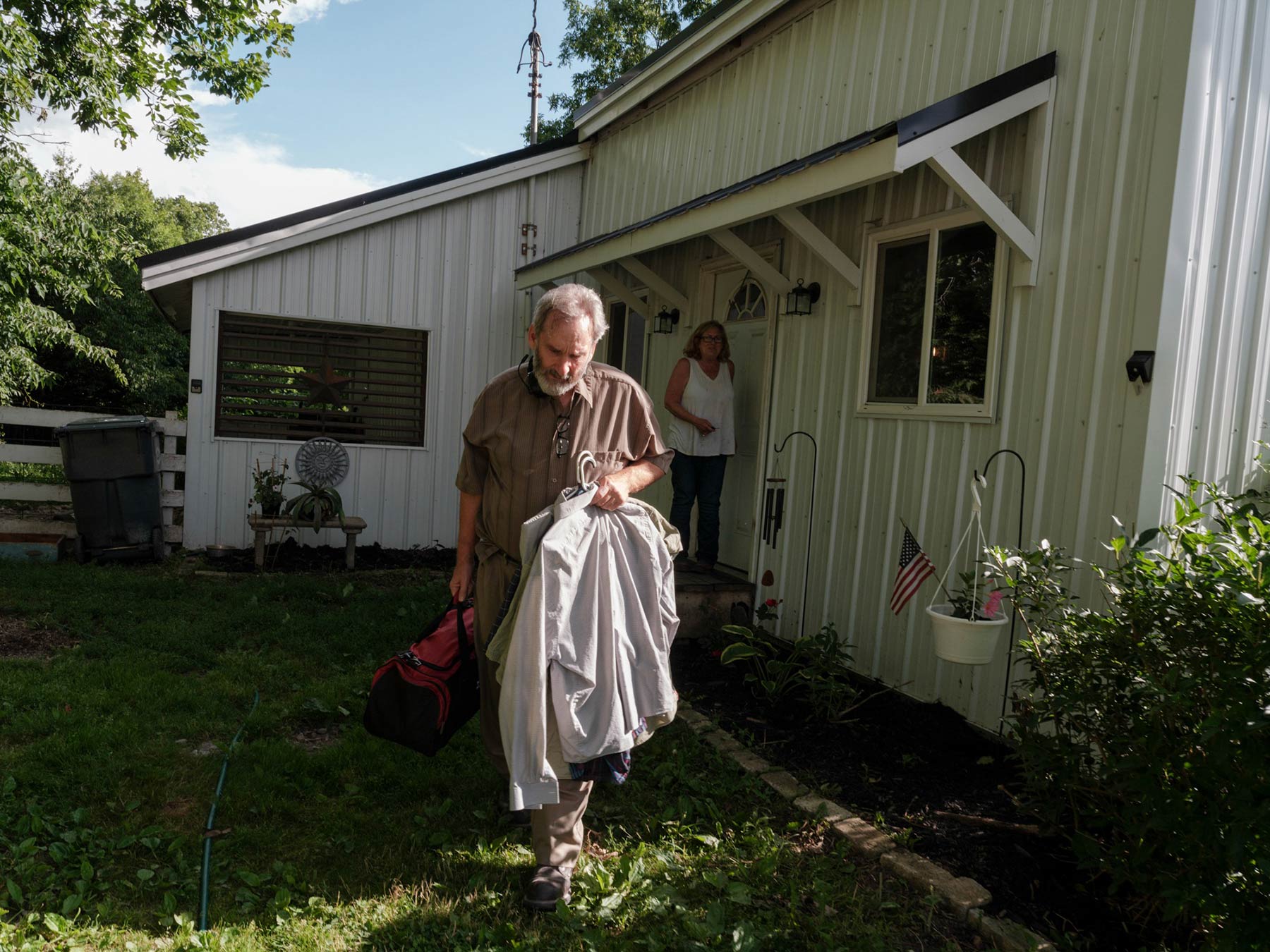
Paul Marhoefer says goodbye to his wife, Denise, for a long haul down to Florida in June of 2023. Marhoefer hauls refrigerated trailers for a family-owned company out of Ohio. The reefer market has been identified as a prime target for automation due to the predictable routes and faster delivery times. “Anytime I hear ‘supply chain solutions,’ I know my paycheck is going to be cut,” said Marhoefer.
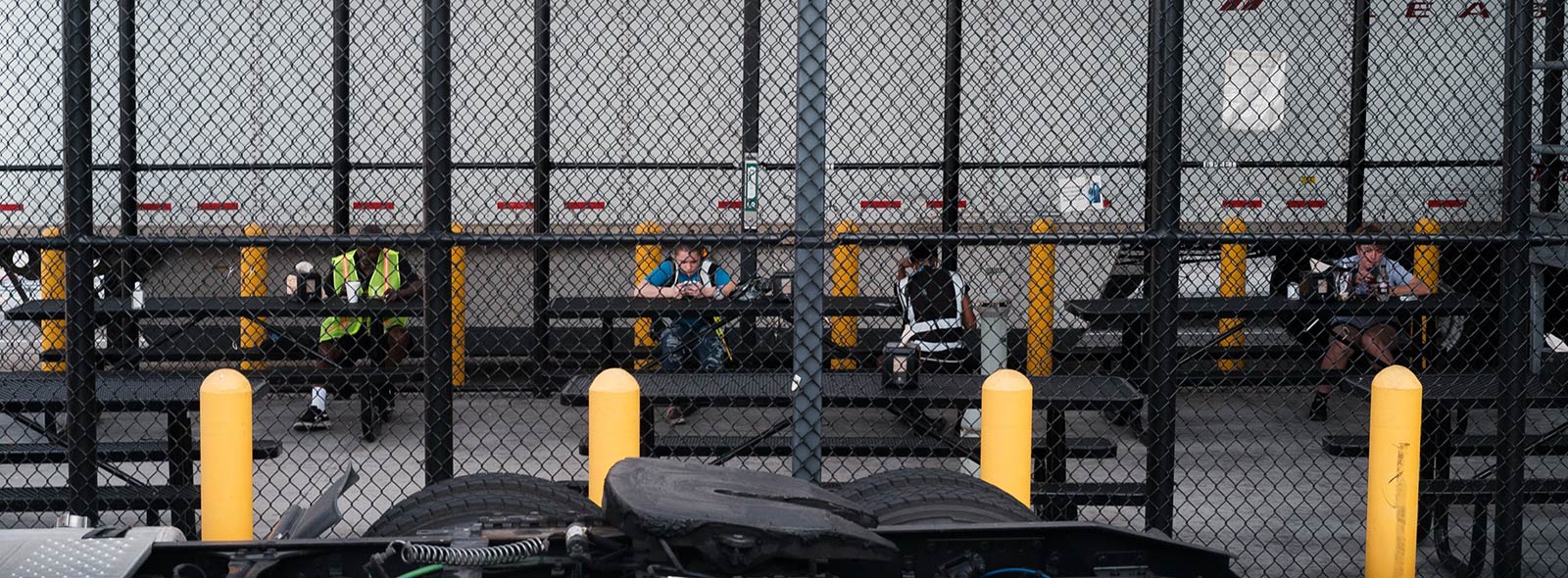
Workers are seen in an outdoor break room at an Amazon Fulfillment Center. Amazon has invested in several autonomous trucking companies. Line haul trucking jobs, between warehouses like this, are at high risk of being automated due to the predictability of the routes and often being conveniently located outside of urban centers. In 2021, Amazon ordered 1,000 retrofit kits from Plus.AI to begin upgrading its existing trucking fleet with autonomous technology. According to reporting from Forbes, that order was being filled at scale in 2022.
One trucker, in particular, Josiah Henry, though he goes by Wild Beard, became furious after Aurora announced the order of 500 autonomous trucks to Hirschbach on April 30th of this year. He posted an AI-generated image of two generic executives kneeling in front of a destroyed Hirschbach truck and encouraged other truckers to leave the company in protest of the order. On May 9th, Henry took to his YouTube channel to show evidence of his former employer, the trucking company Hirschbach, threatening him with harassment charges and even trying to get Henry fired from his current job at Prime Inc. Thankfully, Prime didn’t oblige Hirschbach’s request.
In the video Henry posted, he explained, “We are in a war for our jobs. If anyone says different, that they’re not trying to replace drivers with robots, they’re lying. Okay. Aurora, Hirschbach, Werner, McClane. All of them, anyone buying these trucks, I want you to know you’re on the other side against drivers. You’re not pro-driver, you’re not a driver-first culture, you’re not for veterans, you’re not for anybody, man. You’re for yourselves.”
This statement and recent developments in the trucking community align closely with what Dr. Carl Benedikt Frey, an economics historian at Oxford University, said in his book, The Technology Trap: “Innovation flourished before the eighteenth century, but it rarely took the form of capital that replaced labor—and when it did, fierce opposition typically followed,” Frey wrote. “This should not be taken to imply technological backwardness. However, it does help explain why the job-replacing technologies of the Industrial Revolution did not arrive earlier.”
The core point of Frey’s book is that resistance to labor-replacing technologies is the norm, not the exception. This couldn’t be more relevant to our current moment. The tech industry wants the public to believe that technology and automation, on their terms, are an inevitable march of “progress.” History would differ, and truckers aren’t alone in their fight; actors, longshoremen, writers, artists, students, accountants, and administrators, to name only a few roles, are all facing the same issue. AI is fast becoming the key issue that’s bridging the stubborn and manufactured political divides.
But the thing that makes truckers different is the scale, pressure, and how transformative this specific application of physical AI will be. Average trucking incomes have been cut in half since Jimmy Carter deregulated the industry in 1980. They face a flooded labor market, severe parking shortages, and are crushed between low freight rates, high insurance premiums, and fuel prices, all while getting gouged by inflated pricing on basic necessities on a daily basis. Now, the tech industry is preparing to pull the rug out from under the most common job in 29 states and leave these workers with the remaining debts. Truckers have more to lose and much less to gain in the future that’s supposed to be built for them. By the time trucking jobs get automated wholesale, there will be few places left for them to run.
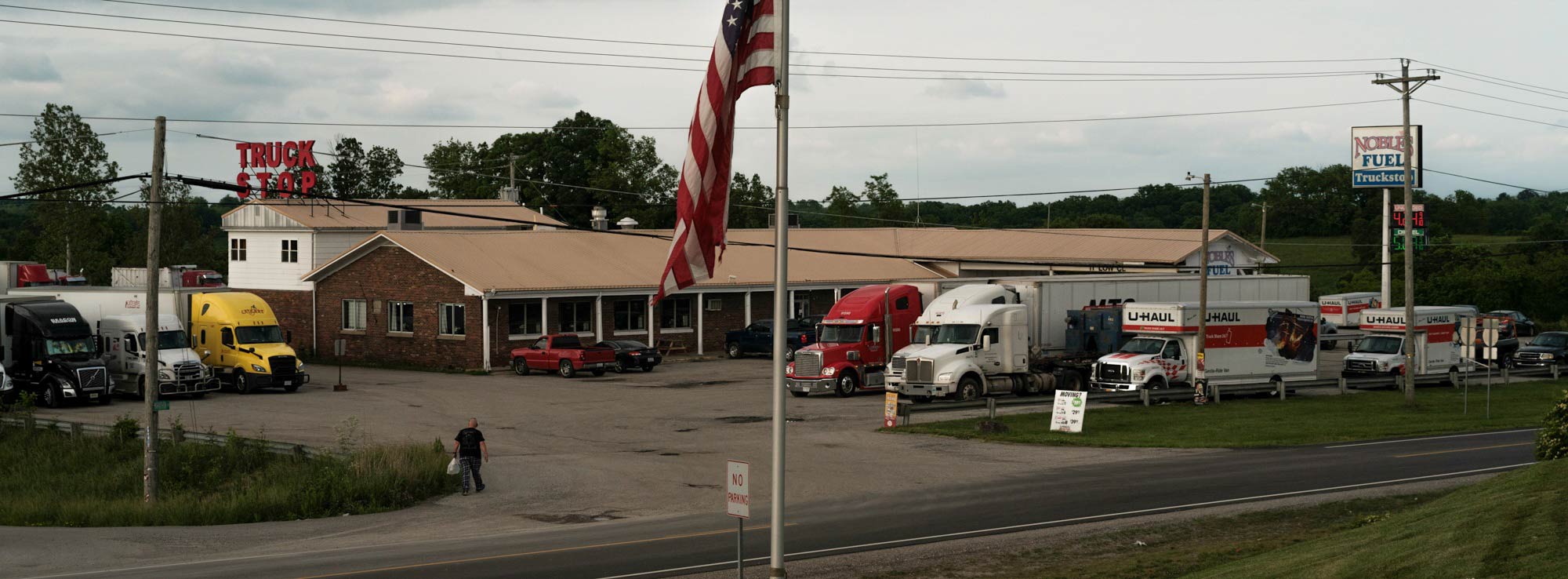
Nobles Truck Stop in Corinth, Kentucky, in May 2022. Independent truck stops used to be the norm, but now it’s increasingly become a rarity after the market was consolidated into a handful of chain outlets. Corporate chains typically offer fast food options for meals, airport-style pricing for necessities, and are increasingly charging for parking.
The economic disruptions from technological advancement will only accelerate, and the lines of debtors stuck in cycles of perpetual retraining will only get longer. After following the trucking community for over four years and looking back on that ride along with Will Cook, counting the lost wages in Cook’s “game” isn’t a game at all. Every job being automated represents a burning fuse.
It’s only a matter of time before it all detonates.

Teamsters respond to California Professional Firefighters President Brian Rice’s question: “How many family members are you representing?” The Teamsters’ Good Jobs, Safe Streets rally was the first showing of organized labor against the use of autonomous trucking. Governor Gavin Newsom vetoed the bill, AB316, that was being advocated for at this rally, which passed by over 90% in both houses of the California State Legislature. In the last month, the California DMV removed restrictions on autonomous trucks to allow testing and deployment throughout the state.