

Excerpts from Sleeping in the Courtyard, edited by Holly Mason Badra:
-
“My Roots Were Somewhere With You” by Nahid Arjouni
-
“Dream and Reality” by Meral Şimşek
-
“Waiting” by Holly Mason Badra
With Kurds in Rojava (Western Kurdistan) and Rojhelat (Eastern Kurdistan) facing insurmountable violence and displacement at the hands of the Iranian, Syrian, and Turkish forces, we in diaspora mobilize in anger and strength. Rojava offers an example of Kurdish liberation so rooted in feminist, ecological, and participatory practices that it must be protected. The threat of erasure follows us from Rojava to Rojhelat where the martyrs that spark revolution and move us to action across the globe are Kurdish women like Jina Amini and Rubina Aminian. It’s imperative to acknowledge their Kurdish identity as we remember and point to them as conduits.
It is within this spirit of anti-erasure that I initially put together Sleeping in the Courtyard, a multi-genre collection of writing by contemporary Kurdish women and nonbinary writers living all over the world. One of the contributors, Choman Hardi, fiercely proclaims, “As a poet, I believe it is my duty to ruin the façade of normality and fairness that prevails.” It is within this current landscape that I invite you to spend time with some poems from the collection and excerpts from the book’s introduction as our communities resist erasure.
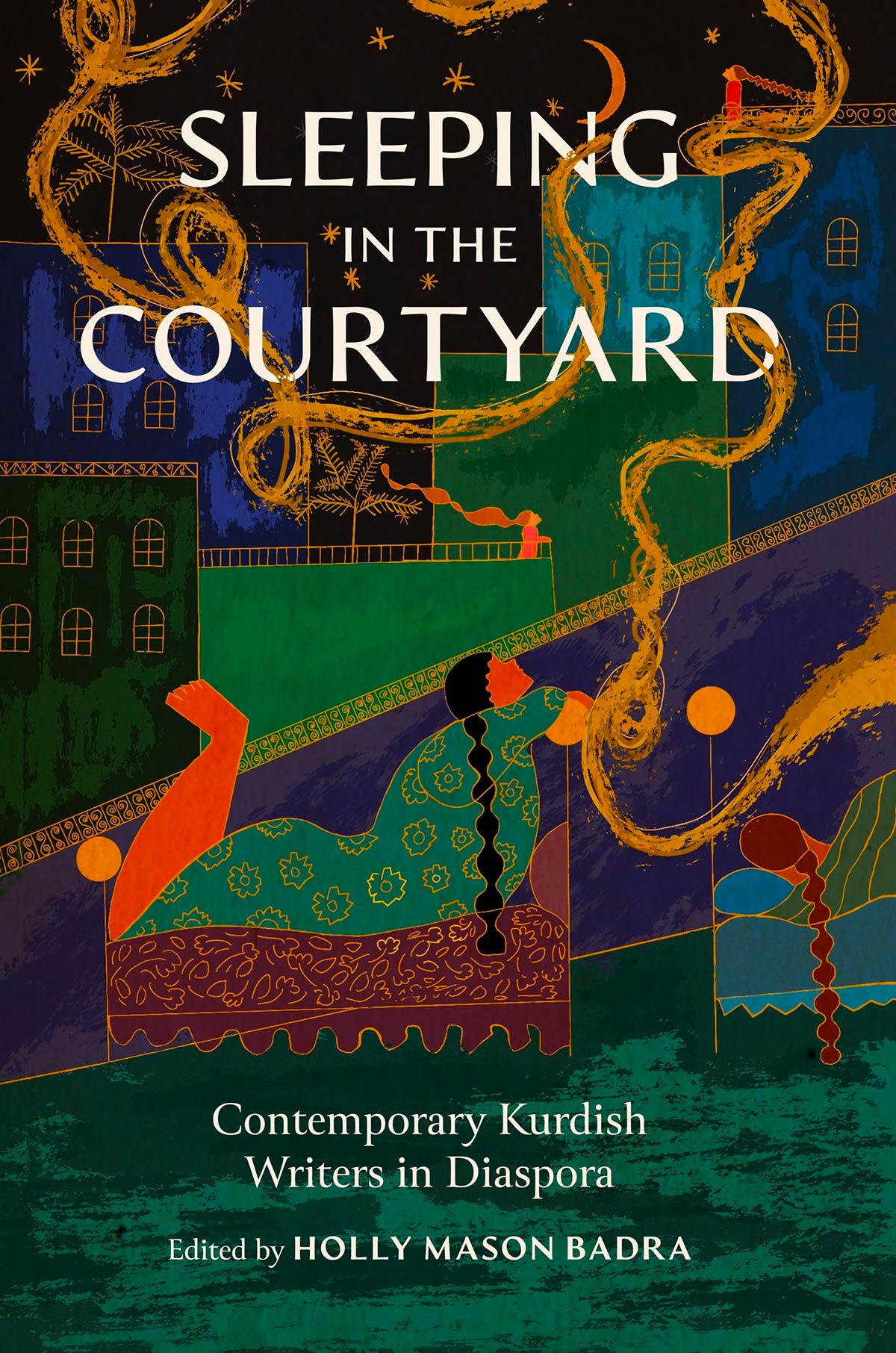
Sleeping in the Courtyard cover image by Shayan Nuradeen
Dedicated to all writers in exile.
Many of the women in this book are writers in exile. They are exiled simply for being women and being writers (the two coexisting at once poses a threat). The fact that the intersecting identity as a Kurdish woman daring to write often means risking one’s safety—simply for writing creatively—also proves that there must inherently be power in writing, if these women are seen as a threat just for doing it.
Exile and erasure are tools of the oppressor.
This collection is the antithesis of erasure. In 2022, when the phrase “Women Life Freedom” rang out in protests transnationally and across digital spaces in response to the death of Jîna Mahsa Amini, many in the Kurdish community felt a twinge of pain and frustration at the lack of recognition for where this outcry originates. “Women Life Freedom” comes from the Kurdish “Jin-Jiyan-Azadî,” which is a verbalization from Kurdish women’s liberation movements. More than that, though, there was pain for the erasure of Jîna’s name and identity as a Kurdish woman. Arrested by the Iranian state for improperly wearing her hijab, the protests in response that spread worldwide were not anti-hijab campaigns but more about the right to choose. The martyr who sparked the revolution that famous writers such as Marjane Satrapi have written about was a Kurdish woman.
Why is it important to recognize her as Kurdish? Why is it important to note the origins of “Women Life Freedom” as Kurdish? Because of the way that Kurdish women are erased from the narrative and Kurdish cultural production is co-opted. More than that, it was the Iranian state that forced Jîna to go by her “official” government name, so it perpetuates further violence when she is not referred to by her Kurdish name in death. It perpetuates further violence when a phrase from Kurdish women’s freedom movements is used in spaces where Kurdish culture and existence is suppressed and criminalized. To gain a deeper understanding of these contexts and implications, turn to “Why ‘Jîna’: Erasure of Kurdish Women and Their Politics from the Uprisings in Iran” by Farangis Ghaderi and Ozlem Goner. The goal here is not to defame the power and necessity of this movement for Iranian women (and Kurdish women alike). The point here is that within feminist solidarities, there must be a recognition of Kurdish women’s roles and contributions in order for true liberation and justice to take place. This book uplifts and spotlights the role that Kurdish women (past and present) play in social, political, and cultural progress.
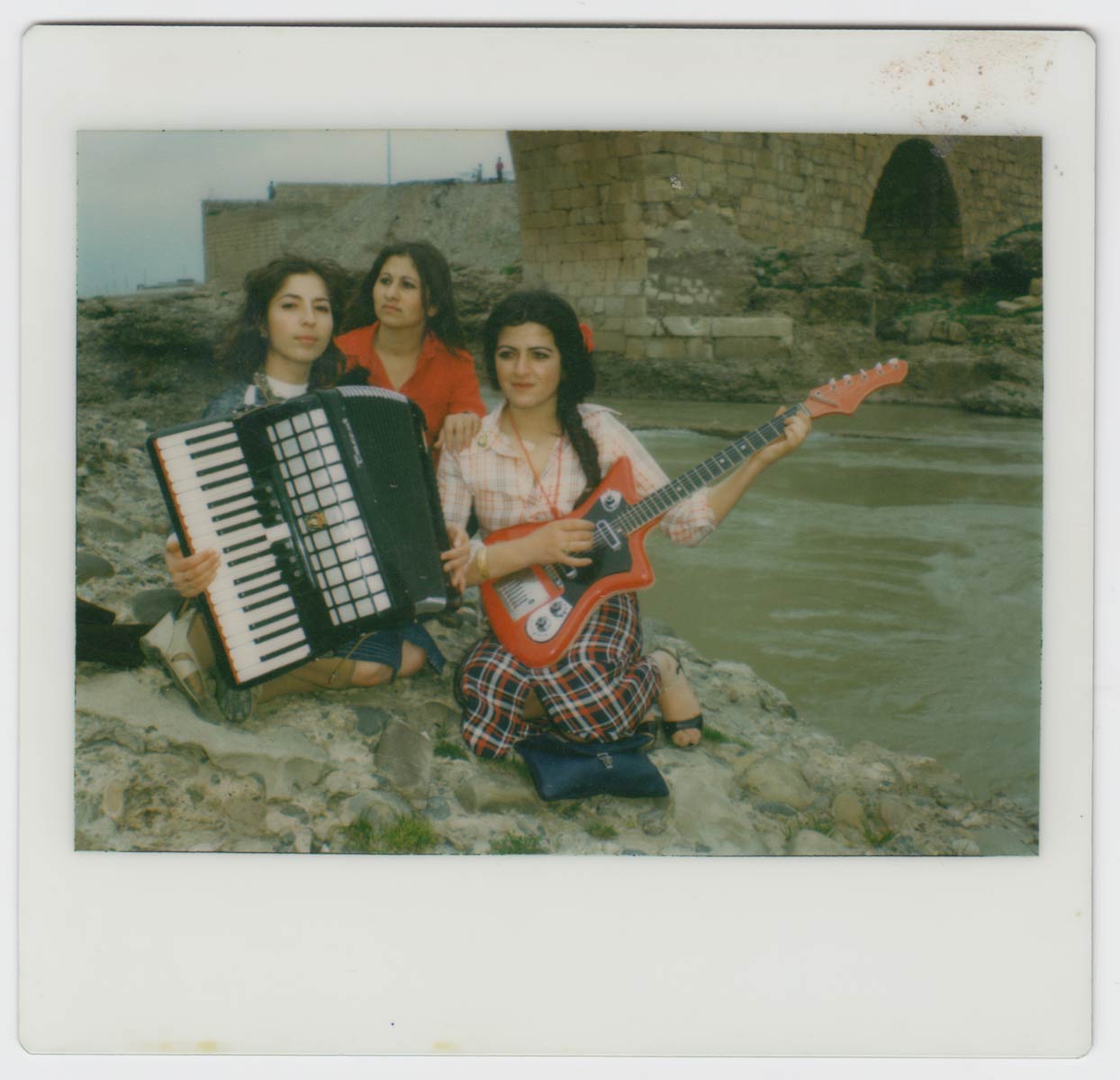
A group of Kurdish college students posing with their musical instruments by Pirdí Delal. Zaxo, Kurdistan, 1970’s.
Photo credit: Raz Xaidan/The Jiyan Archives
“I open my ponytail in class and the horses shriek.”
This line is from Nahid Arjouni’s poem “My Roots Were Somewhere With You” and constantly plays in my mind. I’ve been so moved by the circulating imagery of Kurdish fathers braiding their daughters’ hair. This tenderness is balm and antidote. This tenderness falls against a backdrop of continued state violence while Kurds in Rojava and Rojhelat are fighting for their existence and rights against the Syrian, Turkish, and Iranian regimes. Erasure continues in multiple forms and in dangerous misrepresentations.
This emergence of braiding as protest is in response to a video of a Syrian soldier claiming he cut off a Kurdish female fighter’s braid in Raqqa. The Kurdish braid is a loud symbol. It’s a representation of cultural continuity and protection.
Power and Politics in Kurdish Women’s Braids
I want to tell you a story about my mother braiding her little sister’s hair in Baghdad. She braided her sister’s hair while their father napped. While braiding her sister’s hair, they practiced the Arabic they were learning in school. Only Arabic in public; only Kurdish at home. These were the rules and a slip up in either space was punishable. Their father woke. Small hands braiding, sisters talking and laughing, and he physically reprimanded them for the linguistic transgression. Such anger and violence. And it comes from a deep well of oppression and linguicide. Still, the daughters bear the weight of it all.
I see the man who held the female peshmerga’s braid walking back his claims, saying it wasn’t real, it was a joke. Regardless of the truth—the “joke” holds hefty reverberations. The “joke” is offensive, it’s harmful, it’s violent. It speaks to perceptions of Kurdish dispensability.
The same aunt—whose hair my mom was braiding—brushed and braided my hair when I was 5 days postpartum. I felt comfort return to my body. When my sister-cousin braids my hair, I feel loved and protected. The tradition lives on. This display of braiding spreading among our communities all over the world is a refusal. A refusal to be erased.
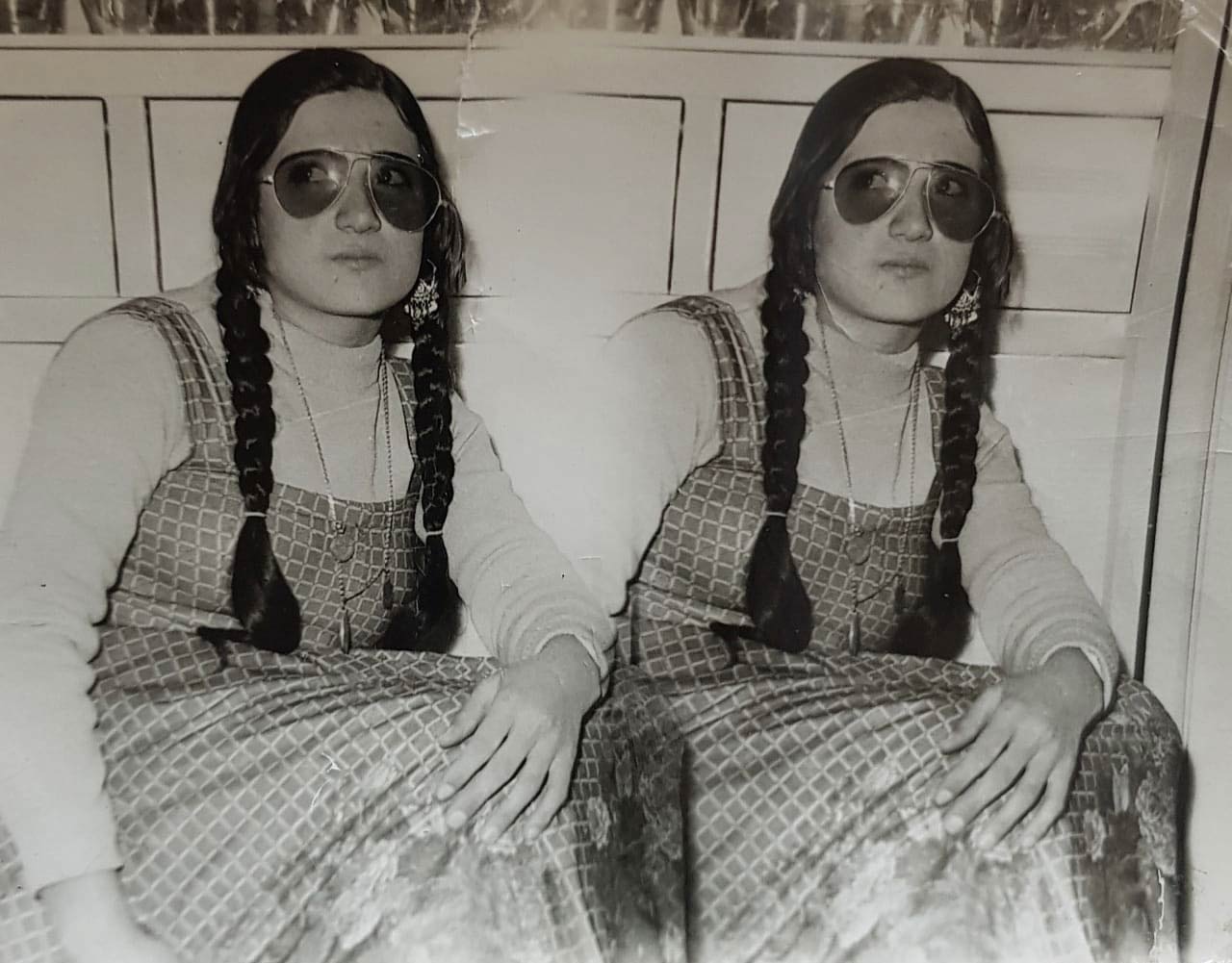
Possibly a double exposure or composite, this 1977 image shows a woman pictured twice - confident, braided, and in sunglasses, Qamişlo, Kurdistan.
Photo credit: Hedîya Xan/The Jiyan Archives.
The first offering is a poem by Nahid Arjouni who is a Kurdish poet known for her exploration of femininity and war. She lives in Sanandaj in Eastern Kurdistan (touching Iran). This poem was translated from the Persian by Shohreh Laici who is a US-based Iranian journalist, writer, and translator. Her documentary My Room in Tehran Is Called America is currently in production by Pirooz Kalayeh and explores her fight for freedom of expression.
My Roots Were Somewhere with You
by Nahid Arjouni
Such a small world
you spend your days with the broken pieces of me,
fallen to earth.
I delete the borders from the books, from my hairs, too;
Father said, “Cut it off.”
He added, “Fuck the horses’ whinnies, we don’t belong to this country!
Don’t you understand?”
I disturb the earth and spread some of my ancestors’ soil near
the geraniums,
and throw more on the broken and ugly asphalt of the streets.
I throw it on the face of the child who calls Grandma “foreigner,” laughing.
Father said, “It happens a lot when your roots are somewhere else,”
and then he stopped talking.
My roots were somewhere with you,
and only the strange horses loved my whinny, those who belong to no land.
I think of my roots at school, in my headscarf, while the smell of blood
in the national anthem
made me deeply sad!
I think it’s the earth’s stupidity which lets us break it into pieces, borders.
I think it’s the politicians’ stupidity that never lets soldiers in love fear
death in war.
Sometimes I think my teachers are dumb, those who believe war is holy
and that not wearing the hijab helps the enemy.
I open my ponytail in class and the horses shriek.
Father said, “Your roots were somewhere else,” and I was thinking of you
who are somewhere else.
You hate the blood,
the politicians, too, those who never let soldiers in love fear war.
In her essay “Poetry’s power to speak the unspeakable: the Kurdish story,” Choman Hardi writes, “It may be difficult for others to understand what it feels like to be forcibly deported, to see your homes given to ‘settlers,’ to witness the renaming of your neighbourhoods and towns. It may be difficult to imagine what it is like not to be allowed to speak your mother tongue, to witness public assassination of your people, to grow up with images of mass graves, gassed victims, hanged leaders. It is even more difficult to describe what it is like to see history repeat itself when you witness your defeat again.”
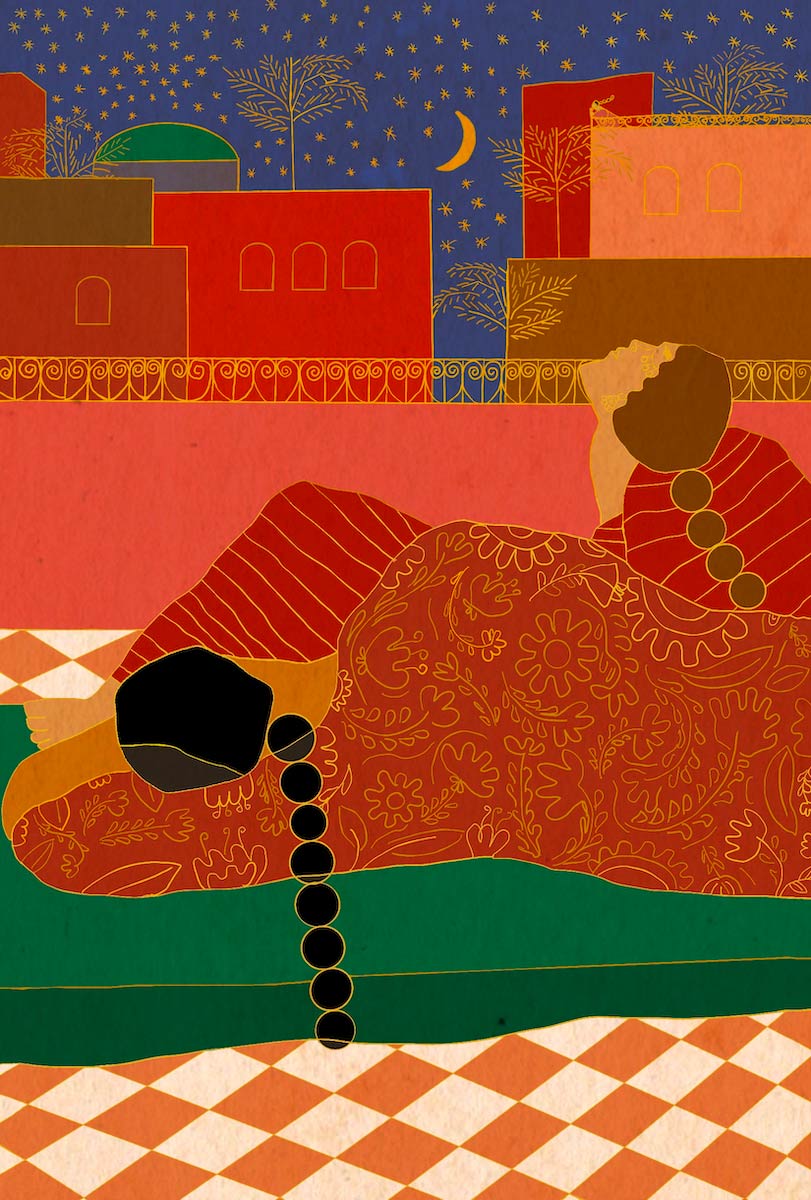
Sleeping in the Courtyard commission image 1 artist attribution, Shayan Nuradeen
I turn us now to another poem in Sleeping in the Courtyard—by exiled writer Meral Şimşek. Meral is a poet, novelist, and editor born in Amed (Diyarbakir) in Northern Kurdistan. Her publications and accolades are many. Due to the content of her books and the awards she received, the Turkish government accused her of making propaganda. The prosecutor’s office requested a prison sentence of up to thirty years. After a lengthy and tumultuous escape from Turkey to Greece and back to Turkey, PEN Berlin managed to bring her safely to Germany in 2022. This poem is translated from the Turkish by Öykü Tekten who is a poet, translator, archivist, and editor splitting her time between Granada and New York. She is the general editor of the Kurdish Poetry Series at Pinsapo Press.
Dream and Reality
by Meral Şimşek
clean tables were set
when the sun was scorched
bread was a stranger to our country
just as othering ourselves,
we burned and scattered our dreams
and sterilized all hopes
our refugee hearts turned to the loop of night
while the gods bore bastard seeds
in crimson gardens of paradise
we were banned from life, from falling in love
it was the time of laughter in thyme
each of us shouldered, one by one,
uncontainable weary dreams
we fell silent in orphaned solitudes
surrendered ourselves so that the world
would be a better place
in fact, we massacred ourselves
for a worthy life through slimy consolations
history of our consciousness filled with delusions
nothing more than a chain of silenced paradoxes
unanswered questions resided with our stagnation
blaming each sin on the darkness
as they became our biggest unanswered question
was it our dream that was the reality
or our reality, the dream?
Excerpt from Introduction to Sleeping
It is in this spirit that I want to finish this offering, to leave you with one of my own poems in the collection–a love poem–because it has been powerful to see the queer Kurdish iconography within the current global protests for Rojava. The Kurdish flag next to the progress pride flag. The Kurdish flag’s sun inserted into the progress pride flag. I am healing.
Waiting
by Holly Mason Badra
Winter branches
silhouette
the darkening sky.
In trying to be tender,
I slice a pear
and add cinnamon.
The gate swings on a hinge.
Imagine
a crescent moon:
the beloved’s ear.
And in her
eye
a silhouette
of winter branches.
We are all waiting, not passively, but actively. While we wait for an end to the oppression, subjugation, and state violence against our people, we care for each other, for our communities, for our families, for our land.
Publication notes:
“My Roots Were Somewhere With You” by Nahid Arjouni (translated by Shohreh Laici) was first published in Two Lines Press, no.29 (2018)
“Dream and Reality” by Meral Şimşek (translated by Öykü Tekten) was first published in The Markaz Review (2022)
“Waiting” by Holly Mason Badra was first published in Bethesda Magazine (2018)