

I left Belarus six years ago and have been living in exile ever since.
In the months that followed, the escalation of repression pushed many people out of the country, including myself.
But I still remember the specific silence of the streets during the Belarusian protest movement of 2020. The silence of blocked central streets, courtyards, closed metro stations, accumulation of military equipment, water cannons, paddy wagons, riot police, conscripts, and “tsikhari” (slang for undercover agents). And in this silence, one was forced to decide whether it is worth taking the risk and going outside.
We called the movement “Like Water.”
These protests were a genuinely revolutionary political event. From the appearance of a female presidential candidate, Sviatlana Tsikhanouskaya, who had no prior political experience but nonetheless mobilized massive support, to the spread of protest activity across the country, far beyond central squares and avenues. The mobilization gradually reached residential neighborhoods and courtyards (dvary).
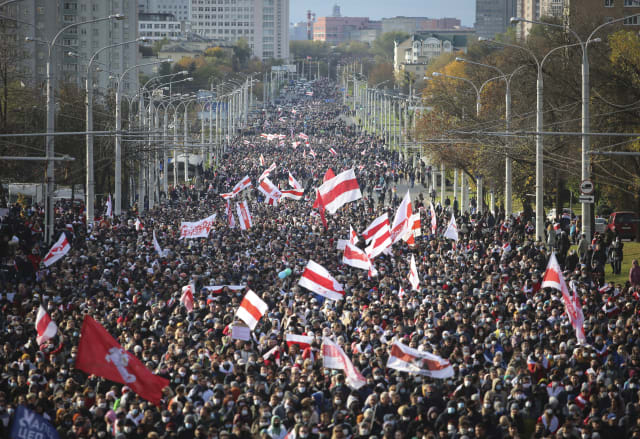
We called it “Like Water,” because of the tactics, decentralized efforts, and a courtyard revolution that was harder to suppress because they were not always visible.
Much of protest life unfolded in between the marches. People gathered in solidarity chains during lunch breaks and after work. Courtyards turned into spaces of meetings, concerts, discussions, assemblies. In the evenings, people leaned out of their windows for roll calls, shouted into the dark, played music, or lit candles to signal their presence to one another.
I participated in these gatherings myself. I watched neighbors hide people from police raids and warn each other when security forces entered the courtyards. Local chats were used as channels of coordination, helping people move through the spaces, avoid arrests, share information, and remain connected. As the protest circulated through the fabric of everyday life, many of us began recognizing one another for the first time.
We learned then to look for the political elsewhere, everywhere.
At the event Europa 2057 in March 2026, Slavoj Žižek said that revolution in our time is a way to pull the emergency brake on a train hurtling toward the abyss of the collapsing world. From within the Belarusian protests, this image feels both accurate and insufficient. It suggests an interruption, and what Belarusian society experienced was less a singular act but a continued struggle to navigate a system already in motion.
Looking back now, the road that led Belarusians to the 2020 protests is clear to me. For decades, political life in Belarus followed a steady rhythm: elections, protests, repression, followed by a seemingly mundane life. This repetition structured political time, and became predictable. Even the desire for change, anger, and hope was normalized. That’s how our society approached ‘Like Water’ — with the sense that the regime would continue indefinitely stagnating in its self-reproduced form.
But then COVID-19 happened, followed by the election campaign — and something shifted. The scale of state violence expanded. And with Russia waging war against Ukraine, millions of people were forced to flee their homes because of shelling and repression.
Authoritarian power does more than clear the streets. It also shapes the criteria for what we are able to see as political.
Everything beyond street gatherings, revolutionary violence, and party struggle dissolves into the realm of the private, remaining outside political scrutiny. Participants themselves often internalize this logic, coming to see their own forms of engagement as insufficient or exhausted. It raised important questions for Belarusians: how do we sustain life under ongoing violence, how do we survive together, what should become central to our collective attention?
The struggle was no longer only about confronting the regime, but about deciding what kinds of relations deserved political attention. What brought so many people onto the streets of Belarus was the expansion of net connections and social trust that preceded the protests, catalyzed by mutual aid initiatives in the beginning of the pandemic.
Even before the marches, information about routes and movements of riot police vehicles was circulated across activist Telegram chats. Participants shared information, reposted it, offered assistance, and announced locations from which people would be moving toward the march to support each other. Long before the 2020 protests, people gained experience of collective action and solving very specific problems together. And the pandemic increased the scale of interaction, as the self-proclaimed regime became the country’s main Covid-dissident, denying the depth of the problems and falsifying statistics.
As state violence escalated, we faced new routines of survival. Mass detentions and hospital visits became part of everyday life. People disappeared for days. Many were released in the middle of the night, kilometers away from home with no phones or documents. Checking the lists of detainees became a daily practice. I would search for the names of my friends and colleagues, as many others did too.
Networks of support began to form around this new reality almost immediately. Volunteers waited outside detention centers with water, food, medicine, warm clothes, and phone chargers. Drivers offered rides home, lawyers coordinated emergency legal aid, human rights groups collected testimonies and tracked court hearings.
The last street gatherings in Belarus took place in 2022, after the full-scale Russian invasion of Ukraine. And yet when people stopped gathering in the streets, much of this infrastructure remained.
The vanguard of women’s marches and networks played an important role in this reorientation of attention toward infrastructures of survival. According to the human rights center Viasna, at least 1,839 women have been convicted in Belarus on politically motivated charges since 2020. Many of them have faced torture, sexualized violence, inhumane conditions, and forced labor.
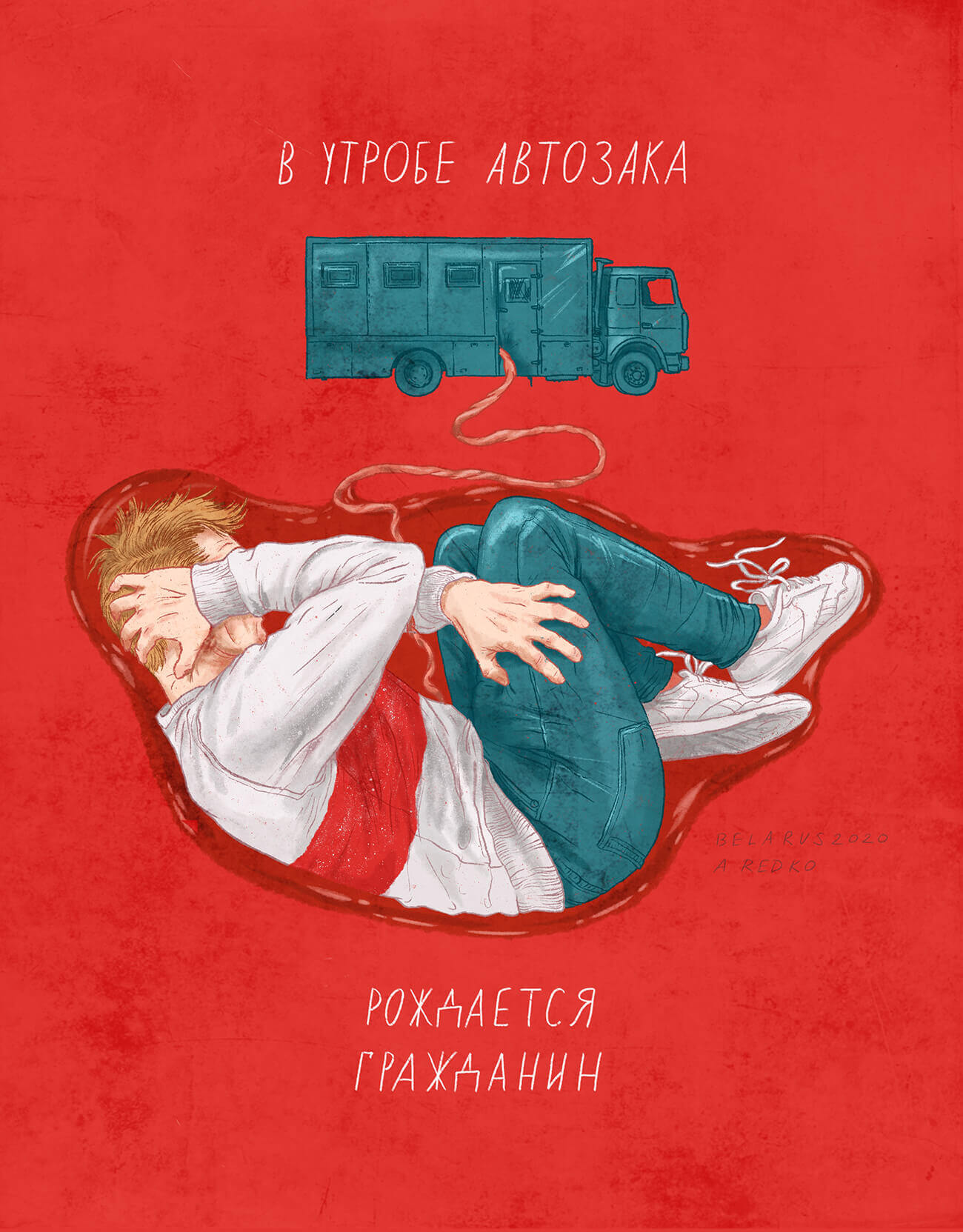
Anna Redko, ‘A citizen is born In the womb of a paddy wagon’ (2020)
Among them was Belarusian artist Nadya Sayapina, who was subjected to administrative detention. Nadya transformed this experience into an artistic practice in which kinship emerges as a bodily practice of connection, a way to organize life where structure collapses. In a series of portraits of cellmates, later included in the installation Dollhouse (2021), as well as in interviews about prison life, Nadya recreates sisterhood as collective care and work in circumstances where this gesture becomes a political choice. Through creating small, shared routines — washing and combing hair, games, lectures, drawing — Nadya and other women were able to regain a sense of self and connection to events outside the prison walls.
When protest becomes impossible on the streets, it happens instead through everyday relations, making resistance possible again.
In this sense, kinship works to increase political sensitivity in dispersed groups. Tactics of disobedience, sabotage, non-reproduction of violence and ideologies became an everyday revolutionary labor. Framed this way, connectedness rejects the figure of the exceptional subject or heroic center of resistance. One of the most persistent problems in conceptualizing a revolutionary movement is its reliance on heroization and glorification. Such figures work poorly under prolonged repression, where exhaustion replaces the expectation of rapid transformation.
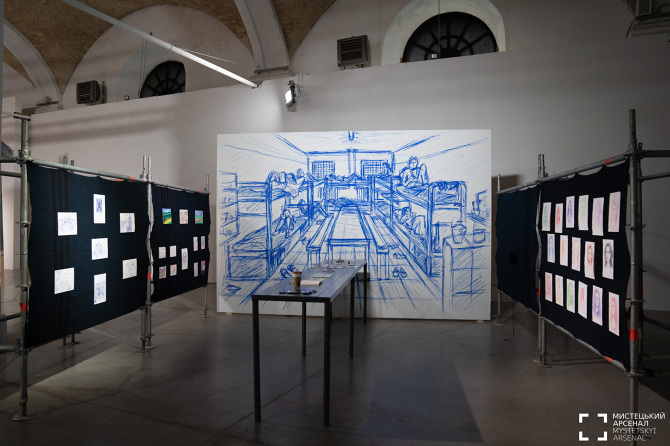
“Dollhouse”, from the exhibition “Every day” , Mystetskyi Arsenal, Kyiv, 2021. Photo - Olexandr Popenko
The movement simply could no longer rely on constant expansion. Instead, kinship - organized around continuity - circulates through survival, repetition, and the reproduction of relations.
From courtyard chats to aid stations to sisterhood initiatives to inside-prison nets of survival, relations became central to protest. The fundamental point for unions and associations was not identity, but the practice of togetherness, which countered isolation and fragmentation in society.
Thus, the question of who will consolidate protest energy has shifted toward how we would continue to interact — placing these tenuous, flickering connections at the center. The web survives only so long as people continue to choose one another despite fear and exhaustion.