
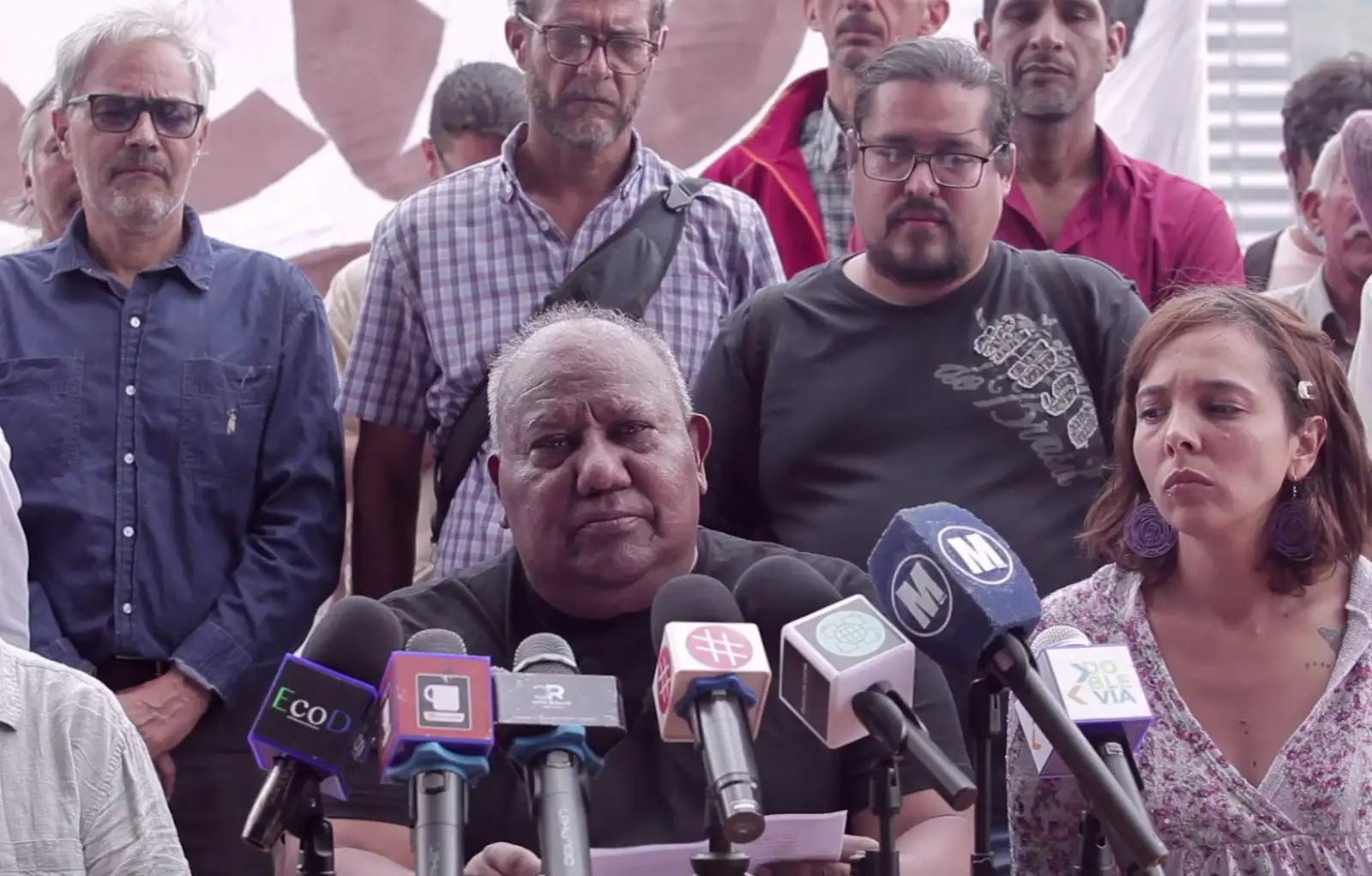
Eduardo Sánchez is an important Venezuelan labor leader with decades of political and union work. He is the president of the National Union of Workers of the Central University of Venezuela (SINATRAUCV) and the Federation of Higher Education Workers of Venezuela (FETRAESUV). He is also a member of Comunes, an organization founded in 2024 that, in its founding documents, aims for the recovery of the legacy of the Bolivarian Revolution, which they believe the Maduro government has broken with, to the point of considering it a neoliberal and “anti-Chavista government.”
Sánchez describes Comunes as “a grouping of left-wing sectors that propose an alternative to the polarization between the so-called reactionary left that rules the country, led by President Nicolás Maduro, and the fascist and right-wing sectors represented by the current headed by María Corina Machado. In other words, we are a third option, seeking to establish a political and social solution for the popular and workers’ movement, with the concept of the homeland as a fundamental element.” The following interview took place January 13.
How would you characterize the events of the last few days in Venezuela, starting with the US attack?
Since the early hours of January 3, the US aggression against Bolívar’s homeland, against Venezuelan soil, materialized. According to statements by US spokespeople themselves, more than 150 aircraft invaded Venezuelan territory to bomb specific areas of Caracas, Miranda, Aragua, and La Guaira. This is an unprecedented event in Venezuelan politics, which has caused outrage because Venezuelan soil has been sullied by the insolence of an imperialist power that, abusing its military might, has taken it upon itself to intervene in our country and remove the president. Not that we defend the president as such, but we do not believe that anyone has given the US president carte blanche to be the world’s policeman and come and control our country. This is a problem for Venezuelans that we Venezuelans must resolve ourselves. Therefore, we condemn this aggression as a disgraceful act that we hope will not happen again in any of our countries on the continent.
President Maduro has led an authoritarian government that arose from an unfortunate event, which leaves doubts about its legitimacy, given that he lost the July 28 elections and arrogated them to himself, generating a process of repression, imprisoning anyone who protested, and acquiring a dictatorial character, which today bears responsibility for what is happening with the current crisis. The gringos have intervened, taking advantage of the crisis and with the support of an anti-national sector of the country that called for intervention and is now very poorly regarded by Venezuelan society.
What is the current situation on the streets?
The situation on the streets of Venezuela is one of astonishing calm, as a result of the fact that more than 70% of Venezuelans did not sympathize with Maduro’s regime, in addition to its repression, imprisonments, and deaths, as well as the economic and social deterioration that has engulfed the Venezuelan working class, which has paid a high price for a crisis it did not create, which has impoverished its wages and plunged it into a state of critical poverty. Today, when the government sought the support of the working class and the people, the response was negligible, with only a small percentage mobilizing due to the general discontent that existed.
This does not mean support for the intervention; everyone laments that more than 100 Venezuelans have died as a result of treacherous bombings against Bolívar’s homeland, and that the concept of homeland has been sidelined and the country’s sovereignty violated.
How do you interpret Trump’s announcements that he will allegedly run the country and take over Venezuelan oil?
For us, there is now a dilemma: republic or colony. Facing it, we are putting forward our proposals to unify the country, to unify the working people around the concept of the Republic. We cannot be a colony of anyone, much less of the gringos, who have been the most reactionary and recalcitrant imperialist power on the continent, responsible for interventions that have taken place since the beginning of the last century, and who now seek to arrogate to themselves rights they do not have in order to turn us into a protectorate.
The call we are making to Venezuelan society and the workers’ movement is for unity and action, and to the interim government, which also lacks legitimacy, despite being the element with which they intend to make a transition, is that any solution that is proposed must be framed within the Constitution and the democratic process. Relations with the US from a commercial point of view must be within the framework of respect for the Venezuelan Constitution and laws, and not under the guise of a kind of protectorate where they are giving orders on the premise that if they are not obeyed, they will bomb again.
We believe that the country has sufficient political reserves to achieve an independent, autonomous, democratic, and patriotic state that can lead this country and put an end to the attempt to impose a dictatorship by a government that claimed to be revolutionary but ended up being neoliberal and capitalist, and prevent us from becoming a protectorate of a foreign power. We consider it important for the country to move towards democracy, allowing us to elect our president in accordance with the Constitution and laws of the Bolivarian Republic of Venezuela.
What message would you give to workers in other countries who are closely following the situation in Venezuela?
This situation is very unfortunate for the entire continent. It represents a wake-up call to the different peoples of the world, in the understanding that the gringos now consider that they are once again managing the region as their backyard, and from that point of view they simply intend to take our oil, our gold, our rare earths, turn Venezuela into a kind of protectorate or colony, and take over the wealth of our country.
It is important that the peoples of the world see themselves in the mirror of the Venezuelan situation, which today stands at a crossroads between becoming a US colony or continuing on the path of the Republic. We call on the working classes of Latin America and the world to unite to avoid ending up in a situation like the one we are now experiencing. We call on them to fight the authoritarian regimes that have brought so much pain to the different countries of the American continent. The call is for unity as a class, with a perspective of struggle, not only for labor rights but also for the homeland, a fundamental and unifying concept of each of the countries that make up the Latin American homeland, which continue in the struggle for self-determination, to expand and develop democracy to place it at the service of the majority.