

Digital & Print Membership
Yearly + Receive 8 free printed back issues
$420 Annually
Monthly + Receive 3 free printed back issues
$40 Monthly
The Toll Working Multiple Jobs Takes on Young People
“Rat race,” “chaos,” “stressful”: these are just a few ways young people are describing days stuffed with side projects, shift schedules, and Google Calendars color-coded by job.
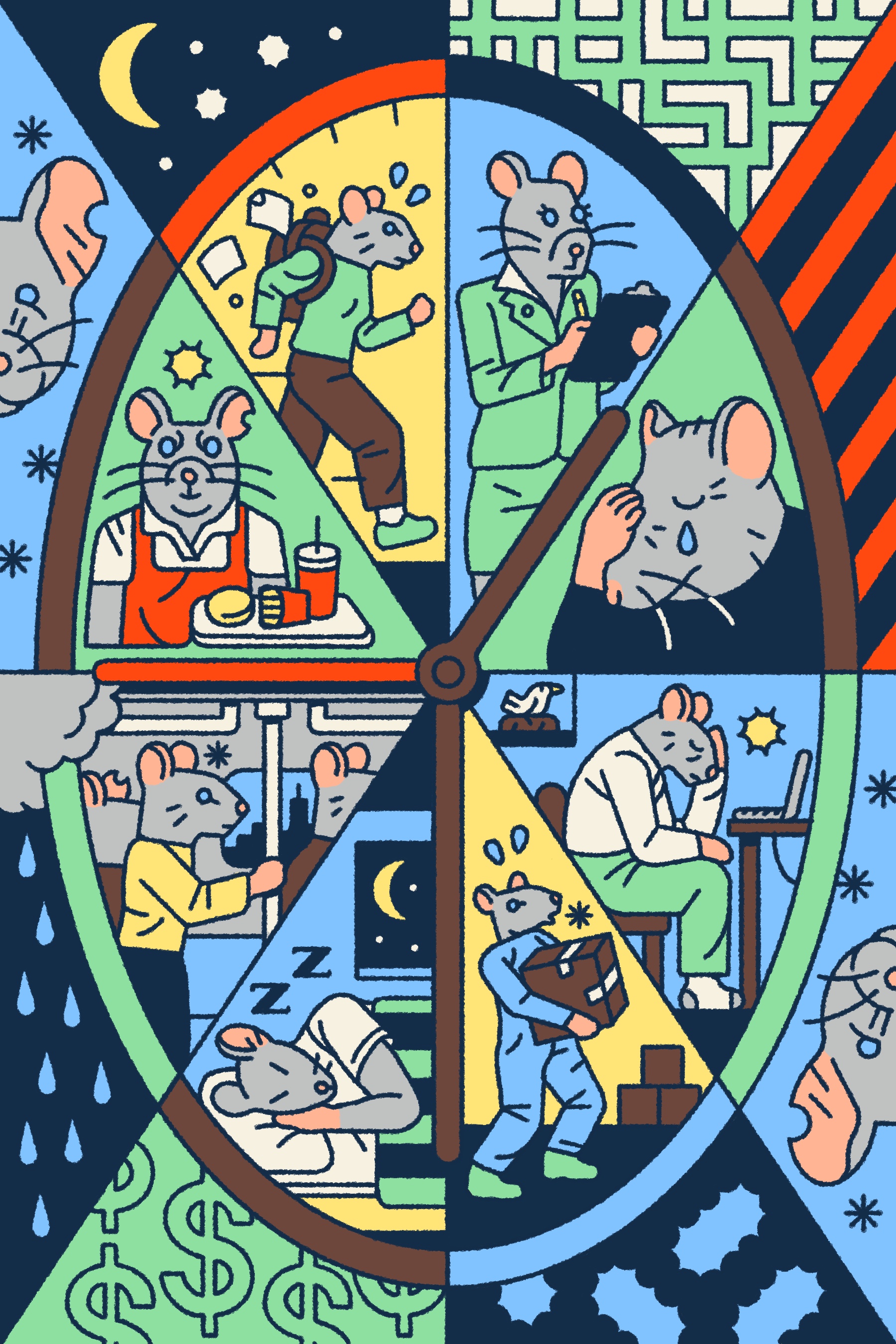
Illustration Credit: Zach Hackman
At one of her three jobs, Makayla, a 22-year-old in Texas, pushes 80-pound crates on a dolly. The seasonal retail position demands a lot of walking and lifting, with customers pulling candles off shelves faster than she can unload them. Makayla (who is going by her first name to protect her privacy) is often sore to the point of pain when she arrives at her other job, where she’s a clerk for a judge, supporting the court’s day-to-day operations.
Though Makayla lives with her parents (who she’s also helped financially in the past, she said), she pays for college tuition, living expenses, and transportation. She’s also saving to pay for law school herself. In addition to working retail and her job with the court, Makayla said she was lucky to find a paid internship related to her major, computer science, where she can build her own schedule. But between the cost of college and the rising cost of living, it feels like it’s not enough.
“It [is] a rat race, but I don’t know who’s chasing me,” Makayla explained. “It’s like I’m chasing myself.”
“Stressful” was one way young workers described days stuffed with side projects, shift schedules, and Google Calendars color-coded by job. “Tiring,” “chaos,” and “shitty” were among others. Makayla is among a growing number of young people with more than one source of income to make ends meet. According to a 2025 Harvard Youth Poll, 43% of young people surveyed say they’re struggling to get by with limited financial security.
This lack of a financial safety net is no accident. This generation’s economic squeeze is the predictable outcome of decades of monopolization and private-equity consolidation while employee wages stagnate and costs of living soar. According to recent data from the Federal Reserve, in the third quarter of 2025, the top 1% of households owned 31.7% of all U.S. wealth. This is the highest recorded disparity since the Federal Reserve began tracking household wealth in 1989.
For a generation that’s never known work without a side of total upheaval—from the pandemic reshaping jobs and internships, to companies offering, then revoking remote work, to now attacks on university funding, the federal workforce, and more—stability feels impossible to come by. With exhaustingly high costs of living and even more political, societal, and economic uncertainty looming, second jobs and side gigs are a crucial part of creating a safety net for young people who don’t have a societal one to catch them.
Why the job market feels impossible for young people right now
Ask anyone and they’ll tell you it’s a bad time to be job searching. After repeated cycles of corruption and privatization—turning housing, utilities, healthcare, and even crisis itself into profit centers—corporations have systematically hollowed out the middle class and extracted value upward. Even if pundits say that “the economy is growing,” all the profits are being pulled out by shareholders at the top. This leaves little for employees to receive basic societal benefits, including fair wages, health and retirement insurance, as well as any sort of path to upward mobility enjoyed by previous generations.
These larger forces are what drive sluggish hiring and endless layoffs, which leads to fewer people leaving or changing positions. There are fewer entry-level jobs with higher requirements — on top of panic that companies are gutting entry-level jobs to replace them with AI. To boot is also the affordability crisis in which the costs of necessities, from healthcare to groceries, have spiked. This sprawling list of factors are part of why so many workers are hanging on to multiple streams of income.
Cloud Benn, a 22-year-old in New Orleans, for instance, works as an English teacher, a gift shop worker in a cultural arts museum, and a writing tutor. Even when they were 18, Benn said working only one job has never felt viable. “Especially me being a minority. I’m Black, and I live in a city that is low-income. I [was] part of what was considered middle-class. I’m part of [the] low-class now with my family,” Benn explained. “Everything has gone up in price, and just to live, just to get your basic necessities, has gone up.”
Rates of people working multiple jobs have been on the rise, including for workers ages 25 to 54, according to Elise Gould, Senior Economist at the Economic Policy Institute. But since less work experiencein a sluggish labor market could mean fewer opportunities to break into the workforce, it feels like a particularly disastrous time to start working life. Landing that one “first job” and working up from there feels like a myth, given the endless economic chaos of the last few years.
During the start of the pandemic, young workers were disproportionately hurt by unemployment and job loss. As employers began hiring again, they had to work harder to attract and retain workers. Gould notes that, in that moment, workers had more leverage. But now, the hiring rate is depressed again, which could hurt young people more than others.
Graduating into a weaker economy can set you back, Gould explained, depending on how long this weakness lasts. Joining the workforce during an economic downturn can negatively impact health, income, and career advancement. While Gould noted this wouldn’t necessarily set you back for your lifetime in terms of career, it could be harder. One notable example, of course, is elder millennials, who graduated into the Great Recession.
Young people are seeing this instability, “among their peers, among their families, among people who often have a lot more experience than they do,” explained Noel Tieszen, a policy strategist focused on youth economic justice at National Collaborative for Transformative Youth Policy. This is especially seen with young Black workers, LGBTQ+ young people, and those whose families come from poorer socio-economic backgrounds. These communities are disproportionately impacted by unemployment or underemployment.
Young people also play multiple roles within their social circles: They are often parents, caregivers, or contributing to their communities or households. When so much time is taken up with multiple jobs, “that’s less time for family. It’s less time for exploring skills and talents,” said Tieszen. “They’re just trying to get by day-to-day, surviving, not thriving.”
It’s not just an affordability issue
In some fields, like the arts, it’s long been an accepted norm that pursuing certain lines of work might happen alongside a day job or extra gigs, an expectation of low wages or limited opportunities that many young artists are pushing back on. But there’s a huge variance in what multiple jobs can look like: While some young workers might have a side hustle outside their day job, others might work multiple jobs if they aren’t getting enough hours at one.
Reporting outlines that, now, working various jobs is appearing across industries. For example, a 2023 survey found workers in the computer and technology space were more likely to have other forms of income; 2025 data found that one in six teachers work a second job; other 2025 estimates note workers in fields like educational and health services and transportation and utilities are more likely to hold a main job with a second job.
But there are also larger shifts within the workforce that are reshaping young people’s relationship to it. Expectations that one will work their way up in a company are almost nonexistent, and stigma around job-hopping has largely been shattered. One 2025 survey noted that over half of Gen Z-ers surveyed think traditional employment will eventually be obsolete.
Thomas Showalter, an independent consultant who specializes in the transition to adulthood, education, job training, and labor, pointed out that for his generation—he’s an elder millennial—the Great Recession was an “acute shock to the system” in terms of labor market prospects. Meaning, some millennials grew up with a sense that there was a social contract, only to find it didn’t add up in early adulthood. “For Gen Z, and probably for [Gen] Alpha too, I think it’s more of a chronic condition,” he explained. “What I observed over the years with younger people is [that] there was never a social contract; I’m just assuming that I’m going to have to hustle all the time.”
This has led many young workers to try to create stability for themselves, since living off one source of income doesn’t always feel possible. Christopher Hendrix, a 25-year-old in Southern California, has a full-time job at a nonprofit, does community organizing work focused on youth homelessness, and is pursuing his master’s degree in social work. In his social circle, he said people are always thinking about what opportunity could be next, and that Gen Z can’t necessarily depend on one job to get them where they want to go. Hendrix grew up low-income and got used to working multiple jobs to support himself. “I can pay my bills. I’m stable, but I still have this itching thought that, no, you got to keep working, because one day it can be taken away from you,” he said.
For some, working multiple jobs can also be a means of pursuing work they’re interested in.
Izabella Escurra, a 23-year-old in New Jersey, works full-time in college admissions and in her off hours has a side hustle as a freelance publicist. “I feel like a lot of Gen Z people are using side hustles to make their own businesses or to take the entrepreneurial mindset,” she said.
She thinks ballooning standards for entry-level jobs are a factor, too. “One to two internships, that’s really not the baseline for a lot of entry-level jobs anymore,” she said. “I think they’re seeing from their older siblings or older relatives that the job market isn’t what it used to be.”
There’s a mental toll to the hustle, too
As workers endlessly hustle, what looms is the toll it takes to work this much—and the potential ramifications it has on the rest of one’s working life.
Burnout, which Gen Z is already experiencing higher rates of, can have a significant impact. “The structural conditions driving young workers toward multiple jobs—wage stagnation, job insecurity, rising costs of living—are themselves chronic stressors that compound the day-to-day demands of managing multiple positions,” said M. Gloria González Morales, an associate professor and director of The Worker Wellbeing Lab at Claremont Graduate University. There is also evidence that work experiences during formative career periods influence someone’s attitude toward work later.
“No one talks about emotionally, how irritable it makes you,” said Makayla. “When you work so much and you’re tired, a lot of times you’re not present for the things you do.”
But there are solutions. Morales pointed to the importance of social support, including from supervisors and coworkers. Workplaces can provide resources, including autonomy, skill development opportunities, and addressing health and safety and work-life balance, she added.
“Policy approaches that improve wages, provide scheduling predictability, and strengthen worker protections could reduce the structural conditions that push young workers toward multiple job arrangements,” Morales said.
Tieszen emphasized the need to ensure young workers are educated about their rights, noting growing interest among young people in unions. But she also noted it demands going beyond jobs: “It’s about making sure that the other systems and structures in society are functioning,” Tieszen said. Funding for healthcare, childcare, and transportation is critical. “The fear of losing a job and having hours cut is real, and it’s grounded in reality,” she said. If other systems are in place, that relieves stress.
Benn said that figuring out how to even survive right now takes a toll, and also believes there needs to be more support and more opportunities for people to talk about what they’re experiencing.
“There are people out there that are like, ‘Oh, young people don’t want to do anything,’” Benn said. “No, we are busting our ass. We’re tired, and we just want to lay down.”
{
"article":
{
"title" : "The Toll Working Multiple Jobs Takes on Young People",
"author" : "Rainesford Stauffer",
"category" : "essays",
"url" : "https://everythingispolitical.com/readings/toll-working-multiple-jobs-young-people",
"date" : "2026-02-10 13:57:00 -0500",
"img" : "https://everythingispolitical.com/uploads/EverythingisPol-ZachHackman.jpg",
"excerpt" : "“Rat race,” “chaos,” “stressful”: these are just a few ways young people are describing days stuffed with side projects, shift schedules, and Google Calendars color-coded by job.",
"content" : "“Rat race,” “chaos,” “stressful”: these are just a few ways young people are describing days stuffed with side projects, shift schedules, and Google Calendars color-coded by job.Illustration Credit: Zach HackmanAt one of her three jobs, Makayla, a 22-year-old in Texas, pushes 80-pound crates on a dolly. The seasonal retail position demands a lot of walking and lifting, with customers pulling candles off shelves faster than she can unload them. Makayla (who is going by her first name to protect her privacy) is often sore to the point of pain when she arrives at her other job, where she’s a clerk for a judge, supporting the court’s day-to-day operations.Though Makayla lives with her parents (who she’s also helped financially in the past, she said), she pays for college tuition, living expenses, and transportation. She’s also saving to pay for law school herself. In addition to working retail and her job with the court, Makayla said she was lucky to find a paid internship related to her major, computer science, where she can build her own schedule. But between the cost of college and the rising cost of living, it feels like it’s not enough.“It [is] a rat race, but I don’t know who’s chasing me,” Makayla explained. “It’s like I’m chasing myself.”“Stressful” was one way young workers described days stuffed with side projects, shift schedules, and Google Calendars color-coded by job. “Tiring,” “chaos,” and “shitty” were among others. Makayla is among a growing number of young people with more than one source of income to make ends meet. According to a 2025 Harvard Youth Poll, 43% of young people surveyed say they’re struggling to get by with limited financial security.This lack of a financial safety net is no accident. This generation’s economic squeeze is the predictable outcome of decades of monopolization and private-equity consolidation while employee wages stagnate and costs of living soar. According to recent data from the Federal Reserve, in the third quarter of 2025, the top 1% of households owned 31.7% of all U.S. wealth. This is the highest recorded disparity since the Federal Reserve began tracking household wealth in 1989.For a generation that’s never known work without a side of total upheaval—from the pandemic reshaping jobs and internships, to companies offering, then revoking remote work, to now attacks on university funding, the federal workforce, and more—stability feels impossible to come by. With exhaustingly high costs of living and even more political, societal, and economic uncertainty looming, second jobs and side gigs are a crucial part of creating a safety net for young people who don’t have a societal one to catch them.Why the job market feels impossible for young people right nowAsk anyone and they’ll tell you it’s a bad time to be job searching. After repeated cycles of corruption and privatization—turning housing, utilities, healthcare, and even crisis itself into profit centers—corporations have systematically hollowed out the middle class and extracted value upward. Even if pundits say that “the economy is growing,” all the profits are being pulled out by shareholders at the top. This leaves little for employees to receive basic societal benefits, including fair wages, health and retirement insurance, as well as any sort of path to upward mobility enjoyed by previous generations.These larger forces are what drive sluggish hiring and endless layoffs, which leads to fewer people leaving or changing positions. There are fewer entry-level jobs with higher requirements — on top of panic that companies are gutting entry-level jobs to replace them with AI. To boot is also the affordability crisis in which the costs of necessities, from healthcare to groceries, have spiked. This sprawling list of factors are part of why so many workers are hanging on to multiple streams of income.Cloud Benn, a 22-year-old in New Orleans, for instance, works as an English teacher, a gift shop worker in a cultural arts museum, and a writing tutor. Even when they were 18, Benn said working only one job has never felt viable. “Especially me being a minority. I’m Black, and I live in a city that is low-income. I [was] part of what was considered middle-class. I’m part of [the] low-class now with my family,” Benn explained. “Everything has gone up in price, and just to live, just to get your basic necessities, has gone up.”Rates of people working multiple jobs have been on the rise, including for workers ages 25 to 54, according to Elise Gould, Senior Economist at the Economic Policy Institute. But since less work experiencein a sluggish labor market could mean fewer opportunities to break into the workforce, it feels like a particularly disastrous time to start working life. Landing that one “first job” and working up from there feels like a myth, given the endless economic chaos of the last few years.During the start of the pandemic, young workers were disproportionately hurt by unemployment and job loss. As employers began hiring again, they had to work harder to attract and retain workers. Gould notes that, in that moment, workers had more leverage. But now, the hiring rate is depressed again, which could hurt young people more than others.Graduating into a weaker economy can set you back, Gould explained, depending on how long this weakness lasts. Joining the workforce during an economic downturn can negatively impact health, income, and career advancement. While Gould noted this wouldn’t necessarily set you back for your lifetime in terms of career, it could be harder. One notable example, of course, is elder millennials, who graduated into the Great Recession.Young people are seeing this instability, “among their peers, among their families, among people who often have a lot more experience than they do,” explained Noel Tieszen, a policy strategist focused on youth economic justice at National Collaborative for Transformative Youth Policy. This is especially seen with young Black workers, LGBTQ+ young people, and those whose families come from poorer socio-economic backgrounds. These communities are disproportionately impacted by unemployment or underemployment.Young people also play multiple roles within their social circles: They are often parents, caregivers, or contributing to their communities or households. When so much time is taken up with multiple jobs, “that’s less time for family. It’s less time for exploring skills and talents,” said Tieszen. “They’re just trying to get by day-to-day, surviving, not thriving.”It’s not just an affordability issueIn some fields, like the arts, it’s long been an accepted norm that pursuing certain lines of work might happen alongside a day job or extra gigs, an expectation of low wages or limited opportunities that many young artists are pushing back on. But there’s a huge variance in what multiple jobs can look like: While some young workers might have a side hustle outside their day job, others might work multiple jobs if they aren’t getting enough hours at one.Reporting outlines that, now, working various jobs is appearing across industries. For example, a 2023 survey found workers in the computer and technology space were more likely to have other forms of income; 2025 data found that one in six teachers work a second job; other 2025 estimates note workers in fields like educational and health services and transportation and utilities are more likely to hold a main job with a second job.But there are also larger shifts within the workforce that are reshaping young people’s relationship to it. Expectations that one will work their way up in a company are almost nonexistent, and stigma around job-hopping has largely been shattered. One 2025 survey noted that over half of Gen Z-ers surveyed think traditional employment will eventually be obsolete.Thomas Showalter, an independent consultant who specializes in the transition to adulthood, education, job training, and labor, pointed out that for his generation—he’s an elder millennial—the Great Recession was an “acute shock to the system” in terms of labor market prospects. Meaning, some millennials grew up with a sense that there was a social contract, only to find it didn’t add up in early adulthood. “For Gen Z, and probably for [Gen] Alpha too, I think it’s more of a chronic condition,” he explained. “What I observed over the years with younger people is [that] there was never a social contract; I’m just assuming that I’m going to have to hustle all the time.”This has led many young workers to try to create stability for themselves, since living off one source of income doesn’t always feel possible. Christopher Hendrix, a 25-year-old in Southern California, has a full-time job at a nonprofit, does community organizing work focused on youth homelessness, and is pursuing his master’s degree in social work. In his social circle, he said people are always thinking about what opportunity could be next, and that Gen Z can’t necessarily depend on one job to get them where they want to go. Hendrix grew up low-income and got used to working multiple jobs to support himself. “I can pay my bills. I’m stable, but I still have this itching thought that, no, you got to keep working, because one day it can be taken away from you,” he said.For some, working multiple jobs can also be a means of pursuing work they’re interested in.Izabella Escurra, a 23-year-old in New Jersey, works full-time in college admissions and in her off hours has a side hustle as a freelance publicist. “I feel like a lot of Gen Z people are using side hustles to make their own businesses or to take the entrepreneurial mindset,” she said.She thinks ballooning standards for entry-level jobs are a factor, too. “One to two internships, that’s really not the baseline for a lot of entry-level jobs anymore,” she said. “I think they’re seeing from their older siblings or older relatives that the job market isn’t what it used to be.”There’s a mental toll to the hustle, tooAs workers endlessly hustle, what looms is the toll it takes to work this much—and the potential ramifications it has on the rest of one’s working life.Burnout, which Gen Z is already experiencing higher rates of, can have a significant impact. “The structural conditions driving young workers toward multiple jobs—wage stagnation, job insecurity, rising costs of living—are themselves chronic stressors that compound the day-to-day demands of managing multiple positions,” said M. Gloria González Morales, an associate professor and director of The Worker Wellbeing Lab at Claremont Graduate University. There is also evidence that work experiences during formative career periods influence someone’s attitude toward work later.“No one talks about emotionally, how irritable it makes you,” said Makayla. “When you work so much and you’re tired, a lot of times you’re not present for the things you do.”But there are solutions. Morales pointed to the importance of social support, including from supervisors and coworkers. Workplaces can provide resources, including autonomy, skill development opportunities, and addressing health and safety and work-life balance, she added.“Policy approaches that improve wages, provide scheduling predictability, and strengthen worker protections could reduce the structural conditions that push young workers toward multiple job arrangements,” Morales said.Tieszen emphasized the need to ensure young workers are educated about their rights, noting growing interest among young people in unions. But she also noted it demands going beyond jobs: “It’s about making sure that the other systems and structures in society are functioning,” Tieszen said. Funding for healthcare, childcare, and transportation is critical. “The fear of losing a job and having hours cut is real, and it’s grounded in reality,” she said. If other systems are in place, that relieves stress.Benn said that figuring out how to even survive right now takes a toll, and also believes there needs to be more support and more opportunities for people to talk about what they’re experiencing.“There are people out there that are like, ‘Oh, young people don’t want to do anything,’” Benn said. “No, we are busting our ass. We’re tired, and we just want to lay down.”"
}
,
"relatedposts": [
{
"title" : "Venezuela should be neither dictatorship nor colony: An interview with union leader Eduardo Sánchez",
"author" : "Simón Rodriguez",
"category" : "essays",
"url" : "https://everythingispolitical.com/readings/venezuela-should-be-neither-dictatorship-nor-colony",
"date" : "2026-02-12 10:51:00 -0500",
"img" : "https://everythingispolitical.com/uploads/Eduardo%20Sa%CC%81nchez%20rueda%20de%20prensa%20diciembre%202024.jpeg",
"excerpt" : "Eduardo Sánchez is an important Venezuelan labor leader with decades of political and union work. He is the president of the National Union of Workers of the Central University of Venezuela (SINATRAUCV) and the Federation of Higher Education Workers of Venezuela (FETRAESUV). He is also a member of Comunes, an organization founded in 2024 that, in its founding documents, aims for the recovery of the legacy of the Bolivarian Revolution, which they believe the Maduro government has broken with, to the point of considering it a neoliberal and “anti-Chavista government.”",
"content" : "Eduardo Sánchez is an important Venezuelan labor leader with decades of political and union work. He is the president of the National Union of Workers of the Central University of Venezuela (SINATRAUCV) and the Federation of Higher Education Workers of Venezuela (FETRAESUV). He is also a member of Comunes, an organization founded in 2024 that, in its founding documents, aims for the recovery of the legacy of the Bolivarian Revolution, which they believe the Maduro government has broken with, to the point of considering it a neoliberal and “anti-Chavista government.”Sánchez describes Comunes as “a grouping of left-wing sectors that propose an alternative to the polarization between the so-called reactionary left that rules the country, led by President Nicolás Maduro, and the fascist and right-wing sectors represented by the current headed by María Corina Machado. In other words, we are a third option, seeking to establish a political and social solution for the popular and workers’ movement, with the concept of the homeland as a fundamental element.” The following interview took place January 13.How would you characterize the events of the last few days in Venezuela, starting with the US attack?Since the early hours of January 3, the US aggression against Bolívar’s homeland, against Venezuelan soil, materialized. According to statements by US spokespeople themselves, more than 150 aircraft invaded Venezuelan territory to bomb specific areas of Caracas, Miranda, Aragua, and La Guaira. This is an unprecedented event in Venezuelan politics, which has caused outrage because Venezuelan soil has been sullied by the insolence of an imperialist power that, abusing its military might, has taken it upon itself to intervene in our country and remove the president. Not that we defend the president as such, but we do not believe that anyone has given the US president carte blanche to be the world’s policeman and come and control our country. This is a problem for Venezuelans that we Venezuelans must resolve ourselves. Therefore, we condemn this aggression as a disgraceful act that we hope will not happen again in any of our countries on the continent.President Maduro has led an authoritarian government that arose from an unfortunate event, which leaves doubts about its legitimacy, given that he lost the July 28 elections and arrogated them to himself, generating a process of repression, imprisoning anyone who protested, and acquiring a dictatorial character, which today bears responsibility for what is happening with the current crisis. The gringos have intervened, taking advantage of the crisis and with the support of an anti-national sector of the country that called for intervention and is now very poorly regarded by Venezuelan society.What is the current situation on the streets?The situation on the streets of Venezuela is one of astonishing calm, as a result of the fact that more than 70% of Venezuelans did not sympathize with Maduro’s regime, in addition to its repression, imprisonments, and deaths, as well as the economic and social deterioration that has engulfed the Venezuelan working class, which has paid a high price for a crisis it did not create, which has impoverished its wages and plunged it into a state of critical poverty. Today, when the government sought the support of the working class and the people, the response was negligible, with only a small percentage mobilizing due to the general discontent that existed.This does not mean support for the intervention; everyone laments that more than 100 Venezuelans have died as a result of treacherous bombings against Bolívar’s homeland, and that the concept of homeland has been sidelined and the country’s sovereignty violated.How do you interpret Trump’s announcements that he will allegedly run the country and take over Venezuelan oil?For us, there is now a dilemma: republic or colony. Facing it, we are putting forward our proposals to unify the country, to unify the working people around the concept of the Republic. We cannot be a colony of anyone, much less of the gringos, who have been the most reactionary and recalcitrant imperialist power on the continent, responsible for interventions that have taken place since the beginning of the last century, and who now seek to arrogate to themselves rights they do not have in order to turn us into a protectorate.The call we are making to Venezuelan society and the workers’ movement is for unity and action, and to the interim government, which also lacks legitimacy, despite being the element with which they intend to make a transition, is that any solution that is proposed must be framed within the Constitution and the democratic process. Relations with the US from a commercial point of view must be within the framework of respect for the Venezuelan Constitution and laws, and not under the guise of a kind of protectorate where they are giving orders on the premise that if they are not obeyed, they will bomb again.We believe that the country has sufficient political reserves to achieve an independent, autonomous, democratic, and patriotic state that can lead this country and put an end to the attempt to impose a dictatorship by a government that claimed to be revolutionary but ended up being neoliberal and capitalist, and prevent us from becoming a protectorate of a foreign power. We consider it important for the country to move towards democracy, allowing us to elect our president in accordance with the Constitution and laws of the Bolivarian Republic of Venezuela.What message would you give to workers in other countries who are closely following the situation in Venezuela?This situation is very unfortunate for the entire continent. It represents a wake-up call to the different peoples of the world, in the understanding that the gringos now consider that they are once again managing the region as their backyard, and from that point of view they simply intend to take our oil, our gold, our rare earths, turn Venezuela into a kind of protectorate or colony, and take over the wealth of our country.It is important that the peoples of the world see themselves in the mirror of the Venezuelan situation, which today stands at a crossroads between becoming a US colony or continuing on the path of the Republic. We call on the working classes of Latin America and the world to unite to avoid ending up in a situation like the one we are now experiencing. We call on them to fight the authoritarian regimes that have brought so much pain to the different countries of the American continent. The call is for unity as a class, with a perspective of struggle, not only for labor rights but also for the homeland, a fundamental and unifying concept of each of the countries that make up the Latin American homeland, which continue in the struggle for self-determination, to expand and develop democracy to place it at the service of the majority."
}
,
{
"title" : "Against Kurdish Erasure: Sleeping in the Courtyard",
"author" : "Holly Mason Badra",
"category" : "essays",
"url" : "https://everythingispolitical.com/readings/against-kurdish-erasure",
"date" : "2026-02-11 09:17:00 -0500",
"img" : "https://everythingispolitical.com/uploads/img_0230%20copy.png",
"excerpt" : "With Kurds in Rojava (Western Kurdistan) and Rojhelat (Eastern Kurdistan) facing insurmountable violence and displacement at the hands of the Iranian, Syrian, and Turkish forces, we in diaspora mobilize in anger and strength. Rojava offers an example of Kurdish liberation so rooted in feminist, ecological, and participatory practices that it must be protected. The threat of erasure follows us from Rojava to Rojhelat where the martyrs that spark revolution and move us to action across the globe are Kurdish women like Jina Amini and Rubina Aminian. It’s imperative to acknowledge their Kurdish identity as we remember and point to them as conduits.",
"content" : "With Kurds in Rojava (Western Kurdistan) and Rojhelat (Eastern Kurdistan) facing insurmountable violence and displacement at the hands of the Iranian, Syrian, and Turkish forces, we in diaspora mobilize in anger and strength. Rojava offers an example of Kurdish liberation so rooted in feminist, ecological, and participatory practices that it must be protected. The threat of erasure follows us from Rojava to Rojhelat where the martyrs that spark revolution and move us to action across the globe are Kurdish women like Jina Amini and Rubina Aminian. It’s imperative to acknowledge their Kurdish identity as we remember and point to them as conduits.*A group of Kurdish college students posing with their musical instruments by Pirdí Delal. Zaxo, Kurdistan, 1970’s. *Photo credit: Raz Xaidan/The Jiyan Archives“I open my ponytail in class and the horses shriek.”This line is from Nahid Arjouni’s poem “My Roots Were Somewhere With You” and constantly plays in my mind. I’ve been so moved by the circulating imagery of Kurdish fathers braiding their daughter’s hair. This tenderness is balm and antidote. This tenderness falls against a backdrop of continued state violence while Kurds in Rojava and Rojhelat are fighting for their existence and rights against the Syrian, Turkish, and Iranian regimes. Erasure continues in multiple forms and in dangerous misrepresentations.This emergence of braiding as protest is in response to a video of a Syrian soldier claiming he cut off a Kurdish female fighter’s braid in Raqqa. The Kurdish braid is a loud symbol. It’s a representation of cultural continuity and protection.Power and Politics in Kurdish Women’s Braids*I want to tell you a story about my mother braiding her little sister’s hair in Baghdad. *She braided her sister’s hair while their father napped. While braiding her sister’s hair, they practiced the Arabic they were learning in school. Only Arabic in public; only Kurdish at home. These were the rules and a slip up in either space was punishable. Their father woke. Small hands braiding, sisters talking and laughing, and he physically reprimanded them for the linguistic transgression. Such anger and violence. And it comes from a deep well of oppression and linguicide. Still, the daughters bear the weight of it all.I see the man who held the female peshmerga’s braid walking back his claims, saying it wasn’t real, it was a joke. Regardless of the truth—the “joke” holds hefty reverberations. The “joke” is offensive, it’s harmful, it’s violent. It speaks to perceptions of Kurdish dispensability.The same aunt—whose hair my mom was braiding—brushed and braided my hair when I was 5 days postpartum. I felt comfort return to my body. When my sister-cousin braids my hair, I feel loved and protected. The tradition lives on. This display of braiding spreading among our communities all over the world is a refusal. A refusal to be erased.Possibly a double exposure or composite, this 1977 image shows a woman pictured twice - confident, braided, and in sunglasses, Qamişlo, Kurdistan. Photo credit: Hedîya Xan/The Jiyan Archives.With Kurds in Rojava and Rojhelat facing insurmountable violence and displacement, we in diaspora mobilize in anger and strength. Rojava offers an example of Kurdish liberation so rooted in feminist, ecological, and participatory practices that it must be protected. The threat of erasure follows us from Rojava to Rojhelat where the martyrs that spark revolution and move us to action across the globe are Kurdish women like Jina Amini and Rubina Aminian. Their Kurdish identities must be acknowledged as we remember and point to them as conduits— otherwise state violence and harm is perpetuated.It is within this spirit of anti-erasure that I initially put together Sleeping in the Courtyard, a multi-genre collection of writing by contemporary Kurdish women and nonbinary writers living all over the world. One of the contributors, Choman Hardi, fiercely proclaims, “As a poet, I believe it is my duty to ruin the façade of normality and fairness that prevails.” It is within this current landscape that I invite you to spend time with some poems from the collection and excerpts from the book’s introduction as our communities resist erasure.\Sleeping in the Courtyard cover image artist attribution, Shayan Nuradeen**The first offering is a poem by Nahid Arjouni who is a Kurdish poet known for her exploration of femininity and war. **She lives in Sanandaj in Eastern Kurdistan (touching Iran). This poem was translated from the Persian by Shohreh Laici who is a US-based Iranian journalist, writer, and translator. Her documentary My Room in Tehran Is Called America is currently in production by Pirooz Kalayeh and explores her fight for freedom of expression.My Roots Were Somewhere with YouSuch a small worldyou spend your days with the broken pieces of me,fallen to earth.I delete the borders from the books, from my hairs, too;Father said, “Cut it off.”He added, “Fuck the horses’ whinnies, we don’t belong to this country!Don’t you understand?”I disturb the earth and spread some of my ancestors’ soil nearthe geraniums,and throw more on the broken and ugly asphalt of the streets.I throw it on the face of the child who calls Grandma “foreigner,” laughing.Father said, “It happens a lot when your roots are somewhere else,”and then he stopped talking.My roots were somewhere with you,and only the strange horses loved my whinny, those who belong to no land.I think of my roots at school, in my headscarf, while the smell of bloodin the national anthemmade me deeply sad!I think it’s the earth’s stupidity which lets us break it into pieces, borders.I think it’s the politicians’ stupidity that never lets soldiers in love feardeath in war.Sometimes I think my teachers are dumb, those who believe war is holyand that not wearing the hijab helps the enemy.I open my ponytail in class and the horses shriek.Father said, “Your roots were somewhere else,” and I was thinking of youwho are somewhere else.You hate the blood,the politicians, too, those who never let soldiers in love fear war.In her essay “Poetry’s power to speak the unspeakable: the Kurdish story,” Choman Hardi writes, “It may be difficult for others to understand what it feels like to be forcibly deported, to see your homes given to ‘settlers,’ to witness the renaming of your neighbourhoods and towns. It may be difficult to imagine what it is like not to be allowed to speak your mother tongue, to witness public assassination of your people, to grow up with images of mass graves, gassed victims, hanged leaders. It is even more difficult to describe what it is like to see history repeat itself when you witness your defeat again.”\Sleeping in the Courtyard commission image 1 artist attribution, Shayan Nuradeen**I turn us now to another poem in Sleeping in the Courtyard—by exiled writer Meral Şimşek. **Meral is a poet, novelist, and editor born in Amed (Diyarbakir) in Northern Kurdistan. Her publications and accolades are many. Due to the content of her books and the awards she received, the Turkish government accused her of making propaganda. The prosecutor’s office requested a prison sentence of up to thirty years. After a lengthy and tumultuous escape from Turkey to Greece and back to Turkey, PEN Berlin managed to bring her safely to Germany in 2022. This poem is translated from the Turkish by Öykü Tekten who is a poet, translator, archivist, and editor splitting her time between Granada and New York. She is the general editor of the Kurdish Poetry Series at Pinsapo Press.Dream and Realityclean tables were setwhen the sun was scorchedbread was a stranger to our countryjust as othering ourselves,we burned and scattered our dreamsand sterilized all hopesour refugee hearts turned to the loop of nightwhile the gods bore bastard seedsin crimson gardens of paradisewe were banned from life, from falling in loveit was the time of laughter in thymeeach of us shouldered, one by one,uncontainable weary dreamswe fell silent in orphaned solitudessurrendered ourselves so that the worldwould be a better placein fact, we massacred ourselvesfor a worthy life through slimy consolationshistory of our consciousness filled with delusionsnothing more than a chain of silenced paradoxesunanswered questions resided with our stagnationblaming each sin on the darknessas they became our biggest unanswered questionwas it our dream that was the realityor our reality, the dream?\Sleeping in the Courtyard commission image 2 artist attribution, Shayan Nuradeen**Sleeping in the Courtyard is dedicated to all writers in exile. **Many of the women in this book are writers in exile. They are exiled writers simply for being women and being writers (the two coexisting at once poses a threat). The fact that the intersecting identity as a Kurdish woman daring to write often means risking one’s safety—simply for writing creatively—also proves that there must inherently be power in writing, if these women are seen as a threat just for doing it.Exile and erasure are tools of the oppressor. This collection is the antithesis of erasure. In 2022, when the phrase “Women Life Freedom” rang out in protests transnationally and across digital spaces in response to the death of Jîna Mahsa Amini, many in the Kurdish community felt a twinge of pain and frustration at the lack of recognition for where this outcry originates. “Women Life Freedom” comes from the Kurdish “Jin-Jiyan-Azadî,” which is a verbalization from Kurdish women’s liberation movements. More than that, though, there was pain for the erasure of Jîna’s name and identity as a Kurdish woman. Arrested by the Iranian state for improperly wearing her hijab, the protests in response that spread worldwide were not anti-hijab campaigns but more about the right to choose. The martyr who sparked the revolution that famous writers such as Marjane Satrapi have written about was a Kurdish woman. Why is it important to recognize her as Kurdish? Why is it important to note the origins of “Women Life Freedom” as Kurdish? Because of the way that Kurdish women are erased from the narrative and Kurdish cultural production is co-opted. More than that, it was the Iranian state that forced Jîna to go by her “official” government name, so it perpetuates further violence when she is not referred to by her Kurdish name in death. It perpetuates further violence when a phrase from Kurdish women’s freedom movements is used in spaces where Kurdish culture and existence is suppressed and criminalized. To gain a deeper understanding of these contexts and implications, turn to “Why ‘Jîna’: Erasure of Kurdish Women and Their Politics from the Uprisings in Iran” by Farangis Ghaderi and Ozlem Goner. The goal here is not to defame the power and necessity of this movement for Iranian women (and Kurdish women alike). The point here is that within feminist solidarities, there must be a recognition of Kurdish women’s roles and contributions in order for true liberation and justice to take place. This book uplifts and spotlights the role that Kurdish women (past and present) play in social, political, and cultural progress.- Excerpt from Introduction to Sleeping**It is in this spirit that I want to finish this offering, **to leave you with one of my own poems in the collection– a love poem– because it has been powerful to see the queer Kurdish iconography within the current global protests for Rojava. The Kurdish flag next to the progress pride flag. The Kurdish flag’s sun inserted into the progress pride flag. I am healing.WaitingWinter branchessilhouettethe darkening sky.In trying to be tender,I slice a pearand add cinnamon.The gate swings on a hinge.Imaginea crescent moon:the beloved’s ear.And in hereyea silhouetteof winter branches.We are all waiting, not passively, but actively. While we wait for an end to the oppression, subjugation, and state violence against our people, we care for each other, for our communities, for our families, for our land.Publication notes:“My Roots Were Somewhere With You” by Nahid Arjouni (translated by Shohreh Laici) was first published in Two Lines Press, no.29 (2018)“Dream and Reality” by Meral Şimşek (translated by Öykü Tekten) was first published in The Markaz Review (2022)“Waiting” by Holly Mason Badra was first published in Bethesda Magazine (2018)"
}
,
{
"title" : "“Fuck My Political Career. People Are Dying.”",
"author" : "Maya Al Zaben, Cameron Kasky",
"category" : "interviews",
"url" : "https://everythingispolitical.com/readings/cameron-kasky-west-bank-politics",
"date" : "2026-02-11 08:46:00 -0500",
"img" : "https://everythingispolitical.com/uploads/Cameron%20Kasky0102-2.jpg",
"excerpt" : "Why Cameron Kasky Ended His New York Congressional Run to Call Attention to the West Bank",
"content" : "Why Cameron Kasky Ended His New York Congressional Run to Call Attention to the West BankPhoto Credit: Alizayuh VigilPolitical urgency has a way of shifting when you witness systemic, unflinching violence and oppression. The 25-year-old activist Cameron Kasky knows this from experience. Last December, Kasky traveled to the West Bank while running for Congress, expecting the experience to inform his platform. Instead, his visit to the West Bank rearranged his priorities entirely. His campaign, and the limits of electoral politics, stopped making sense.“Fuck my political career,” Kasky told me, midway through our portrait photoshoot as he unbuttoned his suit jacket and set it aside. “People are dying.”Kasky, who is best known in the U.S. as a Parkland high school shooting survivor and gun reform activist, had spent days moving between Palestinian villages under military occupation. He went as an American citizen but more importantly, as a candidate running to succeed Congressman Jerry Nadler in New York’s 12th Congressional District. But when he returned, Kasky realized that what he witnessed could not wait for election cycles or party alignment. So he bowed out of the race.“When you see the conditions people there are living under [in the West Bank], [I began to have a] one-track mind, which is: what can I do to help everyone?” he said. “Given my circumstances, given the nature of where we are at on Israel-Palestine, the upcoming midterm being something for which many politicians are going to want to reposition themselves on Palestine, and given the momentum that I have in this political context in the country, I do not know if I will be able to help as much six months from now.”Photo Credit: Alizayuh VigilKasky was tired when he showed up to our shoot. He was fresh off a train from lobbying in D.C. for justice in the West Bank. Actually, taking off the suit was his idea. He wanted to look like what he felt like: just another guy. He chose to wear a simple black T-shirt and an olive tree necklace he’d picked up in Hebron. When I asked what he wanted to listen to while we snapped the photos, he said anything but the Drake I already had on. He wanted to look sad, because, he said, that was the truth. And still—visibly exhausted—he couldn’t stop talking, in the best way, about everything that happened during his trip to the West Bank.While in the West Bank, Kasky traveled through Beit Sahour, Hebron, Sebastia, Tuwani, Tulkarem, Bethlehem, and a small shepherd village in the South Hebron Hills called Umm al-Khair. Each place looked different, but they all shared the condition of occupation.As an American, his body moved differently through space than that of the Palestinians he had met. He could pass where Palestinians could not. He could film until a soldier barked at him to stop. In Hebron, for instance, he accompanied a woman named Nasrin home through a military checkpoint. What should have been a 10-minute walk became 90, as Israeli soldiers turned people away arbitrarily and with no explanation.Umm al-Khair, however, is where things really changed for him.The village is surrounded by Israeli settlements. There are no paved roads, no infrastructure, and at least 14 demolition orders hanging over it. Every night, residents stay awake watching grainy security cameras for settlers who might arrive on ATVs or in so-called “security vehicles.” Children grow up with the knowledge that their homes can disappear at any moment.There, Kasky met a 19-year-old student who had been kidnapped and beaten by settlers at 17. When asked about his future, the boy answered simply: “There is no future. I only think about tomorrow. Will there be settlers tomorrow?”What struck Kasky was how plainly he said it.“And it was just so interesting to me because he didn’t say that to try and make a political point or to add some sort of dramatic effect to the conversation. He was just speaking from his heart and saying, I don’t get to think in the future. I don’t know what the future is. My home can be destroyed.”In another encounter, Kasky met a young woman whose husband had been shot dead by a settler while holding their baby.She showed him a photo of her children. Kasky told her he dreamed of having beautiful children of his own someday. The woman replied: “Inshallah, they will play together.”He knows they probably never will.“I will never be allowed into the state of Israel again,” he said. “And you’re even more likely to be turned away trying to come in from Jordan. So an unfathomable amount of things would have to change dramatically for me to ever be able to see the people of Umm al-Khair again.”Even still, he tries to keep in touch with all of the people he met in Umm al-Khair, though he knows that danger lurks for them at every corner. Every time the young woman Kasky met takes more than a couple of hours to write him back, he feels a creeping fear that something unthinkable has happened. When she finally does, there is a rush of relief. But that, he says, is the feeling people there live with all the time.All throughout his experience, one nagging thought couldn’t escape his mind. “‘God damn it, I can’t believe I have to run for Congress right now,’” he kept thinking. “Because if I weren’t running for Congress right now, I would spend a very long time here.”Photo Credit: Alizayuh VigilWhen Umm al-Khair residents say, ”See you tomorrow, Inshallah,” they are not saying these words casually. It’s clear in the darkly sardonic inflection of their voice that they say it because they genuinely do not know if they will see each other again. When they promise tomorrow, they have to say “God-willing,” because only God can bless them with another day.Although morbid, Kasky says the residents continue to infuse every day with humor, love, and a real sense of community.“It was so shocking to me because I was like, ‘If I were living in these conditions, I don’t understand how I could laugh at all,”’ he explained. “But then I remembered my own experience as a school shooting survivor with all these victims of gun violence whom I’ve met, and everybody’s funny. And you realize that it’s because humor is one of the only weapons we have against trauma.”The violence in Gaza, he says, felt indistinguishable from what he had witnessed as a child. He struggled to reconcile the outrage Americans expressed over the shooting at his school with their relative silence about violence abroad. That’s why, when he returned to the U.S., Kasky no longer believed politics could come first.People questioned his decision to step away from the congressional race, especially his ability to help. Some voiced that perhaps he could do more for Palestine if he actually got elected—that Israel would not pause its next violent move to see how his election turned out.“The people I met can’t wait until November,” he said, thinking back to the residents of Umm al-Khair. “Their villages can be destroyed any day… Settlers who come from my own district in New York could kill them. I can’t make an emergency less urgent just because I’m running for office.”So, he began working directly with lawmakers, including California Congressman Ro Khanna, to push for legislation that addresses the human rights violations in the West Bank. Kasky says that having this experience, being in the West Bank physically, gives him leverage with lawmakers.“It’s easier to get a meeting when you say: ‘I saw this with my own eyes.’”The villages changed the scale of what he was seeing. For Kasky, Gaza and the West Bank are not separate moral categories. Destruction in Gaza is explosive and immediate, but it is just as procedural in the West Bank.“What’s happening in Gaza is snapping their neck,” he said. “What’s happening in the West Bank is slowly choking them out.”He rejects the idea that settler violence is a fringe problem, pointing to the leadership now shaping anti-Palestinian violence in the West Bank for evidence, namely Israel’s Finance Minister Bezalel Smotrich, who has publicly called for Palestinian towns to be destroyed and pushed to legalize settlements built in violation of international law. More recently, he has advanced policies allowing Israelis to purchase land in the occupied West Bank.“[Smotrich] makes Netanyahu look like a Care Bear,” Kasky explains. “He is exploiting the world’s attention towards Gaza to turn the West Bank into even more of a Wild West murder party. And nobody’s paying attention.”In addition to legislative action, Kasky also seeks to challenge the language Zionists, particularly American Zionists, are taught. As a Jewish American raised in a Zionist education system, Kasky feels a responsibility to speak directly to those who were shaped by it, having seen up close how its worldview is taught.“When you have a Zionist upbringing and you have friends with progressive values, you are presented with a choice when Israel-Palestine comes into the conversation,” Kasky said. “You can either blame your friends and assume that they’re wrong and fall victim to some predatory form of Jew hatred. Or you could make yourself uncomfortable and engage with educational materials to which you had previously been unexposed.”“I’ve lost [extended] family members over this ,” he said. “They think I’m a terrorist, and I’m like, ‘Okay, whatever. If you love this foreign country more than you love your family, that’s your problem.’”Photo Credit: Alizayuh VigilAs the shoot came to a close, Kasky seemed visibly more at ease. Somewhere in the conversation, I learned he is a Scorpio and that his parents were divorced. Small facts, but ones that shifted the tone. He felt more relaxed. He truly was just another guy who wanted to make a difference.I later asked Kasky what the word “activist” meant to him. In a world where activism is often reduced to slogans online, he talked about action.“It could mean accompanying undocumented individuals to immigration court to make sure they have somebody with them to serve as a support system while ICE is presumably waiting in the wings to pounce on their right to be free and safe,” Kasky said.He also thought back to a lot of the Westerners that he met in Palestine who sought to help by simply being there–a “protective presence,” he called it. “You are accompanying people who are on their own land to plow their fields and live their lives so you can serve as something of a buffer when the armed settlers come.” In his view, activism is simply knowing what tools are at your disposal and putting them to work for something that matters. It’s carrying the stories and experiences people in the West Bank shared with him—and telling the world about them.As he took his leave, Kasky turned to me and made a little gesture that I’ll never forget. It is a gesture he had learned from Muslim friends in the U.S. years earlier, one that took on new meaning in Palestine: a hand to the heart, then a subtle nod.Tap. “See you tomorrow, Inshallah.” Nod. That’s how he says hello and goodbye now."
}
]
}