

Illustration by Zach Hackman
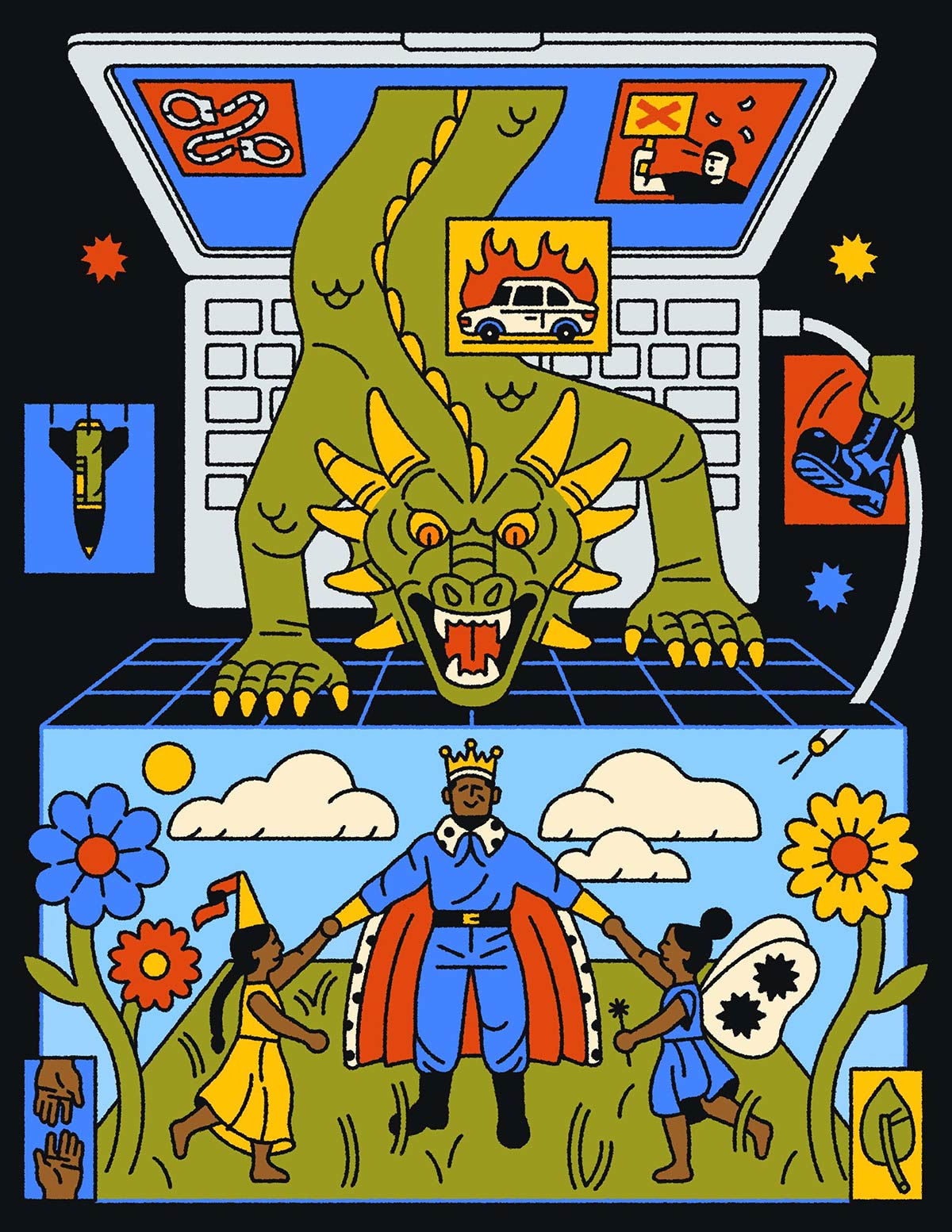
My daughters may be the freest humans in the world. Their ability to imagine the wildest possible scenarios in their play—dragons and monsters, lava, conjured-up magic castles and warlords, as they bend and contort their limbs to heights and distances my tender 43-year-old self can only accomplish under the most strenuous stretching, all for the sake of the “fun”—is astounding. Their ability to drown out the noise, while also embodying another type of, largely more productive, noise is what I am most in awe of. While they are still Nintendo Switch players, Stray Kids video watchers, and iPad game havers at times, they have a childlike curiosity beyond technology. From them, I am continuing to learn the spaciousness that can exist in disconnecting from the internet, attached to so many of us like an umbilical cord.
Because of their “offline-ness,” there is also sometimes a lack of care for what happens in the world around them. It is unborn and untethered to the nuances of state-sanctioned violence surrounding us on a constant loop. Together, we talk about some of the conditions that ail the world and how the lives we live are sometimes at odds with how others are choosing to live—my 6-year-old gawks anytime she sees anyone coming out or going into a McDonald’s; my 10-year-old scrunches her face at patrol cars. Having to sit in the discomfort of answering the questions that come with speaking about authoritarianism, fascism, or genocide is not an easy feat. I’m not sure if I’m even doing it right. I didn’t grow up in a home where we dived deeply into politics. But my kids are curious, so I feed that curiosity with the same fervor when it comes to my social media platform. In fact, a large part of my own personal platform has been using the access I have on social media to shine a light on the sociopolitical issues, regardless of whether they are being swallowed up by the latest fast fashion hauls intertwined with GRWMs, or quickly followed by fascist hot takes and looksmaxxer reels.
It is rather ironic, then, that so much of my effort is now focused on moving my community offline and into more tactile, tangible spaces—spaces my children inhabit without question.
I worry so much about my girls’ safety in a world where technology has more value than their own lives. There is a danger we encounter when we say yes to this new world of technocratic dictatorships run amok. Walking outside your door can mean a bomb can be triggered by your mobile device, or immigration officers will take you away from your home, your job, your family and friends, without so much as a whisper. One need look no further than the U.S. missile strike on the Shajarah Tayyebeh school in Minab, Iran on February 28, 2026, which resulted in the deaths of over 100 children, to know the risk of technology in the hands of war-mongers eager to target marginalized bodies—bodies that exist as a direct contrast to whiteness, to the colonialism feeding on our existence.
This is why now, more than any other time, is the time to take our revolutionary practice offline.
***
The digital world was never designed to save us, as much as we wanted it to. There will always be a barrier to entry when our sole means of connection requires stable internet. Instead, it will be our ability to lean even more diligently into the physical realm, into the tactile experiences that so many generations before us knew easily, as close to self as our own breathing, that will provide us the clarity and focus needed to organize effectively and efficiently with each other. Being together requires our full attention—a human want for enriching experiences that bring us closer to ourselves and each other. That attention, unfortunately, has been manipulated at every opportunity.
My daughters are not on social media. At one point in time, my oldest, when I was still a young father, became a part of my journey online as I shared anecdotes about fatherhood, mental health, and masculinity. But as she grew older, with the birth of her younger sister, it became clear that eyes on them now would mean even greater need for eyes on them later. I did not want the attention, the gaze of others, to become the norm for how they lived their lives.
We crave to be seen, even if that seeing can often lead to emotional and, at times, physical violence. So much of our visibility happens without our knowing consent—from social media third-party language intentionally buried underneath legalese, to the cameras in our train stations, on our buses, and in our neighborhoods. The overwhelming feeling of surveillance is pervasive. Reality TV shows like The Real World and Big Brother brought our personal, private lives to the forefront, where everything was on display. What would soon follow was an unyielding need to have access to each other, living alongside a dangerous desire to be seen by everyone around us, friends, family, and strangers alike.
But attention is not love, no matter how many ways our current society tries to manipulate us into believing otherwise.
The attention of the screen, our desire to communicate mainly through a digital world, void of any sort of authentic or sustainable connection, is destroying our ability to commune and communicate effectively, efficiently, or even at all. The platforms know it, too. They feed on our inability to discern between the absence of community and connection we feel, and the dopamine distraction that keeps us hooked in. We are entranced by the hottest take, viral moment, recipe, and comical banter mixed in with the abhorrent misogyny and genocidal destruction we are either embracing, fighting against, or attempting to avoid, the pull dragging us down along for the ride, each of us a victim of the never-ending doom scroll. The attention economy easily reduces online activism to just that: online only. It keeps us from digging our heels into the more important work of authentic intimacy: the kind that only happens when we are connecting in the flesh, in real time. Paying attention is good. It is necessary. But when our attention becomes a commodity, a thing to be used as a means to drive commerce, to turn our gaze back to the product, to the content, to the commercial, it is no longer about our attention; it is about distractions.
That kind of attention is not love–it is not the kind of care required of us to move the needle toward liberation of all peoples. Love, in practice, is when a dear friend of mine, for instance, started a garden on her property and offers fruits and vegetables to people who come to her home. Love is the faith I have in my daughters, the ways we share time, space, and energy with each other. Love is accountability, and the intention required to offer ourselves to each other for the greater good. My girls require my attention. My attention to them is what assists in their growth and development, much the same way our attention to each other, sans the distraction of our screens and mobile devices.
This love moves us closer to each other, closer to the freedom we deserve and require.
***
My mother played The Staple Singers’ “Respect Yourself” album on repeat on different Saturdays throughout my life. But when I picked up the vinyl as an adult for the first time, I found “The Best of Sam Cooke” album hidden in one of its sleeves. My mother would sit in the living room, a glass of water or a mug of tea in her hand, and endlessly listen to the records and CDs that shaped her experience as a woman. It’s in these moments that I sit in my office, listening to music from my own speakers and record player, that I am reminded of the peaceful, quaint solitude my mother afforded herself while tending to my two brothers and me growing up in the Bronx during the Reaganomics era. She would clean on Saturdays. She would also reflect on Saturdays, with music spilling out of her speakers into our living room, drowning the hallway.
I know and appreciate the fact that aged vinyl cracks differently from new, untouched vinyl. The crackling speaks to history, the grooves no different from the rings of a tree or of Saturn, each putting on full display the marvel of science, of life, of a thing that has lived and will undoubtedly live on longer than we can expect ourselves to exist.
My mother‘s record collection is also an archive that tells me so much about myself and the people I love. It is an opportunity to reckon with myself, the presence of feeling, hearing, and listening in a way that a streaming platform will never afford, no matter how many Unwrapped lists they offer us. The only way I can be open enough to see that is by being truly connected to the world around me.
That same presence felt with a needle to a record is the same presence I feel when my 6-year-old comes to sit on my lap to look at the comic pictures in The New Yorker, or when my 10-year-old wants to show me the latest anime caricatures she drew in her notebook before bedtime. It’s the kind of presence money, or a social media platform, can’t buy. (And, even if bought, it is merely a false sense of attention and presence. When we outsource our presence of mind to an app or product, it only becomes a placebo for the real need to be seen. Real attention, real seeing, is about running toward each other.)
The revolution is offline. Here’s how: Find a third space and support it. Donate. Volunteer. Create programming. Make a zine. Join a local organization. Hand out leaflets. Share resources. Clean your park. Clean your block. Clean your neighborhood. Get or carry groceries for your neighbor. Learn your neighbor’s name. Learn your neighbor’s number. Support a mutual aid. Start one. Teach a workshop. Attend one. Start a record collection. Start a record club—start it in your living room, or your basement, or your favorite local coffee shop. If you don’t see it, build it. If you don’t have it, make it. Hands only. Tangible goods. Tactile products. Communal production. Analog intimacy.
Go touch grass–literally. Put your feet and hands in it and see what the earth tells you.
My daughters play with their imaginations out loud and openly. That is the kind of liberation I seek. And that kind of freedom can’t be found in an app—it’s found outside.