

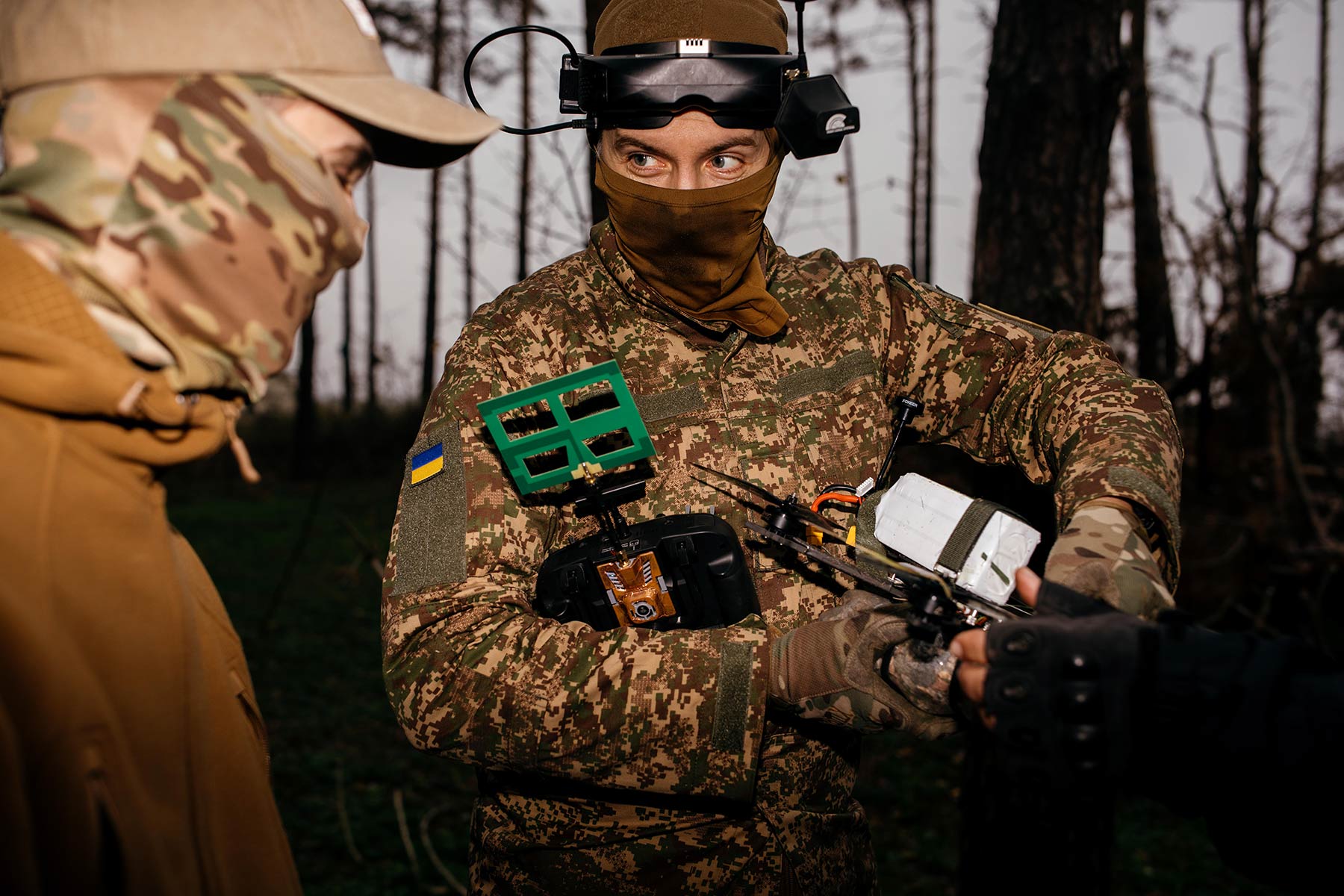
Bar and Fiksyk of the Khartiia Brigade practice FPV drone flying outside Kharkiv.
Under the protection of a forest outside Kharkiv on the northeastern front, Ukrainian soldiers are staccatoed throughout the birch and linden trees as they practice flying first-person-view (FPV) drones. Civilians walking dogs or seeking moments of relative quiet stroll past; there’s high-pitched buzzing from these small 10-inch drones, undercut by intermittent air raid alarms blasting from the city. These have become ubiquitous sounds of war in Ukraine over the past four years.
This is a war now fought not only with soldiers, but on the Ukrainian side, fortified by DIY drone economies— built underground, funded by civilians—many who have made the career pivot to focus on military support—and littering the soil with the toxic remains of a fight for survival.
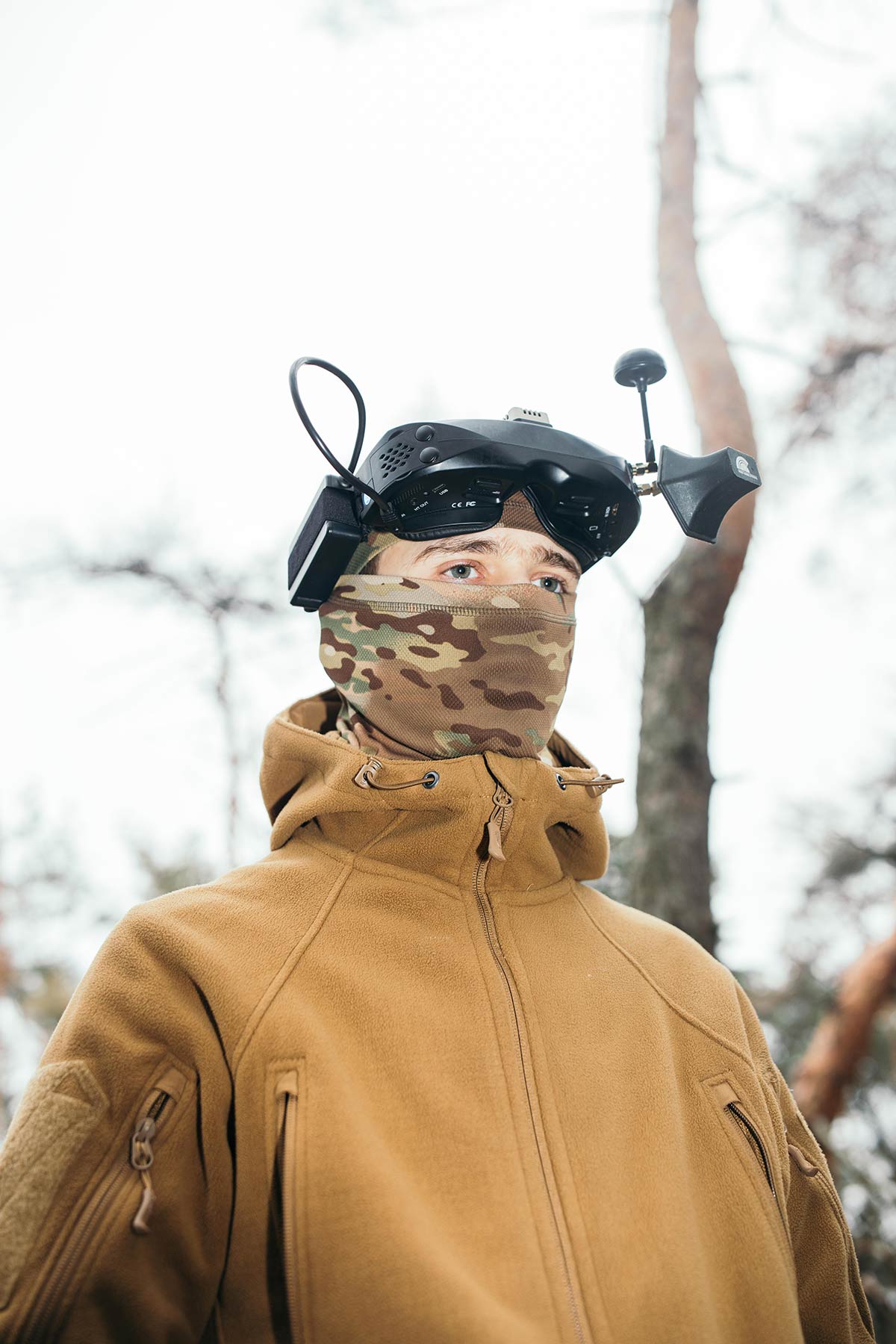
Fiksyk, a 21-year-old member of the Khartiia Brigade.
Two FPV drone pilots introduce themselves by their call signs ‘Bar’ and ‘Fiksyk,’ in accordance with Ukrainian security rules. Both are members of the 13th Khartiia Brigade, a combat brigade of the National Guard of Ukraine, formed as a volunteer battalion to protect Kharkiv. Bar has fought this war from the trenches and now from the sky. What the drone war is becoming—faster and more improvisational—is also his lived experience.
“Right now the enemy is disguising themselves very well,” explains 35-year-old Bar. “We are constantly training to match that.” They work 24/7 in any weather, under any conditions. Trench life is awful, he says—there’s no rest, the constant edge of sheer survival while identifying weaknesses in the Russians. Time on rotation blurs together, particularly when soldiers stay underground, seeking protection from enemy drones, not seeing sunlight for long stretches of time. Having to defecate in a bag, not having running water, being separated from family, witnessing unbelievable horrors, not having the means or bandwidth to process ongoing trauma. It all takes a toll.
For Bar and his comrades, the escalation of this war into one contingent on drones means an ongoing anxiety that some flying machine is searching for them to kill.
Since late 2023, this war has largely come down to how cleverly and skillfully drones are wielded. Bar describes their days as one big blur—fitful sleep when possible, charging batteries, scouting the enemy, repositioning as needed. When Russia launched a full-scale invasion of Ukraine on February 24, 2022, drones were mainly used for reconnaissance. Now, they have become the war’s pulsing lifeblood. “The world has changed, drone pilots are very in demand right now,” says Bar, who was in the infantry before making the shift himself in 2023, as dictated by his unit’s needs. For soldiers fighting on the frontlines, they are witnessing unparalleled shifts to global security.
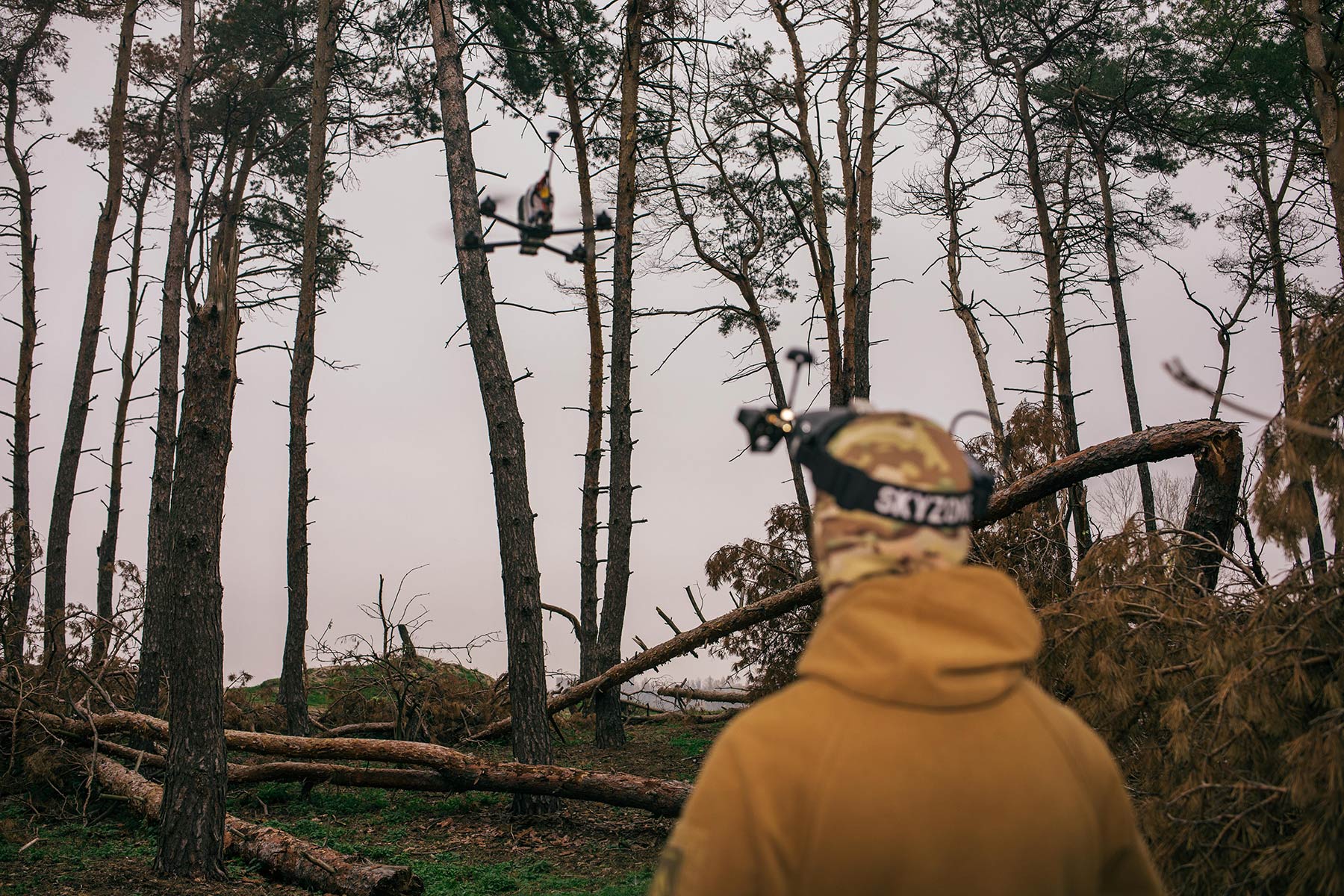
Fiksyk, member of the Khartiia Brigade, practicing drone flying outside Kharkiv.
“Everything is fucking documented. The enemy finds out things within a matter of days,” he continues. “The evolution of drone technology is so fast.” Both Bar and Fikysk give a nod of approval to how their commanders in the Khartiia Brigade encourage them to constantly train and improve: like right now, the drone ‘seconds’ they are practicing with here in the forest. Fiksyk navigates a drone through thickly settled trees, his deftness and precision a matter of life or death, occupation or victory. “Playing video games helps being a drone pilot,” he says, concentration unbroken. Fiksyk has an air of unperturbed calmness about him; you can tell he’s been through real shit for someone just twenty-one years old, who studied engineering in university. “You have to make the same split-second decisions.”
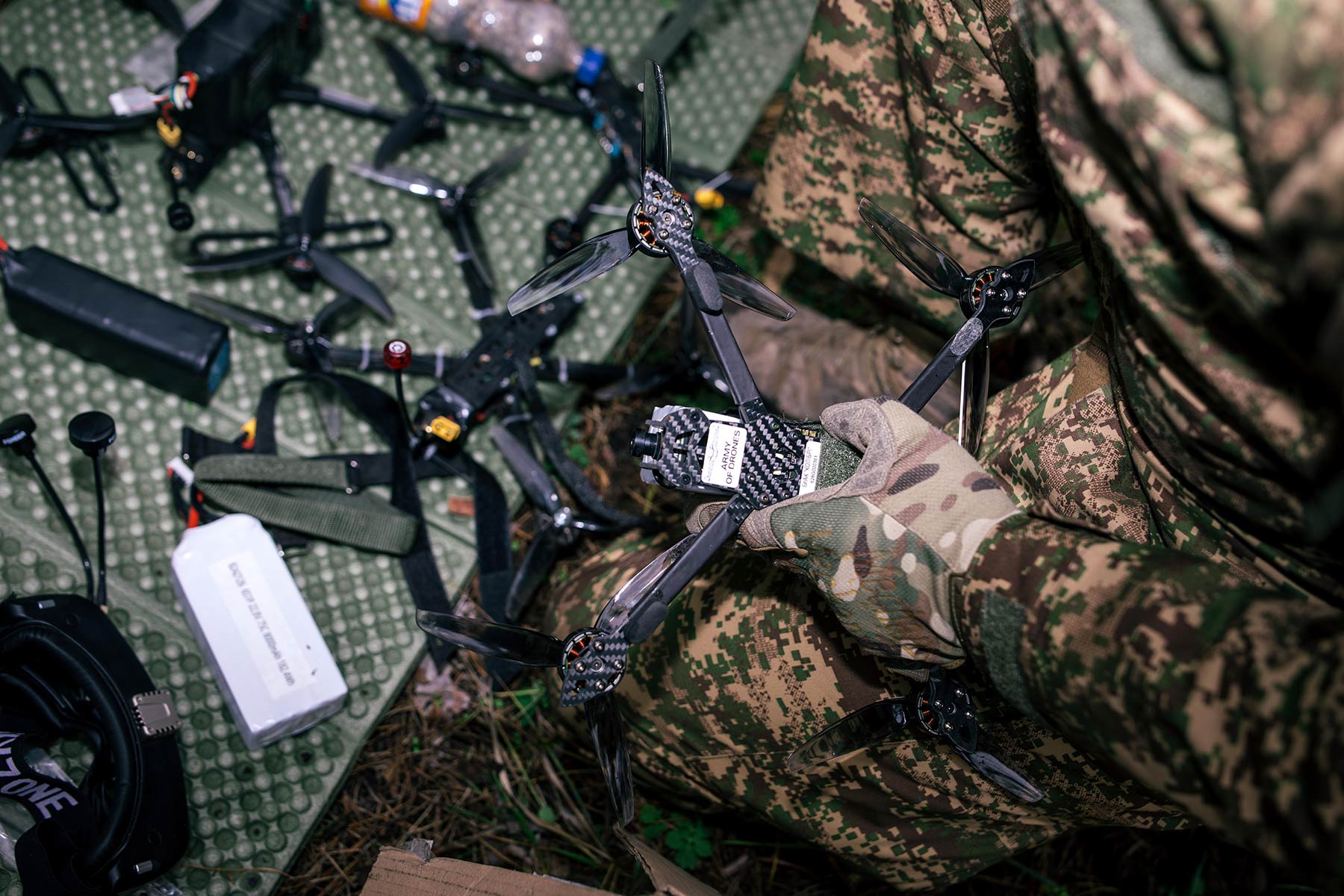
FPV drones ‘seconds’ that the Khartiia brigade practices drone flying with.
Khartiia has evaded serious problems with finances, resources, and corruption that other units may be plagued with. As a whole, Ukraine is on a fiscal ledge, requiring an estimated 137 billion euros from 2026-2027 considering the current, unlagging pace of Russian attacks.
Smaller FPV drones average a 2kg payload, bombing soldiers trapped in trenches and carrying out ‘human safari’ attacks on unarmed civilians. There’s also Iranian-designed Shahed drones the size of cottages, sleeper drones that lie dormant on the roadside and triggered by passing vehicles. Drone attacks across Ukraine have become an infamous, nightly terror.
In that forest outside Kharkiv, which the war repurposed into grounds for drone flight practice, it feels a portal into an alternate reality—less than 20 kilometers away, soldiers are mangled and dying in conditions that survivors have described as worse than hell on earth. According to the UN’s Human Rights monitors, long-range missiles and drones account for more than half of all civilian casualties.

A whatsapp screenshot of full-day power outages in Kyiv.
The end of 2025 has marked the most difficult winter since the full-scale invasion. As diplomatic attempts to end the war are in limbo, Russia has ramped up attacks on energy infrastructure. This causes both logistical problems in extended power outages during below freezing temperatures—residents in the capital city of Kyiv receiving just a few hours of electricity a day—and chips away at morale.
Odesa-born tattoo artist Mariika Lobyntseva says that most civilians understand the psychological warfare being waged right now. As tough as it is getting through a Ukrainian winter with just small pockets of electricity, everyone understands that there is no comparison to frontline conditions. As a member of Stroom Studio in Kyiv, a small collective of tattoo artists, they have dwindling hours to work.
When I visited in early November, the real cold had yet to set in, but already, the studio was chilly with ongoing ‘scheduled’ power outages. On occasion I check in on my friends there, although it inherently is weird to ask someone how they are doing in a country at war. “We have electricity today since morning (it’s 13:00 now)??” Lobyntseva texted me a few days ago. “I don’t know what to do hahahha.”
Besides donating personal funds to support the war effort, Stroom also has hosted a number of pop-ups to help bolster units with the drones they desperately need. This illustrates what Bar meant when he said drone pilots are in demand: someone, somewhere, has to keep that demand survivable.
Last year, a member of Stroom was killed on the frontlines, a blow that they are still reeling from. “We know what is at stake here,” Lobyntseva says. “Everyone does.”
—
Bar doesn’t talk about the incredible technological developments happening by the day as ‘innovation.’ To those fighting on the frontlines, it is a requisite part of what this war has become—what you build when you’re under-resourced and always running out of time. Every advantage is temporary, because the enemy adapts within days.
Ukraine’s military developments since 2022 have been unmatched in terms of innovation and adaptability in recent years. According to the Royal United Services Institute (RUSI), NATO procurement systems originated from Cold War-era models where weapons systems were created as integrated, monolithic platforms that treat innovation as an anomaly rather than an ongoing process. The war’s abruptness and high stakes of defending Ukraine, keeping the nation from getting sucked back into Russia’s sphere of control and suffering, spurred innovation at an unprecedented pace.
Despite Ukrainian drone systems’ overall reliance on imported parts, engineers, developers, and soldiers have been rapidly testing, modifying, and redeploying systems in weeks, not years. The extenuating needs of this war have catalyzed a trend of underground drone-makers, such as Klyn drones, which uses majority Ukrainian parts and is working toward having 100% Ukrainian-made drones.
In Russia, ammunition is state-issued; production and distribution are straightforward, explains Bar. Ukraine lacks such standardization, which can complicate the supply chain—particularly as Russian attacks impede production—but freeing in terms of the lack of constraints.
“My favorite drones are made with mixed components and brands,” he shares, illustrating the successful alchemy that can come from hybrid approaches. Khartiia regularly communicates with engineers on the backend on their needs. “We have a lot of requests, and [the developers] are bright people,” he shares. “People who have a lot of will to make this work.”
With prioritization on speed, scalability, and affordability, Ukraine’s stance toward drone warfare has upended the military technology status quo. Over three years, Ukrainian production spiked from 3,000-5,000 drones in 2022 to over 2.2 million by 2024. Many are constructed from commercially available components, costing as little as $300.
But the same affordability and scale that makes this drone economy possible is also leaving behind residues—chemical, electronic, and ecological. Experts credit Ukraine’s decentralized approach, where frontline operators are in collaboration with developers, for its remarkable military adaptation.
“Russia has so many sources behind them, they can simply reposition as needed,” Bar explains. But Ukraine’s constraints have pushed its innovation: “We are still so much more creative than Russia. Conscripts—simple people from the streets, not from a military background—are bringing their skillsets in.”
“New blood brings innovation,” he continues. And as for his female comrades, Bar lauds them for their multitasking capacity and overall agility. “If women choose to focus and fight, it’s amazing.”
The boundless urgency of war means that environmental costs take a backseat to survival. Brian Roth, a Kyiv-based ecologist and founder of Forest Release, has spent the war tracking both what the front destroys and what it leaves behind. We’ve gotten to a stage of war where the zero-line (roughly 20km on each side from the heart of active fighting, where artillery shells are being thrown back and forth) and frontlines are blurred, he shares. “Sometimes you realize the enemy is behind you, and you wonder how the hell they got there.”
Roth focuses on demining, yet recognizes the myriad of environmental issues that will impact Ukraine for decades to come. “There’s going to be problems with FPV drones that run on lithium batteries,” he says over an encrypted call from Kharkiv. “Including those one-way kamikaze drones that self-destruct when the job is done. Those batteries are super toxic and just leaching into the soil.”
There’s also pollution from fiber optic drones, which are connected to their operators via ultra-thin fiber-optic cables, up to 20 km long, rather than radio links. In the electronic warfare realm, such drones are resistant to jamming or spoofing (the hacking of radiowaves), but can be physically disrupted should the cables be cut. The aftermath of cleaning up after fiber optic drones will also be messy.
You can come across fields piled with these cables, says Roth. “Birds are building nests out of them. “There’s massive clean-up issues that come from the concentration of FPV drones,” he continues. But for now, there is no other way.
Back outside Kharkiv, Bar watches another practice drone vanish into the trees. In this war, even the air is occupied—and survival now depends on who can learn to fly through it faster, smarter.
This reporting was supported by the International Women’s Media Foundation’s Women on the Ground: Reporting from Ukraine’s Unseen Frontlines Initiative in partnership with the Howard G. Buffett Foundation. Tetiana Burianova contributed to this report.