

For surfers around the world, the ocean has long offered itself as a place of freedom and expanse. More than a mere hobby or sport, surfing is a portal to presence and connection with something greater amidst ordinary motions of life. It is no surprise then that surfers in the Gaza Strip, a community besieged by an ongoing genocidal war with no end in sight, are finding refuge and resilience amidst the waves.
The Gaza Strip, once home to a budding community of an estimated 30-40 surfers, now only has a handful who remain. Several were killed in the ongoing bombardment of the territory, with survivors often being seriously injured or displaced from their homes, now living in tents with no running water, electricity, or sewage systems. Even so, a defiant few continue.
Twenty-six-year -old Gazan surfer and former graphic designer Abdullah Abu Ghanem, originally from the neighborhood of Sheikh Ijlin bordering the sea, was taught to surf by his father Jawad Abu Ghanem, who was among the first surfers in Gaza.
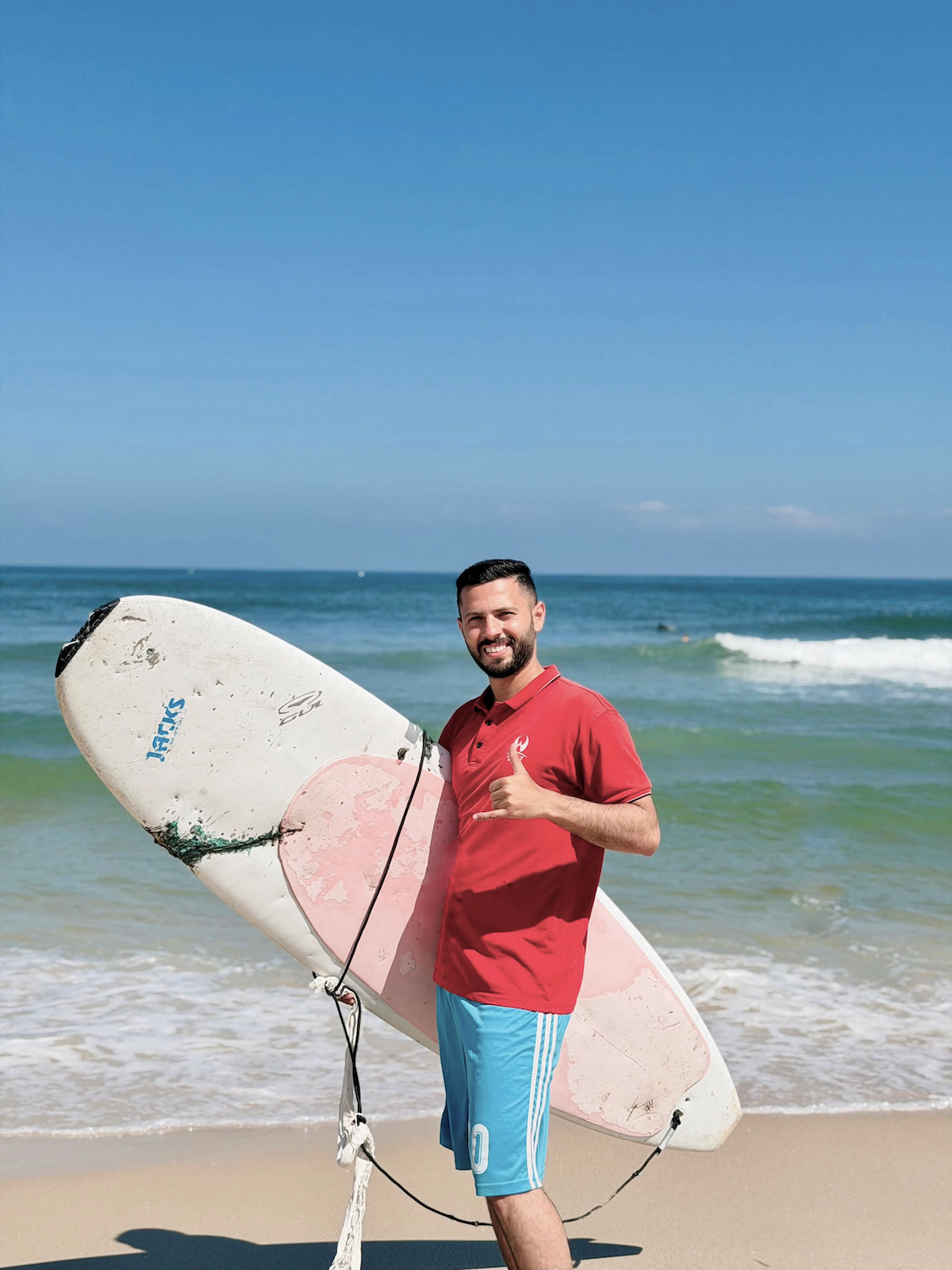
Abdullah Abu Ghanem with his surfboard
“I started surfing because I was fascinated by the sea and wanted to learn something different. My father taught me when I was ten years old, and I learned by spending as much time as possible in the water,” he says.
Like many Gazans, Abu Ghanem has lost his family home and been displaced again and again. He now lives in one of many makeshift encampments that have spread across the strip since the war began.
“I lost my job, my company, my beautiful home, family members, neighbors, and friends,” he says. “All my dreams and ambitions, for which I stayed up for years, were destroyed because of the cruel war against us.”
“Surfing gives me something that’s hard to find in everyday life here: freedom,” continued Abu Ghanem. “When I’m on the wave, I forget, for a moment, the fear, tension, and pressure around me. I can breathe, feel alive, and simply be myself.”
No longer simply dreaming of surfing, Abu Ghanem hopes to be able to evacuate with his family to safety in Egypt.
Similarly, Abdalraheem Al Ostaz, a nineteen-year-old university student from Gaza, began surfing at the age of ten. Without access to a surfboard, he had his first experience on a piece of foam from an old refrigerator, eventually convincing his father to buy him a board of his own.
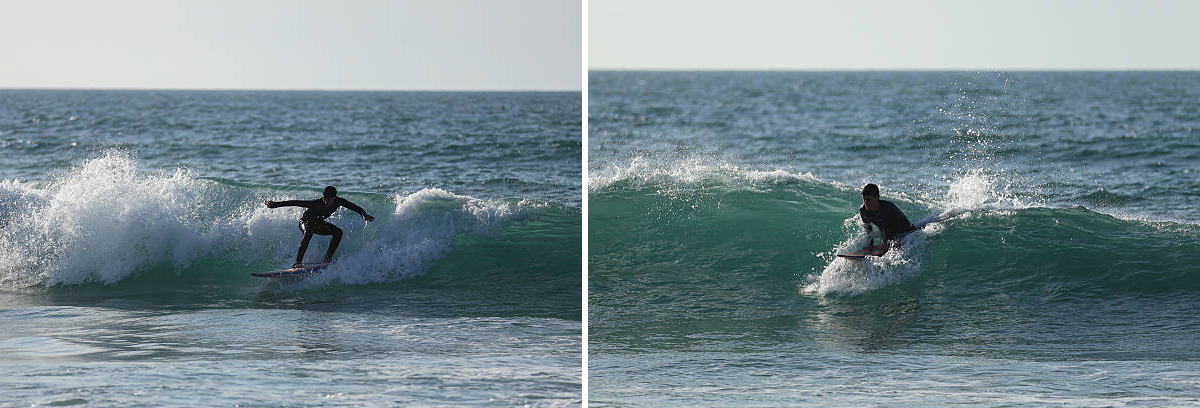
Abdulraheem on the waves
“When I rode a wave for the first time, I felt something difficult to describe — happiness and freedom. At that moment I realized that I truly loved surfing,” he said.
Al Ostaz dreams of being able to leave Gaza and one day represent Palestine as a surfer, making the sport more accessible to youth in Gaza. “For me, surfing is not just a sport, it is one of the most beautiful things in my life,” Al Ostaz says.
“When I go to the sea and stand on a wave, I feel freedom, peace, and safety, even if only for a few moments. I feel as if I am getting away from everything around me — the war, destruction, hunger, and tents — and simply going to the sea to do the thing I love,” he continues.
However, the sea itself is not free of threats and entering it comes with its own risks. Since October 7, surfing has become increasingly difficult and dangerous. Last year, the Israeli military heavily restricted sea activity in Gaza declaring its waters a “no-go zone,” banning fishing, swimming, and sea access.
Even after an increasingly fragile ceasefire went into effect early last year, there have been numerous reports of Israeli naval forces opening fire at fishermen onshore or at sea, killing and arresting them as well as damaging their boats. “Sometimes, when I go to the sea to surf, warships fire in my direction. I am afraid every time I go into the water, but surfing means so much to me,” says Al Ostaz.
Even before the war, boards were scarce. Israel has long banned surfboards from entering Gaza, along with fiberglass, the main material used to build and repair them. The few boards in the Strip mostly arrived through nonprofit donation drives. Surfing 4 Peace delivered 14 boards in 2007, and a second shipment of 30 was allowed in only in 2010, after more than two years of negotiations.
“Even surf wax, which is something very basic, is difficult to obtain, and a single bar can cost around $100, which is extremely expensive,” says Al Ostaz. “I use ordinary candle wax on my surfboard instead.”
Many of Gaza’s few surfboards have been lost or destroyed in the debris of shattered buildings, with surviving boards often being damaged. Through numerous displacements, Al Ostaz not only feared for his own life, but feared for the safety of board. “I worry about my surfboard more than I do about myself,” he joked.
“I consider my surfboard very valuable so I did everything I could to protect it,” says Al Ostaz. “Every time we were forced to evacuate or move from one place to another, I carried my board with me and tried to store it in the safest places possible so it wouldn’t be destroyed.”
Despite his efforts, Al Ostaz’s board, like most others, has sustained big cracks and damage from shrapnel. “I repaired it using the simplest materials. The simple fact is, if it breaks, I won’t be able to get another one,” he shares.
Gaza’s first organized surf club, the Gaza Surf Club, was established in 2008. The project, founded by Hawaii-based Matt Olsen through his nonprofit Explore Corps, helped provide donated equipment, workshops and training to Gazan surfers.
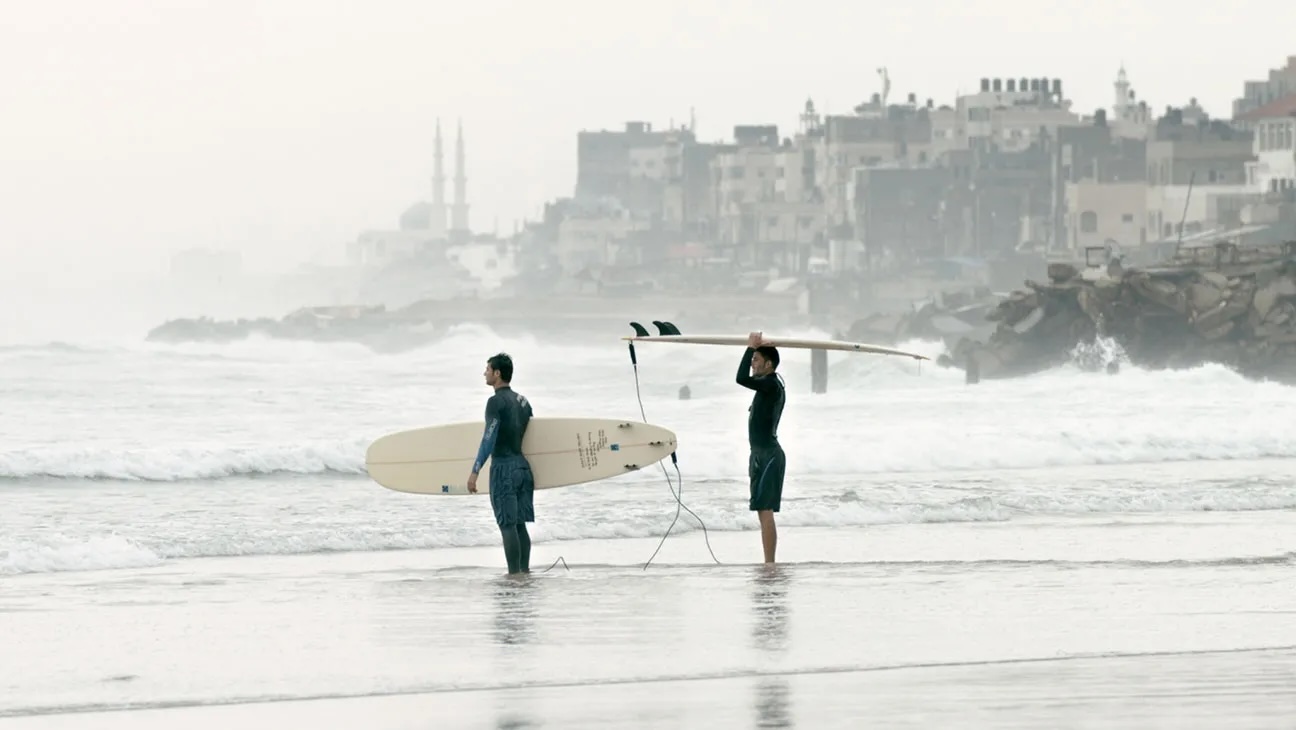
“We built our community with very limited resources, passion, determination, and encouragement. We wanted to show the world that Gaza has hidden talents and that we can create something beautiful even when we have almost nothing,” said Abu Ghanem.
A 2016 documentary film following the lives of Gazan surfers revealed that even pre-October 7, daily life was marked by extreme difficulty.
“For you, it is easy to come here, from Egypt, Spain, or Europe, but we can’t leave this place. It’s true, we live by the sea, but it feels like a prison,” said Mohammed Abu Jayab, one of the surfers featured in the film. He was speaking under the blockade imposed on Gaza in 2007, which has since hardened into a full siege.
Even with dwindling supplies of equipment and active threats to their survival, Gazan surfers try to make it to the waves whenever they have a chance.
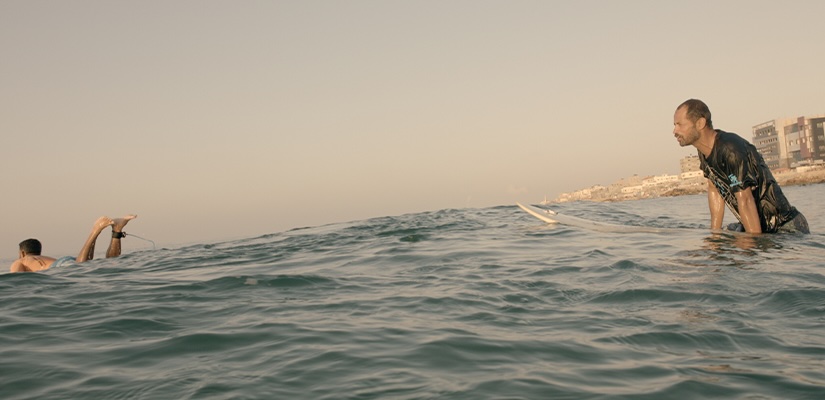
“I continue surfing because I don’t want the war to rob us of our identity. Surfing gives me hope,” says Abu Ghanem. “It reminds me that even in the darkest of times, we still have dreams, passions, and the right to imagine a different future.”