

Dear Grandma,
I was in my garden last night, watering, tending, and speaking to the plants, when I discovered the first ripe tomato.
I tasted it this morning, in disbelief at its rich colour, at the pattern of seeds encased in various pockets within the fruit.
I was reminded of all the August days I have walked into your home, greeted with a table of tomatoes, of sun-gold bursts of delight and rubies so large they crossed the palm of my hand. Summer tastes like your tomatoes, and I will always be reminded of who I am and where I come from with a taste of them.
Thank you for this gift you have given me, a taste of summer, a taste of childhood, and a return to the being I have always been.
Lots of love to you and Grandpa,
From, Bianca
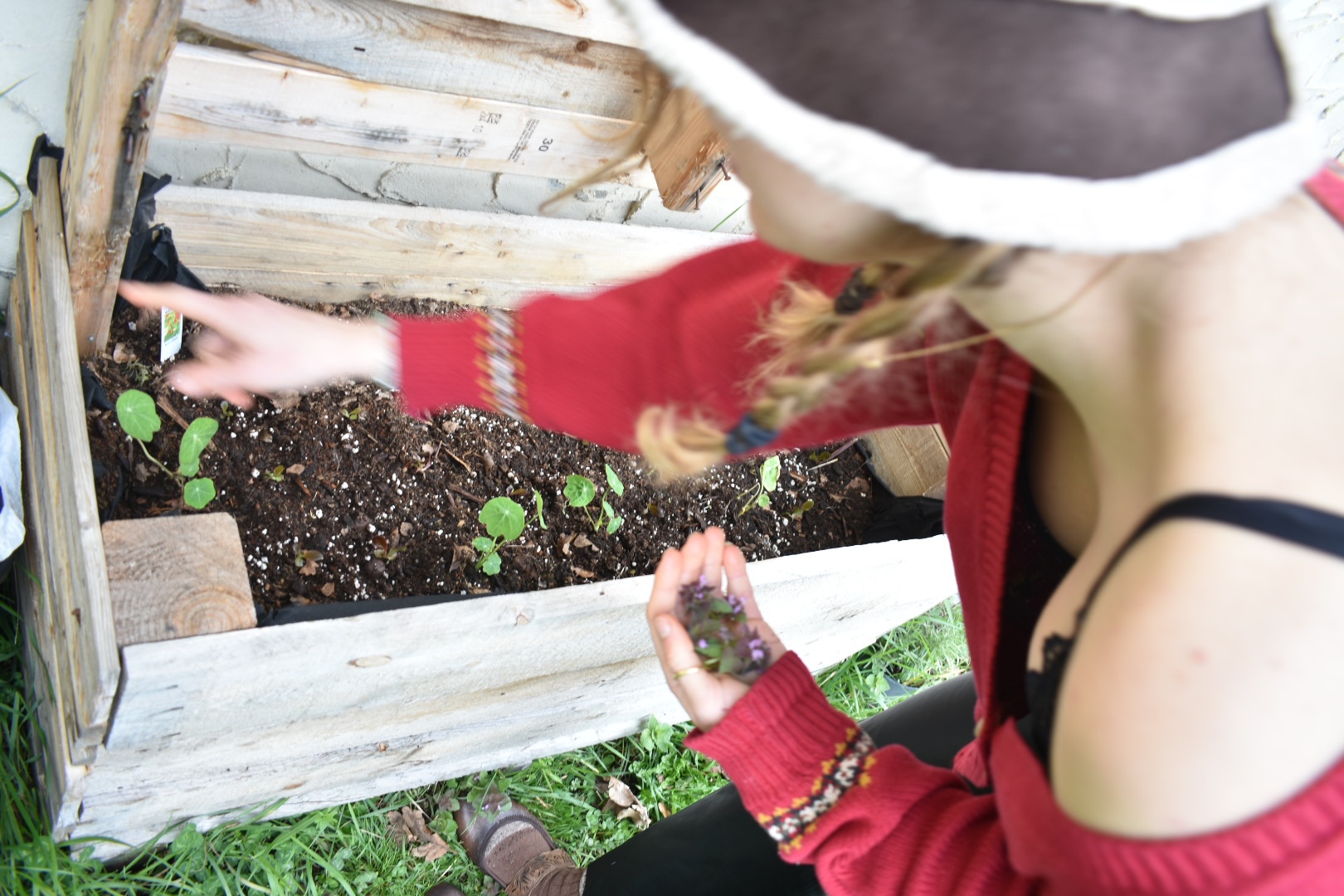
“It’s all so fucking hopeless,” Mira says sharply.
Her voice is calculated, silencing in its pristine conviction. I don’t blame her, yet I can’t help but meet her dystopian attitude with a surprisingly pointed anger. Across from us, Mia concurs: the mess of our food system is complicated, nuanced, and inevitably plagued to be this way.
I’m baffled by my own silence. The hope I wish to convey is swallowed by the uncertainty of its approval. I run through the stats I know: according to Statistics Canada one in four people living in this country lack food security, seven out of ten agri-business owners are worried about their futures, and issued reports state that four transnational corporations control 50-60% of seeds. I remain quiet, searching to dispel the desperation.
The global impacts of the conventional agricultural system span from farmer suicides, to species sacrifice caused by chemical runoff, to soil robbed of its once-abundant nutrients.
I want to grab my friends and shake them, to shout that this is only inevitable if we never try. It is not by fault or consequence that a system so integral to life is interdependent on so many elements — how could our food system exist in isolation?
In colonial attempts to fracture Indigenous communities in so-called Canada, European colonizers deliberately disrupted their food systems through endangering food sources such as plains bison, Atlantic salmon, and camas bulbs. Settlers were also encouraged to farm on stolen lands using seeds shipped from Europe, further displacing Indigenous food systems and people. This displacement functioned as a tool of oppression — a tactic to destabilize sovereignty, culture, and intergenerational health.
The effects of this genocide are tragically evident in the disproportionate percentage of food insecurity among Indigenous communities today, inequities in health outcomes, and the barriers of access to traditional foods due to policies, extinction, and pollution. “If you were lucky, one of the gas stations might have some bananas or apples for sale but most didn’t, and nearly everything was priced higher than what you’d find at the grocery store in the city.” writes Alicia Elliot in A Mind Spread out on the Ground, recounting her experience of food insecurity living on the Six Nations rez where she lived as a teenager.
In my steps I hear an echo: the system is broken, the system is broken, the system is broken.
When I was thirteen, my mum would drive herself, my sister, and me out to Abundance Community Farm (ACF). The drive felt long, but something angry within me returned to the soil as I dug, weeded, and sowed seeds on the land.
Our friend Amir purchased the farm when he recognized how growing food together can be a catalyst for social change. He is a scientist who grew up in Iran, where both of his grandparents had hobby farms. He felt a sense of belonging through both his maternal and paternal lineages, which he craved from Vancouver’s organized urban landscape. Amir and the farm community show people that something else is possible.
Since 2016, kids have grown up visiting this farm. There’s a sense of relationship they carry towards the land, and a particular pride they feel in belonging to a community, says Amir. People come to share their gifts and art generously. Amir sees the work that happens on the farm as interdependent between self, land, and community — the three values that hold up his way of relating to ACF, and the ethos of co-creation that takes place there. The farm functions outside of capitalism with a currency of gifts: generosity, time, and care. “We are preparing our own inner soil,” Amir says, “so that when conflict comes up we have tools and communication skills ready to collectively move through it.”
At ACF, the community grows 70 varieties of vegetables and 30 types of fruits, all from non-GMO seeds. The way in which the community gathers and works together on the land contributes to the thriving ecosystem which humans are not separate from, but reciprocally intertwined with. “Of course the plants get sick sometimes” says Amir, “but in a monocrop it spreads to infect all the others, while on a biodiverse farm, one plant may get sick, but the others will survive.”
The farm neighbors blueberry fields, which he sees sprayed with chemical fertilizers consistently throughout the year in attempts to keep the berries healthy. “There is no biodiversity there,” Amir says.”Only blueberries. People will come to spray then they leave. The farmer doesn’t even live on the land.”
Amir tells me that we need to stop seeing conventional agriculture as the enemy, that viewing farming as a dichotomy is not helpful because we do, in fact, rely on the current system.
He questions how we can cultivate more energy efficiency and dampen the existing environmental and social impacts of agriculture. The neighbour comes to harvest his hay for cows living in a livestock barn nearby. By the time it’s ready to be delivered to the animals, a tractor has already driven around the field at least seven times to cut, gather, organize, and roll the hay. “Why don’t they just bring the cows over here?” Amir asks, contemplating the wasted energy. In the pause, I wonder how we could change our practices to support the land, rather than change the land to suit our practices.
ACF is located on the traditional, unceded territories of the Chema, Seabird Island, Skwah, and Kwaw-kwaw-a-pilt First Nations. The process of building relationships with the local Indigenous groups has been an ongoing effort in which the community continues to engage. A community member from the Eagle Clan of the Xanuksiala First Nation with Nuchanulth and Lummi Ancestry, offers the core farm members workshops around the personal process of decolonization.
Colonization is not a one-time event, but ongoing exploitation that pervades insidiously through social, economic, and political structures built by and for the benefit of colonizers. Beginning the process of decolonization at the personal level has aided in communication and connection between the farm members and the local First Nations. These workshops examine relative privileges and the effects of the structures of colonialism, recognizing how these dominant systems disrupt and damage people, cultures, and land. Reconciliation is not an event, but a continuous process. Reconciliation includes learning about the historical and present ways that the nation state of Canada disrupts Indigenous sovereignty, by listening and being present to truth telling when invited to. It includes supporting Indigenous initiatives and taking accountability for and calling out racism, advocating for land back, and contributing to mutual aid efforts.
Above all it is important to center Indigenous voices and support their desired ways of healing. Funding and ensuring transparent gathering rights, Indigenous seed access, and hunting are ways in which reconciliation can be supported in the food system.
In Amir’s view, the best way of social change is through food. It represents a common denominator for society coming together, and it is easy to share. “The food system is at the bottom, and if we can choose to make change, it will propagate into other types of growth.”
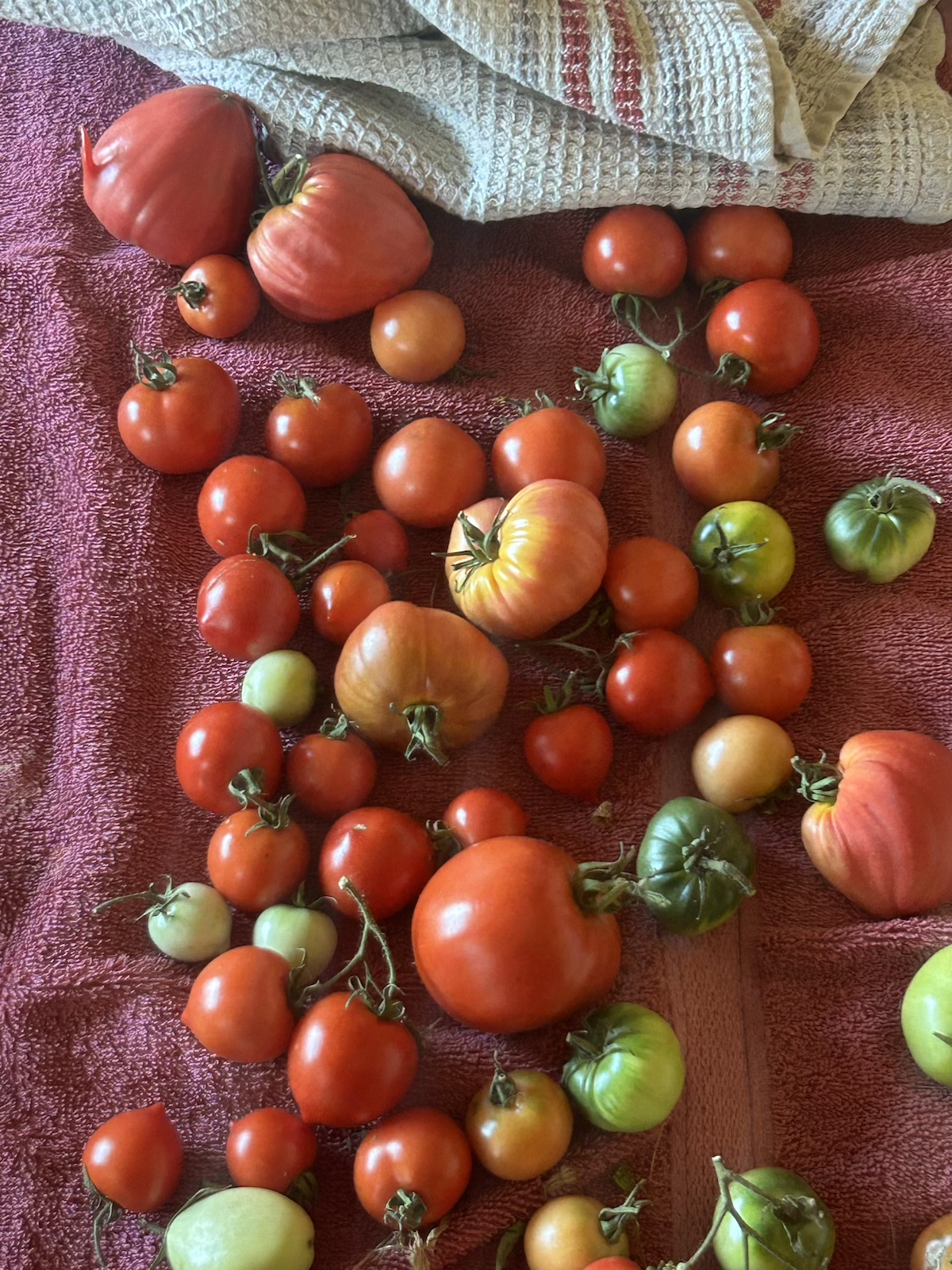
Like Amir, my Grandmother Brita’s garden is where I feel the sincerest belonging. The cyclical breath of life, decay, and repurpose surrounds me. Everything has its place. Her tomatoes have always tasted the best: the sun-gold cherries — perfectly plump and juicy, bursting with a ray of July’s lush skies, her oxhearts shaped just like the name suggests, strikingly meaty and tender. Grandma Brita grew up growing food. Her skills are an heirloom from her maternal lineage.
When my dad was young, Grandma taught him about water, soil, and sun, so he built a greenhouse in our backyard. It encased magic: a humid forest of soft, pointed leaves and yellow flowers. It held a puzzle of precariously labelled pots of every size: tomatoes, peppers, and basil. We grew them all from seed.
This past summer, I drove down to Cedar Hill Cross Roads, to visit with Grandma Brita on a lazy August afternoon. She asked me how my Oregon Spring tomato plant was doing, the one that she had generously gifted me for my birthday earlier that year. She told me that hers weren’t growing the way that they used to. Her harvest should have been over by now, but it was just beginning.
Grandma, Grandpa, and I sit around their wooden dining table, small bowls of sugar snap peas, devil’s ears lettuce, and Nantes carrots before us. The aroma of Carie’s split pea soup lingers in the air.
“If I am paying for this piece of concrete, I may as well grow food on it,” Grandma says, while laying out matching soup spoons, repeating the ethos she often shares, in hopes to instill its importance in future generations.
Every day for a full calendar year, Grandma wrote down exactly what she did kneeling in the soil. She recorded her plants, her movements, and the sun and rain. She keeps paper bags of seeds collected from her previous harvest stored in her garage. Grandma shares intentionally and abundantly. Her freezer is full of shredded zucchini and homemade pesto. In the basement, jars of tomatoes line the shelves among colourful autumnal squashes and potatoes.
Her system not only feeds herself and Grandpa, it makes them resilient. A common thread of pre-colonial food systems is that they are land-based and upheld through the relationships of the surrounding ecosystem, which harvesters, hunters, and cultivators are a part of. The health of each of these elements determines the health of the other. Reciprocity, where gifts are given for what is taken, is a central tenet of these systems, ensuring a circulation of abundance.
“A gift economy nurtures the community bonds that enhance mutual well-being; the economic unit is ‘we’ rather than ‘I’, as all flourishing is mutual” writes Potawatomi author, professor, and scientist Robin Wall Kimmerer in her book The Serviceberry. It’s important not to commoditize Indigenous values but to respectfully learn how to better relate to the land to support health and healing for all beings.
I am blessed to be my grandmother’s granddaughter, knowing that I am not alone in my appreciation for the gift of fresh tomatoes on a summer day.
Hearing Amir’s story cemented my understanding that it is not an individual plight to solve the food system on your own, but a community effort to create alternatives and bring people into a deeper relationship with the land. Supporting and funding Indigenous foodways supports food security, because there is no sovereignty until there is transparent access for all. I call grandma Brita to thank her for her presents, and wonder how these spaces can function as a gift of hope.
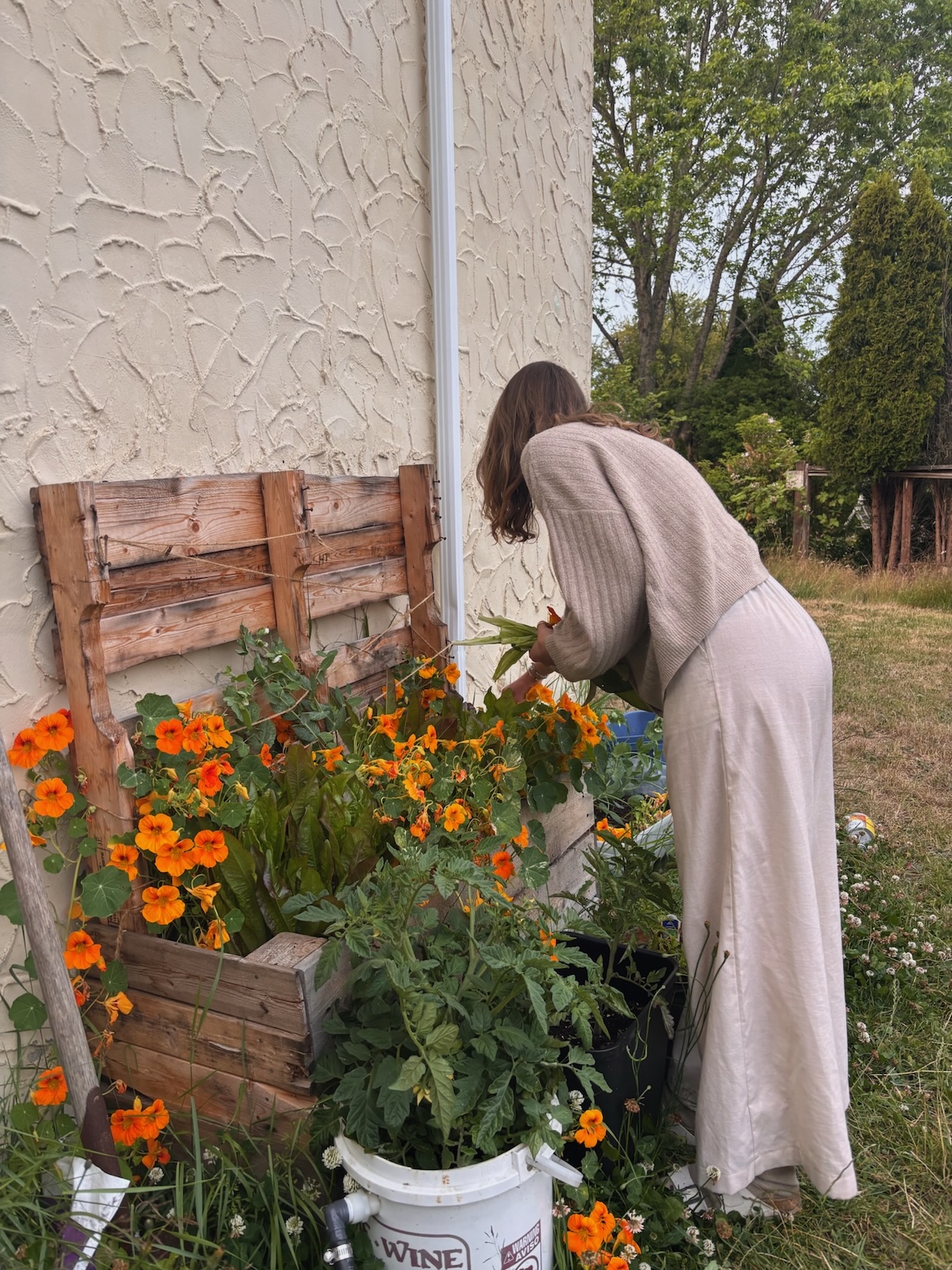
“Okay, who’s ready for a garden tour?” I call out to my sleepy friends. It’s August and the days are long, lazy, and pleading laughter. Their quiet steps follow mine around the side of my home onto the lawn. The wooden boxes come into sight. I harvest a couple of tomatoes, and let them pick some peas, nasturtiums, and devil’s ears lettuce (Grandma’s favourite, because they won’t go bitter in the late-summer heat).
Returning inside, we slice the tomatoes in the bright kitchen, my roommates are smiling as we enter. They have come to expect me holding some sort of plant every time I walk through the front door. The red jubilant tomato flesh glistens on the cutting board, I carefully hand out a dripping slice to each of them. I can tell they recognize the preciousness. “To a happy summer,” I say gratefully.
In the silence of our tasting I witness meditation, softening, and soothing. “I can finally understand why a tomato is a fruit,” one of them comments. We nod. “It tastes like something I had forgotten,” they say quietly.