

Photo Credit: Sarah Sinno
There was a time, not long ago, when suggesting that Israeli plans to take over the Litani River would have been dismissed as a conspiracy theory, despite historical documents that clearly outlined such ambitions. Today, those ambitions are no longer implied, but openly and repeatedly voiced by Israeli officials.
On March 30, Finance Minister Bezalel Smotrich stated that Israel’s new border should extend up to the Litani River. Defense Minister Israel Katz made clear that Israel intends to maintain a so-called “security zone” in Southern Lebanon, extending to the Litani River, indefinitely. Meanwhile, Prime Minister Benjamin Netanyahu announced that he has instructed the military to further expand the existing “buffer zone,” an escalation he framed as replicating the “Gaza model,” amid plans to mobilize up to 400,000 reservists.
These statements point to a larger Israeli strategy in which isolation, ecocide, and occupation operate in tandem. It not only cuts off the South from the rest of Lebanon, this strategy also asserts control over the Litani River, devastating the ecological conditions that make life possible. The result is the transformation of the region into a no-man’s land, paving the way for an expanded occupation of the South.
The Weaponization of Water
While Lebanon’s longest river is casually being claimed by an invading army, the occupation has simultaneously and systematically targeted water infrastructure. A March 2026 analysis by Oxfam highlights a dangerous parallel between the weaponization of water witnessed in Gaza and it being replicated in Lebanon.
Described as a national lifeline, the Litani River spans an area equivalent roughly to 20% of Lebanon’s territory, linking inland regions to the coast. It serves as a hub where water, agriculture, and energy intersect, irrigating vast stretches of farmland while also contributing to electricity generation. The Litani Basin is home to 288 municipalities. When access to such a life-sustaining resource is disrupted, it is undeniably a war crime. The deliberate use of water as a tool of war to inflict deprivation and suffering violates international law, for which Israel must be held accountable.
The destruction of reservoirs, pipe networks, and pumping stations severs entire communities from the most basic conditions of survival, enforcing a form of separation that cuts people off from their land and their ability to remain. Without access to water, return becomes nearly impossible, preventing displaced populations from safely resettling and rebuilding their lives, while those who remain are gradually pushed out. The lack of safe water heightens the risk of disease outbreaks, posing a growing public health threat. At the same time, it strips land-dependent communities of their livelihoods by devastating agricultural systems and accelerating the loss of green spaces.
Farmland Under Fire
This control over water is central to a broader strategy of territorial domination in which agriculture is systematically driven to collapse. On March 27, the Lebanese Ministry of Agriculture released alarming data: 22% of the country’s agricultural land has been impacted by Israeli bombardment, amounting to 49,564 hectares, an area larger than the city of Vienna. Of this, 16,064 hectares of olive-growing land have been affected. To grasp the scale of destruction, this alone represents an area almost identical in size to Brussels-Capital region.
The report also found that 76.6% of farmers have been displaced from the South and the Beqaa, the most affected regions, and the core of Lebanon’s agricultural heartland. This uprooting is intended to alienate people from the land they care for and depend on. Through this disconnection, farmers are cut off from the land they cultivate and from local markets. Entire systems that sustain agricultural production are dismantled, ultimately jeopardizing national food security.
What was once a living, cultivated landscape is turned into isolated, abandoned terrain.
The Weight of Rubble
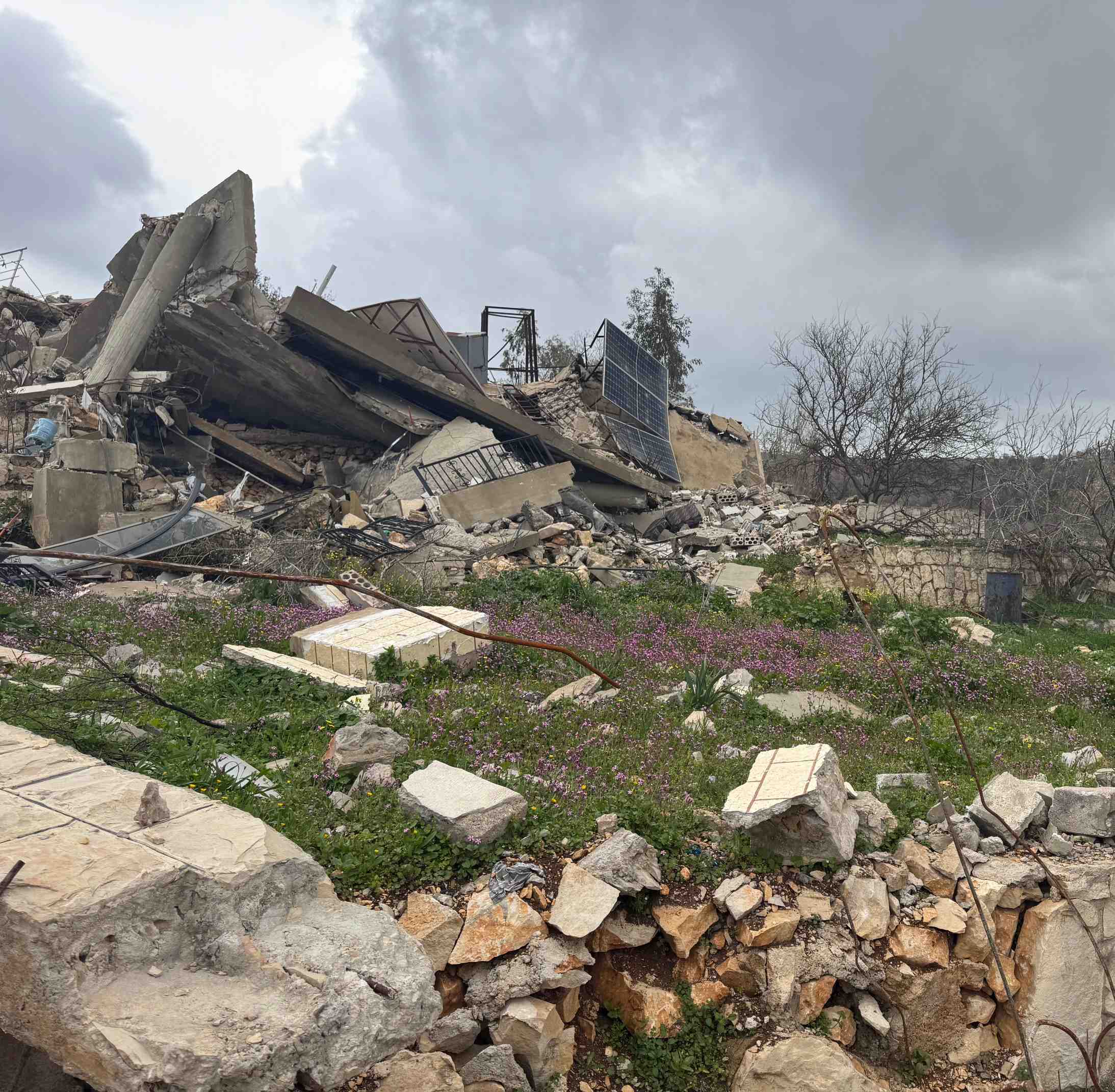
It is not only farmers who have been displaced. Over a million Lebanese are being prevented from returning to their land, while their villages are systematically reduced to rubble. In many border areas in South Lebanon, nothing remains but vast fields of debris, concrete, metals, plastics, and potentially asbestos and other hazardous materials, on a scale that is likely unprecedented.
Collapsed infrastructure, homes, roads, bridges, hospitals, schools, and other essential facilities are transformed into waste, creating an environmental crisis that will persist long after the violence ends. Toxic substances from these wrecked structures can leach into soil and groundwater, poisoning them, while dust contaminates the air, affecting both human health and ecosystems alike.
Toxic Skies
While the total carbon footprint of Israel’s war, and its contribution to the broader climate crisis, has yet to be fully quantified, existing studies already indicate that its war emissions alone can exceed the annual output of entire countries. Beyond its global implications, this pollution will have lasting local consequences, driving long-term deterioration in air quality and increasing the prevalence of chronic illnesses among affected populations.
Widespread destruction generates large volumes of dust, both from the initial bombardment and from the clearing of rubble. Combined with toxic fumes from repeated airstrikes, wildfires, and burning fuels, this fills the air with high concentrations of dangerous particulate matter that severely degrade atmospheric quality.
For instance, smoke from white phosphorus, an incendiary substance used over Lebanon for decades and not only in recent escalations, can cause respiratory disorders, gastrointestinal irritation, and bone damage. Prolonged exposure carries a high risk of organ failure, including damage to the heart, kidneys, and liver. It does not discriminate, harming all living beings in its path.
The Collapse of Animal Habitats
Death, displacement, and isolation resulting from Israeli illegal wars extend beyond human life to the natural world. According to the Ministry of Agriculture report, losses include 49%of beehives, as well as 72% of horses and 63% of donkeys, alongside severe declines across livestock, from cows to sheep and goats.
Beyond the direct casualties of Israeli bombing, animals are forcibly displaced as forests burn and habitats collapse. Exhausted and vulnerable, and pushed into smaller, already inhabited areas in search of food and shelter, they face intensified competition and increased predation. These pressures destabilize predator–prey relationships and disrupt broader ecosystem dynamics.
In addition, the physiological effects of war, including constant noise, ground vibrations, and extreme stress, disrupt nervous systems, weaken immune responses, impair reproduction, and reduce survival rates across species. Domesticated animals, often abandoned as people flee under bombardment, are cut off from the human care they depend on. Many will not survive on their own.
The Making of an Empty Land
With the South cut off from the rest of Lebanon, its transformation into a poisoned landscape is accelerating at the hands of settler-colonizers. At this stage, healing the land and restoring what has been damaged is no longer possible in their presence. Israel’s objective is to prevent return, recovery, and the cultivation of the land, while advancing its territorial ambitions: a “Greater Israel” that can only take shape if the land is scorched and rendered empty.
Yet this attempt at uprooting will only deepen the Lebanese people’s resistance, one that insists on the right to remain.