

There’s been much talk lately about whether Fashion Month is being entirely consumed by stunts and drama rather than the clothes themselves. What happened over the weekend at New York Fashion Week did little to abate those concerns.
During a presentation for COS–the Swedish minimalist label owned by retail giant the H&M Group–at the WSA Building in Manhattan, several PETA activists bypassed venue security and walked onto the catwalk. Holding placards bearing messages like, “Sheep beaten and bloodied for wool. Don’t buy it,” they targeted the brand’s heavy reliance on wool and cashmere. The action followed a damning PETA Asia undercover investigation exposing workers kicking, beating, and dragging terrified sheep and leaving them bleeding from shearing wounds, at a South African wool farm that supplies through the exact certified pipeline used by H&M Group. PETA’s broader indictment of the fashion industry has long argued that luxury and contemporary labels hide behind greenwashed paper trails like “Responsible Wool Standard” and NATIVA certifications while turning a blind eye to baseline brutality.
Seated in the front row right next to COS CEO Daniel Herrmann was Steven Kolb, Chief Executive Officer of the Council of Fashion Designers of America (CFDA). While venue security personnel were occupied managing other demonstrators elsewhere along the space, Kolb bypassed waiting for them and intervened physically.
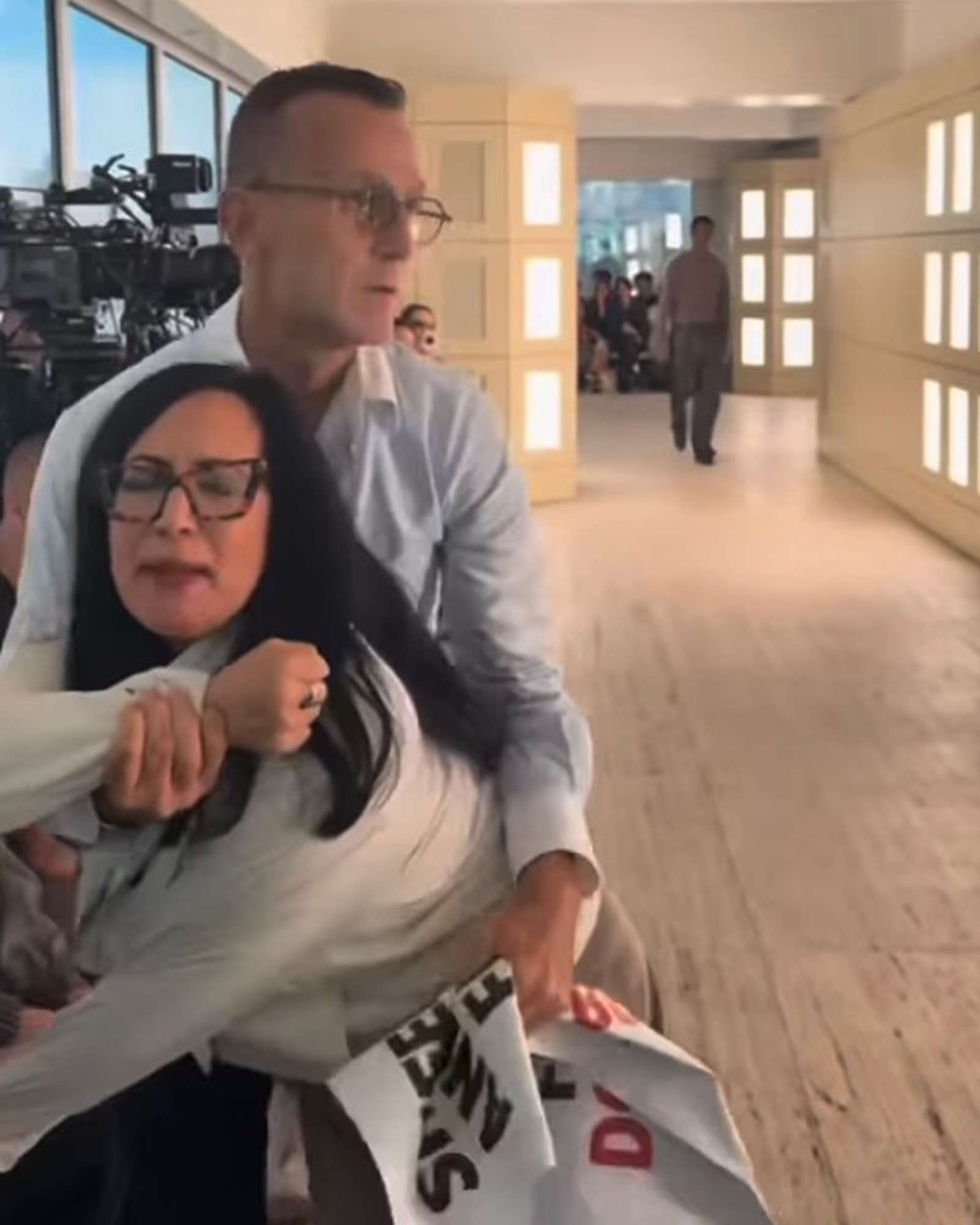
As a female activist walked past carrying a sign, Kolb sprang from his seat, ripped the placard from her hands, and pulled her backward off the runway. He forced her to the floor, using his leg to pin her while placing his hand over her mouth and nose before finally letting her go. As she stood back up, she shouted, “Sheep bloodied and beaten for wool!” while continuing to voice her protest.
Simultaneously, Kolb targeted a second PETA member who was filming the demonstration, shoving him toward a window and pressing a hand over his face.
Footage captured live from the front row by Fashionista Beauty and Style Director Stephanie Saltzman documented the entire sequence as it unfolded. The video quickly spread online, sparking immediate backlash, with PETA announcing plans to file a police report for assault.Kolb later issued a public non-apology acknowledging he reacted inappropriately.
While PETA’s tactics, frequently relying on civil disobedience and unauthorized access, routinely spark debate over where activism crosses a line, no amount of disruption excuses physical violence. The president of the Council of Fashion Designers of America, an institution ostensibly tasked with representing and setting the ethical standard for American fashion, resorted to behavior that crossed squarely into the territory of assault and battery. Trained, professional security personnel were present to manage the situation safely; instead, industry leaders took matters into their own hands with a disturbing level of physical aggression.
To understand why Kolb had so much skin in the game, one only has to look at the financial and structural ties binding corporate sponsors to the CFDA. The CFDA owns and manages the official New York Fashion Week calendar, and through initiatives like the CFDA NYFW Travel Fund (the NYFW Fund for Global Media & Retail), which relies on brand contributions to bring select international buyers and elite editors to the city, the organization depends heavily on major corporate entities like COS and the H&M Group. Kolb wasn’t just reacting as an overzealous spectator; his self interest lay in protecting a lucrative corporate partnership and demonstrating absolute loyalty to an entity that helps fund the very machinery he oversees.
Equally disturbing was the reaction, or complete lack thereof, from the rest of the front row. A nonviolent demonstrator was put into a leg lock and forced to the floor with the active, physical complicity of the brand’s own CEO. Nearby, individuals appeared paralyzed, one woman visibly concerned yet seemingly confused as to how to react while adjusting her clothes, while a man right beside her kept his phone raised to capture the violence instead of intervening. Aside from a lone photographer seemingly gesturing for Kolb to let the protester go, the room largely watched in passive, compliant silence.
This widespread apathy on display that Sunday afternoon was the natural byproduct of modern fashion brand activations. Specifically for fast fashion brands attempting to elevate their status into the upmarket tier, runway shows like COS’s are heavily curated marketing machines. A massive portion of the room, from influencers and digital creators to press publications, is there on transactional terms, tied to paid partnerships, sponsored travel ( like the COS-supported CFDA Travel Fund ), or gifted wardrobes. In an environment where everyone’s presence is commercially incentivized, dissent is an existential threat to the bottom line.
Furthermore, nobody wants to cross the head of the CFDA. The organization holds immense institutional power over careers, awards, and access, creating an atmosphere where industry players self-censor to avoid career suicide. This effect extends well beyond the physical venue. When The Cut, a publication rarely shy about viral, high-interest media, mysteriously deleted its footage of the incident, it raised immediate questions in my mind about whether editorial independence was bowing to institutional pressure or fear of getting on Kolb’s bad side. It echoes a long-standing pattern of intimidation within the upper echelons of American fashion, evidenced by past instances where brands like former CFDA member Fallon Jewelry publicly alleged being cornered by a phone call from Kolb and ordered to take down a post criticizing the CFDA’s praise of Melania Trump’s inauguration look.
Yet even with this documented history of corporate muscle-flexing, the fallout over the past few hours has laid bare a starkly divided ecosystem. Public outrage is absolute, insisting that Steven crossed a line, committed assault, and must resign. After an initial wall of silence, the CFDA rolled out the full, multi-slide crisis-management script: placing Kolb on a “voluntary leave,” serving up the obligatory “I don’t recognize that person” dissociation, promising he’s “meeting with a professional,” and pivoting the narrative into a supposedly enlightened invitation to sit down with PETA. Inside the industry echo chamber, PR insiders rush to circle the wagons. Outside in the feeds, influencers roll out contractually obligated carousels and COS affiliate links, so pristine and unbothered that the violence twenty-four hours prior might as well have happened in another dimension.
Ultimately, the central takeaway from the COS runway is clear. PETA often accuses the fashion industry of prioritizing style over empathy and of operating behind a wall of corporate disconnect. Kolb clearly fancied himself a defender of that wall. Instead, he ripped a hole right through it, lunging out of a front-row seat of quiet luxury to hand-deliver every cynical caricature ever whispered about fashion people while conveniently burying the conversation around COS’s possibly unethically sourced wool under the weight of his own ego.