
Digital & Print Membership
Yearly + Receive 8 free printed back issues
$420 Annually
Monthly + Receive 3 free printed back issues
$40 Monthly
Dreaming Beyond Punishment
Samora Pinderhughes On a New Way of Making Art and His Upcoming MoMA Show

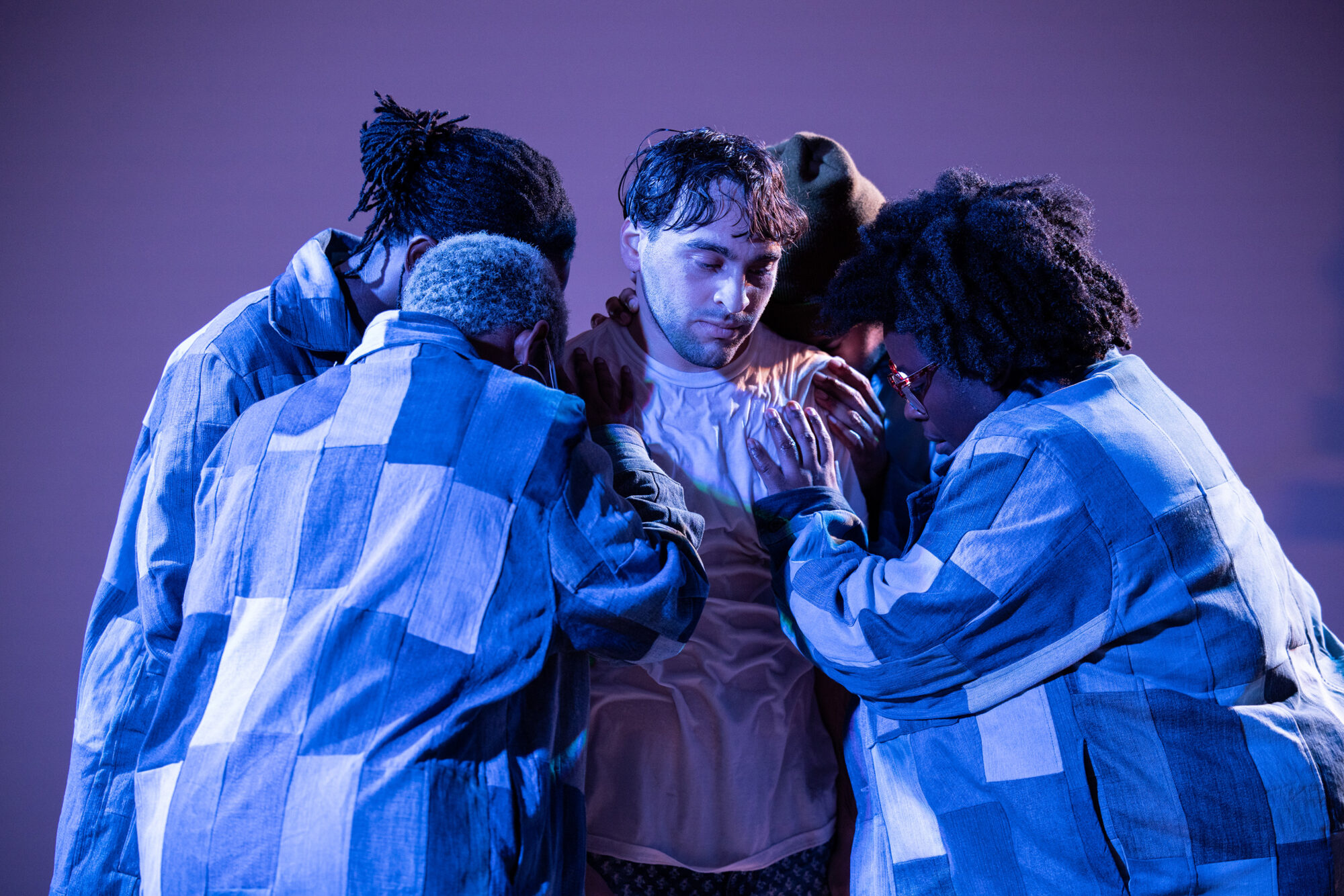
Samora Pinderhughes performs Rituals for Abolition at The Kitchen in New York, NY. Photo Credit: Walter Wlodarczyk
In a dark green jumpsuit, a man in his early twenties sits at what resembles a prison visiting room table in a living room in Queens, NY. It’s a chilly evening in October 2025, and, surrounded by sheets and lights to reflect bar-like shadows on the room’s front wall, he’s looking at a family picture. A rendition of Dinah Washington’s soaring anthem “This Bitter Earth” begins to play, and the entire film crew is silent as they watch him. Offscreen, a choreographer calls out to the man: “How does your body feel with this grief?” He becomes rigid, his back straight, fists clenched, and arms outstretched, struggling. “What gestures as a kid make you feel joyful?” the choreographer prompts again. Slowly, the protagonist unbuttons his jumpsuit, pulling the sleeves over his shoulders as if strapping himself into a plane. He looks like he’s flying. Behind the camera, artist, musician, director, and prison abolitionist Samora Pinderhughes weeps.
“It was everything we wanted to say without words, the pain of the experience of incarceration and separation from family,” he recalls of that moment in filming. “I was mostly thinking about people I know in this situation.”
The scene is part of a short narrative film, REAL TALK (SOMETIMES I FEEL TOO MUCH), which Pinderhughes has been meticulously preparing for about a year now. It is the centerpiece of the artist’s debut exhibition, Call and Response, at the Museum of Modern Art (MoMA), premiering on January 24. The film follows two estranged brothers navigating their mother’s passing in the absence of their brother who has long been incarcerated. Grief is meant to be an emotional anchor in the piece—“a doorway,” as Pinderhughes puts it—for those who have not directly experienced the criminal legal system. This is how you “make somebody feel violence without the presence of violence,” Pinderhughes explains.
Pinderhughes has long been a fixture within the New York City arts scene. He has been a recording artist for 10 years and runs The Healing Project, an organization that creates artistic works, healing spaces, and advocacy initiatives by, for, and with people impacted by systemic violence. But despite his extensive artistic chops, Pingerhughes says that exhibiting at MoMA feels like a different beast from his career as a musician.“When you’re playing [music], people are coming to see you,” he explains. “But here, someone on a random Tuesday decides to go see art and will experience this emotional work about grieving somebody in prison—they’re just not going to expect that.”
Perhaps audiences won’t expect it. But the exhibition, and the year’s work that brought it to life, are emblematic of how Pinderhughes has been addressing structural violence his whole life.
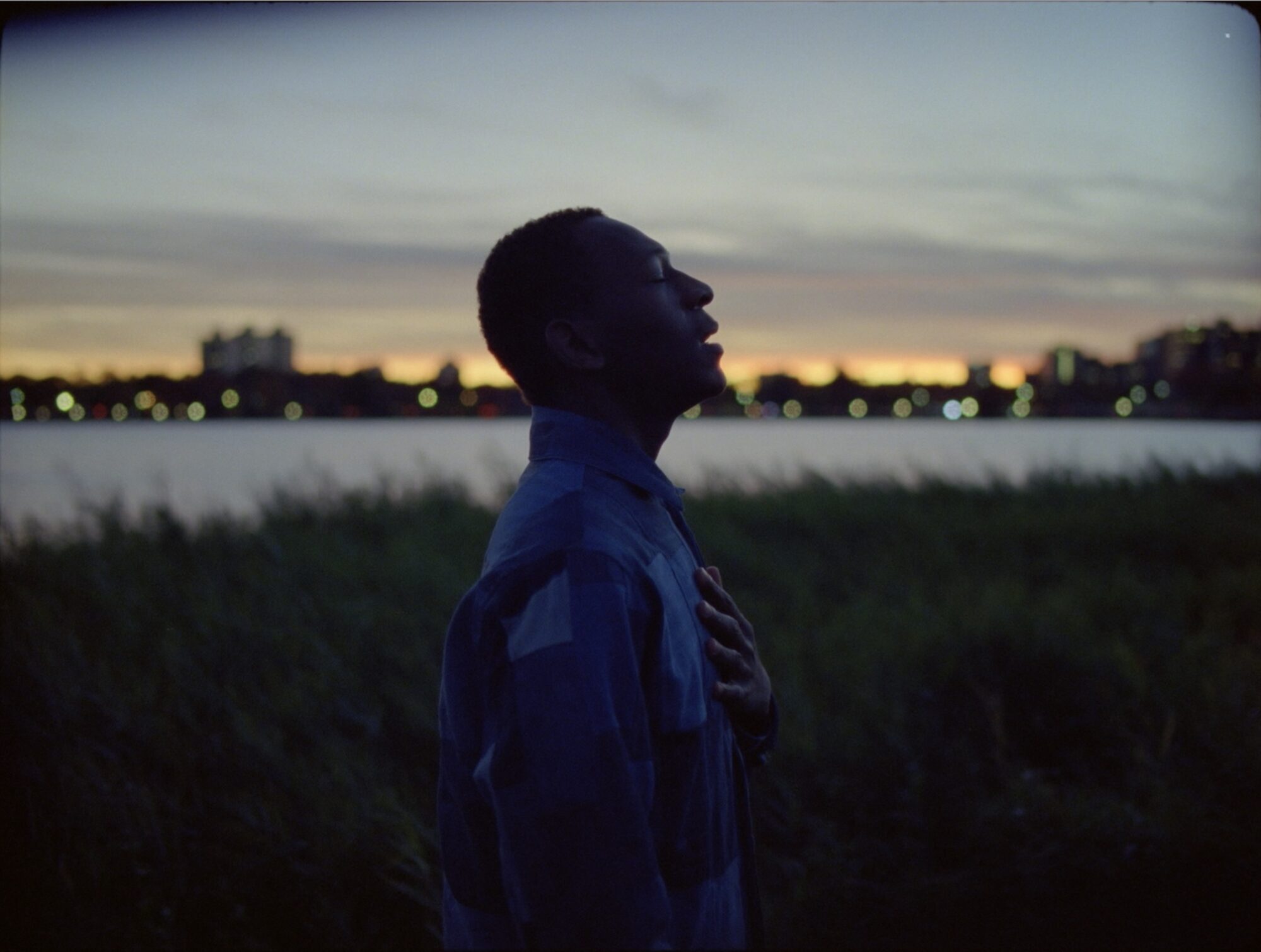
Still from REAL TALK. Courtesy the artist and MoMA.
When Pinderhughes was 13, he submitted his eighth-grade social studies paper on conscientious objection. There wasn’t a military draft; it was 2004. And yet, as if petitioning the U.S. government directly, Pinderhughes refused army participation on the grounds of being a pacifist. “I come from rich traditions of organizing,” he laughs, crediting this level of passion to the community that shaped him: a genealogist for a grandmother, a union organizer as a grandfather, and parents whose professorial and civic work spans urban planning, environmental literacy in prisons, violence prevention, and social behavioral health to this day.
These experiences helped Pinderhughes conceive The Healing Project in 2014—in particular, to examine what it would look like to build a world outside of punishment. Guiding the organization’s programming and the artist’s music is over 100 testimonials from survivors of incarceration, detention, police brutality, poverty, and other systems that make communities vulnerable to harm. Inspired by his mentor, actor and playwright Anna Deavere Smith’s work in verbatim theater, a theater practice that uses the words of real people in plays, Pinderhughes spent a decade recording people across the country as they discussed their lived experience, courageously laying bare the complexities of causing and healing from harm. “He has this interesting combination of grace, humility, confidence, and creative energy,” Smith shares. “I don’t think it’s just that his work has a platform at MoMA. I think MoMA has a platform through the work to reach different audiences.” Smith sits on MoMA’s board, and adds that she’s confident Pinderhughes “will test and push the institution in a way that asks it to do things differently.”
And he has: In addition to the short film, Pinderhughes and The Healing Project’s longstanding Choir will also perform I Hope This Finds You Well. The work in progress interweaves original music with aforementioned testimonials about surviving and healing from structural violence. He has also partnered with four local organizations—Parole Prep, Fortune Society, Brotherhood Sister Sol, and South Bronx Unite—to create collaborative works that range from a photography series and mixtape to a short documentary and audio play. While MoMA has worked with artists in a similar vein on local collaborations, this exhibition is the largest in scale to date, with four partners across multiple boroughs. These partnerships will culminate in a community celebration on February 7, where the works will be displayed at the museum.
For Pinderhughes, our current landscape is one where “people are normalized to spectacle and violence.” Because of this, many creators employ disturbing, shocking content, which the artist argues only has a temporary effect—especially if intertwined with a barrage of information. A method with an impact, sure, though shock is not the goal for Pinderhughes. As composer, pianist, and mentor Vijay Iyer says, Pinderhughes’ “work delves into all the things our society tries to hide—its history, its structures, and the daily things we all experience but don’t know how to talk about.” The goal, as a result, is to listen deeply, creating a collection of abolitionist works that specifically counter archaic narratives of people and communities who experience incarceration, foster care, detention, and other systems of violence in this country.
Pinderhughes notes that we used to see more artists work this way, citing singer-songwriter Curtis Mayfield. “In the sixties, his album Back to the World was a concept record about a veteran coming back home,” he says. “It wasn’t his experience—it was a community-oriented storytelling approach.” This is the type of artist Pinderhughes wants to be, though he says it can “sometimes feel a little lonely, because not a lot of people are doing it that way.” “But when I operate outside of my artist’s brain and in community, I feel proud of what I’ve done,” he explains. For Iyer, this uniquely distinguishes Pinderhughes, who “never lets go of what’s important to him, even as he gets elevated into this echelon of culture that not many people get to participate in.”
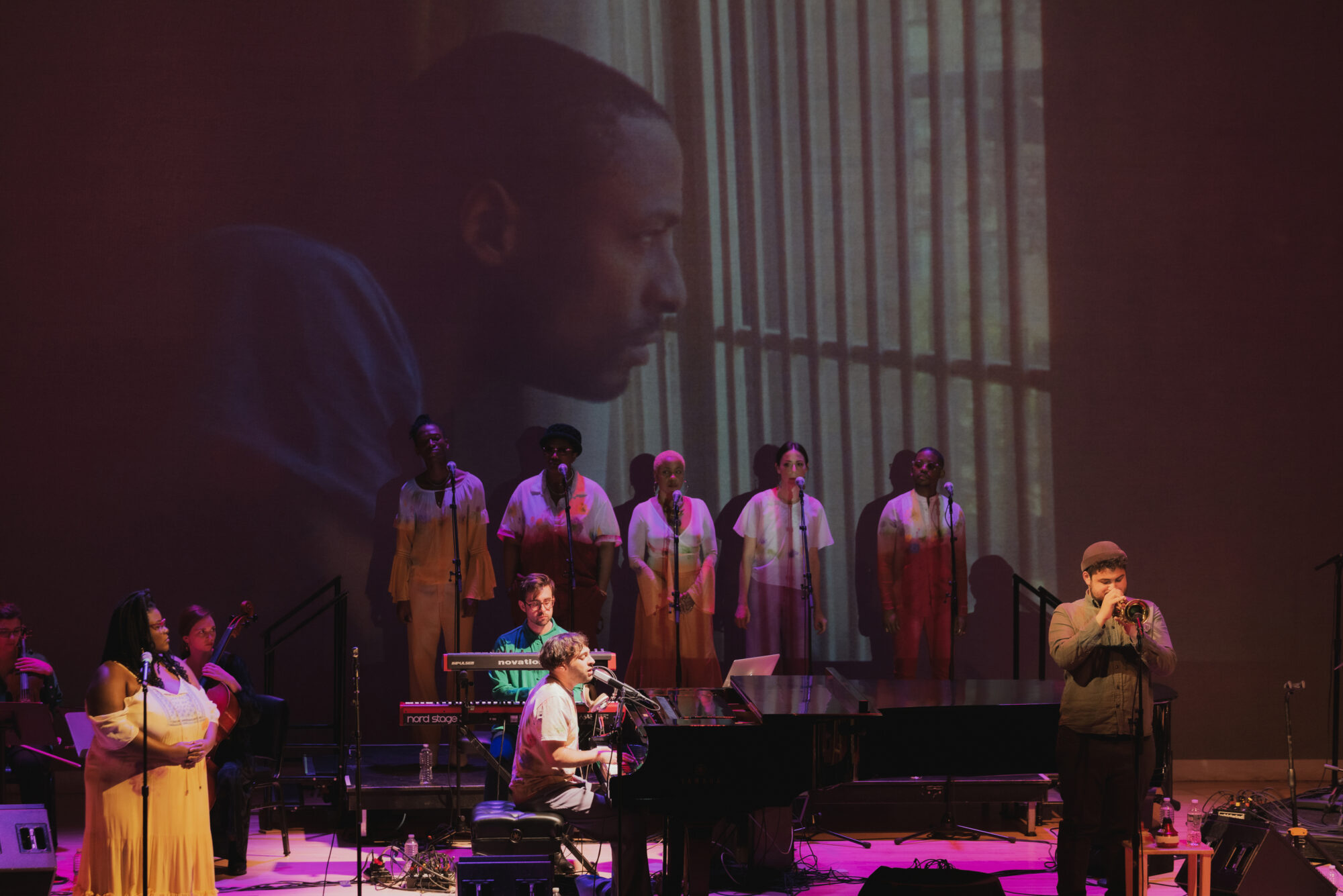
Pinderhughes performs “I Hope This Finds You Well” with The Healing Project in 2023 at Carnegie Hall in New York, NY. Photo Credit: Lawrence Sumulong
On a Friday morning in early September 2025, Pinderhughes and The Healing Project Choir started to set up in the main hall of the Fortune Society, an organization that provides reentry services for people coming home from prison while also promoting alternatives to incarceration.
“I don’t think anybody really knew what was coming,” says Caleb Knight, Fortune’s Creative Arts Senior Associate.
Without a formal stage, the Choir began to sing an original composition by Pinderhughes and, in a typically hyperactive communal space, everyone got quiet—even those at the foosball table. As the performance continued, the Choir invited the audience to participate. Four community members took to the stage. Sandwiching themselves between performers, they began improvising vocal harmonies. “I don’t think people were ready for the actual physical sensation of emotional release. That set the expectation for the rest of the year,” Knight says.
Following the performance, Pinderhughes gathered audience members and the Choir to discuss what the performance meant to them and to introduce what collaborating as a group could look like moving forward. “Samora took them so seriously as artists,” Knight shares. Through songwriting workshops and a collaborative photography project called Who Gets to Name You?, participants’ musical and lyrical work evolved with every meeting. “He gave them the type of feedback he would give any artist.”
The resulting mixtape and photo series are just two of the works born from community partnerships that Pinderhughes and The Healing Project will present at MoMA. Across the East River, they also partnered with the Black and Latinx youth justice organization, The Brotherhood Sister Sol, to create a short film focused on establishing wellness centers in high schools amid escalating suspensions. The group additionally worked with community organization South Bronx Unite to develop a found-footage documentary that traces the neighborhood’s artistic and political history. Pinderhughes also teamed up with incarcerated artists who work with Parole Prep, an organization that advocates for the release of people serving life sentences, by mixing their reflections on what mutual aid looks like in prisons against original music.
“We’ve never really had our whole staff engage with something creative like this,” says Willie Kearse, co-founder of Parole Prep’s Archive-Based Creative Arts Program. “The music made it really warm, inviting—it resonated in a different way. I feel it will make people more comfortable with talking about some of the worst moments they’ve had in [prison].”
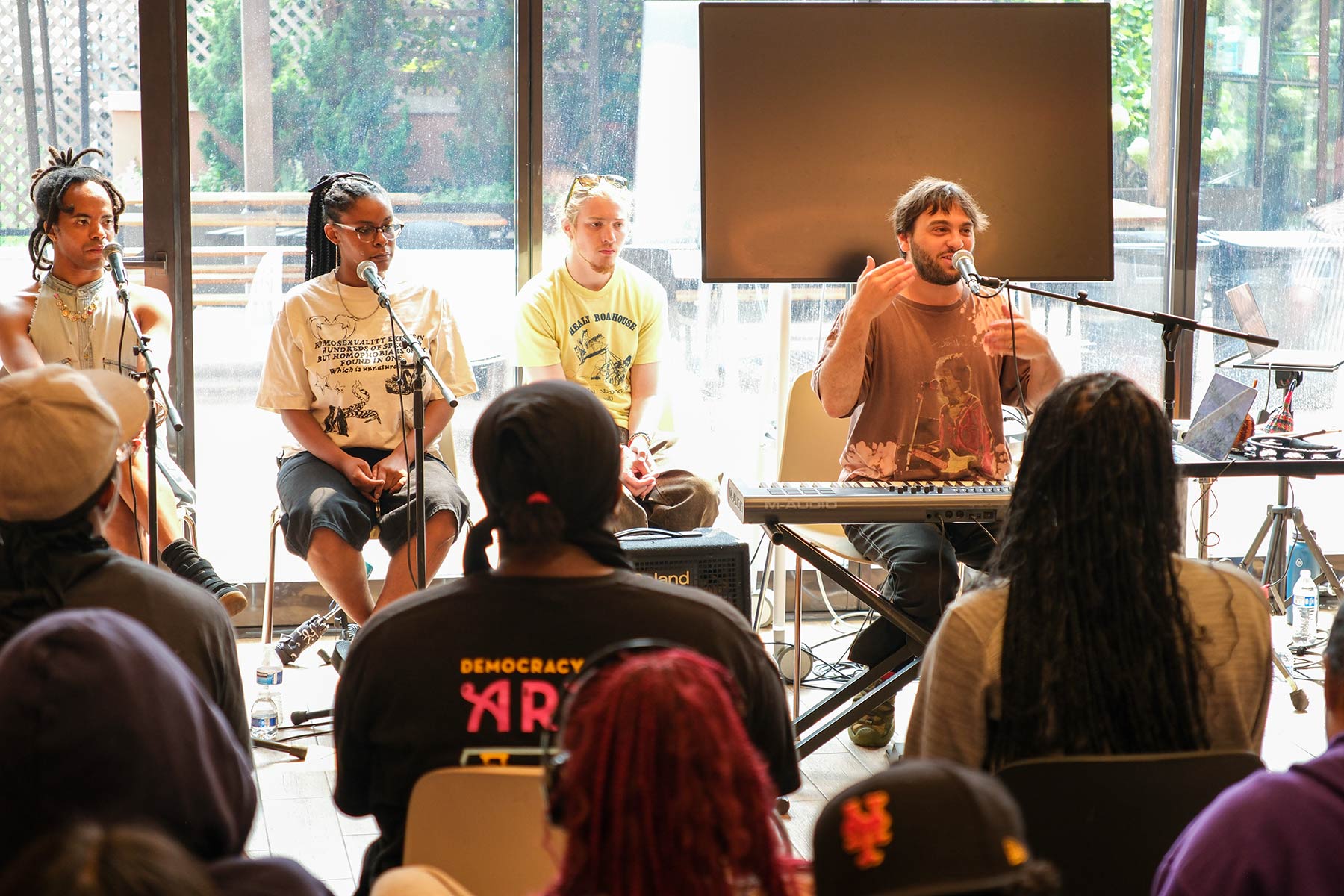
Pinderhughes performs at The Brotherhood Sister Sol in 2025. Photo Credit: Anthony Artis
To digest the entirety of this work requires consistently returning to it. It is not unlike the process of absorbing structural violence’s role in our society; there is an inherent need to return to those directly impacted by these systems in order to understand the whole picture. The work demands space, invites questions, and, ultimately, communicates the interpersonal and artistic nature of building a world around healing rather than punishment.
“I have to find ways within my artistic practice to evidence the world I want people to live in,” says Pinderhughes of not only the MoMA show, but his work going forward. “As artists, we have the capacity to move people. We must ask what we’re moving them towards.”
Pinderhughes pauses, thoughtfully, and then explains further: “I don’t think people are moved by guilt and shame; I believe we must at once dismantle systems while also evidencing systems of care.”
{
"article":
{
"title" : "Dreaming Beyond Punishment: Samora Pinderhughes On a New Way of Making Art and His Upcoming MoMA Show",
"author" : "Abigail Glasgow",
"category" : "interviews",
"url" : "https://everythingispolitical.com/readings/dreaming-beyond-punishment-samora-pinderhughes",
"date" : "2026-01-20 08:47:00 -0500",
"img" : "https://everythingispolitical.com/uploads/Samora-Pinderhughes-2_The-Kitchen_press-cred_Walter_Wlodarczyk.jpg",
"excerpt" : "",
"content" : "Samora Pinderhughes performs Rituals for Abolition at The Kitchen in New York, NY. Photo Credit: Walter WlodarczykIn a dark green jumpsuit, a man in his early twenties sits at what resembles a prison visiting room table in a living room in Queens, NY. It’s a chilly evening in October 2025, and, surrounded by sheets and lights to reflect bar-like shadows on the room’s front wall, he’s looking at a family picture. A rendition of Dinah Washington’s soaring anthem “This Bitter Earth” begins to play, and the entire film crew is silent as they watch him. Offscreen, a choreographer calls out to the man: “How does your body feel with this grief?” He becomes rigid, his back straight, fists clenched, and arms outstretched, struggling. “What gestures as a kid make you feel joyful?” the choreographer prompts again. Slowly, the protagonist unbuttons his jumpsuit, pulling the sleeves over his shoulders as if strapping himself into a plane. He looks like he’s flying. Behind the camera, artist, musician, director, and prison abolitionist Samora Pinderhughes weeps.“It was everything we wanted to say without words, the pain of the experience of incarceration and separation from family,” he recalls of that moment in filming. “I was mostly thinking about people I know in this situation.”The scene is part of a short narrative film, REAL TALK (SOMETIMES I FEEL TOO MUCH), which Pinderhughes has been meticulously preparing for about a year now. It is the centerpiece of the artist’s debut exhibition, Call and Response, at the Museum of Modern Art (MoMA), premiering on January 24. The film follows two estranged brothers navigating their mother’s passing in the absence of their brother who has long been incarcerated. Grief is meant to be an emotional anchor in the piece—“a doorway,” as Pinderhughes puts it—for those who have not directly experienced the criminal legal system. This is how you “make somebody feel violence without the presence of violence,” Pinderhughes explains.Pinderhughes has long been a fixture within the New York City arts scene. He has been a recording artist for 10 years and runs The Healing Project, an organization that creates artistic works, healing spaces, and advocacy initiatives by, for, and with people impacted by systemic violence. But despite his extensive artistic chops, Pingerhughes says that exhibiting at MoMA feels like a different beast from his career as a musician.“When you’re playing [music], people are coming to see you,” he explains. “But here, someone on a random Tuesday decides to go see art and will experience this emotional work about grieving somebody in prison—they’re just not going to expect that.”Perhaps audiences won’t expect it. But the exhibition, and the year’s work that brought it to life, are emblematic of how Pinderhughes has been addressing structural violence his whole life.Still from REAL TALK. Courtesy the artist and MoMA.When Pinderhughes was 13, he submitted his eighth-grade social studies paper on conscientious objection. There wasn’t a military draft; it was 2004. And yet, as if petitioning the U.S. government directly, Pinderhughes refused army participation on the grounds of being a pacifist. “I come from rich traditions of organizing,” he laughs, crediting this level of passion to the community that shaped him: a genealogist for a grandmother, a union organizer as a grandfather, and parents whose professorial and civic work spans urban planning, environmental literacy in prisons, violence prevention, and social behavioral health to this day.These experiences helped Pinderhughes conceive The Healing Project in 2014—in particular, to examine what it would look like to build a world outside of punishment. Guiding the organization’s programming and the artist’s music is over 100 testimonials from survivors of incarceration, detention, police brutality, poverty, and other systems that make communities vulnerable to harm. Inspired by his mentor, actor and playwright Anna Deavere Smith’s work in verbatim theater, a theater practice that uses the words of real people in plays, Pinderhughes spent a decade recording people across the country as they discussed their lived experience, courageously laying bare the complexities of causing and healing from harm. “He has this interesting combination of grace, humility, confidence, and creative energy,” Smith shares. “I don’t think it’s just that his work has a platform at MoMA. I think MoMA has a platform through the work to reach different audiences.” Smith sits on MoMA’s board, and adds that she’s confident Pinderhughes “will test and push the institution in a way that asks it to do things differently.”And he has: In addition to the short film, Pinderhughes and The Healing Project’s longstanding Choir will also perform I Hope This Finds You Well. The work in progress interweaves original music with aforementioned testimonials about surviving and healing from structural violence. He has also partnered with four local organizations—Parole Prep, Fortune Society, Brotherhood Sister Sol, and South Bronx Unite—to create collaborative works that range from a photography series and mixtape to a short documentary and audio play. While MoMA has worked with artists in a similar vein on local collaborations, this exhibition is the largest in scale to date, with four partners across multiple boroughs. These partnerships will culminate in a community celebration on February 7, where the works will be displayed at the museum.For Pinderhughes, our current landscape is one where “people are normalized to spectacle and violence.” Because of this, many creators employ disturbing, shocking content, which the artist argues only has a temporary effect—especially if intertwined with a barrage of information. A method with an impact, sure, though shock is not the goal for Pinderhughes. As composer, pianist, and mentor Vijay Iyer says, Pinderhughes’ “work delves into all the things our society tries to hide—its history, its structures, and the daily things we all experience but don’t know how to talk about.” The goal, as a result, is to listen deeply, creating a collection of abolitionist works that specifically counter archaic narratives of people and communities who experience incarceration, foster care, detention, and other systems of violence in this country.Pinderhughes notes that we used to see more artists work this way, citing singer-songwriter Curtis Mayfield. “In the sixties, his album Back to the World was a concept record about a veteran coming back home,” he says. “It wasn’t his experience—it was a community-oriented storytelling approach.” This is the type of artist Pinderhughes wants to be, though he says it can “sometimes feel a little lonely, because not a lot of people are doing it that way.” “But when I operate outside of my artist’s brain and in community, I feel proud of what I’ve done,” he explains. For Iyer, this uniquely distinguishes Pinderhughes, who “never lets go of what’s important to him, even as he gets elevated into this echelon of culture that not many people get to participate in.”Pinderhughes performs “I Hope This Finds You Well” with The Healing Project in 2023 at Carnegie Hall in New York, NY. Photo Credit: Lawrence SumulongOn a Friday morning in early September 2025, Pinderhughes and The Healing Project Choir started to set up in the main hall of the Fortune Society, an organization that provides reentry services for people coming home from prison while also promoting alternatives to incarceration.“I don’t think anybody really knew what was coming,” says Caleb Knight, Fortune’s Creative Arts Senior Associate.Without a formal stage, the Choir began to sing an original composition by Pinderhughes and, in a typically hyperactive communal space, everyone got quiet—even those at the foosball table. As the performance continued, the Choir invited the audience to participate. Four community members took to the stage. Sandwiching themselves between performers, they began improvising vocal harmonies. “I don’t think people were ready for the actual physical sensation of emotional release. That set the expectation for the rest of the year,” Knight says.Following the performance, Pinderhughes gathered audience members and the Choir to discuss what the performance meant to them and to introduce what collaborating as a group could look like moving forward. “Samora took them so seriously as artists,” Knight shares. Through songwriting workshops and a collaborative photography project called Who Gets to Name You?, participants’ musical and lyrical work evolved with every meeting. “He gave them the type of feedback he would give any artist.”The resulting mixtape and photo series are just two of the works born from community partnerships that Pinderhughes and The Healing Project will present at MoMA. Across the East River, they also partnered with the Black and Latinx youth justice organization, The Brotherhood Sister Sol, to create a short film focused on establishing wellness centers in high schools amid escalating suspensions. The group additionally worked with community organization South Bronx Unite to develop a found-footage documentary that traces the neighborhood’s artistic and political history. Pinderhughes also teamed up with incarcerated artists who work with Parole Prep, an organization that advocates for the release of people serving life sentences, by mixing their reflections on what mutual aid looks like in prisons against original music.“We’ve never really had our whole staff engage with something creative like this,” says Willie Kearse, co-founder of Parole Prep’s Archive-Based Creative Arts Program. “The music made it really warm, inviting—it resonated in a different way. I feel it will make people more comfortable with talking about some of the worst moments they’ve had in [prison].”Pinderhughes performs at The Brotherhood Sister Sol in 2025. Photo Credit: Anthony ArtisTo digest the entirety of this work requires consistently returning to it. It is not unlike the process of absorbing structural violence’s role in our society; there is an inherent need to return to those directly impacted by these systems in order to understand the whole picture. The work demands space, invites questions, and, ultimately, communicates the interpersonal and artistic nature of building a world around healing rather than punishment.“I have to find ways within my artistic practice to evidence the world I want people to live in,” says Pinderhughes of not only the MoMA show, but his work going forward. “As artists, we have the capacity to move people. We must ask what we’re moving them towards.”Pinderhughes pauses, thoughtfully, and then explains further: “I don’t think people are moved by guilt and shame; I believe we must at once dismantle systems while also evidencing systems of care.”"
}
,
"relatedposts": [
{
"title" : "To Grieve Together Is to Heal Together: Rituals of Care In Minneapolis",
"author" : "Joi Lee",
"category" : "essays",
"url" : "https://everythingispolitical.com/readings/healing-rituals-minneapolis",
"date" : "2026-02-20 08:48:00 -0500",
"img" : "https://everythingispolitical.com/uploads/Lee_Minn_Image1.jpeg",
"excerpt" : "",
"content" : "Signs of resistance and community solidarity are found on every block, in every neighborhood. This is a sign a few houses down from Renee Good’s memorial. Photo Credit: Joi LeeOver the last three months, the Twin Cities of Minneapolis and St. Paul, Minn. have lived under siege. On December 4, 2025, the Department of Homeland Security announced the start of Operation Metro Surge as part of Trump’s crackdown on immigration. Around 3,000 immigration agents flooded into the region, turning Minneapolis into the epicenter for what would become the largest immigration enforcement operation in United States history.Neighbors watched other neighbors being abducted. The shrill sound of whistles—the warning sign that ICE was nearby—became the all-too-familiar soundtrack to the city. Streets, and the businesses that lined them, once bustling, became quiet, threatening the many diverse communities that form the cultural backbone of the Twin Cities: Somali, Hmong, Latine, among others.And then, on January 7, Renee Good, an everyday Minnesotan who was watching out for her neighbors, a legal observer, was shot and killed. Seventeen days later, Alex Pretti, an ICU Nurse, met the same fate at the hands of ICE officers.What followed made international headlines: civilians clashing with federal agents as flash bangs, tear gas, and rubber bullets filled the streets of Minneapolis. Images of confrontation traveled far beyond the city, flattening a much more complicated reality unfolding on the ground—as the news cycle has done repeatedly to Minneapolis over the years with the murders of Jamar Clarke in 2014, Philando Castile in 2016, and George Floyd in 2020 at the hands of police brutality.As tensions threatened to spiral further, the Trump administration announced a series of changes: replacing ICE commander Greg Bovino with so-called “border czar” Tom Homan, and on February 12, announcing that the operation in Minneapolis would come to an end. But in Minneapolis, many residents say the shift has been more cosmetic than substantive. Raids continue, surveillance lingers, and entire communities remain on edge.The fear has not lifted. It has settled.In this fragile uncertainty of what happens next, the Minneapolis community has turned to care. Across the city, people are gathering not just to strategize or protest, but to also grieve together: to light candles, pray, sing, and move their bodies in unison. Memorials for Good and Pretti have become meeting grounds. Healing circles, ceremonies, and music-filled vigils have emerged as lifelines for a community nowhere near recovered, yet refusing to unravel.Posters of Renee Good and Alex Pretti adorn the city, plastered on empty walls, hung up on store windows. Photo Credit: Joi LeeA legacy of trauma—and healingIn Minneapolis, trauma does not arrive without memory. Neither does healing.I met Leslie Redmond, an organizer and former president of Minneapolis NAACP, at a healing circle she convened the day after Pretti’s murder. Nestled in a small community cafe, tables were pushed aside and chairs brought into the circle. Wafts of warm home-made chili floated in from the vegan kitchen, and cups of piping hot lemon ginger tea—nourishing for the soul, we were assured—were handed out.As folks trickled into their seats, nervous chatter gave way to quiet realization that everyone was holding a pain that needed to be shared. Looking around the faces in the room, many etched with stress and exhaustion, Redmond reminded us, “Before we can build, we must heal.”Redmond is no stranger to collective trauma inflicted by the hands of law enforcement. She had lived through the police killings of Jamar Clarke, Philando Castile, and George Floyd, as well as the uprisings that followed.“Back then, I wasn’t actively healing. My back went out. My hair was falling out. We were in the fight phase. And then I realized, we need to move to the healing phase.”By the end of 2020, Redmond decided to create a community healing team for collective mourning. When Good was killed, that infrastructure, built slowly and deliberately, was ready to spring into action.“Healing is fundamental,” Redmond said, before quoting Audre Lorde’s seminal words from A Burst of Light: “Self-care is not self-indulgence. Self-care is self-preservation, which is an act of political warfare.”These days, Remond facilitates weekly healing circles. For many, the healing circles have become a place to reset. To find solace in knowing that what Minnesotans are going through is real, and not imagined. To find validation in their pain, yet also resolution in how to move forward. At one of the meetings, a 13-year-old quietly confessed to the group, “I feel like I’ve lost my peace.” At another, a Somali elder shared, “We’ve been living in fear. But looking around, how beautiful to remember why I decided to call this place my home.”Different cultures, shared medicine in memorialThe memorials of Pretti and Good, built at the sites where they were killed, have become living spaces of ceremony and connection. The rituals of healing are as diverse as the communities that Pretti and Good gave their lives to protect. At a vigil for Pretti organized by his fellow nurses, I met members of the Hmong community, an ethnic group that originates from Southeast Asia and largely came over as refugees to Minneapolis in the mid-1970’s. The Twin Cities are home to the largest concentration of Hmong people in the U.S.One person held a sign reading, “A Hmong shaman for healers & humanity!” Another read, “A Hmong Christian for healers & humanity!”A woman who asked me to call her Yaya explained why she was there. “As a healer from the Hmong community, as a shaman, I came to support them, healer to healer,” she said. “Because we do so much healing, but we forget to heal ourselves. Today is about healing the healers.”The group offered both prayers and blessed strings. People approached quietly, asking for care. Some requested Christian prayer, others a shamanic blessing. Kiki, the Christian, clasped their hands tightly, offering a prayer and a hug. Yaya took each person’s right hand, looping a thin string around the wrist and tying it gently in place, murmuring a prayer so soft it barely rose above the street noise.Many accepted both.Ceremony as resistanceIndigenous communities also organized ceremonies honoring Good and Pretti.Among them was a Jingle Dress Dance ceremony, rooted in Ojibwe healing traditions, meant to restore health and balance to those who need it. Over 30 members of the Minneapolis Native community came together at both memorials to perform their sacred dance, adorned in vibrant dresses. Metal cones are woven in intricate patterns around the dress, such that a slight movement creates a rhythmic sound.“The dress came to our people when there was a time of sickness. And so that’s what we do. We show up when there’s people suffering,” Downwind said, one of the organizers of the ceremony.Jingle Dress Dancers gather at Renee Good memorial’s site to perform a healing ceremony. Photo Credit: Joi LeeThe sound of metal cones sewn onto the dresses echoed through the cold air—each step a prayer, each movement an offering—was met with quiet attentiveness by the audience.When the dance finished at Good’s memorial, the crowd moved to Pretti’s, a journey that in itself felt like a pilgrimage, connecting the deaths of two Minnesotans with the lives of all those who remained, continuing their legacy.For many in attendance, the presence of Native dancers felt both sacred and a reminder that this land holds older traditions of survival. That healing did not begin, nor will it end, with this moment.**Music and the permission to feel **Music has also become a vessel for collective healing. Groups like Brass Solidarity,a band that was founded in response to the murder of George Floyd, have organized performances at the memorials, bringing instruments into spaces thick with grief.In the cold, unforgiving nights of Minneapolis, hundreds gather by Alex Pretti’s memorial site to listen to the musical tribute given by Brass Solidarity. Photo Credit: Joi LeeOne evening at Pretti’s memorial, hundreds of people stood shoulder to shoulder, bodies seeking warmth and rhythm. Brass instruments rang out, fingers braving subzero temperatures to play. Anthony Afful, a musician with Brass Solidarity, described the role of music in these spaces. “Part of what we’re doing,” he said, “is helping people remember that they’re human.”Music, he explained, creates room for the full range of emotion. “This is a dark time. There has to be space for grief, for rage, and also for joy—to exist together.”I spoke to another musician, Tufawon, who is Native-Boricua. For him, it is not just experiencing music but also its creative expression that helps unlock emotional processing. He’s currently holding a music workshop for Native youth, many of whom have been deeply impacted by ICE raids despite being the Indigenous peoples of this land.“As colonized people, we’re impacted by historical trauma,” Tufawon explained. “We carry it through our genes. And now there’s a collective trauma that the entire city, the entire state, really, is holding. We don’t take the time to process what we experience. Music is a mindfulness practice. So I use music to bring healing into the moment, so they can find some level of balance and not crash so hard when it’s all over.”Tufawon is a local Minneapolis artist, both Native and Puerto Rican, who uses music as an educational and community tool to heal and lift up the Native youth community. Photo Credit: Joi LeeHealing circles, ceremonies, music, and prayer: many of these are rituals with a rich, long history. They have navigated many cultures in the past and will continue to do so in the future.They have passed through countless cultures and generations, carrying meaning far beyond any single moment.But in a time where Minneapolis is being ripped apart—when the very definition of who belongs, of what it means to be an “American,” is under violent scrutiny—these rituals of care have reaffirmed something that cannot be detained, erased, or deported. That the very fabric of this place has been woven together by so many cultures, by so many peoples. And that it will be healed by them, together.Minneapolis is no stranger to rebuilding. It is a city, a sacred land, that is practiced in rising from devastation, again and again."
}
,
{
"title" : "aja monet’s new single: “hollyweird”",
"author" : "aja monet",
"category" : "visual",
"url" : "https://everythingispolitical.com/readings/aja-monet-hollyweird-release",
"date" : "2026-02-19 05:00:00 -0500",
"img" : "https://everythingispolitical.com/uploads/aja-monet---Hollyweird-_-Single-Art.jpg",
"excerpt" : "Surrealist blues poet aja monet shares her first new music since 2024 with the release of her timely new single “hollyweird” via drink sum wtr. The track, produced by monet, Meshell Ndegeocello and Justin Brown, arrives with a bold video directed by B+ and Monet herself, and features Chicago rapper and close collaborator, Vic Mensa.",
"content" : "Surrealist blues poet aja monet shares her first new music since 2024 with the release of her timely new single “hollyweird” via drink sum wtr. The track, produced by monet, Meshell Ndegeocello and Justin Brown, arrives with a bold video directed by B+ and Monet herself, and features Chicago rapper and close collaborator, Vic Mensa.“I wrote ‘hollyweird’ on scraps of found paper, frantically jotting down observations and sentiments of the moment during the Los Angeles fires and its aftermath,” monet explains. “The song is an Afropunkesque ode to frustrations and feelings around our current culture of social isolation and performative solidarity. I wanted to speak to the emptiness of ‘hollyweird’ not as a place but as a way of being where insincerity is normalized. Where social interactions become void in of sincerity and we lose sight of community and connection.”“hollyweird” is the first taste of new music from monet since the release of her debut album, when the poems do what they do, in 2023. The album was released by drink sum wtr to wide critical praise and was nominated at the 66th GRAMMY Awards for Best Spoken Word Poetry Album in 2024. The album marked the arrival of a singular poet and peerless lyricist. On it, monet explored themes of resistance, love, and the inexhaustible quest for joy.monet is bringing her singular live show to New York City’s famed Carnegie Hall Theater. The show will take place at the Zankel Hall on May 20th.Get the track on all digital platforms here"
}
,
{
"title" : "How to Resist “Organized Loneliness”: resisting isolation in the age of digital authoritarianism ",
"author" : "Emma Cieslik",
"category" : "essays",
"url" : "https://everythingispolitical.com/readings/how-to-resist-organized-loneliness",
"date" : "2026-02-13 15:11:00 -0500",
"img" : "https://everythingispolitical.com/uploads/American_protesters_in_front_of_White_House-11.jpg",
"excerpt" : "Over the past year, many of us have encountered, navigated, and processed violence alone on our phones. We watched videos of Renee Nicole Good and Alex Pretti being fatally shot and Liam Conejo Ramos being detained by ICE agents. These photos and videos triggered anger, sadness, and desperation for many (along with frustration that these deaths were the inciting blow against ICE agents that have killed many more people of color this year and last).",
"content" : "Over the past year, many of us have encountered, navigated, and processed violence alone on our phones. We watched videos of Renee Nicole Good and Alex Pretti being fatally shot and Liam Conejo Ramos being detained by ICE agents. These photos and videos triggered anger, sadness, and desperation for many (along with frustration that these deaths were the inciting blow against ICE agents that have killed many more people of color this year and last).While the institutions and people committing these crimes do not want them recorded, the Department of Homeland Security and the wider Trump administration is using “organized loneliness,” a totalitarian tool that seeks to distort peoples’ perception of reality. Although seemingly a symptom of COVID-19 pandemic isolation and living in a more social media focused world, “organized loneliness” is being weaponized to change the way people not only engage with violence but respond to it online, simultaneously desensitizing us to bodily trauma and escalating radicalization and recruitment online.Back in 2022, philosopher Samantha Rose Hill argued that the loneliness epidemic sparked by the COVID-19 pandemic could and would have dangerous consequences. She specifically cites Hannah Arendt’s 1951 book The Origins of Totalitarianism, which argued that authoritarian leaders like Hitler and Stalin weaponized people’s loneliness to exert control over them. Arendt was a Jewish woman who barely escaped Nazi Germany.As Hill told Steve Paulson for “To The Best Of Our Knowledge,” “the organized loneliness that underlies totalitarian movements destroys people’s relationship to reality. Their political propaganda makes it difficult for people to trust their own opinions and perceptions of reality.” Because as Arendt wrote, “the ideal subject of totalitarian rule is not the convinced Nazi or the convinced Communist, but people for whom the distinction between fact and fiction and the distinction between true and false no longer exist.”While this piece grounds discussions of organized loneliness in Arendt’s work, Black feminist scholars and organizers have long called out how isolation, state-sanctioned surveillance, and fragmentation are functions of racialized and gender-based control. bell hook’s writings about forced isolation cemented by individualism and materialism in All About Love: New Visions and Audre Lorde’s discussions of fragmentation of the mind from the body and self from community assert that “organized loneliness” is not new in the United States. Loneliness has long been used as a weapon of the American state to assert emotional, political, and structural control by keeping up separated. This piece, and modern reflections on “organized loneliness” is built on the foundation of Black feminist scholars like hooks, Lorde, and Angela Davis; they were some of the first to name “organized loneliness” along with Arendt.But there are ways in which we can resist the threat that “organized loneliness” represents, especially in the age of social media. They include acknowledging this campaign of loneliness, taking proactive steps when engaging with others online, and fostering relationships with friends and our communities to stand in solidarity amidst the rise of fascism.1. The first step is accepting that loneliness affects everyone and can be exploited by authoritarian movements.Many of us know this intimately. Back in 2023, the U.S. Surgeon General flagged an already dire loneliness epidemic, that in combination with a transition of most interaction onto social media, changes the way in which we engage with violence and tragedy online. But it can be hard to admit that loneliness affects us, especially when we are constantly connected through social media. It’s important to admit that even for the most digitally literate and active among us, “organized loneliness” not only can occur but especially occurs on social media.Being susceptible to or affected by “organized loneliness” is not a moral shortcoming or a personal failure but acknowledging it and taking steps to connect with one another is the one way we resist totalitarian regimes.2. Next, take social media breaks–and avoid doomscrooling.Even before the advent of social media or online news outlets, Arendt was warning about how loneliness can become a breeding ground for downward spirals. She explains that the constant consumption of tragic, violent, and deeply upsetting news–and watching it unfold in front of us can not only be overstimulating but can desensitize us and disconnect us from reality.While it can be difficult when most of our social lives exist on social media (this will be unpacked later), experts recommend that people limit using social media to less than two hours per day and avoid using it during the first hour after waking up and the last hour before going to sleep. People can use apps that limit overall screen time or restrict access to social media at set times–the best being Opal, One Sec, Forest, and StayFree. People can also use these apps to limit access to specific websites that might include triggering news.But it’s important to recognize that avoiding doomscrooling does not give people license not to stay informed or to look away from atrocities that are not affecting their communities.3. Resist social media echo-chambers by diversifying your algorithm.When you are on social media, however, it’s important to recognize that AI-based algorithms track what we engage with and show us similar content. People can use a VPN to search without creating a record that AI can track and thus offer us like offerings, but while the most pronounced (and reported on) examples focus on White, cis straight men and the Manoverse, echochambers can affect all of us and shift our perception of publicly shared beliefs.People can resist echo-chambers by seeking out new sources and accounts that offer different, fact-based perspectives but also acknowledge their commitment to resisting fascism, such as Ground News, ProPublica, and Truthout. Another idea is to follow anti-fascist online educators like Saffana Monajed who promote and share lessons for media literacy. People can also do this by cultivating their intellectual humility, or the recognition that your awareness has limits based largely on your own experiences and privileges and your beliefs could be wrong. Fearless Culture Design has some great tips.While encountering and engaging different perspectives is vital to resisting echochambers and social algorithms, this is not an invitation to follow or platform any news outlet, content creator, or commentator that denies your or other people’s personhood.4. Cultivate your friendships and make new ones.In a time when many of us only stay in contact with friends through social media, friendships are more important than ever. Try, if you can, to engage friends outside of social media–whether it’s through in-person meet ups (dinners, parties, game nights) or on digital platforms that are not social media-based, for example coordinating meet-ups over Zoom or Skype. This can be a virtual D&D campaign, craft circle, or a virtual book club. While these may seem like silly events throughout the week, they help build real connection.It’s important to connect with people outside of a space that uses an algorithm to design content and to reinforce that people are three-dimensional (not just a two-dimensional representation of a social media profile). There are even some apps that assist with this goal, such as Connect, a web app designed by MIT graduate students Mohammad Ghassemi and Tuka Al Hanai to bring students from diverse backgrounds together for lunch conversations.Arendt writes that totalitarian domination destroys not only political life but also private life as well. Cultivating friendships–and relationships of solidarity with your neighbors and fellow community members–are the ways in which we not only resist the destruction of private relationships but also reinforce that we and others belong in our communities–and that we can achieve great things when we stand together!5. With this in mind, practice intentional solidarity with one another.While it’s likely no surprise, fascism functions to both establish a nationalist identity that breeds extremism and destroy unification and rebellion against authority. The best way to resist the isolation that totalitarian governments breed is to practice intentional acts of solidarity with marginalized communities, especially communities facing systemic violence at the hands of an authoritarian power.Writer and advocate Deepa Iyer discusses the importance of action-based solidarity in her program Solidarity Is, part of the Building Movement Project, and Solidarity Is This Podcast (co-hosted with Adaku Utah) discusses and models a solidarity journey that foregrounds marginalized communities. I highly recommend reading her Solidarity Is Practice Guide and the Solidarity Syllabus, a blog series that Iyer just started this month to highlight lessons, resources, and ideas of how to cultivate solidarity within your own communities.6. Consume locally and ethically, and reject capitalist productivity.And one way that people can stand in solidarity with their communities is to support local small businesses that invest back into the communities. When totalitarianism strips people of many platforms to voice concern, one of the last remaining power people have is how and where they spend their money. Often, this is what draws the most attention and impact, so it’s important to buy (and sell) based on Iyer’s Solidarity Stances and to also resist the ways in which productivity culture not only disempowers community but devalues human labor.At the heart of Arendt’s criticism of totalitarian domination is the ways in which capitalism, a “tyranny over ‘laborers,’” contributes to loneliness itself (pg. 476). Whether intentional or not, this connects to modern campaigns not only of malicious compliance but also purposeful obstinance in which people refuse to labor for a fascist regime but to mobilize their ability to labor as a form of resistance–thinking about the recent walkouts and boycotts that resist by weaponizing our labor and our spending power.Not only should people resist the conflation of a person’s value to their productivity, but they should use their labor–and the economic products of it–as tools of resistance in capitalism.Thankfully as Arendy writes, “totalitarian domination, like tyranny, bears the germs of its own destruction,” so totalitarianism by definition cannot succeed just as humans cannot thrive under the pressure of “organized loneliness.” For this reason, it’s a challenge to hold on and resist the administration using disconnection to garner support for the dehumanization of and violence against human beings. But as long as we do, we have the most powerful tools of resistance–awareness, friendship, community, and solidarity–at our disposal to undo totalitarianism just as it was undone back in the 1940s."
}
]
}