
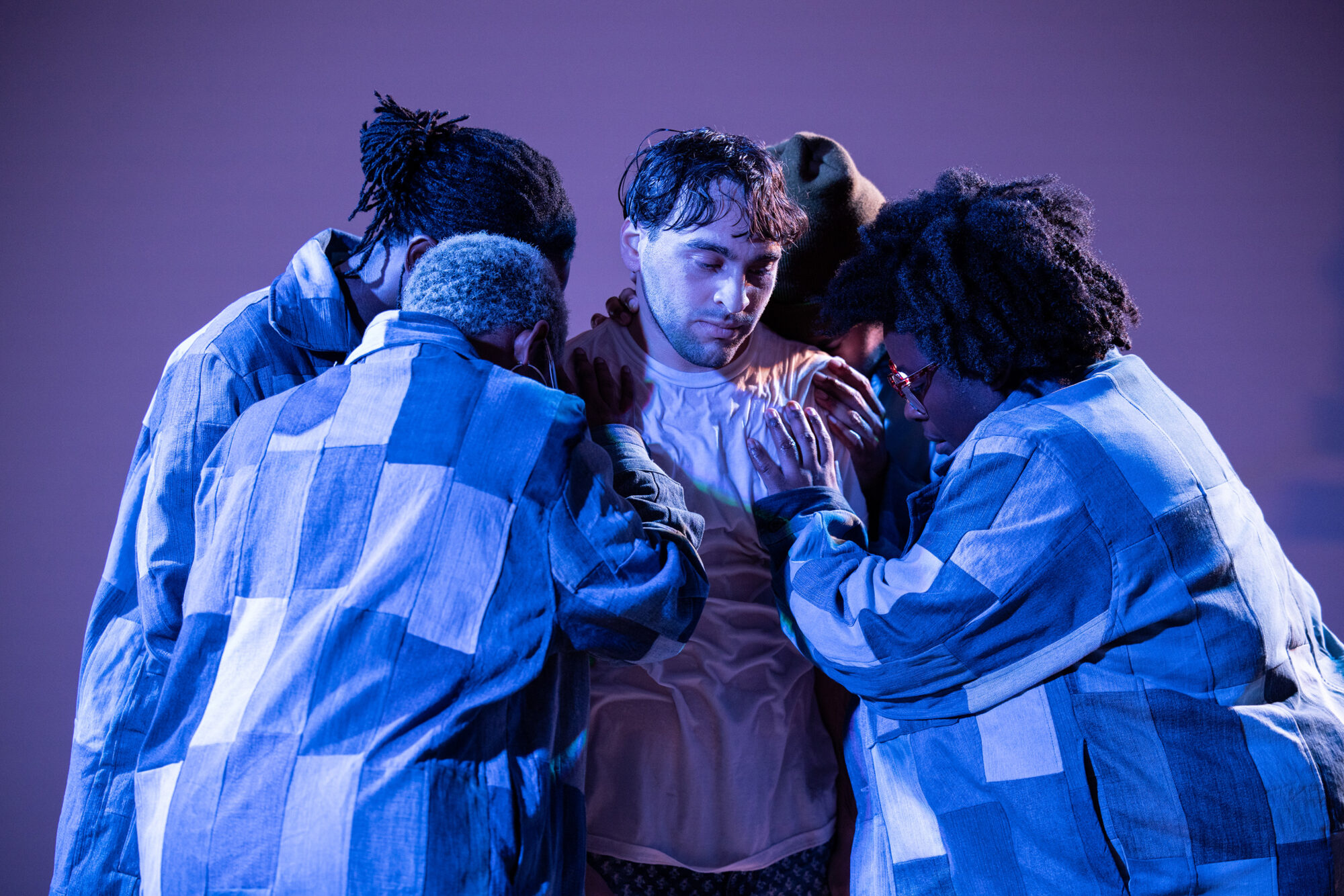
Samora Pinderhughes performs Rituals for Abolition at The Kitchen in New York, NY. Photo Credit: Walter Wlodarczyk
In a dark green jumpsuit, a man in his early twenties sits at what resembles a prison visiting room table in a living room in Queens, NY. It’s a chilly evening in October 2025, and, surrounded by sheets and lights to reflect bar-like shadows on the room’s front wall, he’s looking at a family picture. A rendition of Dinah Washington’s soaring anthem “This Bitter Earth” begins to play, and the entire film crew is silent as they watch him. Offscreen, a choreographer calls out to the man: “How does your body feel with this grief?” He becomes rigid, his back straight, fists clenched, and arms outstretched, struggling. “What gestures as a kid make you feel joyful?” the choreographer prompts again. Slowly, the protagonist unbuttons his jumpsuit, pulling the sleeves over his shoulders as if strapping himself into a plane. He looks like he’s flying. Behind the camera, artist, musician, director, and prison abolitionist Samora Pinderhughes weeps.
“It was everything we wanted to say without words, the pain of the experience of incarceration and separation from family,” he recalls of that moment in filming. “I was mostly thinking about people I know in this situation.”
The scene is part of a short narrative film, REAL TALK (SOMETIMES I FEEL TOO MUCH), which Pinderhughes has been meticulously preparing for about a year now. It is the centerpiece of the artist’s debut exhibition, Call and Response, at the Museum of Modern Art (MoMA), premiering on January 24. The film follows two estranged brothers navigating their mother’s passing in the absence of their brother who has long been incarcerated. Grief is meant to be an emotional anchor in the piece—“a doorway,” as Pinderhughes puts it—for those who have not directly experienced the criminal legal system. This is how you “make somebody feel violence without the presence of violence,” Pinderhughes explains.
Pinderhughes has long been a fixture within the New York City arts scene. He has been a recording artist for 10 years and runs The Healing Project, an organization that creates artistic works, healing spaces, and advocacy initiatives by, for, and with people impacted by systemic violence. But despite his extensive artistic chops, Pingerhughes says that exhibiting at MoMA feels like a different beast from his career as a musician.“When you’re playing [music], people are coming to see you,” he explains. “But here, someone on a random Tuesday decides to go see art and will experience this emotional work about grieving somebody in prison—they’re just not going to expect that.”
Perhaps audiences won’t expect it. But the exhibition, and the year’s work that brought it to life, are emblematic of how Pinderhughes has been addressing structural violence his whole life.
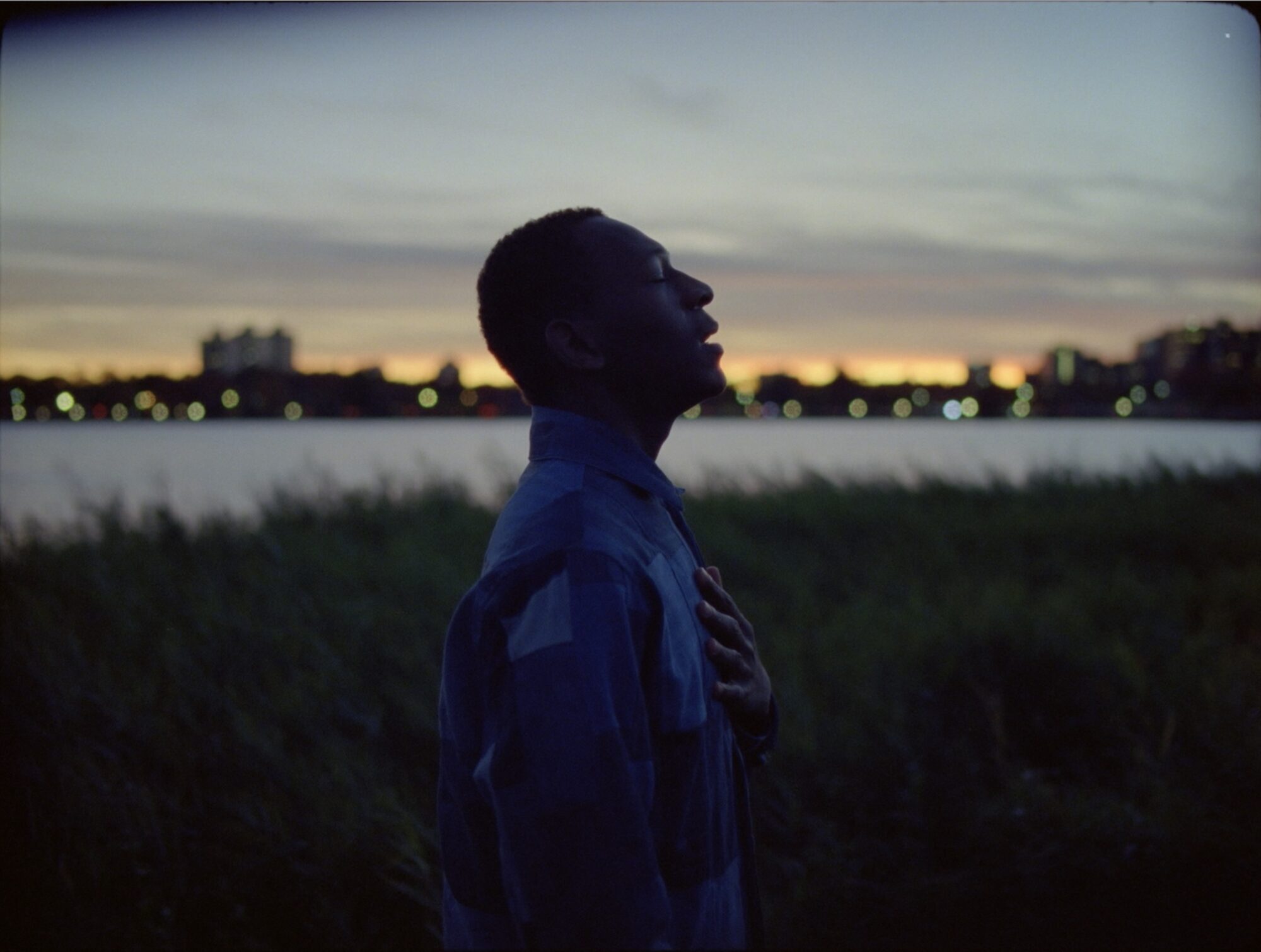
Still from REAL TALK. Courtesy the artist and MoMA.
When Pinderhughes was 13, he submitted his eighth-grade social studies paper on conscientious objection. There wasn’t a military draft; it was 2004. And yet, as if petitioning the U.S. government directly, Pinderhughes refused army participation on the grounds of being a pacifist. “I come from rich traditions of organizing,” he laughs, crediting this level of passion to the community that shaped him: a genealogist for a grandmother, a union organizer as a grandfather, and parents whose professorial and civic work spans urban planning, environmental literacy in prisons, violence prevention, and social behavioral health to this day.
These experiences helped Pinderhughes conceive The Healing Project in 2014—in particular, to examine what it would look like to build a world outside of punishment. Guiding the organization’s programming and the artist’s music is over 100 testimonials from survivors of incarceration, detention, police brutality, poverty, and other systems that make communities vulnerable to harm. Inspired by his mentor, actor and playwright Anna Deavere Smith’s work in verbatim theater, a theater practice that uses the words of real people in plays, Pinderhughes spent a decade recording people across the country as they discussed their lived experience, courageously laying bare the complexities of causing and healing from harm. “He has this interesting combination of grace, humility, confidence, and creative energy,” Smith shares. “I don’t think it’s just that his work has a platform at MoMA. I think MoMA has a platform through the work to reach different audiences.” Smith sits on MoMA’s board, and adds that she’s confident Pinderhughes “will test and push the institution in a way that asks it to do things differently.”
And he has: In addition to the short film, Pinderhughes and The Healing Project’s longstanding Choir will also perform I Hope This Finds You Well. The work in progress interweaves original music with aforementioned testimonials about surviving and healing from structural violence. He has also partnered with four local organizations—Parole Prep, Fortune Society, Brotherhood Sister Sol, and South Bronx Unite—to create collaborative works that range from a photography series and mixtape to a short documentary and audio play. While MoMA has worked with artists in a similar vein on local collaborations, this exhibition is the largest in scale to date, with four partners across multiple boroughs. These partnerships will culminate in a community celebration on February 7, where the works will be displayed at the museum.
For Pinderhughes, our current landscape is one where “people are normalized to spectacle and violence.” Because of this, many creators employ disturbing, shocking content, which the artist argues only has a temporary effect—especially if intertwined with a barrage of information. A method with an impact, sure, though shock is not the goal for Pinderhughes. As composer, pianist, and mentor Vijay Iyer says, Pinderhughes’ “work delves into all the things our society tries to hide—its history, its structures, and the daily things we all experience but don’t know how to talk about.” The goal, as a result, is to listen deeply, creating a collection of abolitionist works that specifically counter archaic narratives of people and communities who experience incarceration, foster care, detention, and other systems of violence in this country.
Pinderhughes notes that we used to see more artists work this way, citing singer-songwriter Curtis Mayfield. “In the sixties, his album Back to the World was a concept record about a veteran coming back home,” he says. “It wasn’t his experience—it was a community-oriented storytelling approach.” This is the type of artist Pinderhughes wants to be, though he says it can “sometimes feel a little lonely, because not a lot of people are doing it that way.” “But when I operate outside of my artist’s brain and in community, I feel proud of what I’ve done,” he explains. For Iyer, this uniquely distinguishes Pinderhughes, who “never lets go of what’s important to him, even as he gets elevated into this echelon of culture that not many people get to participate in.”
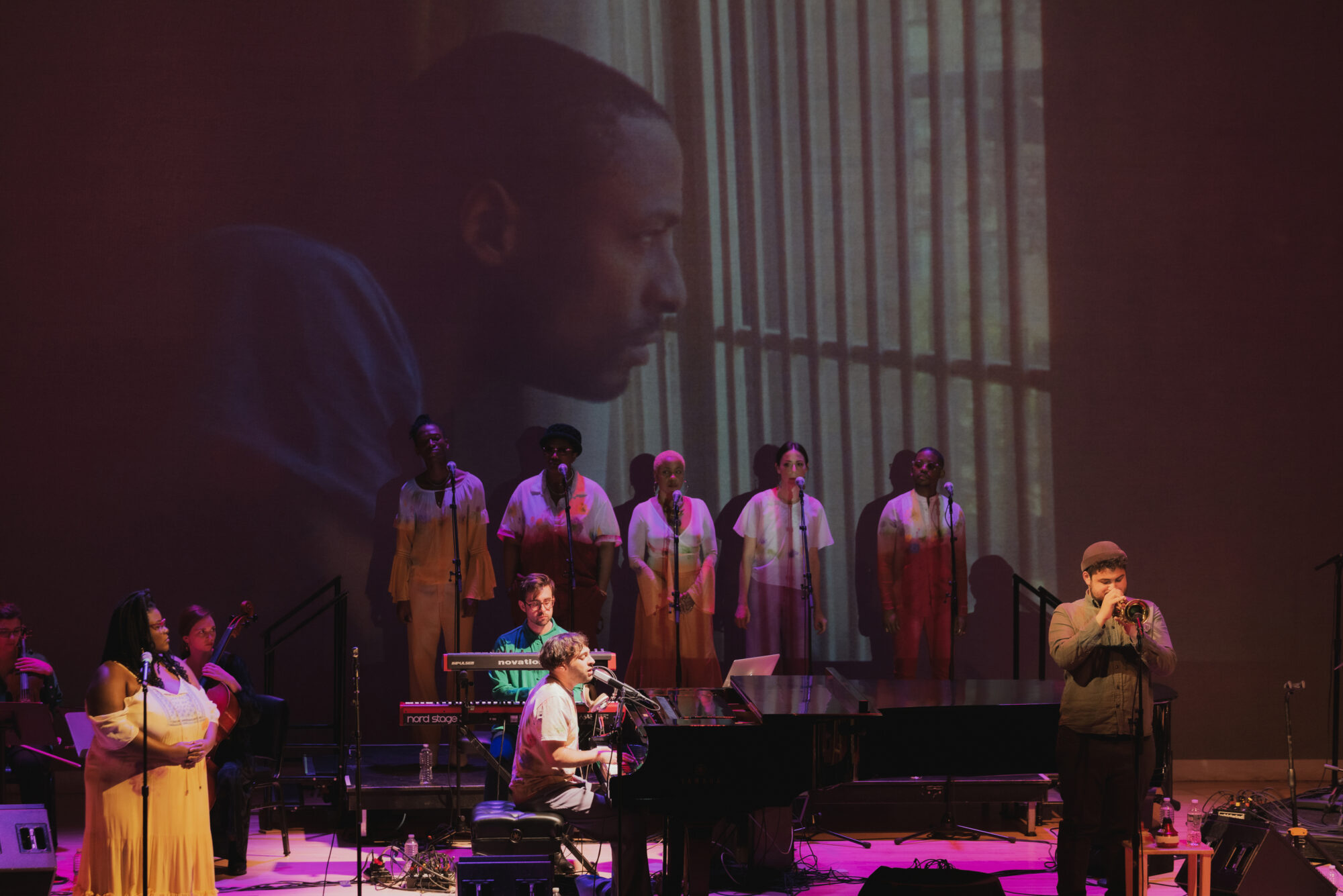
Pinderhughes performs “I Hope This Finds You Well” with The Healing Project in 2023 at Carnegie Hall in New York, NY. Photo Credit: Lawrence Sumulong
On a Friday morning in early September 2025, Pinderhughes and The Healing Project Choir started to set up in the main hall of the Fortune Society, an organization that provides reentry services for people coming home from prison while also promoting alternatives to incarceration.
“I don’t think anybody really knew what was coming,” says Caleb Knight, Fortune’s Creative Arts Senior Associate.
Without a formal stage, the Choir began to sing an original composition by Pinderhughes and, in a typically hyperactive communal space, everyone got quiet—even those at the foosball table. As the performance continued, the Choir invited the audience to participate. Four community members took to the stage. Sandwiching themselves between performers, they began improvising vocal harmonies. “I don’t think people were ready for the actual physical sensation of emotional release. That set the expectation for the rest of the year,” Knight says.
Following the performance, Pinderhughes gathered audience members and the Choir to discuss what the performance meant to them and to introduce what collaborating as a group could look like moving forward. “Samora took them so seriously as artists,” Knight shares. Through songwriting workshops and a collaborative photography project called Who Gets to Name You?, participants’ musical and lyrical work evolved with every meeting. “He gave them the type of feedback he would give any artist.”
The resulting mixtape and photo series are just two of the works born from community partnerships that Pinderhughes and The Healing Project will present at MoMA. Across the East River, they also partnered with the Black and Latinx youth justice organization, The Brotherhood Sister Sol, to create a short film focused on establishing wellness centers in high schools amid escalating suspensions. The group additionally worked with community organization South Bronx Unite to develop a found-footage documentary that traces the neighborhood’s artistic and political history. Pinderhughes also teamed up with incarcerated artists who work with Parole Prep, an organization that advocates for the release of people serving life sentences, by mixing their reflections on what mutual aid looks like in prisons against original music.
“We’ve never really had our whole staff engage with something creative like this,” says Willie Kearse, co-founder of Parole Prep’s Archive-Based Creative Arts Program. “The music made it really warm, inviting—it resonated in a different way. I feel it will make people more comfortable with talking about some of the worst moments they’ve had in [prison].”
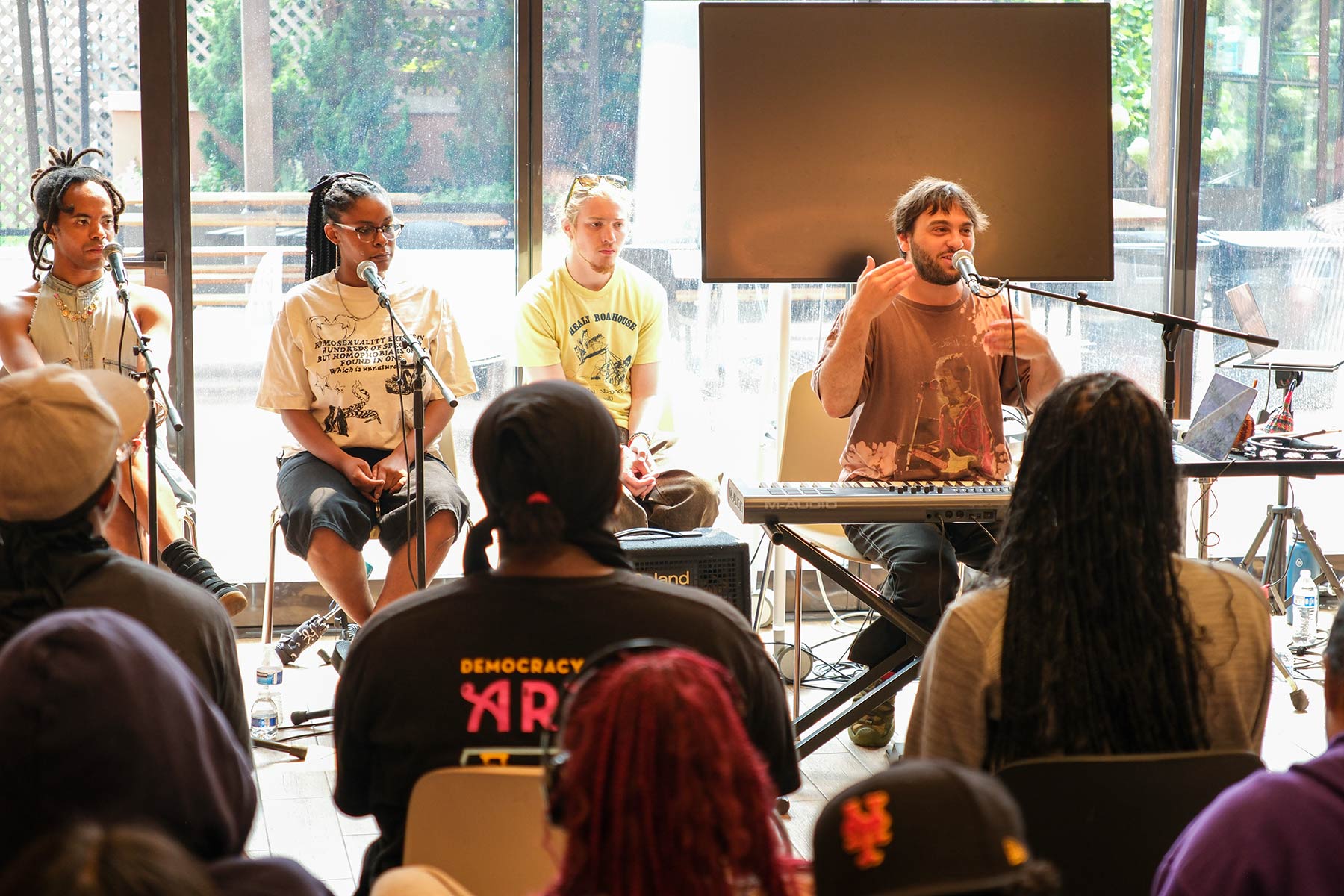
Pinderhughes performs at The Brotherhood Sister Sol in 2025. Photo Credit: Anthony Artis
To digest the entirety of this work requires consistently returning to it. It is not unlike the process of absorbing structural violence’s role in our society; there is an inherent need to return to those directly impacted by these systems in order to understand the whole picture. The work demands space, invites questions, and, ultimately, communicates the interpersonal and artistic nature of building a world around healing rather than punishment.
“I have to find ways within my artistic practice to evidence the world I want people to live in,” says Pinderhughes of not only the MoMA show, but his work going forward. “As artists, we have the capacity to move people. We must ask what we’re moving them towards.”
Pinderhughes pauses, thoughtfully, and then explains further: “I don’t think people are moved by guilt and shame; I believe we must at once dismantle systems while also evidencing systems of care.”