

A rage that doesn’t belong anywhere. An uncertainty that doesn’t yield to any mental remedy.
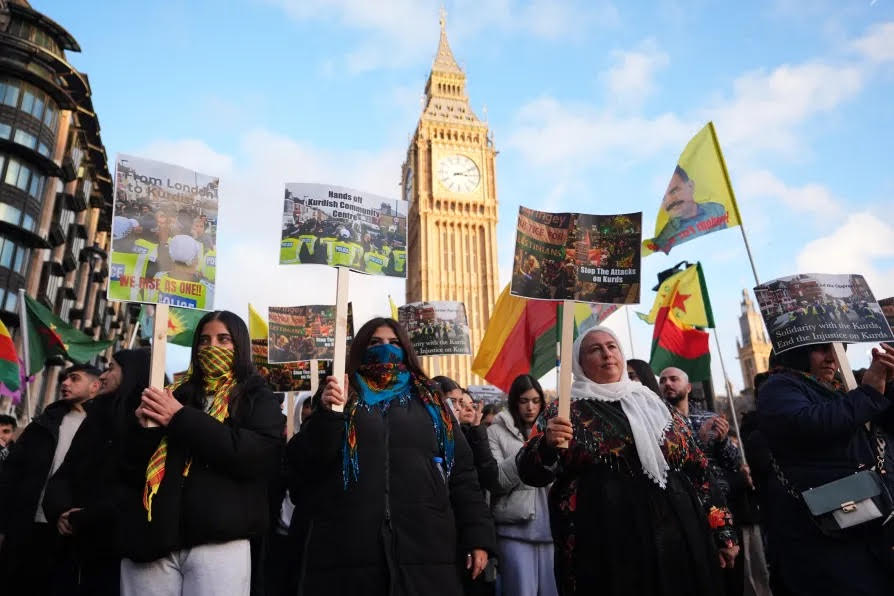
I can only perform stoicism to a limited extent in what has often felt like inescapable moments of great challenge. I write from London as one of six Kurds who were on trial between January 2026 – May 2026 for allegations of membership and support of the Kurdistan Workers’ Party (PKK), which has been proscribed in the United Kingdom since 2001.
On November 27th, 2024, our homes and the Kurdish Community Centre in North London were simultaneously raided by armed police in a dawn operation. I, and fellow co-defendants, were jumped in our sleep and handcuffed by balaclava-clad officers. We were formally arrested and sent off to what would become a two-week solitary confinement experience. I forgo detailing the degree of trauma inflicted on our families, including young children, who witnessed the state’s crackdown on Kurdish political activism. I also forgo detailing the short-lived experience of being sent to a British prison for a few days, while awaiting bail, for it is perhaps the peak of my carceral trauma, where time was suspended, hope had diminished, and my body had fully deteriorated. Perhaps someday, I will revisit those particular moments.
I have lost memory of most of the time we were in solitary confinement at the police station, albeit many of those hours, in my case, were relentless cries expressing rage, anger, injustice, loneliness, rebellion - in material forms. The personal had become political, and vice versa.
In solitary, I often found myself thinking less about politics than about the people I had hurt throughout years of struggling with my mental health. The isolation began to feel like punishment I was meant to endure. I struggled to fully politicise and give meaning to the carceral experience, except for those days we collectively engaged in hunger strike, or sang Kurdish resistance songs overnight. The force of the operation had left an indescribable scar on my mind, one that continues to feel sore to this day.
After being released on bail, I returned to my Master’s studies at the London School of Economics (LSE). Back then, I had not made any friends at school and my absence for a few weeks in class had not surprised anyone in particular. Before the arrest, classmates already knew me as ‘the missing one’ because my social anxiety often kept me away from campus. I had been missing, but this time, not because of a personal choice. I, and my friends, disappeared from life.
Upon my return, as if it was the universe’s calling, we began a module called ‘Lawful Violence’; we delved into theories of violence predicated on the idea of the state as violence in organised and legitimised form. The course proposed the idea that state violence becomes legitimate simply because the state carries it out. After the first class of this module, I had confessed to my professor that only a few weeks prior, I had been in prison. Multiple times as we progressed through the module, my life - my psychological and existential reality - was being narrated through those lectures and class conversations. Words caught in my throat whenever discussions turned toward counterinsurgent violence, not knowing what would be too much to say in such a controlled, academic environment.
The distance between academic discussions of violence and the realities of those subjected to it often felt unbearable.
I’m tired of feeling that pain only becomes intelligible once translated into academic language. In the process of conveying lived experiences of violence intellectually, we often flatten ourselves into something more acceptable. Perhaps a fellow human will see themselves in me, or I shall live with such delusional optimism to get me through another day of struggle. In the end, whatever it takes to outlive violence, right?
In the last year and a half since my carceral experience, I have been engaged in internal negotiations as for where I sit between being prisoner-enough for my story to find ground in the anticolonial world, and innocent-enough that my personal-political existence is integrable with the mainstream world. It may sound bizarre to the outside reader, but the mind has its ways of gaslighting you into never feeling enough anywhere. My encounter with the collective-oriented world imaginary of the Kurdistan Freedom Movement through archival literature and community practices has conditioned an urge to always exist in symbiosis with the collective. Otherwise, what am I? I exist to the extent that I am recognised. Until then, I struggle. That is, as I see it, the pinnacle of Kurdish revolutionary subjectivity, and of anticolonial subjectivities throughout time.
A prime example of that struggle: political prisoners. The array of experiences of violence that may not come close to my individual carceral experience. I think of Kurdish political prisoners who are incarcerated for life on politically motivated “terrorism” prosecutions in Turkey, some of whom have died or fallen permanently ill on various political cycles of hunger strike in the last 40 years, to those in Iran who are, in this day and age, publicly executed. Close to home, I recall the painful moments seeing incoming news of hunger strikers for Palestine in British prisons, who were so close to death miles away from our monitored houses.
And what about those we fail to mention, or even have no knowledge of whatsoever?
We often romanticise struggle because it helps us survive the reality of what violence actually does to people. How violence yields hopelessness, lovelessness and tragedy so easily. We must acknowledge that in a system built on endless dispossession and destruction, hope and fear end up existing side by side; I certainly find myself in the epicenter of those two conditions of being. As humanity continues to witness conflict and grief so unabated, I have been awaiting a sliver of freedom. Not simply to remove the chain fixed onto my ankle, but to continue engaging in the making and re-making of a freer and better world.
Note: Following a 4-month trial with over 50 sitting days in court, three of six defendants, including myself, were acquitted unanimously by the jury of membership of a proscribed organisation. The jury did not reach verdicts on 12 further charges.
On 5th June 2026, the UK Crown Prosecution Service (CPS) formally dropped remaining charges against myself and one other defendant in court, while a retrial date for three defendants has been set for January 2028.