

Israeli settlers are both occupying and showing commitment to orientalist visions that helped colonize Palestine.
An Israeli settler is posting videos from the Galilee. In them, Ayala Ben Baruch bakes bread on a taboon, picks olives, wears embroidered dresses. In the background, familiar folk music plays, familiar in melody and rhythm, yet the words are foreign. These carefully crafted videos sell an image: that Israeli settlers can be indigenous. She performs this by tending to olive trees that preceded her arrival in Palestine by generations, by wearing dresses stitched in inspired patterns that belong to villages her state destroyed, and by playing songs copied and stolen in style and rhythm from Palestinian folklore that generations composed and carried.
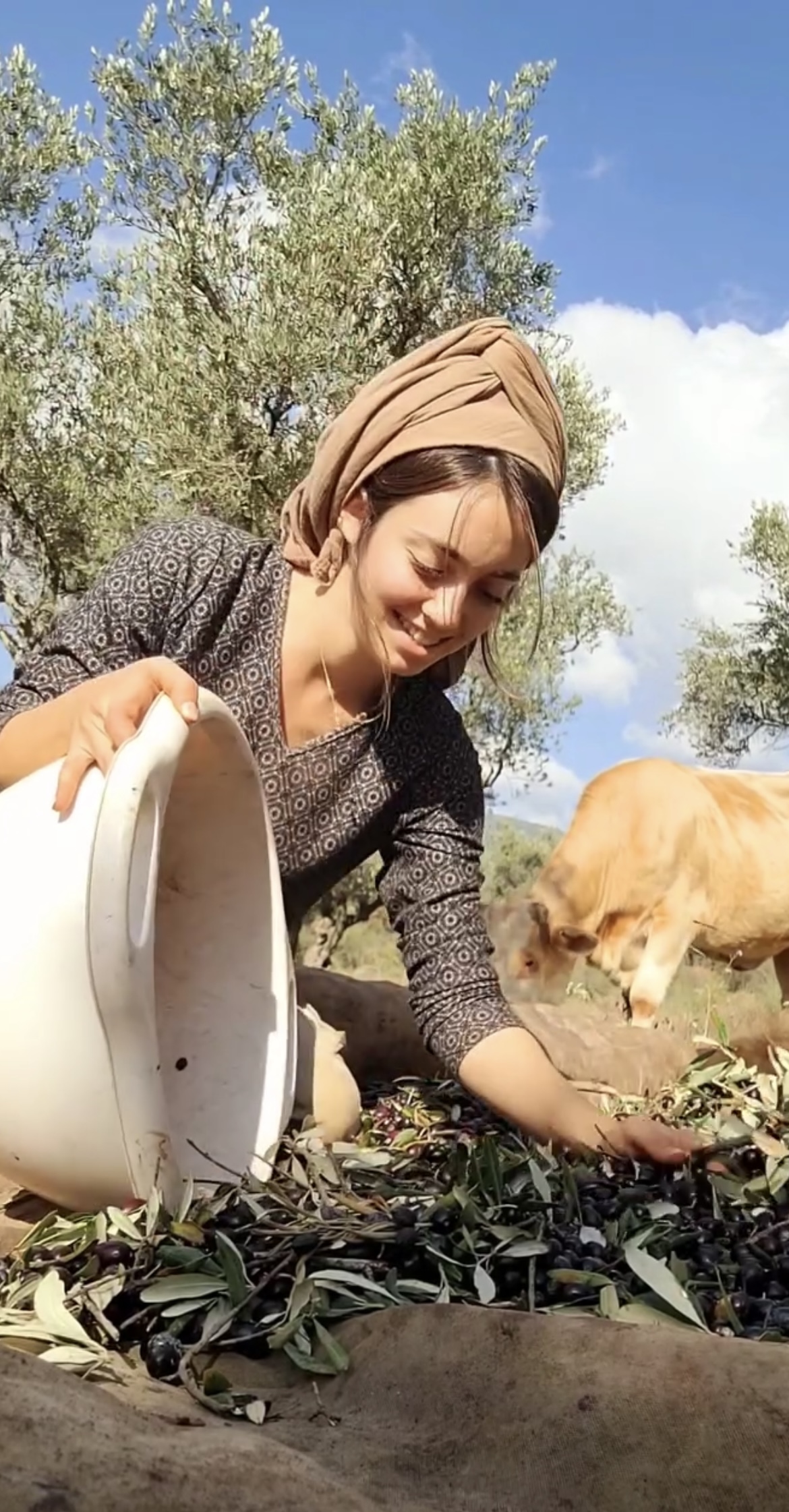
In her bio, she links leading to a fundraising page for Geffen Ri Farm, a settlement outpost in the West Bank. The outpost was established only recently in 2025. The fundraising page names nearby Palestinian villages - Tura, Halhul, Sa’ir, and Khoza’a - not as neighbours, but as threats; mentioning in her recent video, the narrative that this settlement has been created with all the hardships from hostile neighbors. Calling out for donations to perimeter paths and surveillance systems and water infrastructure. Help us, they say, to strengthen one of the most critical areas between Hebron and Jerusalem. The pastoral is a pitch.
.jpg)
This isn’t simply appropriation, it’s replacement: a digital performance of indigeneity designed to erase the people who actually live it.
Orientalism and Digital Colonialism
These ‘acts of indigeneity’ depend on constructed categories - like ‘Israeli Bedouin life’ - that collapse the distinction between colonizer and Indigenous people. Adopting this image gives them a chance to be both occupier and native simultaneously. This fantasy has precedent. It did not emerge from nowhere; constructed through images long before any settlement began. To understand how, we must look at how the West learned to see Palestine. Orientalism, as Edward Said argued, was never about the Orient but what the West needed it to be. European photographers produced Palestine as a biblical landscape, a vision, for Western audiences; timeless figures frozen in an ancient world viewers could romanticize and dismiss.
What operates here exceeds cultural appropriation; it is not theft in the conventional sense, because theft implies something taken and held elsewhere. Through figures like Ayala and countless others, symbols are dressed as acts of indigeneity. The present does not expel the past; it simply is, and the past recedes as if by nature rather than force. It goes beyond appropriation into something more active: the colonizer not just stealing cultural elements but inhabiting the colonized identity. By doing so, they take the narrative space with it as well. Settling in the cultural territory online the way they settle the physical territory. The algorithm becomes another frontier, and “content” becomes another form of claim-making.
Colonizing Evolutionary folklore
One of the songs in Ayala’s videos - אני לדודי - is actually a reworking of a Palestinian song Shmaali, a Tarweedeh. And here’s the thing about Tarweedeh: Palestinian women composed Tarweedeh and passed them down through generations as acts of preservation and resistance. They would sing it to their imprisoned menfolk to convey revolutionary messages of upcoming freedom and liberation. Carrying coded messages to political prisoners-hostages, one told them: tonight you escape. A promise of breaking free from the regime that now uses its counterfeit, the Israeli version, to collect donations for settlements on the land of those prisoners. Tarweedeh, by the time it reached her video, had been displaced twice. Now playing under footage of a woman who has never seen the inside of an Israeli prison, harvesting from trees her state stole. The Tarwedah code has been decontextualized here, violently so.
What Resists
As a Palestinian watching a settler perform acts of indigeneity inspired by my ancestors’ ways of living, even today’s farmers in the villages, I know this: Indigenous culture is lived, it is rooted, it resists. Palestinian farmers carry culture as action: as opposition to colonization, as a practice that refuses to be emptied or aestheticized. Colonizers might understand the surface: the dress, the song, the rhythm. But what is culture when severed from the people being driven from their land, the singers imprisoned, the farmers whose olive groves are burned for settlements, the generations being killed in genocide? What is indigeneity in the hands of those who make others disappear? And in that absence they create, the culture resists them back.
Palestinians on the other hand are actively countering this erasure. The Palestinian Museum Digital Archive has digitized in the time of writing this, 369,522 items including photographs, documents, audio recordings, films–from endangered collections across Palestine, Lebanon, and Jordan, making them accessible online in a massive effort to preserve what Israel seeks to destroy or confiscate. In Amman, the Tiraz Centre houses the world’s largest collection of Palestinian, Jordanian, and Arab traditional dresses. with over 2,000 costumes and weavings from the 19th and 20th centuries. The Widad Kawar Collection preserves the embroidery patterns that settlers like Ayala mimic without understanding, documenting the precise village origins and stitching techniques that carry entire histories in their threads.
Women singers are keeping Tarweedeh alive. The late Rim Banna dedicated her life to reviving Palestinian folk songs on the verge of being forgotten, reintroducing Ya Taali’een ‘ala el-Jabal in 1993, dedicating it to Palestinian political prisoners-hostages. Sanaa Moussa, raised in Deir Al-Asad in the Galilee, spent years doing fieldwork with women documenting oral histories and recording elders singing the original Tarweedeh for her album Ishraq Reminiscence. Dana Salah’s 2023 song “Ya Tal3een” became a global soundtrack to Palestinian protests after she incorporated the Tarweedeh Al-Shamali into her music, encoding the letter “L” in the song’s title as homage to the coded messages Palestinian women once sang to prisoners-hostages.
This is what refusing erasure looks like in practice, in the ordinary persistence of being. Indigenous solidarity across continents proves it. Archives document it. Women sing it. Farmers plant it. The project of replacement is incomplete because Palestinians and their allies who recognize the colonial pattern refuse to disappear or be silenced.
The settler can wear the dress. She cannot make it hers. The song can play over her video. It still belongs to the women who sang it to prisoners. The trees can appear in her frame. They remember who planted them.
This is a theft of existence. But existence, as it turns out, is harder to steal than land. And tonight, you escape.
Shmali lali ya hawali ldira
Shmali lali ya werillo
ʿa lali lal-buwab hololom tiftaḥ
Shmali lali ya rawillo
Northern blows the wind of home, northern
To those whose doors open to the north
And tonight I will send [a message] with the northern wind
It will reach and search for the loved ones