
Digital & Print Membership
Yearly + Receive 8 free printed back issues
$420 Annually
Monthly + Receive 3 free printed back issues
$40 Monthly
Engineering for Genocide at MIT
Two years into the genocide in Gaza, universities across the United States are still exposing their role as collaborators in state violence. Among the most complicit is the Massachusetts Institute of Technology (MIT). As documented in the 83 page report MIT Science for Genocide, MIT aids and abets genocide in Gaza through its engagements with the Israeli military and its arms suppliers. At least $3.7 million have flowed into MIT through these channels, and MIT corporate partners include the Israeli state-owned weapons giant Israel Aerospace Industries (IAI).

The MIT community and global public have challenged MIT on its complicity, notching victories over the Institute’s ties to Israeli arms makers and forcing MIT professors to cancel Israeli military grants. These efforts build on our history and broad popular support. But our work is not finished.
We call on people of conscience everywhere to challenge MIT over its unethical research. Click here to send an email to MIT officials or grab the copy from here.
IMOD AND GENOCIDAL APPLICATIONS
The Israeli government enters the MIT research funding structure through the Institute’s historic war nexus. From 2017 to 2021, 60% of MIT revenue came from the federal government, and 17.4% came from the now re-named Department of War. The department provides Israel with billions of US tax dollars in the form of yearly Foreign Military Financing grants. The Israeli Ministry of Defense (IMOD) then uses these funds to sponsor laboratory research at MIT of interest to its affiliates and their military objectives. MIT has accepted some $3.7 million through this channel since 2015. According to MIT audit files, the connection extends back to 2008 at least, and MIT approves the contracts on an ongoing basis. In a July 2025 report to the UN Human Rights Council, UN Special Rapporteur Francesca Albanese named MIT a “sustaining Israel’s settler-colonial project” through its IDF-funded research.
**What kind of research does the Israeli military sponsor? **One example is Daniela Rus, director of MIT’s Computer Science and AI laboratory. She led a recent project “Coreset Compression Algorithms,” which received $425,000 in direct sponsorship from the Israeli government since 2021, according to MIT’s annual reports tracking the flow of external funds into MIT. Rus’ research program develops AI algorithms for applications like “city-scale observation systems” and “surveillance and vigilance”. The goal is to teach drones to track and pursue targets with increased autonomy.
Another example is Christopher Voigt’s lab in the MIT department of Biological Engineering. Voigt programs “sentinel bacteria” to respond to human DNA sequences. The Israeli Ministry of Defense funds his lab and provides soil samples for testing. In another of Voigt’s papers, sentinel bacteria are “used to detect diverse signals in the environment,” including landmine detection. Between two grants labeled “Field-Capable Bacterial Biosensors” and “Effects of Oxidizing Environments on Carbon-Based Materials”, Voigt has taken over $850,000 in IMOD-sponsored contracts. This technology (if it ever works) is poised to enable the Israeli military to clear land for settlements or invade ‘hostile territory’.
MIT’S PARTNERSHIPS WITH MERCHANTS OF DEATH
Firms that sell and transport weapons to Israel also recruit from MIT and enter institutional collaborations with the university – Lockheed Martin, Maersk, Boeing, BAE Systems, Northrop Grumman, Caterpillar, General Dynamics, and L3Harris. One firm, Liquid AI, co-founded by an MIT professor sponsored by the Israeli military, attempts to build autonomous fighter jets. Together, these firms recruit MIT researchers into genocidal activity and bias scientific research agendas toward belligerent instead of life-affirming applications.
MIT also goes beyond ordinary corporate relations to pursue institutional commitments with the Israeli arms industry itself. An egregious example is Israel Aerospace Industries (IAI), **a corporation owned wholly by the Israeli government. IAI makes weapons used in the Gaza genocide. **According to the CEO, their Heron drone has played “a pivotal role” in the war on Gaza. The state-owned company also makes the Harop suicide drone, used to bomb refugee tents, as well as autonomous armored bulldozers. In the past two years, IAI missile systems have bombed Syria, Lebanon, Yemen, and Iran.
After October 2023, MIT began a new institutional engagement with IAI through its CSAIL Alliances and Quantum Science and Engineering Consortium (QSEC). In June 2025, as the Israeli government starved Gaza, MIT welcomed IAI executives to campus in order to deepen institutional collaboration in quantum computing and artificial intelligence. Guests included IAI North America’s CTO, CEOs, and an Israeli missile factory director. These partnerships give IAI access to MIT scientists, influence on research projects, and a recruitment pipeline.
ENDING TIES TO ELBIT SYSTEMS
**Our movement has made some progress against companies at MIT. **Elbit Systems, for instance, is one of Israel’s largest weapons manufacturers, supplying an estimated 85% of Israel’s drone arsenal. It is also a central provider of white phosphorus, cluster munitions, and flechette projectiles to Israel. We know Elbit Hermes 450 drones were used in the 2024 World Central Kitchen massacre in Gaza. Elbit also abets oppressive regimes globally, selling weapons to assist the Azerbaijani occupation of Nagorno Karabakh, as well as the Indian occupation of Kashmir and Bastar.
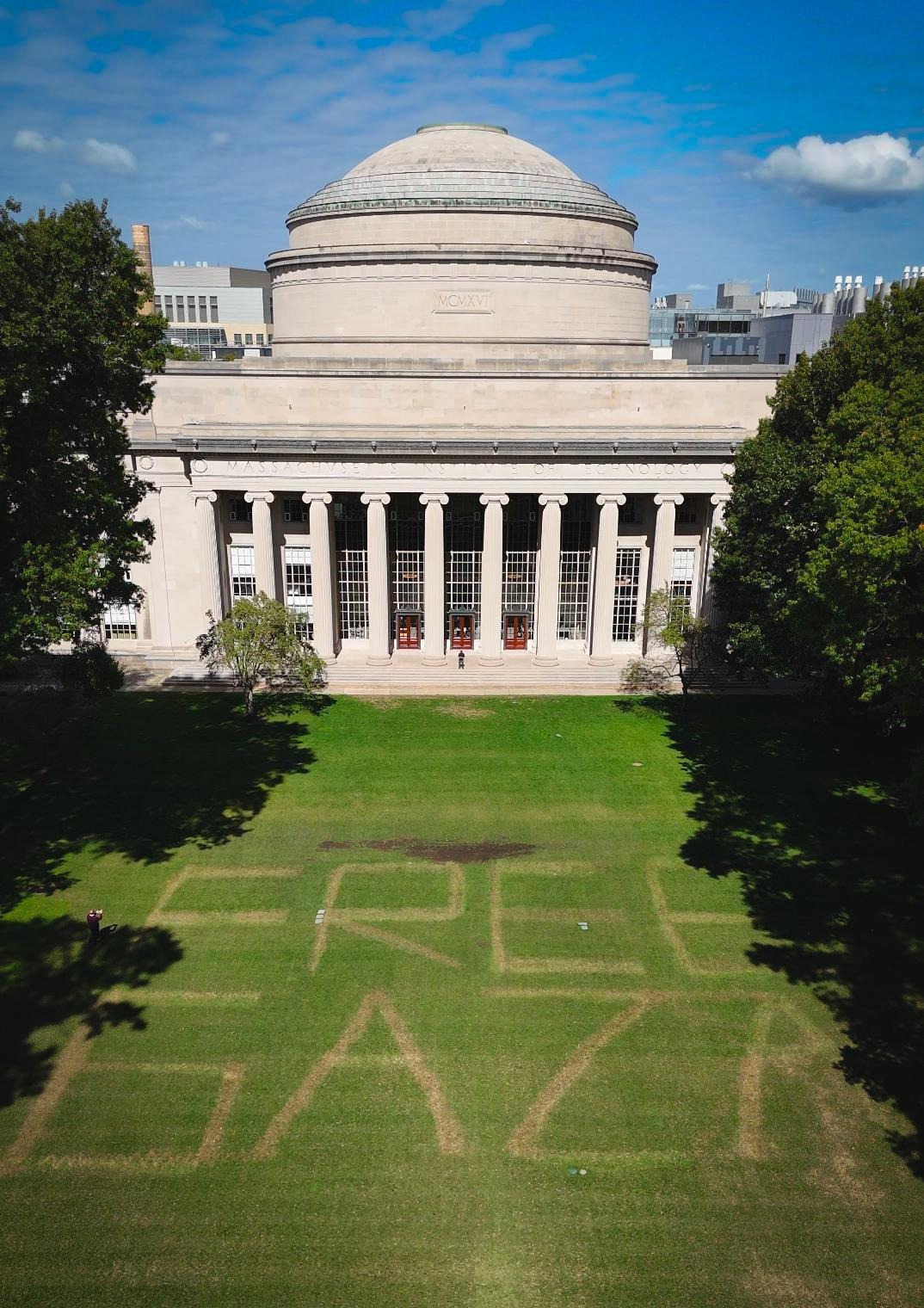
Despite its direct, material support for human rights abuses, Elbit was a member of the MIT Industrial Liaison Program (ILP) from 2017 until late 2024. Through this program, Elbit monitored MIT research developments, advised on research sponsorship and technology licensing opportunities, and linked with MIT-connected startups. In 2021, Elbit Systems and Elbit’s medical subsidiary KMC announced a new “innovation center” in Cambridge that hoped to recruit MIT and Harvard graduates into the company.
**Through an organized pressure campaign, this did not come to fruition. **In August 2024, following protests from Boston-area community activists in BDS Boston, Elbit Systems vacated its Cambridge office. Then BDS Boston and MIT activists turned attention to MIT’s Industrial Liaison Program. In spring 2025, MIT and BDSB announced that the ILP program had ended its engagement with Elbit Systems after global pressure. We need a similar campaign to succeed in ending MIT’s ties with IAI.

DIVESTMENT IS TRIED AND TESTED
The wins against Elbit highlight that although divestment is sometimes framed as a political taboo, it has a long history at MIT. The school’s Fluid Mechanics Laboratory shifted to civilian research and funding in 1966 under pressure from the anti-war movement. In May 1970, MIT activists pushed the Institute to acknowledge atrocities committed by US forces in Vietnam and divest its Draper Laboratory, which worked on guidance systems for the Poseidon missile. MIT also ended a Taiwan Program in 1976 following concerns over ballistic missile proliferation. In the 1980s American student movements, including the original MIT Coalition Against Apartheid, led divestment campaigns against South African apartheid.
The MIT Coalition for Palestine builds on this legacy as well as a recent history of divestment. In 2007, MIT declared the Darfur Genocide “abhorrent” and pledged to divest its endowment. The MIT Energy Initiative cut ties with Saudi Aramco in 2021 following the state murder of a Saudi journalist. In 2022, MIT ended its Skoltech collaborations in Russia following the invasion of Ukraine. Following mass protests in solidarity with Palestine, Lockheed Martin left a program managed by MISTI-Israel and chose to not renew it. An MIT professor recently cancelled an Israeli military grant after student pressure.
When invoking our past, MIT activists draw on a wellspring of moral tradition. As MIT students in 1937 wrote in a petition against the Institute sending a delegate to the Nazi festival in Göttingen, MIT’s participation would “condone the acts and practices of the forces now controlling Germany”. Similarly, MIT’s contracts with the Israeli military condone the acts and practices of Israeli forces. Academic freedom does not protect such ties. As the anti-war student leader Ira Rubenzahl told our student newspaper in 1969 during the Vietnam War: “One doesn’t have the right to build gas chambers to kill people.”
CONCEALMENT AND CALL TO ACTION
In defiance of the mandate handed to them by the public, MIT officials conceal and misdirect over the institution’s complicity. In summer 2025, MIT revoked access to tools for the MIT community to understand its research funding sources, such as the annual Brown Books, which track the flow of external funds into MIT. It also barred us from using the university’s Kuali Coeus grant-tracking website, which MIT researchers use to better understand our external grants. They have further engaged in a campaign of persecution against student activists, as detailed by a May 2025 letter of UN rapporteurs to the MIT President.
**MIT’s actions are antithetical to the Institute’s supposed motto “Mind and Hand” for the “betterment of humankind.” **Instead, MIT’s minds and hands are engineering for genocide — a damning moral stain on the Institute. Majorities of MIT students demand that the Institute cut ties with the Israeli military, as confirmed by three separate campus votes in 2024 and 2025 as well as our Scientists Against Genocide encampment in spring 2024.
We call on people of conscience to challenge MIT to end its unethical science.
Send an email here to MIT officials or grab the copy from here.
{
"article":
{
"title" : "Engineering for Genocide at MIT",
"author" : "MIT Coalition for Palestine",
"category" : "essays",
"url" : "https://everythingispolitical.com/readings/engineering-for-genocide-at-mit",
"date" : "2025-11-25 11:30:00 -0500",
"img" : "https://everythingispolitical.com/uploads/Cover.jpg",
"excerpt" : "Two years into the genocide in Gaza, universities across the United States are still exposing their role as collaborators in state violence. Among the most complicit is the Massachusetts Institute of Technology (MIT). As documented in the 83 page report MIT Science for Genocide, MIT aids and abets genocide in Gaza through its engagements with the Israeli military and its arms suppliers. At least $3.7 million have flowed into MIT through these channels, and MIT corporate partners include the Israeli state-owned weapons giant Israel Aerospace Industries (IAI).",
"content" : "Two years into the genocide in Gaza, universities across the United States are still exposing their role as collaborators in state violence. Among the most complicit is the Massachusetts Institute of Technology (MIT). As documented in the 83 page report MIT Science for Genocide, MIT aids and abets genocide in Gaza through its engagements with the Israeli military and its arms suppliers. At least $3.7 million have flowed into MIT through these channels, and MIT corporate partners include the Israeli state-owned weapons giant Israel Aerospace Industries (IAI).The MIT community and global public have challenged MIT on its complicity, notching victories over the Institute’s ties to Israeli arms makers and forcing MIT professors to cancel Israeli military grants. These efforts build on our history and broad popular support. But our work is not finished.We call on people of conscience everywhere to challenge MIT over its unethical research. Click here to send an email to MIT officials or grab the copy from here.IMOD AND GENOCIDAL APPLICATIONSThe Israeli government enters the MIT research funding structure through the Institute’s historic war nexus. From 2017 to 2021, 60% of MIT revenue came from the federal government, and 17.4% came from the now re-named Department of War. The department provides Israel with billions of US tax dollars in the form of yearly Foreign Military Financing grants. The Israeli Ministry of Defense (IMOD) then uses these funds to sponsor laboratory research at MIT of interest to its affiliates and their military objectives. MIT has accepted some $3.7 million through this channel since 2015. According to MIT audit files, the connection extends back to 2008 at least, and MIT approves the contracts on an ongoing basis. In a July 2025 report to the UN Human Rights Council, UN Special Rapporteur Francesca Albanese named MIT a “sustaining Israel’s settler-colonial project” through its IDF-funded research.**What kind of research does the Israeli military sponsor? **One example is Daniela Rus, director of MIT’s Computer Science and AI laboratory. She led a recent project “Coreset Compression Algorithms,” which received $425,000 in direct sponsorship from the Israeli government since 2021, according to MIT’s annual reports tracking the flow of external funds into MIT. Rus’ research program develops AI algorithms for applications like “city-scale observation systems” and “surveillance and vigilance”. The goal is to teach drones to track and pursue targets with increased autonomy.Another example is Christopher Voigt’s lab in the MIT department of Biological Engineering. Voigt programs “sentinel bacteria” to respond to human DNA sequences. The Israeli Ministry of Defense funds his lab and provides soil samples for testing. In another of Voigt’s papers, sentinel bacteria are “used to detect diverse signals in the environment,” including landmine detection. Between two grants labeled “Field-Capable Bacterial Biosensors” and “Effects of Oxidizing Environments on Carbon-Based Materials”, Voigt has taken over $850,000 in IMOD-sponsored contracts. This technology (if it ever works) is poised to enable the Israeli military to clear land for settlements or invade ‘hostile territory’.MIT’S PARTNERSHIPS WITH MERCHANTS OF DEATHFirms that sell and transport weapons to Israel also recruit from MIT and enter institutional collaborations with the university – Lockheed Martin, Maersk, Boeing, BAE Systems, Northrop Grumman, Caterpillar, General Dynamics, and L3Harris. One firm, Liquid AI, co-founded by an MIT professor sponsored by the Israeli military, attempts to build autonomous fighter jets. Together, these firms recruit MIT researchers into genocidal activity and bias scientific research agendas toward belligerent instead of life-affirming applications.MIT also goes beyond ordinary corporate relations to pursue institutional commitments with the Israeli arms industry itself. An egregious example is Israel Aerospace Industries (IAI), **a corporation owned wholly by the Israeli government. IAI makes weapons used in the Gaza genocide. **According to the CEO, their Heron drone has played “a pivotal role” in the war on Gaza. The state-owned company also makes the Harop suicide drone, used to bomb refugee tents, as well as autonomous armored bulldozers. In the past two years, IAI missile systems have bombed Syria, Lebanon, Yemen, and Iran.After October 2023, MIT began a new institutional engagement with IAI through its CSAIL Alliances and Quantum Science and Engineering Consortium (QSEC). In June 2025, as the Israeli government starved Gaza, MIT welcomed IAI executives to campus in order to deepen institutional collaboration in quantum computing and artificial intelligence. Guests included IAI North America’s CTO, CEOs, and an Israeli missile factory director. These partnerships give IAI access to MIT scientists, influence on research projects, and a recruitment pipeline.ENDING TIES TO ELBIT SYSTEMS**Our movement has made some progress against companies at MIT. **Elbit Systems, for instance, is one of Israel’s largest weapons manufacturers, supplying an estimated 85% of Israel’s drone arsenal. It is also a central provider of white phosphorus, cluster munitions, and flechette projectiles to Israel. We know Elbit Hermes 450 drones were used in the 2024 World Central Kitchen massacre in Gaza. Elbit also abets oppressive regimes globally, selling weapons to assist the Azerbaijani occupation of Nagorno Karabakh, as well as the Indian occupation of Kashmir and Bastar.Despite its direct, material support for human rights abuses, Elbit was a member of the MIT Industrial Liaison Program (ILP) from 2017 until late 2024. Through this program, Elbit monitored MIT research developments, advised on research sponsorship and technology licensing opportunities, and linked with MIT-connected startups. In 2021, Elbit Systems and Elbit’s medical subsidiary KMC announced a new “innovation center” in Cambridge that hoped to recruit MIT and Harvard graduates into the company.**Through an organized pressure campaign, this did not come to fruition. **In August 2024, following protests from Boston-area community activists in BDS Boston, Elbit Systems vacated its Cambridge office. Then BDS Boston and MIT activists turned attention to MIT’s Industrial Liaison Program. In spring 2025, MIT and BDSB announced that the ILP program had ended its engagement with Elbit Systems after global pressure. We need a similar campaign to succeed in ending MIT’s ties with IAI.DIVESTMENT IS TRIED AND TESTEDThe wins against Elbit highlight that although divestment is sometimes framed as a political taboo, it has a long history at MIT. The school’s Fluid Mechanics Laboratory shifted to civilian research and funding in 1966 under pressure from the anti-war movement. In May 1970, MIT activists pushed the Institute to acknowledge atrocities committed by US forces in Vietnam and divest its Draper Laboratory, which worked on guidance systems for the Poseidon missile. MIT also ended a Taiwan Program in 1976 following concerns over ballistic missile proliferation. In the 1980s American student movements, including the original MIT Coalition Against Apartheid, led divestment campaigns against South African apartheid.The MIT Coalition for Palestine builds on this legacy as well as a recent history of divestment. In 2007, MIT declared the Darfur Genocide “abhorrent” and pledged to divest its endowment. The MIT Energy Initiative cut ties with Saudi Aramco in 2021 following the state murder of a Saudi journalist. In 2022, MIT ended its Skoltech collaborations in Russia following the invasion of Ukraine. Following mass protests in solidarity with Palestine, Lockheed Martin left a program managed by MISTI-Israel and chose to not renew it. An MIT professor recently cancelled an Israeli military grant after student pressure.When invoking our past, MIT activists draw on a wellspring of moral tradition. As MIT students in 1937 wrote in a petition against the Institute sending a delegate to the Nazi festival in Göttingen, MIT’s participation would “condone the acts and practices of the forces now controlling Germany”. Similarly, MIT’s contracts with the Israeli military condone the acts and practices of Israeli forces. Academic freedom does not protect such ties. As the anti-war student leader Ira Rubenzahl told our student newspaper in 1969 during the Vietnam War: “One doesn’t have the right to build gas chambers to kill people.”CONCEALMENT AND CALL TO ACTIONIn defiance of the mandate handed to them by the public, MIT officials conceal and misdirect over the institution’s complicity. In summer 2025, MIT revoked access to tools for the MIT community to understand its research funding sources, such as the annual Brown Books, which track the flow of external funds into MIT. It also barred us from using the university’s Kuali Coeus grant-tracking website, which MIT researchers use to better understand our external grants. They have further engaged in a campaign of persecution against student activists, as detailed by a May 2025 letter of UN rapporteurs to the MIT President.**MIT’s actions are antithetical to the Institute’s supposed motto “Mind and Hand” for the “betterment of humankind.” **Instead, MIT’s minds and hands are engineering for genocide — a damning moral stain on the Institute. Majorities of MIT students demand that the Institute cut ties with the Israeli military, as confirmed by three separate campus votes in 2024 and 2025 as well as our Scientists Against Genocide encampment in spring 2024.We call on people of conscience to challenge MIT to end its unethical science.Send an email here to MIT officials or grab the copy from here."
}
,
"relatedposts": [
{
"title" : "Mamdani & The Era of Possibilities",
"author" : "Collis Browne, Céline Semaan, EIP Editors",
"category" : "essays",
"url" : "https://everythingispolitical.com/readings/mamdani-and-the-era-of-possibilities",
"date" : "2026-01-01 12:25:00 -0500",
"img" : "https://everythingispolitical.com/uploads/zohran-inauguration-1.jpg",
"excerpt" : " What wins elections? Laser focus on challenging the brutal economic oppression that defines our global reality.",
"content" : " What wins elections? Laser focus on challenging the brutal economic oppression that defines our global reality.There is an air of undeniable hope. No matter how hard the knee-jerk catastrophic thinking might try to override with doubt, the moment is hopeful. This is proof of collective power. No matter what comes of it, we are already in a winning moment, because the people of New York city have toppled a dynasty built on greed and corruption. The entire world was inspired by this moment that was made possible by everyday people rallying together. That is how monopoly gets interrupted by people power. It’s not rocket science or AI, it’s sweat, effort, and in person collaboration.Let’s remember why this landslide engagement across political divides, why this excitement from communities and demographics who have never voted, and why this worldwide inspiration from a local election: it is a direct response to Mamdani’s laser focus on challenging the brutal economic oppression that defines our global reality.That is what wins elections; that is what inspires and unites the majority across age, ethnicity, race, and all other factors. Speaking the truth of the crushing economic reality that we live under.So now, resist the urge to follow the media’s double edge sword to fetishize and make individualized mythologies around Mamdani, his wife, the personal and aesthetic choices they are making. But continue to see them simply as people, continue to join forces with them and to remain educated, informed and most importantly not in silo but in community. Realize that we need thousands more like him who have decided that they can make a better mayor than these corrupt relics of the antiquated self-destructive past, and we need millions to always raise them up against those colluding with oligarchic corruption. And when the inevitable “fall from grace” comes, when the “media darling” moment wants to swing the other way and vilify him, resist the urge to jump on and make him any more important than but one human who wanted to make a difference in a dehumanizing system — focus on the system.Resist the urge to join in a culture war, to focus on religion or lifestyle or taste or how we spend our time as non-billionaires, and remain focused on what we can all be doing daily to gather power away from the centers of wealth and exploitation.Resist the urge to isolate in ideals, instead join the messy moment of change by being an active participant in the political spaces you wish existed.The moment calls for more action. This year, 2026, begins a new cycle filled with possibilities and people power. The moment is you. It is now. Continue to be present, be active, and take your place in making the future possible. Being an active part of your world is the antidote to the overwhelming feeling of disempowerment. The ways in which we rise, is through verbs and action. Excited to build with you all internationally and locally here in New York City. Our city."
}
,
{
"title" : "Narrative Sovereignty in the American Wing of The Met: Don't Miss ENCODED at the MET",
"author" : "",
"category" : "",
"url" : "https://everythingispolitical.com/readings/narrative-sovereignty-in-the-american-wing-of-the-met",
"date" : "2025-12-22 12:58:00 -0500",
"img" : "https://everythingispolitical.com/uploads/Cover_EIP_Hidden_Exhibition.jpg",
"excerpt" : "As artists and multicultural activists, we did not come to the Metropolitan Museum of Art’s American Wing seeking permission, instead we showed up to the work with intention, responsibility, and a commitment to truth. ENCODED: Change the Story, Change the Future exists because silence is not neutral, presence without agency is insufficient and solidarity across values-based creativity is essential for liberation.",
"content" : "As artists and multicultural activists, we did not come to the Metropolitan Museum of Art’s American Wing seeking permission, instead we showed up to the work with intention, responsibility, and a commitment to truth. ENCODED: Change the Story, Change the Future exists because silence is not neutral, presence without agency is insufficient and solidarity across values-based creativity is essential for liberation.The American Wing is often described as a celebration of American art, yet it also functions as a carefully curated archive of colonial mythology and westward expansion propaganda. Its paintings and sculptures rehearse familiar narratives: conquest framed as destiny, extraction framed as progress, whiteness framed as purity, Indigenous absence framed as inevitability. These works are not merely historical artifacts; they are instruments of narrative power. They encode ideas about belonging, legitimacy, and nationhood, ideas that continue to shape cultural consciousness and public policy today. ENCODED intervenes in this institutional space not to negate history, but to complicate it. Using augmented reality, the exhibition overlays Indigenous artistic expression and counter-narratives directly onto famous works in the American Wing, reframing them through Indigenous epistemologies, lived experience, and historical truth. This is not an act of erasure. It is an act of expansion and an overt insistence that American art history is incomplete without Indigenous voice, presence, and critique.At its core, ENCODED is grounded in the principle of narrative sovereignty. Narrative sovereignty asserts that communities most impacted by historical and ongoing harm such as Indigenous peoples, Afro-descendant people, Palestinians, Pacific Islanders, Trans folks and the working class all must have the authority to tell their own stories, in their own words, and within the institutions that have historically excluded or misrepresented them. This is not a symbolic gesture. It is a democratic imperative.Democracy depends on access to truth. When museums present a singular, sanitized vision of history, they do not merely reflect power, they reinforce it. The American Wing has long upheld myths of “taming the West” and the so-called exhaustion of empire, narratives that obscure the violence of settler colonialism, normalize Indigenous dispossession and chattel slavery. ENCODED challenges these myths by making visible what has been omitted: resistance, survival, continuity, solidarity and accountability. For me, I also hope this intervention reflects back to museum goers and viewers the perils of authoritarianism, fascism and ongoing colonial projects such as legacy media consolidation, rapid creation of datacenters to produce AI, cutting access to healthcare, education, rights, or the current US regime’s attempt to erase history by any means necessary.The artists participating in ENCODED are not responding nostalgically to the past. They are engaging the present. Their work examines how colonial narratives persist in contemporary systems including environmental destruction justified by extraction, racial hierarchies reinforced through cultural storytelling, and institutions that benefit from the aesthetics of inclusion while resisting structural change. These are not abstract critiques; they are lived realities and for me deep lessons that have been shaped by having formerly worked at a neocolonial conservation nonprofit ran by wealthy cis wyt men and their enablers for nearly five years.Artistic integrity, in this context, cannot be separated from ethical responsibility. For too long, the art world has upheld a false binary between aesthetics and politics, suggesting that rigor diminishes when artists engage power directly. ENCODED rejects this premise. Integrity is not neutrality. Integrity is the willingness to tell the truth, even when it destabilizes comfort or prestige. Walking with integrity can be painful and takes courage.Importantly, ENCODED is not positioned as a protest staged outside the institution, nor as a request for institutional validation. It is an act of presence with agency. The project uses accessible technology to meet audiences where they are, inviting participation rather than reverence. Viewers scan QR codes and encounter layered narratives that ask them to look again, listen differently, and question inherited assumptions. Except for a few organized tours, the experience is self-guided, decentralized, and deliberately democratic. It’s also fun, and it is so special to hear the familiar sounds from the ENCODED pieces ring throughout the galleries signalling that kin is close by.This kinship network and accessibility is central to the work. Cultural literacy should not be gated by academic language, curatorial authority, white exceptionalism or economic privilege. By operating through personal devices, ENCODED rejects the museum’s traditional hierarchy of knowledge and affirms that interpretation is a shared civic space. The exhibition does not dictate conclusions; it creates conditions for reckoning and deep dialogue.Solidarity is another foundational principle of the project. ENCODED brings together Indigenous artists across nations and disciplines, in relationship with Black, Brown, and allied communities who recognize that colonialism is not a single-issue structure. The logics that dispossessed Indigenous peoples are the same logics that underwrote slavery, environmental exploitation, the seizing of Palestine, forced child mining labor of cobalt in Congo and in general global empire. Working in solidarity does not collapse difference; it honors specificity while resisting division and acknowledging historic patterns of systemic oppression.In a cultural landscape shaped by scarcity and competition, ENCODED models an alternative, one rooted in collective presence, shared resources, and mutual accountability. The project refuses the extractive norms of both empire and the contemporary art economy, offering instead a relational approach grounded in care, collaboration, and long-term impact on community.The decision to situate ENCODED within the American Wing was deliberate. Indigenous art has too often been confined to anthropological contexts or framed as premodern, separate from the narrative of American art. ENCODED asserts what has always been true: Indigenous peoples are not peripheral to American history; we are foundational to it. Our stories do not belong on the margins, nor do they belong solely to the past or through a white gaze.Yet presence without counter-narrative risks assimilation. ENCODED insists that visibility must be accompanied by authorship. By intervening directly within the American Wing, the project challenges the authority of colonial framing and invites institutions to reckon with their role in shaping public memory. Our hope is that eventually the Met will see this as an opportunity to engage in discussion and support its presence well into 2026.There is risk in this work. Naming colonial propaganda within revered institutions invites discomfort, defensiveness, and critique. But risk is inseparable from integrity. Artists and cultural workers are accountable not only to institutions and audiences, but to future generations. The question is not whether institutions will change, but whether artists will continue to lead with courage when they do not.ENCODED is an offering and a provocation. It asks what it means to inherit a cultural legacy and whether we are willing to transform it. Empire is not exhausted; it is contested. And art remains one of the most powerful sites of that contestation. When we change the story, we do change the future. Not through erasure, but through expansion. Not through dominance, but through relationship.Ultimately, ENCODED affirms that art is not merely a reflection of society, but a tool for shaping it and that when artists from the margins claim space at the center, together and with integrity, we open pathways toward a more honest, inclusive, and democratic cultural future. Join us.To access ENCODED review the exhibit website for instructions. While at the Met scan the QR code and click through the prompts for the self guided tour.https://www.encodedatthemet.com"
}
,
{
"title" : "The Aesthetics of Atrocity: Lockheed Martin’s Streetwear Pivot",
"author" : "Louis Pisano",
"category" : "",
"url" : "https://everythingispolitical.com/readings/the-aesthetics-of-atrocity",
"date" : "2025-12-20 10:30:00 -0500",
"img" : "https://everythingispolitical.com/uploads/Cover_EIP_Lockheed_StreetWar.jpg",
"excerpt" : "On December 12, The Business of Fashion published an article titled “The Unlikely Rise and Uncertain Future of Lockheed Martin Streetwear,” detailing the world’s largest arms manufacturer’s entrance into casual apparel.",
"content" : "On December 12, The Business of Fashion published an article titled “The Unlikely Rise and Uncertain Future of Lockheed Martin Streetwear,” detailing the world’s largest arms manufacturer’s entrance into casual apparel.Through a licensing deal with South Korea’s Doojin Yanghang Corp., Lockheed turns fighter jet graphics, corporate slogans, and its star logo into gorpcore staples. Oversized outerwear, tactical pants, and advanced synthetic fabrics sell out at Seoul pop-ups like the Hyundai department store with young Korean consumers chasing the edgy, functional vibe. Andy Koh, a Seoul-based content creator, tells BoF that while arms manufacturing is, in theory, political, he has never encountered widespread discomfort among Korean consumers. “As long as it looks cool and the product functions as expected,” he says, “they seem okay with it.”This trend aligns with a broader South Korean fashion phenomenon: licensing logos from global non-fashion brands to create popular streetwear lines. Examples include National Geographic puffers, Yale crewnecks, Kodak retro tees, CNN hoodies, Discovery jackets, Jeep outdoor wear, and university apparel from institutions like Harvard and UCLA. These licensed collections, often featuring media, academia, sports leagues, or adventure themes, have become staples on online retailers like Musinsa and in brick-and-mortar stores, propelled by K-pop influence and a tech-savvy youth market that make these odd crossovers multimillion-dollar successes.Lockheed, however, is categorically different. Its core business is not exploration, education, or journalism. It is industrialized death, and its arrival in fashion forces a reckoning with how far commodification can stretch.Having spent years in the military, maybe I’m the wrong person to critique this. Or maybe I’m exactly the right one. I know what weapons are for, how they’re used, and the human cost they carry. Lockheed manufactures F-16 and F-35 fighter jets, Hellfire missiles, and precision-guided systems that human rights organizations have repeatedly linked to civilian casualties across multiple conflicts. In Yemen, U.S.-supplied weapons incorporating Lockheed technology contributed to thousands of civilian deaths since 2015, most notoriously the 2018 airstrike on a school bus in Saada that killed dozens of children. In Gaza, since October 2023, Lockheed-supplied F-35s and munitions have formed the backbone of air operations that Amnesty International and other watchdogs have flagged for potential violations of international humanitarian law, cases now under examination by the International Court of Justice.In 2024, the company reported $71 billion in revenue, almost entirely from military contracts, with more than 1,100 F-35s already delivered worldwide and production lines running hotter than ever. That staggering scale is the reality lurking beneath a logo now casually printed on everyday apparel.So why does the planet’s largest arms manufacturer license its brand to streetwear? The answer seems to be twofold: easy money and sophisticated image laundering. Licensing delivers low-risk royalties from Korea’s reported $35-40 billion apparel market with virtually no operational headache. Lockheed simply collects checks while a third-party manufacturer handles design, production, distribution, and deals with all the mess of retail.The far more ambitious goal, however, is reputational refurbishment. Doojin deliberately markets the line around “future-oriented technical aesthetics” and “aerospace innovation,” leaning on cutting-edge fabrics to conjure high-tech futurism instead of battlefield carnage. By late 2025, as U.S. favorability in South Korea continued to slide amid trade tensions and regional geopolitical shifts, the brand quietly de-emphasized its American roots, according to Lockheed representatives. The strategy clearly tries to sever the logo from political controversy and plant it firmly in youth culture, where aesthetic appeal routinely outmuscles ethical concern.Lockheed has honed this kind of rebranding for decades. Their corporate brochures overflow with talk of “driving innovation” and “advancing scientific discovery,” spotlighting STEM scholarships, veteran hiring initiatives, and rapid-response disaster aid. The clothing itself carries the same sanitized messaging. One prominent slogan reads “Ensuring those we serve always stay ahead of ready”, euphemistic corporate-speak that sounds heroic until you remember that “those we serve” includes forces deploying Hellfire missiles against civilian targets. Other pieces feature F-35 graphics paired with copy declaring the jet “strengthens national security, enhances global partnerships, and powers economic growth”. It’s textbook PR varnish. Instruments designed for lethal efficiency, now rebranded as symbols of progress and prosperity.We’ve also seen this trick before: Fast fashion brands that slap “sustainable” labels on sweatshop products. Tech giants that fund glamorous art installations while they harvest user data. Oil companies that rebrand themselves as forward-thinking “energy” players as the Earth’s climate burns. Lockheed, though, traffics in something uniquely irreversible: export-grade death. By licensing its identity to apparel, multibillion-dollar arms contracts are reduced to mere intellectual property; civilian casualties dissolved into, simply, background static.In other words, vibes overpower victims. And when those vibes are stamped with the logo of the planet’s preeminent death merchant, resistance feels futile.Gorpcore has always drawn from military surplus for its rugged utility: endless cargo pockets, indestructible nylons, tactical silhouettes born in combat and repurposed for city streets. Brands like Arc’teryx, The North Face, and Supreme mine that heritage for authenticity and performance. After World War II, army fatigues became symbols of genuine rebellion, worn by anti-war protesters as an act of defiance against the establishment. Today, the dynamic threatens to invert entirely. The establishment itself, the world’s preeminent arms dealer, now supplies the “authentic” merchandise, turning subversion into subtle endorsement.Streetwear grew out of skate culture, hip-hop, and grassroots rebellion against mainstream norms. Importing the aesthetics of atrocity risks converting that legacy into compliance, rendering militarism the newest version of mainstream cool. For a generation immersed in filtered feeds and rapid trend cycles, Lockheed’s logo can sit comfortably beside NASA patches or National Geographic emblems, conveniently severed from the charred wreckage in Saada or the devastation in Gaza. Research on “ethical fading” demonstrates how strong visual design can mute moral alarms, a phenomenon intensified in Korea’s hyper-trendy ecosystem, where mandatory military service may further desensitize young consumers to defense branding while K-pop’s global engine drives relentless consumption.If the line proves durable, escalation feels inevitable. Palantir, another cornerstone of the defense-tech world, has already gone there, hyping limited merch drops that sell out in hours: $99 athletic shorts stamped “PLTR—TECH,” $119 nylon totes, hoodies emblazoned with CEO Alex Karp’s likeness or slogans about “dominating” threats. What’s to stop Northrop Grumman from launching its own techwear line? Or BAE Systems from dropping high-end collaborations?Lockheed already licenses merchandise worldwide through various agencies; broader international rollouts beyond Korea seem only a matter of time. Backlash is possible, boycotts from ethically minded buyers, perhaps even regulatory scrutiny as anti-militarism sentiment swells. Gorpcore’s longstanding flirtation with military aesthetics could calcify into outright fetish, obliterating whatever daylight remained between practical function and state-sanctioned propaganda.Yet, history suggests that in oversaturated markets, “cool” almost always trumps conscience. Lockheed’s streetwear pivot is a stark illustration of how fashion and culture launder raw power, enabling the machinery of war to conceal itself among hype, hoodies, and sold-out drops."
}
]
}