
It is the only way to move toward collective liberation.
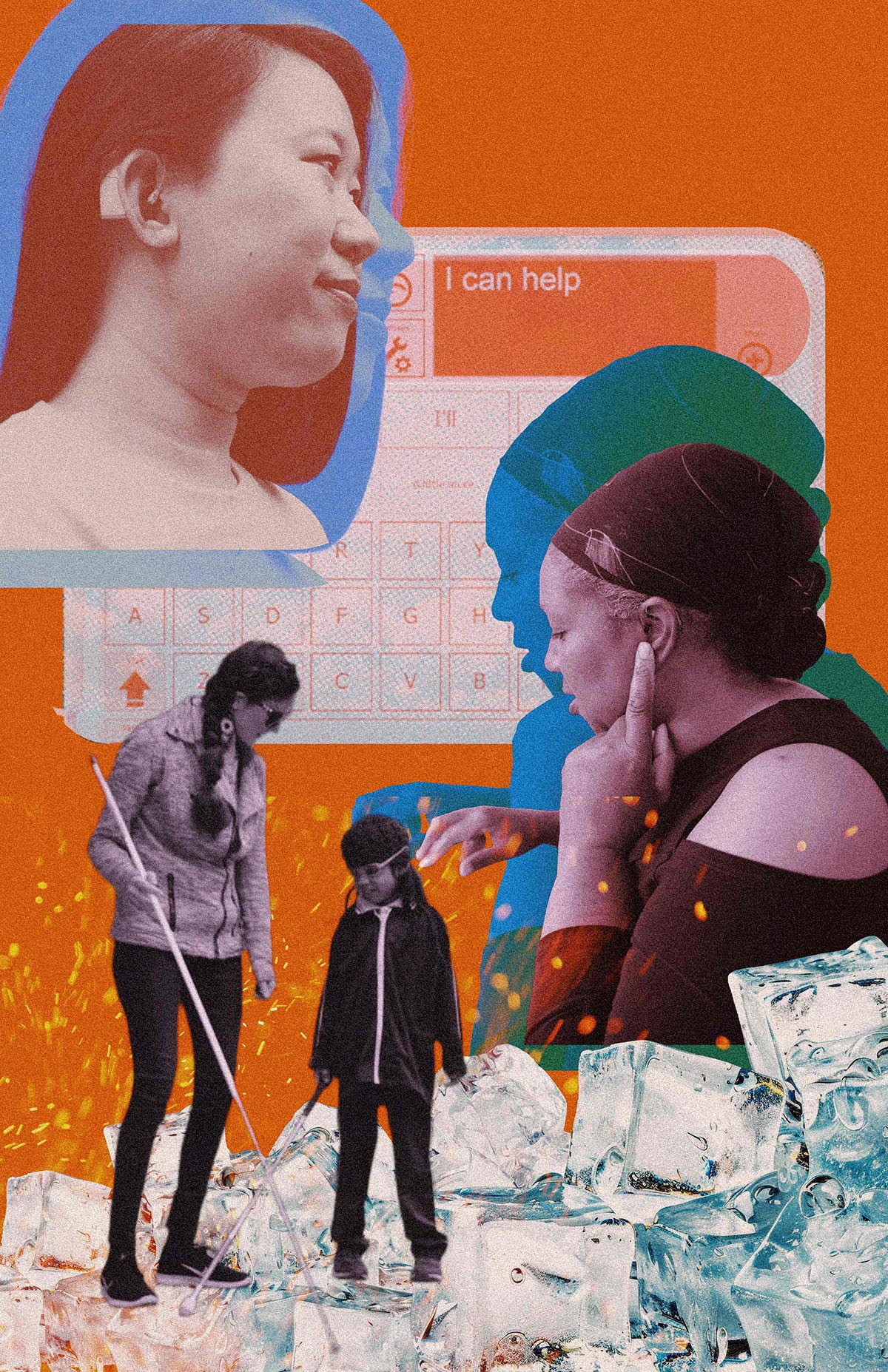
A vertical digital collage in shades of orange, teal, and blue. In the background, a semi-transparent AAC communication device displays the text “I can help.” The top left shows a woman with a hearing aid in profile. On the right, a woman in a black headscarf gestures toward her ear. At the bottom, a woman and a child stand on a bed of large, realistic ice cubes; both are using white canes for the blind. Orange sparks float across the center, and the overall style is grainy, reminiscent of a Riso-printed protest zine. Illustration Credit: Jennifer White-Johnson
The deadly surge of ICE agents in Minneapolis and across the country has wreaked havoc across communities, with particularly dangerous consequences for disabled people. In one instance on January 15, 2026, a woman in Minneapolis, Aliya Rahman, was pulled from her car and into an ICE vehicle, despite telling the ICE agents that she was on her way to a doctor’s appointment. The woman explained that she was autistic and needed accommodations, which the ICE agents readily ignored.
The reentrenchment of ableism in Trump 2.0 is everywhere. In July 2025, for example, the president issued an executive order, “Ending Crime and Disorder on America’s Streets,” which seeks to overturn decades of progress for disabled people. The “R- word,” a slur against people with cognitive disabilities and a word that so many activists fought to eliminate from our daily lexicon, is back in full force. And for many immigrants with disabilities, the cultural landscape is more treacherous than ever: since Trump’s ascent, his administration has continued to double down on a centuries-old legacy of ableism and maltreatment of disabled immigrants. Most recently, the State Department announced that it will suspend the processing of immigrant visas from 75 countries because their citizens are collectively deemed likely to become reliant on public assistance if admitted into the U.S. This not only reflects our government’s racist and xenophobic approach to immigration—it is also a clear manifestation of its contempt for disabled people, or anyone perceived as unable to produce the labor that drives American capitalism.
This is why conversations about disability must be central to the movement for immigrant justice. When we create resources and protections for the most marginalized, we move closer to liberation for all immigrant communities.
The term “no le digas a nadie” or “do not tell anyone” is a phrase many immigrants know and take to heart. It speaks to the fear that, if you tell the wrong person, your life and your family’s can be turned upside down. This is felt tenfold by disabled immigrants: Today, an estimated 1 in 4 Americans has a disability. With over 15.2 million immigrants in the United States, a large portion may have disabilities, even if they do not identify as having one. Disability is often stigmatized, leading people to hide their conditions or have less access to information and services. Disability is also the only minority group that anyone can join at any time, whether from birth, through chronic illness, or accident. What’s more, many people become disabled as they travel long distances to cross borders. The immigration system itself creates disability in the violence of enforcement and the terrible conditions of immigrant detention.
As a formerly undocumented blind educator and a blind law professor who has spent the past 15 years advocating for immigrant and disability justice, we understand firsthand the added layer that comes with being disabled, in addition to being a target of immigration enforcement. One of us (Conchita) remembers feeling anxious to go outside while growing up undocumented, for fear of having any type of encounter with law enforcement. She and her family were terrified of disclosing any information to the wrong person who might report them to immigration officials. As a result, Conchita hid her immigration and disability status from most people. This led to a lack of information and access to resources, as well as exclusion from a community that could have supported her.
Conchita’s story is not unique. We have heard countless accounts of disabled immigrants being arrested and detained without basic access to the tools they need to communicate and defend themselves. In November 2025, ICE detained a blind man in New York and denied him access to his white cane and a text-to-speech app on his phone that he needed in order to read legal documents. A few months before that, in June, a Deaf man lawfully present in the U.S. was arrested in Los Angeles, and even though he signaled to the ICE agents that he could not speak, he was thrown into a vehicle and sent to a detention center without any communication about why he was being detained. ICE took away his phone when he attempted to communicate, and when he arrived at the detention facility in El Paso, Texas, he was provided with documents in Spanish, a language he cannot read. In all of these situations, lack of accessibility led to needless incarceration and family separation without fair due process.
But despite this struggle, ableism, disability, and accessibility are rarely discussed in the fight for immigrant justice. Activists on the front lines of immigration work often do not understand the full scope of disability and its impact on people’s lives. Many immigration advocates tend to be on a shoestring budget and have told us, “We do not have the capacity right now” when we’ve asked to make immigration resources accessible, or to grow their understanding of disability rights laws and the lived experiences of disabled people. Not to mention, disabled lawyers and legal advocates are grossly underrepresented in their professions, and as a consequence, this perspective, including making critical legal information accessible to all, is not part of the conversation. For instance, videos that show how to confront ICE should include captions, transcripts, and audio descriptions, but rarely do.
This became clear to us when we presented a “Know Your Rights” webinar to support disabled immigrants in August 2025, as ICE enforcement actions expanded across the country. To our surprise, over 150 people attended the webinar, including disabled immigrants and their allies concerned about how they would protect themselves if they encountered ICE. We received questions like, “What do I do if I’m blind and I’m presented with a paper warrant I can’t read?” or “What if ICE agents take my phone and I can’t signal to them that I’m deaf and need an interpreter?”
What many people tend to forget is that when accessibility and inclusion are part of the conversation for any movement work, the result benefits everyone. We saw this during the COVID-19 pandemic, when immigration and disability rights advocates came together to challenge the detention of those at risk of severe illness or death using federal disability rights laws. This helped reduce transmission rates, reaffirm fair legal standards for all, and strengthen public health by giving everyone accessible vaccination information and even food resources. Designing a world and protections that help people with disabilities is just as crucial to our advocacy as organizing protests, defending individuals in deportation cases, and lobbying our lawmakers to support more humane immigration policies.
Our plea to immigration advocates is that they make it a priority to understand the full extent of how immigration and disability justice intersect. They can do this by educating themselves on disability rights laws that apply in detention centers and when people come into contact with federal, state, and local law enforcement. Immigration advocates must also ensure that legal information and other educational content they produce are accessible to everyone.
Above all, they must form coalitions with people with disabilities and incorporate their ideas into all advocacy efforts. Because our shared survival depends on the survival of every individual and community affected by this administration. Bringing disability into the immigrant struggle is the only way to move toward collective access, cross-movement solidarity, and collective liberation.