
Digital & Print Membership
Yearly + Receive 8 free printed back issues
$420 Annually
Monthly + Receive 3 free printed back issues
$40 Monthly
Designing for Justice
The Slow Factoryʼs Role in Amplifying Global South Voices & Narratives
Topics:
Filed under:
Location:
{
"article":
{
"title" : "Designing for Justice: The Slow Factoryʼs Role in Amplifying Global South Voices & Narratives",
"author" : "EIP Editors",
"category" : "essays",
"url" : "https://everythingispolitical.com/readings/designing-justice-slow-factory-amplifying-global-south-voices-narratives",
"date" : "2024-12-11 14:33:00 -0500",
"img" : "https://everythingispolitical.com/uploads/slowfactory-designingjustice-1.jpg",
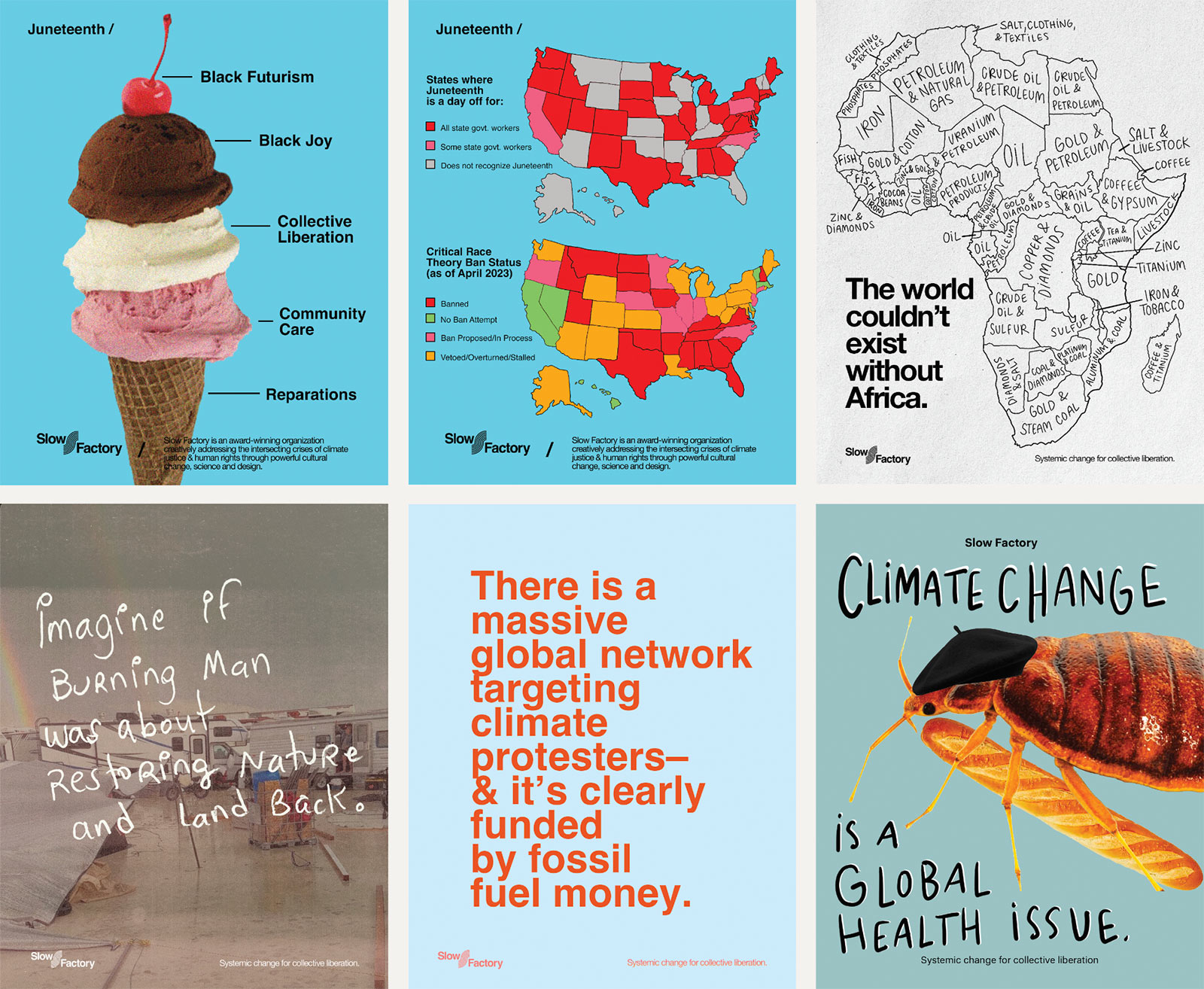
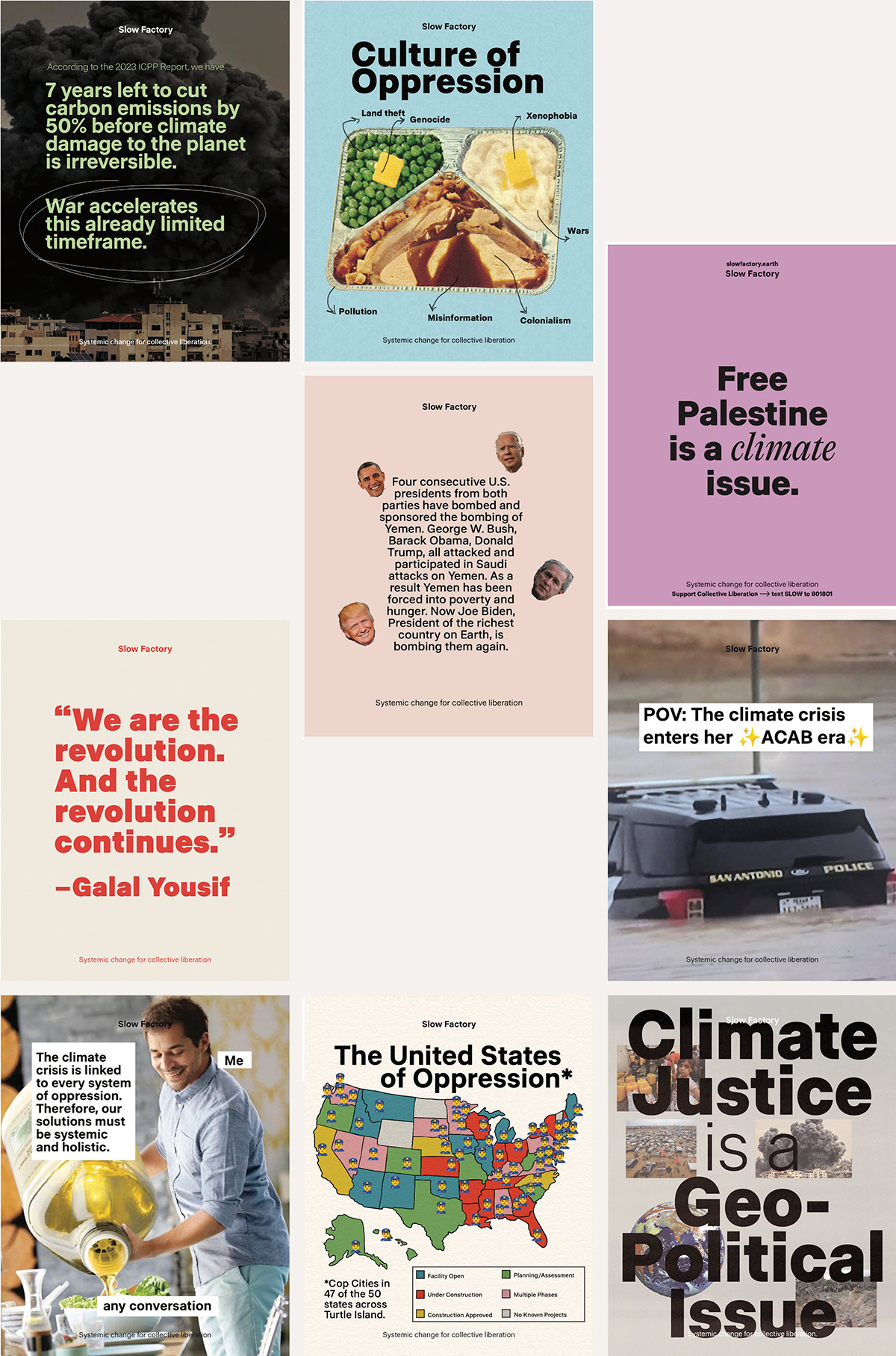
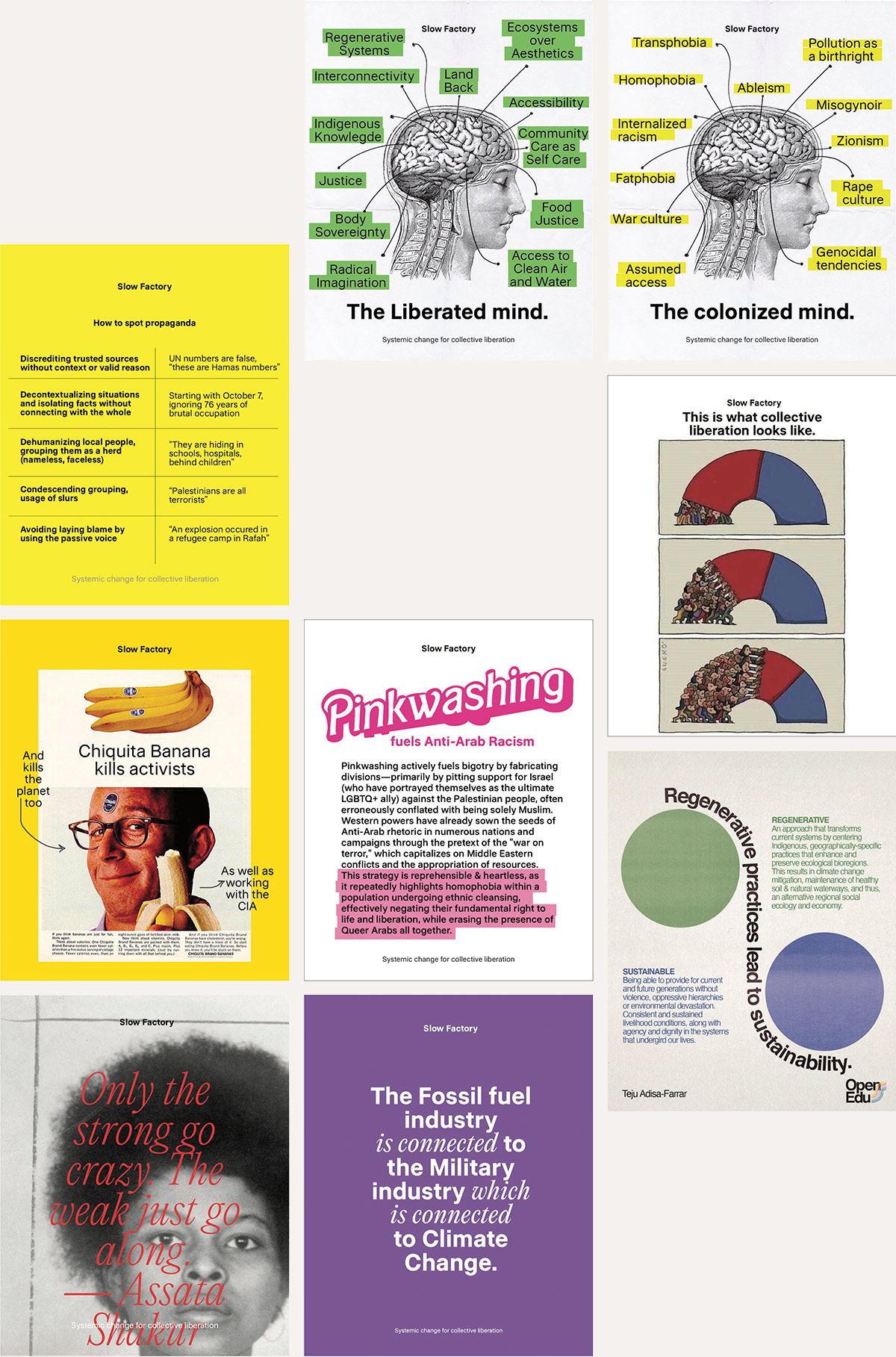
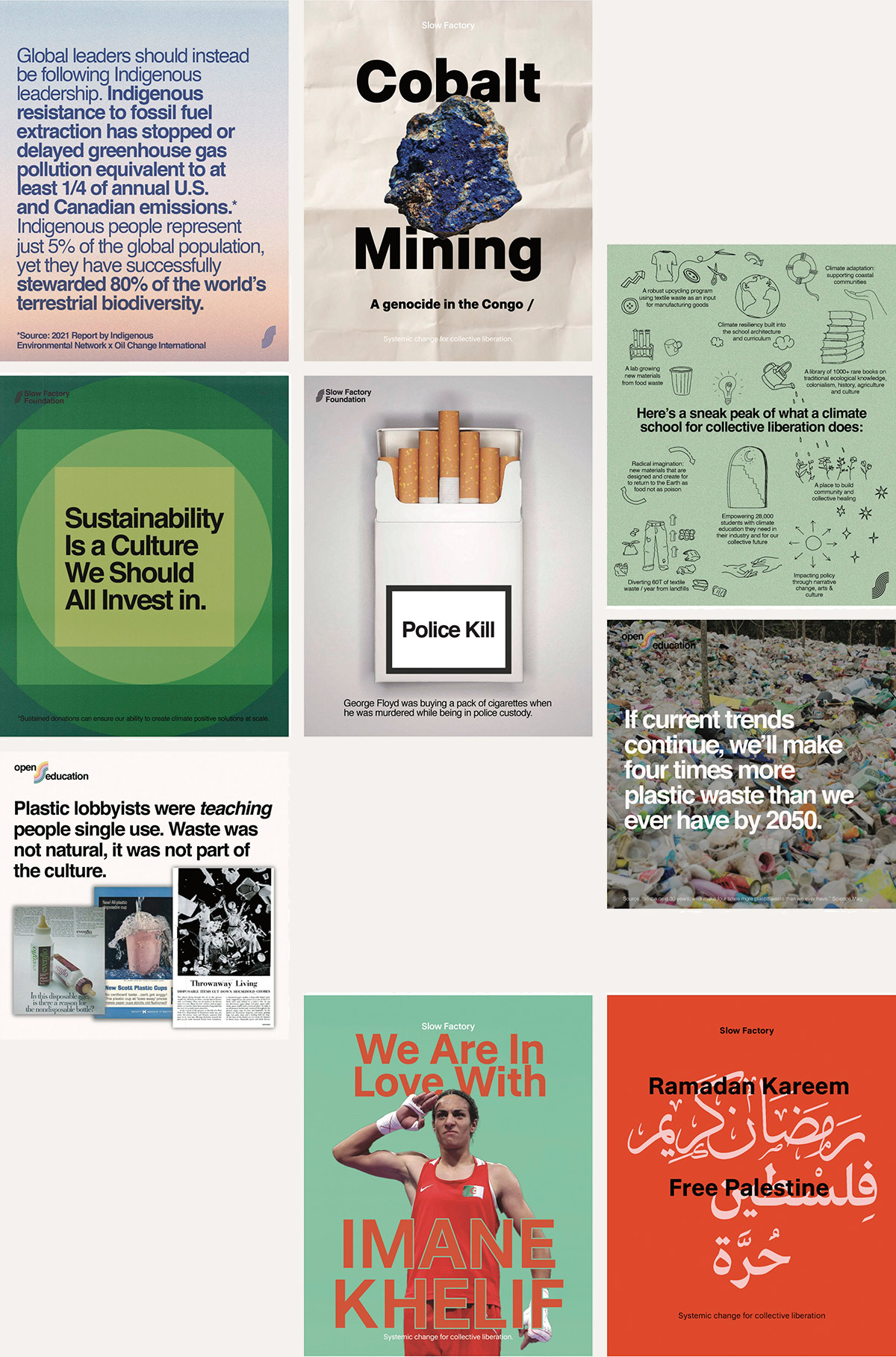
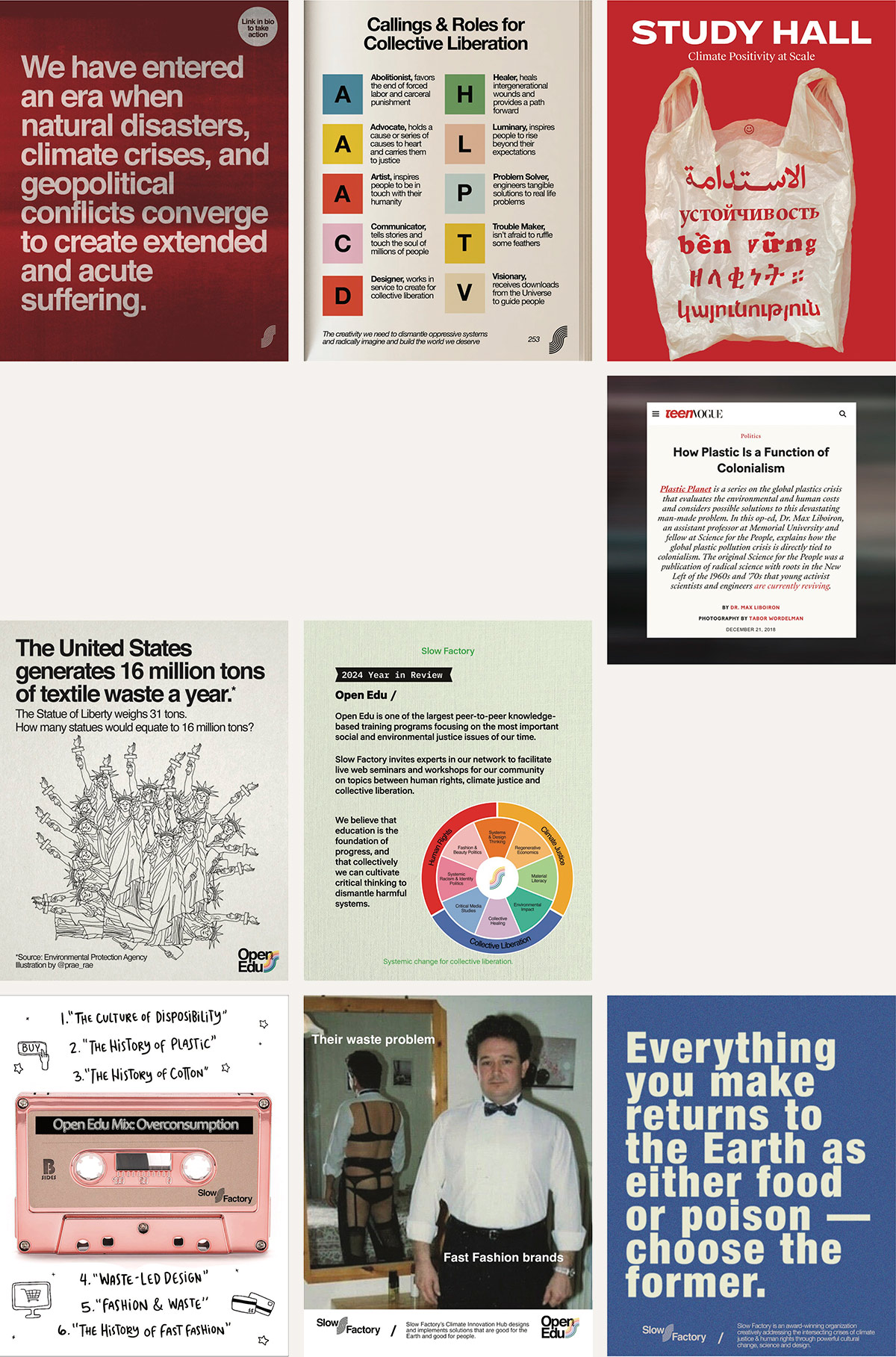
"excerpt" : "The Slow Factory celebrates the power, beauty, resilience, and importance of Global South communities and their diasporas, calling for a collective responsibility to address systemic oppression and inequality. The visual communication design language pioneered by the Slow Factory design team emphasizes decolonization, environmental sustainability, and equity. This design language has been strategically deployed to engage millions of people in conversations about power dynamics, systemic exploitation, and the need for urgent action on issues like climate change and social justice. The Slow Factory has made a global impact in creating a new movement in accessible information design, and in providing a platform for Global South communities to share our narratives on a global stage; a testament to how design can transcend aesthetic values to become a powerful tool for social transformation.",
"content" : "The Slow Factory celebrates the power, beauty, resilience, and importance of Global South communities and their diasporas, calling for a collective responsibility to address systemic oppression and inequality. The visual communication design language pioneered by the Slow Factory design team emphasizes decolonization, environmental sustainability, and equity. This design language has been strategically deployed to engage millions of people in conversations about power dynamics, systemic exploitation, and the need for urgent action on issues like climate change and social justice. The Slow Factory has made a global impact in creating a new movement in accessible information design, and in providing a platform for Global South communities to share our narratives on a global stage; a testament to how design can transcend aesthetic values to become a powerful tool for social transformation."
}
,
"relatedposts": [
{
"title" : "Seeds of Chronic Hope",
"author" : "Corinne Jabbour",
"category" : "essays",
"url" : "https://everythingispolitical.com/readings/seeds-of-chronic-hope",
"date" : "2026-03-04 12:06:00 -0500",
"img" : "https://everythingispolitical.com/uploads/Heirloom%20Corn%20at%20Buzuruna%20Juzuruna.jpg",
"excerpt" : "",
"content" : "Gathering in BeirutOn the 22nd of November 2025, a day which coincided with Lebanon’s Independence day, we gathered with a crowd at a venue facing the Beirut Port silos, which still stand half demolished, a constant reminder that our crises are in fact not tragic misfortunes, but carefully designed and manufactured atrocities. We gathered that day for the public launch of the Agroecology Coalition in Lebanon (ACL). Agroecology is not just a science or farming practices, but the movement calling for food justice and sovereignty.Mathematics of PredationThe global food system today demands that we forfeit our farmers’ rights and autonomy, our people’s dignity, health, and wellbeing, and the resilience and abundance of the environment we are a part of, all to achieve its goals. It is not driven by hatred for farmers or hatred for the environment and its people, but rather simply by the cold mathematics of this economic system that do not take things like justice, dignity, sovereignty or the health of the ecosystem into account. As a result, they are methodically sacrificed when the outcome is more profit, because this system’s one and only goal is: Ever increasing profit for ever increasing capital accumulation, no matter the cost, a fact proven yet again by today’s colonial wars, and the re-escalation of Israeli aggressions and land invasion in Lebanon.Green Colonialism in LebanonThe World Bank’s hundreds of millions of dollars in “recovery and reconstruction” loans arrive alongside efforts to redirect our production further toward export. New laws compromise seed sovereignty, threaten our cannabis heritage varieties, and surrender the autonomy of our fishermen. Layer by layer we are stripped of food sovereignty and pushed deeper into hegemonic global markets - green colonialism advancing under the banner of modernization. Our news channels are filled with the echoes of our politicians promising wealth and prosperity through global markets. These promises ignore the reality that our country’s one airport, two ports, and limited land crossings can - and have been - paralyzed by Israel within hours. They forget what happened to our imports and exports during Covid, or after the 2019 currency collapse. We grow thirsty crops that do not fill our needs but fulfill the desires of the Global North, and we send them our produce and within it our water, our labour, and the health of our land. Then to complete the dance, our government ships in food grown in poorer soil on distant land, drowning our local markets and driving our farmers into the arms of export traders, or pushing them to abandon farming and migrate to the city… As our Gibran once wrote, “Woe to a nation that eats what it does not grow!”The Trap of Conventional AgricultureOur farmers are coerced into buying hybrid seeds, synthetic chemical fertilizers, biocides (pesticides, fungicides, herbicides, rodenticides…), and other inputs at prices controlled by multinational corporations and their local allies. They sell their crops at prices controlled by traders in the wholesale markets, prices so low they barely cover their costs!“Being a farmer is like being in love with a bad woman, the whole world will tell you she is bad but all you see is the beauty in her!” This was the reply of Georges, a seasoned farmer from a mountain village in the Chouf, when I asked him why he still chooses to be a farmer one disappointing season after another. As we walked through his terraces he told me some stories: “We used to sprinkle grains on the snow, to help the birds through the harsher days of winter… My father would tell us to skip harvesting some of the fruits on the high branches of the trees, he would say that those were the share of the birds from this season!” How did capitalism succeed at slowly eroding our worldview, where we shared our harvest with the birds? How far can this love for the land and its abundance carry our increasingly burdened growers? How long can they stand in the face of the scourge of the industrial model of food production that has invaded our way of life?Our farmers are stuck in a rat race, bullied into finding ways to intensify production with every season. Instead of fair distribution where farmers get their fair share, the only choice this system offers them is: “We will take the largest share of the profit generated by your hard labour, but if you keep finding ways to produce more, the small percentage we allow you to keep might become enough for you.” The outcome is farmers under tremendous pressure to produce more, better, and faster, and that intensification requires more and more synthetic chemicals!As for people who are choosing what to eat, they find themselves with limited choices, mostly laced with toxins, because within this system, clean and nutritious food has become a luxury! Beyond human health, these intensive production methods and long-distance transportation are crumbling our entire ecosystem and massively contributing to climate change, the consequences of which we are all experiencing, from unpredictable and extreme weather, to raging wildfires and prolonged droughts. Our farmers are among those paying the highest price for this change!A System of OppressionThis system, in complicity with our local varieties of comprador aspiring billionaires, continues to turn every right that we have, every care we offer each other, every abundance we receive from nature, into commodities to be bought and sold for profit. Today’s realities in the Global South are living testament to the price that the many have to pay in service of the few, and we are the many!We reject attempts to depoliticize food, we reject attempts to sanitize this predatory dynamic with performative gestures and token measures. The charades of charity and benevolence have long expired. These tools of neo-colonialism are now seen for what they are, instruments of oppression and hegemony. We do not need an invitation to drown further in debt through loans offered under the guise of development and recovery by the same powers that fund, arm and enable the Zionist colonial project that brings on that destruction. This system has exposed itself through its oppression and subjugation of nature, women, and colonized peoples. Through military complexes, genocides, sanctions, poverty, and famine, it leaves devastation in the wake of its hollow promises of prosperity through progress and development.Tangible AlternativesWhat brought us together that day in Beirut was not just a common perspective on the root of the so-called “crises”, but a shared conviction that this system is dying, and that real, tangible, solid alternatives already exist. Alternatives that spring from the ground and require change on all levels, including the political level. Alternatives that converge the world into ways of life that prioritize human wellbeing, dignity, and harmony with the planet that is our home.For the food system, one such alternative is Agroecology, the fundamental pillar of food sovereignty. It is not just a set of farming practices or the science behind them, agroecology is a social movement that places the autonomy of small scale farmers at its center, embraces traditional knowledge, and adopts democratic and horizontal methods for governance and knowledge transfer. It is a roadmap, not for superficial reform, but for radical transformation from exploitation to sovereignty. We need to liberate our commons, our seeds, our water, our land, our spaces, our festivals, our ancestral knowledge and worldview. We need to meet our growers, trust and support them. We need to rebuild resilience into our food system in preparation for the inevitable changes that have already begun to impact our food production. We need to decentralize our seed banks, our power sources, and our decision making. Systems such as seed harvesting and propagation have been managed collectively by farmers ever since agriculture was born in our fertile crescent, it is our treasured pool of biodiversity that should not be handed over to corporations. Intellectual property rights over seeds are the equivalent of visiting the ruins of Baalbek, installing a gate at the entrance, and claiming that the ruins are now yours because of that final modification! The absurdity of this system is not lost on us.The time has come to reclaim food, health, ecosystem, and lives with dignity, for ALL people, not SOME people, as rights and not as commodities for sale! The time has come to decolonize our food, to delink ourselves from this parasitic system that has been bleeding us dry for decades, and will not stop until it starves the world, and the last bird on the last tree goes silent.We gathered that day, not for romantic ideals, but a concrete political project, a vision, and a battle for liberation that we do not wage alone. We are part of a global and widespread movement that includes farmers, peasants, and peoples everywhere, all clearly and loudly united in their categorical demand for their fundamental right to food sovereignty!Chronic HopeAfter the day had ended, with smiles, inspiration, and a warm atmosphere of camaraderie, while walking away from that venue and passing by the remains of the silos, the walk took me back 5 years, where I took those same steps after the Beirut Port explosion. I had been walking and looking around at the destruction with tears blurring my vision and silently rolling down my cheeks. I remember looking down at the ground and finding seeds in the corner where the sidewalk meets the shoulder of the road. The pods on the trees had popped open at the pressure of the explosion, spreading their seeds everywhere along with the shattered glass and rubble. I couldn’t help smiling through my tears, smiling and thinking: “We are those seeds, and we will never stop bringing life back into the death that is brought upon us.”"
}
,
{
"title" : "When Sufien Met Nefisa: An Excerpt from 'Paradiso 17' by Hannah Lillith Assadi",
"author" : "Hannah Lillith Assadi",
"category" : "excerpts",
"url" : "https://everythingispolitical.com/readings/when-sufien-met-nefisa",
"date" : "2026-03-03 11:26:00 -0500",
"img" : "https://everythingispolitical.com/uploads/Assadi.jacket.jpg",
"excerpt" : "This is an excerpt from Paradiso 17, a new novel by Hannah Lillith Assadi, which maps the journey of a Palestinian boy, Sufien, through exile from his homeland to the Middle East, Europe, and then America. This particular moment is from his time in Kuwait and his first experience with young love. Excerpted by permission of Alfred A. Knopf, a division of Penguin Random House LLC. All rights reserved. No part of this excerpt may be reproduced or reprinted without permission in writing from the publisher.",
"content" : "This is an excerpt from Paradiso 17, a new novel by Hannah Lillith Assadi, which maps the journey of a Palestinian boy, Sufien, through exile from his homeland to the Middle East, Europe, and then America. This particular moment is from his time in Kuwait and his first experience with young love. Excerpted by permission of Alfred A. Knopf, a division of Penguin Random House LLC. All rights reserved. No part of this excerpt may be reproduced or reprinted without permission in writing from the publisher.What Sufien always remembered about Kuwait was the voice of the Gulf, that rolling tongue, languorous and all-knowing, like the voice of the divine.The new house, his father’s, recently built by the government, stood alone. Sufien was accustomed to stone walls, stone ceilings, the musty smell of old buildings. This place was echoey, almost alien in its bigness. The most unfamiliar part was its modern electricity. Sufien had been raised by candlelight. Walking outside and looking up, he saw the constellations spread out like cities in every direction. Sufien had never seen a night like this. It was so dry, and he was so thirsty. This was the loneliest part of the desert: the clarity of the sky. There was no blanket. No hills, no trees. The land was just exposed to the beyond. Sometimes Sufien could hear the din of some distant party carried across the dunes, which made him think, maybe that better place is just there. What he learned in time, though, was that the desert carried sounds for miles. By the time that happier gathering reached his ear, it was just a ghost. What he missed again, what he missed forever, was the camp—that camp at the end of the world back in Syria. And now all there was in the night after all of his little brothers and sisters were asleep—there were seven of them now—and after even his parents had fallen asleep, was Sufien, alone, trying to shut his eyes despite the moan of the wind in the sand. He had stayed up with the night from a very young age, and always would. Night was the texture of his soul.There were other problems for Sufien in Kuwait. The schoolmaster belittled his Palestinian dialect, and made him sit apart from the other students. This sense of deprivation only made Sufien more willful. So he conquered algebra. Sufien understood even then that math was the only language which had completely evaded human evil even if it might be used to forward it. Once it was clear he had excelled beyond any other pupil, studying calculus by the equivalent of the eighth grade, he looked for other pathways to excellence. None of the other Kuwaiti pupils could speak English fluently, for instance, nor had anyone else memorized as many verses of the Quran. None except Nefisa.Nefisa was from Haifa, a girl of the sea, not the Gulf but Sufien’s sea, the Mediterranean, the sea which had informed the blood of his ancestors. She had his people’s eyes, the eyes of a lion, hazel, that whirl of blue, and silky dark hair, and when she was deep in thought over an equation or reciting a script of ancient poetry, she cupped her hands across her brow and squinted like she was trying to see something far into the distance. It was the first time Sufien recognized beauty. He was only thirteen, but he felt the pain of it, the inability to hold on to it, the way it could simultaneously exist and not be grasped. A thing, a real thing, was something a person could touch, point to, like a soccer ball, or his mother’s hand, or a dinar. Whereas Nefisa smelled of rain, which he had scarcely felt or seen in the years since they came to Kuwait. When she passed Sufien in the hall or on the way to the car which always waited for her after school, a 1953 baby blue Volvo station wagon, her father’s, the same model Sufien’s own father had but in turquoise, he smelled off of her a yearning petrichor, that perfume of the desert.There had to be some way to keep her, or rather keep what he felt when he beheld her. Keep it still. Keep it forever. Keep beauty. Thinking of Nefisa, the curl of her words when she recited the Quran in his own accent, or seeing the way her breasts had risen under her shirt, the fabric of her hair, like velvet, he felt like something was slipping from his grasp. Like he needed more time, more pages, more words. The poet’s curse had stricken him.The present, that enviable superpower of childhood, had abandoned him, and now he understood time and space. If she left him, if Nefisa escaped his gaze, as she did every day, if she removed herself beyond the steel doors of that station wagon, and disappeared from view, then everything would. He understood missing. Yes, this was first love. There is no difference between it and an encounter with death but a degree of charm.Sufien, Nefisa said one day. Oh, can you hear it, the voice of a pubescent girl? Shaky and sweet. She said, Walk me home. But what did Sufien know of love and how much it could hurt? To be face-to-face with desire? Almost no one of us can handle it even once we’ve known it and known it again. He looked at her and knew she could see him. Too much of him. He felt naked. So he ran ahead of her toward his father’s house.From that day onward, Sufien avoided Nefisa. It was simpler not to behold her, the gentleness of her cheekbones, the sad curvature of her mouth. She was like a tiny adult already, mourning the heaviness of the life she would later live. Her parents would be killed in the war to come once they returned to Palestine. And she would be a refugee once more, in Gaza. She would never marry, and never bear children. And on her final evening, she would walk into the sea. So they would find her like that, thrown out, half buried in the sand, after some great final exhale.Meanwhile Sufien regretted what he had not said to Nefisa for so long that it burrowed deeply inside of him. He had loved her; he had loved her purely. But he was just thirteen then. He had not yet had the courage to feel something so big.They say Allah works in mysterious ways, but everyone forgets to say how beautiful are His mysteries.Sufien might have expected his mother or his father to be the ones to greet him on his way to the land of the dead all those decades later. It would be Nefisa. When they were finally rejoined, he was no longer thirteen, but a shriveled old man, a hundred pounds of failed flesh clinging to his skeleton, his body undone by cancer, drool falling down his face. Whereas there she was, more beautiful than he had ever seen her, a grown woman, and also the child he had known, the way people can be all things at once in a dream. She was like the archetypal fool, sitting there at the pool, or was it the spring on Jebel Kan’aan, or was it the Sea of Galilee?, dipping her toes into the everlast- ing water, splashing about, a being even younger than a toddler, and likewise timelessly old.Nefisa, Nefisa, Nefisa, he would whisper. Is it you?She would say, Come, walk me home."
}
,
{
"title" : "Nature As the Battlefield: Ecocide in Lebanon and Corporate Empire",
"author" : "Sarah Sinno",
"category" : "essays",
"url" : "https://everythingispolitical.com/readings/ecocide-lebanon-chemical-warfare",
"date" : "2026-02-25 15:16:00 -0500",
"img" : "https://everythingispolitical.com/uploads/PHOTO-2026-02-25-13-34-24%202.jpg",
"excerpt" : "",
"content" : "Photo Credit: Sarah SinnoOn February 2, the United Nations Interim Force in Lebanon (UNIFIL)issued a statement announcing that Israeli occupation forces had instructed their personnel to remain under cover near the border between south Lebanon and occupied Palestine. They were ordered to keep their distance because the IOF had planned aerial activity involving the release of a “non-toxic substance.” Samples collected and analyzed by Lebanon’s Ministries of Agriculture and Environment, in coordination with the Lebanese Army and UNIFIL, confirmed that the substance sprayed by Israel was the herbicide, glyphosate. Laboratory results showed that, in some locations, concentration levels were 20 to 30 times higher than normal. Not to mention, this is not the first instance of herbicide spraying over southern Lebanon, nor is the practice confined to Lebanon. Similar tactics have been documented in Gaza, the West Bank, and Quneitra in Syria.While the IOF didn’t provide further explanation as to its purpose, these operations are part of a broader Israeli strategy to establish so-called “buffer zones” by dismantling the ecological foundations upon which communities depend. The deployment of chemical agents kills vegetation, producing de facto “security” no-go areas that empty entire regions of their Indigenous inhabitants. Cultivated fields are deliberately destroyed, soil fertility declines, and water systems become polluted. Farmers lose their livelihoods, and communities are forcibly uprooted. Demographic realities are reshaped, and space is incrementally cleared for future settlers. Simply put, these tactics function as a mechanism of displacement, dispossession, and elimination—and are importantly part of a long history of this kind of colonial territorial engineering.Glyphosate and Ecological HarmFor decades, glyphosate has been marketed as a formulation designed to kill weeds only and increase crop yields. But the consequences of its use on humans and the environment cannot be ignored: In 2015, Glyphosate was classified by the International Agency for Research on Cancer (IARC) as “probably carcinogenic to humans,” and it has been associated with a range of additional health risks, including endocrine disruption, potential harm to reproductive health, as well as liver and kidney damage. In November of last year, the scientific journal Regulatory Toxicology and Pharmacology formally withdrew a study published in 2000 that had asserted the chemical’s safety.Beyond its human health implications, glyphosate is ecologically harmful. Studies have shown that it degrades soil microorganisms; others have linked it to increased plant vulnerability to disease. It can also leach into water systems, contaminating surface and groundwater sources. Exposure may be lethal to certain species like bees. Even when it does not cause immediate mortality, glyphosate eliminates vegetation that provides habitat and shelter for bees, birds, and other animals, disrupting food webs and ecological balance. What’s more, research indicates that glyphosate can alter animal behavior, affecting foraging and feeding patterns, anti-predator responses, reproduction, learning and memory, and social interactions.Despite a growing body of scientific literature highlighting its risks to both human health and the environment, and bearing in mind that corporate giants manufacturing such products have been known to fund and even ghostwrite research to promote the opposite, glyphosate remains the most widely used herbicide globally.The Monsanto ModelTo understand how it became so deeply entrenched, normalized within agriculture systems in some contexts, and used as a weapon of war in others, it is necessary to look more closely at the corporation responsible for its global expansion: Monsanto.Founded in 1901, Monsanto’s corporate history reflects a longstanding pattern of chemical production linked to environmental devastation. Over the past century, the corporation has manufactured products later proven harmful and has faced tens of thousands of lawsuits, resulting in billions of dollars in settlements.Among the products it manufactured were polychlorinated biphenyls (PCBs), synthetic industrial chemicals that were eventually banned worldwide due to their toxicity. Through their production and disposal, including the discharge of millions of pounds of PCBs into waterways and landfills, Monsanto contributed to some of the most enduring chemical contamination crises in modern history, the consequences of which continue to reverberate today.One of the most notorious cases unfolded in Anniston, Ala., where Monsanto’s chemical factory polluted the entire town from 1935 through the 1970s, causing widespread harm to the community. Despite being fully aware of the toxic effects of PCBs, the company concealed evidence, according to internal documents, a conduct that reflects a longstanding pattern of disregard for both environmental care and human health. Whether in the case of PCBs or glyphosate, the underlying logic remains consistent: ecological systems and communities are harmed in order to prioritize profit and, at times, territorial expansion.Monsanto also became the world’s largest seed company. Through the enforcement of restrictive patents on genetically modified seeds, the corporation consolidated unprecedented control over global food systems. By prohibiting seed saving, a practice upheld by farmers and Indigenous communities for millennia, it undermined seed sovereignty and compelled farmers to purchase new seeds each season rather than replanting from their own harvests. What had long functioned as part of the commons since the origins of human civilization, the foundational basis of food and life itself, was privatized. Monsanto transferred control over seeds from cultivators to corporations, further creating systems of structural dependency.What was once embedded in reciprocal relationships between land, seed, and cultivator is now controlled by the same chemical-producing corporations implicated in the degradation of land—as is the case of what is unfolding in southern Lebanon. Power is thus consolidated within an industrial architecture that, at times, prohibits the exchange and regeneration of seeds and, at other times, renders the land uninhabitable. In both cases, it undermines the ability to grow food and remain rooted in the land, thereby threatening the conditions necessary for survival.Chemical WarfareAlongside its record of manufacturing carcinogenic products, dumping hazardous chemicals into the environment, and contributing to the destruction of agricultural systems, Monsanto has also been linked to chemical warfare. During the Vietnam War (1962–1971), it was among the U.S. military contractors that manufactured Agent Orange, a defoliant used to strip forests and destroy crops that provided cover and food to Vietnamese communities.The chemical contained dioxin, one of the most toxic compounds known, contributing to the defoliation of millions of acres of forest and farmland. It has been associated with hundreds of thousands of deaths and long-term illnesses, including cancers and birth defects.Although acts of ecocide long predated this period, well before the term itself was coined, it was in the aftermath of Agent Orange that the word “ecocide” was first used to describe the deliberate destruction of ecosystems and began to enter political and legal discourse.The Vietnam War exposed a structural link between chemical production, corporate power, and a military doctrine in which ecosystems and farmlands are targeted precisely because they sustain human life. Nature, because it nourished, protected, and anchored Indigenous communities, was treated as an obstacle to military and imperial control. As a result, it became a battlefield in its own right.Capital and RuinThis historical precedent continues to reverberate today in Lebanon, Palestine, and Syria. Decades apart, these are not isolated acts of ecological destruction but part of a continuous trajectory carried out by the same imperial, corporate, and financial machinery.In 2018, Monsanto was acquired by Bayer. Bayer’s largest institutional shareholders include BlackRock and Vanguard, the world’s two largest asset management firms.Both firms have been identified in reports, including those by UN Special Rapporteur Francesca Albanese, as major investors in corporations linked to Israel’s occupation apparatus, military industry, and surveillance infrastructure. These include Palantir Technologies, Lockheed Martin, Caterpillar Inc., Microsoft, Amazon, and Elbit Systems.Mapping these financial linkages reveals how ecocide is structurally embedded within broader systems of violence that are deeply entrenched and mutually reinforcing. Ecocide and genocide are financed through overlapping capital networks that connect chemical production, militarization, and territorial control.The spraying of glyphosate over agricultural land in southern Lebanon must therefore be situated within this historical continuum. The same corporate-financial structure that profits from destructive chemicals and agricultural control is interwoven with the industries that maintain a settler-colonial stronghold."
}
]
}