
How do you define Black cinema? It’s a question that’s seemingly impossible to answer, given its vast and rich history, but one that feels more urgent than ever as the Trump administration is actively attempting to erase Black history and culture. The writer and Criterion Collection’s Curatorial Director Ashley Clark, however, has proven he’s more than up to the challenge with The World of Black Film: A Journey Through Cinematic Blackness in 100 Films. The book is a dazzling and expansive chronological survey of over a century’s worth of Black films, spanning multiple countries and genres, and makes the case that Black cinema is not only global in its scope but also accessible in its reach.
“I’ve often found that Black cinema has been overlooked and marginalized,” Clark told Everything Is Political. “I certainly wasn’t exposed to a lot of Black film growing up, as a burgeoning teenage cinephile. This kind of book would have been really helpful and useful for me [growing up], and that’s who I had in mind when I was writing.”
The book also functions as an archive of Black cinema, which feels overwhelmingly necessary in this moment—as Trump-era policies have cut funding for cultural institutions in the U.S. like the National Museum of African American History and Culture to imposing tariffs and travel bans that have had global repercussions for all industries, including film. For Clark, loving Black cinema also means protecting it.
“Don’t be silent. Don’t be quiet about it. Advocate for it. Support filmmakers. Write about it, talk about it, hold it to high standards.”
Clark spoke with writer Cady Lang about his lifelong love of film, why he wants Black cinema to be seen through an international, kaleidoscopic lens, and how film can fight systemic oppression.
This interview has been edited for length and clarity.
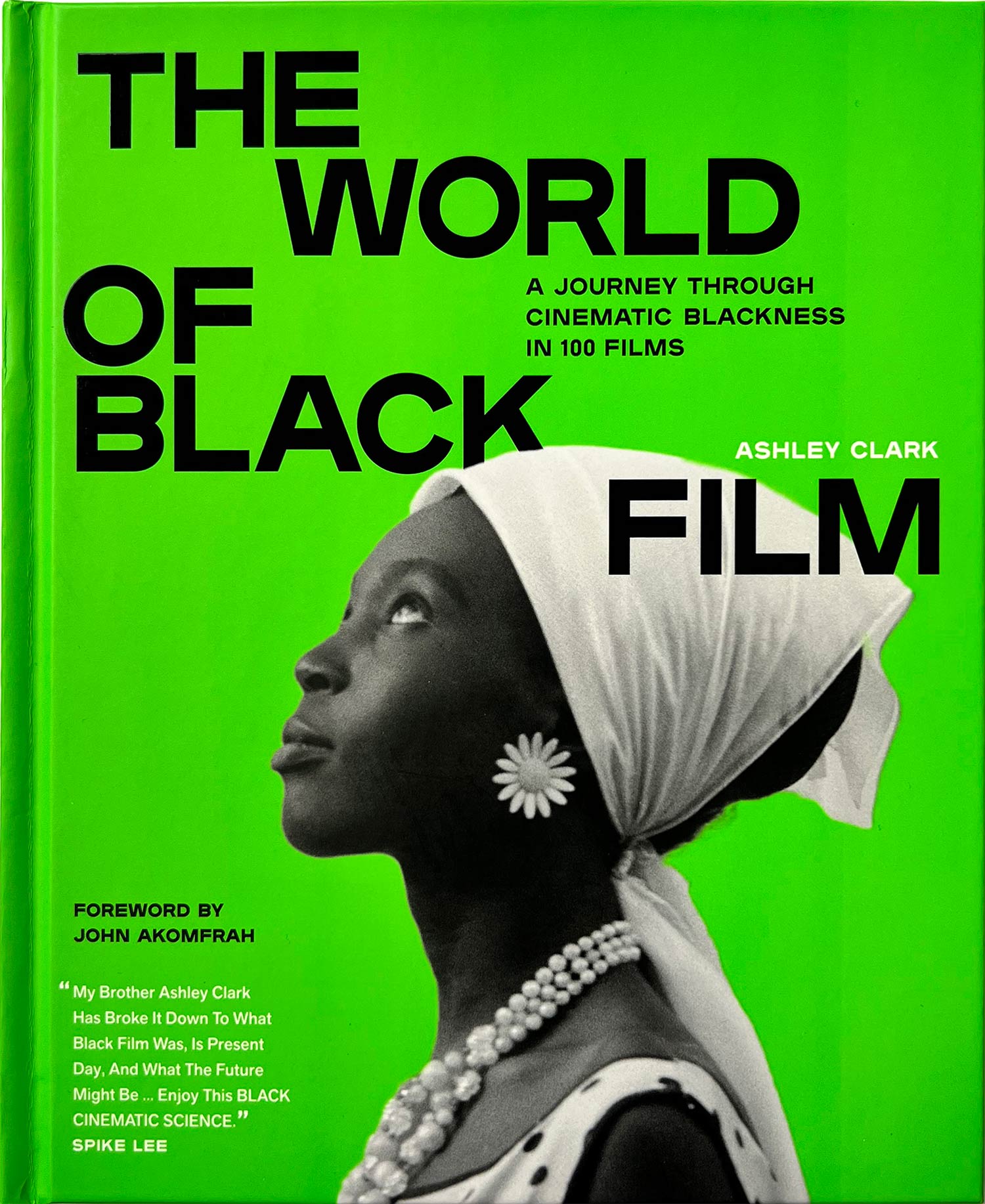
Courtesy of Clark and the Publisher.
CADY LANG: It’s a huge, somewhat daunting task to pick just 100 films to embody Black cinema. What drove you to undertake this?
ASHLEY CLARK: What came to mind was to do something that looked at Black cinema through a very specific international lens. Often—and it’s not necessarily a negative thing—but when people talk about Black cinema, they’re automatically talking about Black American film. But I thought, wouldn’t it be interesting to slightly subvert that and bring in films from Africa, from the Caribbean, from Europe, and see if I could draw some connections between them, whether that was from actors and artists like Paul Robeson and Josephine Baker and Melvin Van Peebles, who had spent time and made work in Europe, to international collaborations between the USA and Nigeria with the Ozzie Davis film, Countdown at Kusini (1976), or Brazil and Nigeria with the film, Black Goddess (1978).
CADY: Why was international focus on Black cinema important for you while writing this book?
ASHLEY: I think there’s so much Black film from around the world that deserves to be better known. It’s as good as any film that is made, whether it’s West Indies (1979) by the Mauritanian filmmaker Med Hondo, or Black Girl (1966) by Ousmane Sembène, these are films that deserve to be in conversation with the great international classics and it takes people to advocate and to make that case. This, for me, is just a contribution to that.
It’s also a reflection of my own life—I have Jamaican heritage, I was born and raised in England, I live in America, so I have an international personal experience, and I wanted to channel that into the films I was writing about.
CADY: There are films in the 100 that you selected that have complicated legacies, like Lime Kiln Club Field Day, which is one of the earliest surviving films with an all-Black cast, but also deals with some racist tropes (perhaps most significantly, actor Bert Williams appears in blackface). How do you think about films like this in cinema history, while also thinking about the fraught historical contexts that shaped them?
ASHLEY: For me, every step of the way, it’s respecting the audience and trusting that they will be able to hold multiple complicated truths. It’s really about providing context and history and giving a framework to these things. Even in the short piece that I wrote about Lime Kiln Club Field Day (1913), which stars the great vaudevillian entertainer Bert Williams, a light-skinned black man from the Bahamas who came to America and became a huge star in Jim Crow-era America and was famous for wearing skin-darkening blackface makeup, I wanted to include multiple perspectives on him. He was the only cast member in this film to do so, even though he was among other Black cast members, and there are various suggestions as to why. His legacy has been criticized by filmmakers like Spike Lee as someone who was doing things that negatively would negatively affect the race. But then you have filmmakers like Garrett Bradley and RaMell Ross, who in their work, have used images of Bert Williams to further complicate his legacy and ask questions about authorship and how much control he had, whether he was wearing blackface makeup to protect his other castmates, so they didn’t have to do it. It’s about trying to provide some sense of historical or industrial context that can help the reader because it can be upsetting and difficult if you don’t have the requisite context to encounter the material.
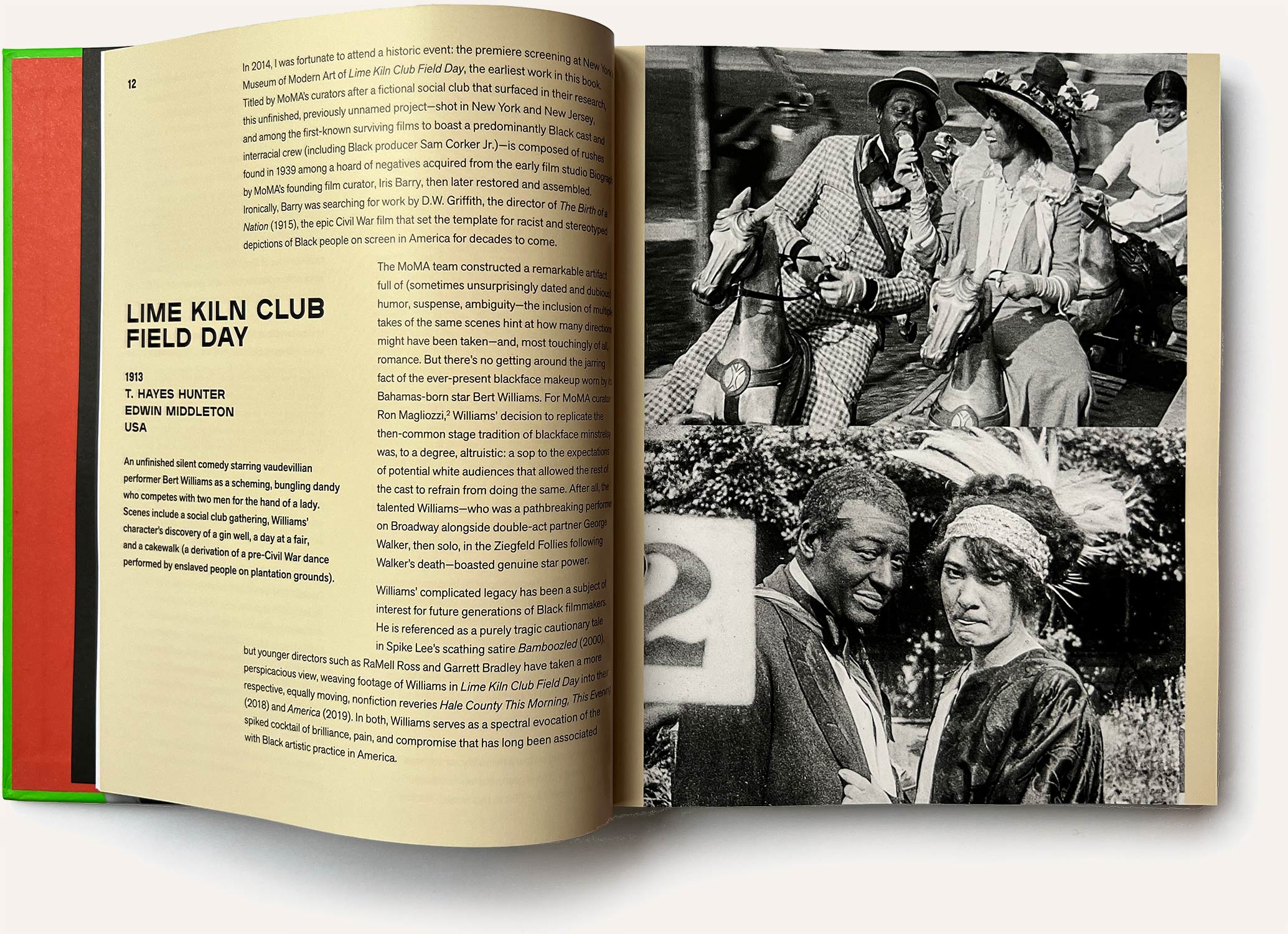
Courtesy of Clark and the Publisher.
CADY: How did you strike a balance between commercial and more avant-garde cinema for your selection? I think a good example of this in your book, is your selection of Tyler Perry’s very commercially successful 2009 film, Madea Goes to Jail, which appears before Isaac Godfrey Geoffrey Nabwana (Nabwana I.G.G.)’s decidedly experimental 2010 film, Who Killed Captain Alex?
ASHLEY: I had to set myself a series of criteria and guard rails; for example, one film per director. I wanted to make sure that there was a wide variety of genres and styles, highbrow and lowbrow. Just because I may not be the world’s biggest Tyler Perry fan or fan of the content of his movies, that doesn’t mean that he’s not a hugely significant figure in the broader history of Black film in America and beyond, because his work is explicitly speaking to an audience that has been underserved. He has a massive, predominantly female, African-American, often religious viewership in the American Heartlands, who haven’t been served for a long time. With that in mind, you can connect that to other audiences and filmmakers who were being underserved
Even if there are potentially regressive tropes dotted throughout these films, they’re serving an audience that has been dramatically underserved. In picking something like Tyler Perry’s Madea Goes to Jail (2009), it’s in a continuum you can even throw all the way back to certain films in the race movies era by Spencer Williams. There’s a legacy there.
And in the case of something like Who Killed Captain Alex? (2010), that allows us to talk about genuine DIY filmmaking. A lot of the films I picked are by filmmakers who did not go to film school and learn all the tricks of the trade; they did it their own way, the only way that they could, which was scrapping together budgets, coming up with these often wild and weird films that feel like six films rolled into one, because the filmmakers thought they might only get that one chance to do it.
CADY: As a curator and a programmer, you’ve helped recover and restore lost and lesser-known work, like Zeinabu irene Davis’ Compensation (1999), which was recently re-released by the Criterion Collection in 2025. I’d love to know what the process is like for you to bring works that are lost or nearly lost back to audiences and why that’s important for you.
ASHLEY: The number one rule for me as a curator or programmer is to serve the artist’s work. It’s all about them. Compensation (1999) was distributed by the amazing [non-profit media arts organization] Women Make Movies and was never really lost. Lost is different from just not necessarily being amplified and advocated for. I felt very fortunate to be in the position to put it in front of a larger audience; when I joined Criterion, it was one of the first films on my list to tell my colleagues about.
To work with [Compensation director] Zeinabu irene Davis, who is such an inspirational and thoughtful person, to get the film in front of new audiences, younger audiences, is the reason for doing what I do.
CADY: Did this book introduce any new thoughts about Black cinema or film in general for you?
ASHLEY: Once I had made my selection, it was interesting to see this corridor of films in the ‘60s through the ‘80s, against a backdrop of African decolonization movements and rising Black international consciousness around the world, and how these films were in dialogue with each other. Intellectually, I knew it, but to actually watch the films and see certain stylistic things that were coming up in the films, like Burning an Illusion, a British film from 1981 about a woman’s political coming of age, and then watching Alile Sharon Larkin’s A Different Image, an L.A. Rebellion film from the following year, it was constantly opening up new windows on work that I thought I knew in ways that perhaps I hadn’t considered and sequencing the films in that respect was very enjoyable and moving for me.
Also, finding out how certain things have changed and improved and certain things haven’t. It struck me watching Saint Omer by Alice Diop from 2022, and realizing, to my dismay, how much the film was in dialogue with [Ousmane] Sembène’s Black Girl from 1966, in terms of the lived experiences of Black African women in France, that runs counter to any comforting narratives of progress. This book is not a journey of progress where everything’s great—it’s very cyclical and things are coming up and intersecting and interacting in ways that are sometimes joyous, but sometimes painful.
CADY: Did you see any recurring trends or themes emerge?
ASHLEY: Trends are tricky. You see these moments where, especially in Hollywood, Black film is hot for a while, it’s profitable, everyone’s interested, and then the interest sort of falls away.
You have this incredible explosion in the ‘90s. Spike Lee is the on-ramp to that. Then Boys n the Hood (1991). You have this explosion of Black studio filmmaking in the ‘90s. And then it falls away a little bit. You have Get Out (2017) and Hollywood is reminded that actually there are masses and masses of Black audiences who are completely underserved and want intelligent genre filmmaking that speaks to their experiences. And then it falls away again.
It’s happened recently with Sinners (2025), right? People are surprised that it’s a massive box office hit and it’s like, “Why are you surprised?” That idea of Hollywood dropping the ball repeatedly as it comes to serving Black audiences came up. Another trend across the book is this idea of DIY filmmaking—industrious, independent, political work for filmmakers that were often only able to make one or two films and had so much to say and said it in the best way that they could.
CADY: We’re in a moment right now in the U.S. where the Trump administration is actively trying to erase Black history and culture. I think your book acts as both an affront to that and an archive for Black cinema. What do you think are the best ways that we can preserve and protect Black cinema, especially in this moment?
ASHLEY: Don’t forget our history. Don’t forget the history of the work—that’s a really important thing. In this book, there are filmmakers like Marlon Riggs with his film Tongues Untied that came under fire, you know, during another round of America’s culture wars. He was singled out as a kind of illicit and morally objectionable filmmaker. And he turned around and said, “No.”
A lot of filmmakers in the book have done the same thing, working in oppressive regimes, making explicitly anticolonial cinema. The book is a statement to remind ourselves of that history, that a lot of these issues are not confined to this present moment in time—although things feel really scary at the moment—these issues are cyclical, historical, and colonial. Oppression and state terror have been a feature of life for a long time and artists have always found ways to fight back against them. Write, create, support filmmakers, and don’t forget the work that’s gone before. It’s really important that we lift it up.
CADY: Why do you think that film is political?
ASHLEY: Film is at its best as an expression of artists’ personal visions, and the personal is always political.