
From EVERY MOMENT IS A LIFE compiled by susan abulhawa. Copyright © 2026 by Palestine Writes. Reprinted by permission of One Signal Publishers/Atria Books, an Imprint of Simon Schuster, LLC.
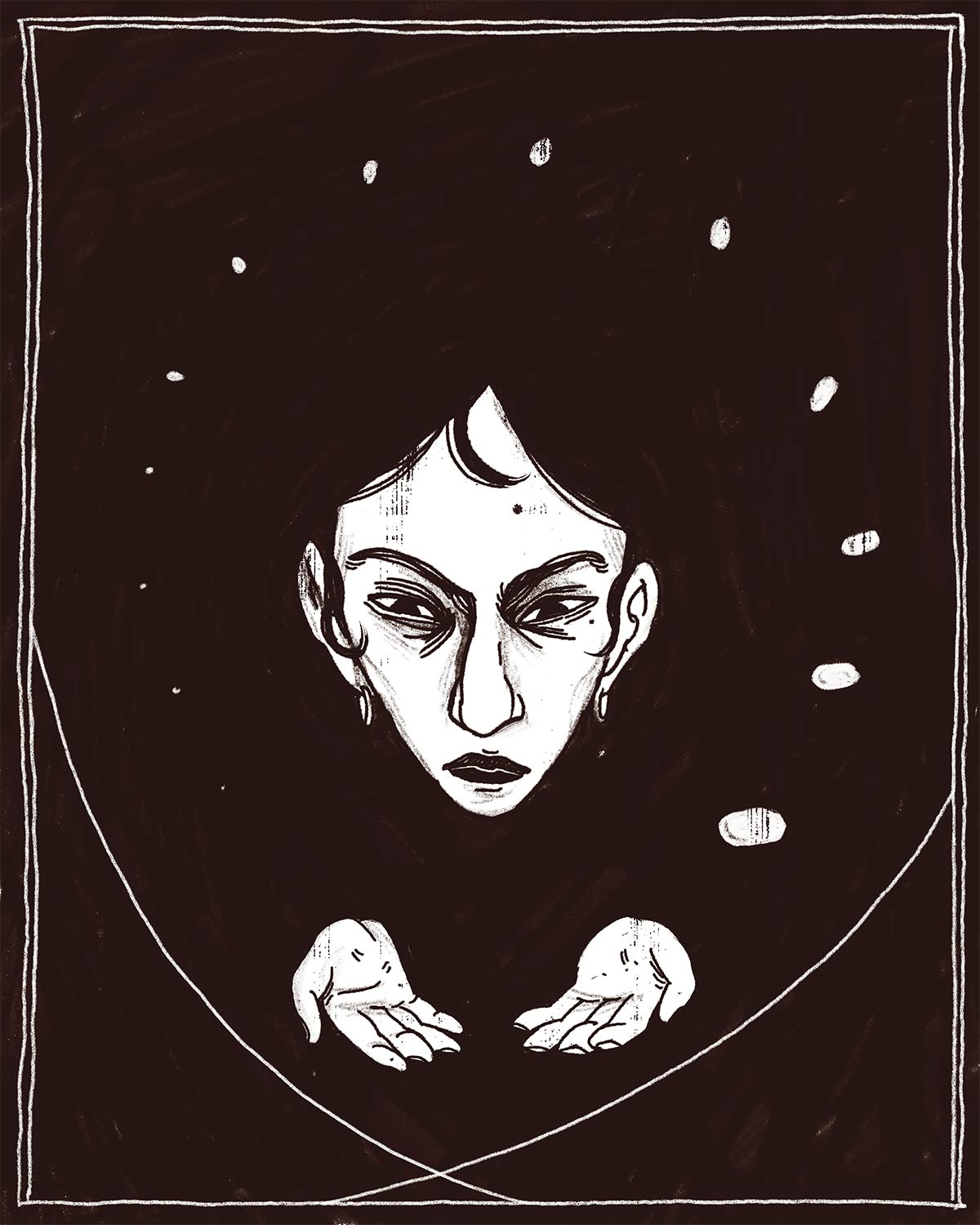
Illustration by Rama Duwaji
I met Diana Islayih at a series of writing workshops I conducted in Gaza between February and May 2024. She was one of a couple dozen young people who traveled for hours on foot, by donkey cart, or in cars forced to crawl through the crush of displacement. They were all trying to survive an ongoing genocide. Still, they risked Israeli drones and bombs to be there, just to feel human for a few hours, like they belong in this world, to touch the lives they believed they might still have.
Soft-spoken and slight, Diana was the only one who recognized me, asking quietly if I was “the real susan abulhawa.” Each writer progressed their piece at their own pace, and would read their work aloud in the workshops to receive group feedback. Diana’s was the only story that emerged almost fully formed, as if it had been waiting for language. She teared up the first time she read it aloud, and again, the second.
By the third reading, the tears were gone. “I got used to the indignities,” she told me. “Now I’m used to reading them out loud.” She confessed that she struggled living “a life that doesn’t resemble me.” On our last day together, I reminded her of what she’d said. She smiled ironically. “Now I don’t know if I resemble life,” she said.
What follows is Diana’s story, written from inside that unrecognizable life, bearing witness not through spectacle, but through one intimate moment in the unbearable weight of the everyday. — susan abulhawa, editor of Every Moment Is a Life, of which this essay is part.
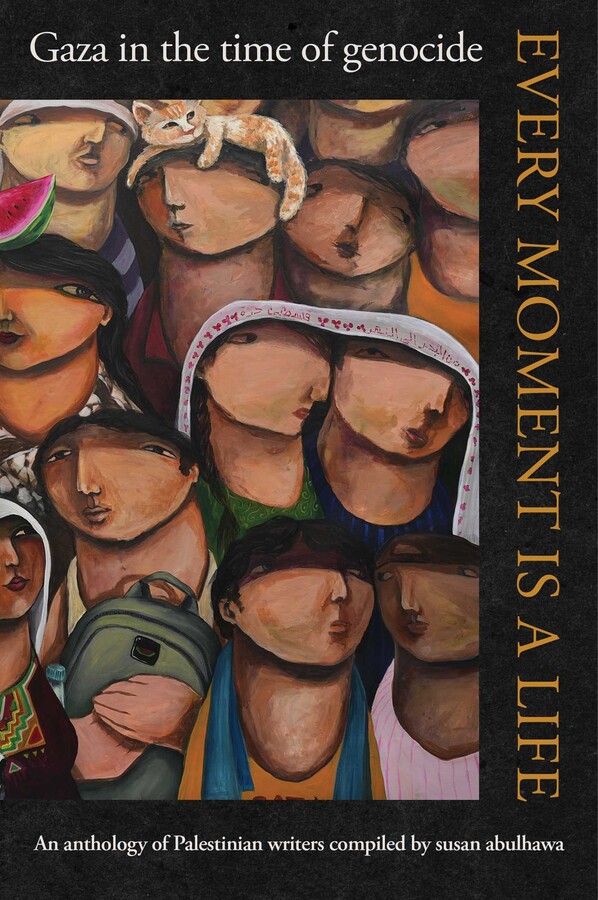
Courtesy of Simon & Schuster
I poured yellow liquid dish soap into my left palm, which instinctively cupped into a deep hollow, like a well yearning to be a well once more. I would need to wash my hands after using the toilet near our tent, though the faucet was usually empty. Water had been annihilated alongside people in this genocide, becoming a ghost that graciously deigns to appear to us when it wishes to—one we chase after rather than flee.
The miserable toilet was made of four wooden posts, wrapped in a makeshift curtain made from an old scrap of fabric—so sheer you could see silhouettes behind it. A blanket full of holes and splinters served as a “door.”
Inside, a concrete slab with a hole in the middle. You need time to convince yourself to enter such a place. The stench alone seizes your eyelids and turns your stomach the moment it creeps into your nose.
I thought about going to the damned, distant women’s public toilet. I hated it during the first weeks of our displacement, but it was the only one in the area where you could both relieve yourself and scrub off the dust of misery that clung to every air molecule.
It infuriated me that it was wretched and run-down, and the crowding only made it worse—full of sand, soiled toilet paper, and sanitary pads scattered in every corner.
“Should I go?” I asked myself, aloud.
I decided to go, taking one step forward and two steps back. I’d ask anyone returning from the toilet, “Is there water in the tap today?” and await the answer with the eagerness of a child hoping for candy.
“You have to hurry before it runs out!”
Or, more often, “There isn’t any.”
So we’d all—men, women, and children—arm ourselves with a plastic water bottle, which was a kind of public declaration: “We’re off to the toilet.” We’d also carry a bar of soap in a box, although most people didn’t bother using it since it didn’t lather and was like washing your hands with a rock.
I looked up and exhaled, staring into the vast gray nothingness that stared right back at me. Then I stepped out onto the sand across from our ramshackle displacement camp—Karama, “Camp Dignity”—though dignity itself cries out in this filthy, exhausted place, choked with chaos and a desperate scramble to moisten our veins with a drop of life.
The road was empty, as it was early morning, and even the clamor of camp life lay dormant at that hour. Still, I couldn’t relax my shoulders—to signal my senses that we were alone, that we were safe. My fingers remained clenched over the yellow dish soap, my hand hanging at my side to keep it from spilling.
I crossed the distance to the toilet—step by step, meter by meter, tent by tent. The souls who dwelled in them, just as they were, unchanged, their curious eyes fixed on me. I passed a garbage heap, shaped like a crescent moon, overflowing with all kinds of empty food cans—food that had ruined the linings of our intestines and united us in the agonies of digestion and bowel movements.
Something trickled from my palm—a thread of liquid that felt like blood dripping between my fingers, down my wrist in thickening droplets. My hand trembled, and my eyes blurred. I convinced myself—without looking—that it was all in my head, not in my hand, quickened my pace, my heartbeat thudding in my ears.
At last, I reached the only two public toilets in the area, one for men and the other for women, both encased in white plastic printed with the blue UNICEF logo.
Inside, I was met with the “toilet chronicles”—no less squalid than the toilet itself—unparalleled chatter among women who’d waited long hours in the line together.
The old women bemoaned the soft nature of our generation, insisting our condition was a “moral consequence” of our being spoiled.
Other women pleaded to be let into the toilet quickly because they were diabetic. They banged on the door with urgency and physical pain, like they would break in and grab the person behind it by the throat, shouting, “When will you come out?!”
The woman inside yelled back, “I’m squeezing my guts out! Should I vomit them up too? Have patience! Damn whoever called this a ‘rest room’!”
I looked around. A pale-faced woman smiled at me. I returned her smile, but my face quickly stiffened again, as if the muscles scolded me for stretching them into a smile. A voice inside me whispered meanly, What are you both even smiling about?
A furious cry rang from the other stall, “Oh my God! Someone is plucking her body hair! What are you doing, you bitch? It’s a toilet! A toilet!”
Another voice shot back, “Lower your voice, woman, and hurry up! The child’s crying!”
Two little girls stood nearby, with tousled hair, drool marking their cheeks, their eyes half shut. They were crying to use the toilet, clutching their crotches, shifting restlessly in the sandy corridor where we stood.
I was trying to push through to the water tap at the end of the hall, attempting to escape this tiresome, tragic theater. As my luck would have it, there was no water. I opened my palm. It too was empty. The yellow dish soap my mother bought yesterday was gone. All that remained was a sticky smear across my left hand and a long thread trailing behind me in the sand. Had it been dripping from my hand all along the way?
I twisted the faucet handle back and forth—a futile hope for even a thin thread of water. Not a single drop came.
My body sagged under the weight of rage, disappointment, fury, and a storm of unanswerable questions. I rushed through the crowded corridor of angry women, out into the street. I couldn’t hold back tears.
I wept, cursing myself and the occupation and Gaza and her sea— the sea I love with a weary, lonely love, just as I’ve always loved everything in this patch of earth.
I sobbed the entire way back. Without shame. I didn’t care who saw—not the passersby, not the homes or tents, not the ground I walked on. My grief rained tears on this land on my way there and back.
But the land’s thirst is never quenched—neither with our tears, nor with our blood.
My eyes were wrung dry from crying by the time I reached our tent. I collapsed on the ground, questions clamoring in my head.
Can a homeland also be exile?
Can another exile exist within exile?
What is home?
Is home the homeland itself, the soil of a nation?
Or is it the other way around—the homeland is only so if it’s truly home? If the homeland is the home, why do I feel like a stranger in Rafah—a place just ten minutes from my city, Khan Younis?
And why did I fear the feeling I had when I imagined myself in our kitchen, where my mother cooked mulukhiya and maqluba for the first time in six months, even though I wasn’t at home—in our house?
That day, I said aloud, “Is this what the occupation wants? For me to feel ‘at home’ merely in the memory of home?”
How can I feel at home without being there?
How can I be outside of my homeland when I’m in it?
I looked down at my hand—dry and cracked with January’s chill. The yellow soap liquid had turned into frozen white powder between my fingers.