

Digital & Print Membership
Yearly + Receive 8 free printed back issues
$420 Annually
Monthly + Receive 3 free printed back issues
$40 Monthly
The Toll Working Multiple Jobs Takes on Young People
“Rat race,” “Chaos,” “Stressful”: these are just a few ways young people are describing days stuffed with side projects, shift schedules, and Google Calendars color-coded by job.
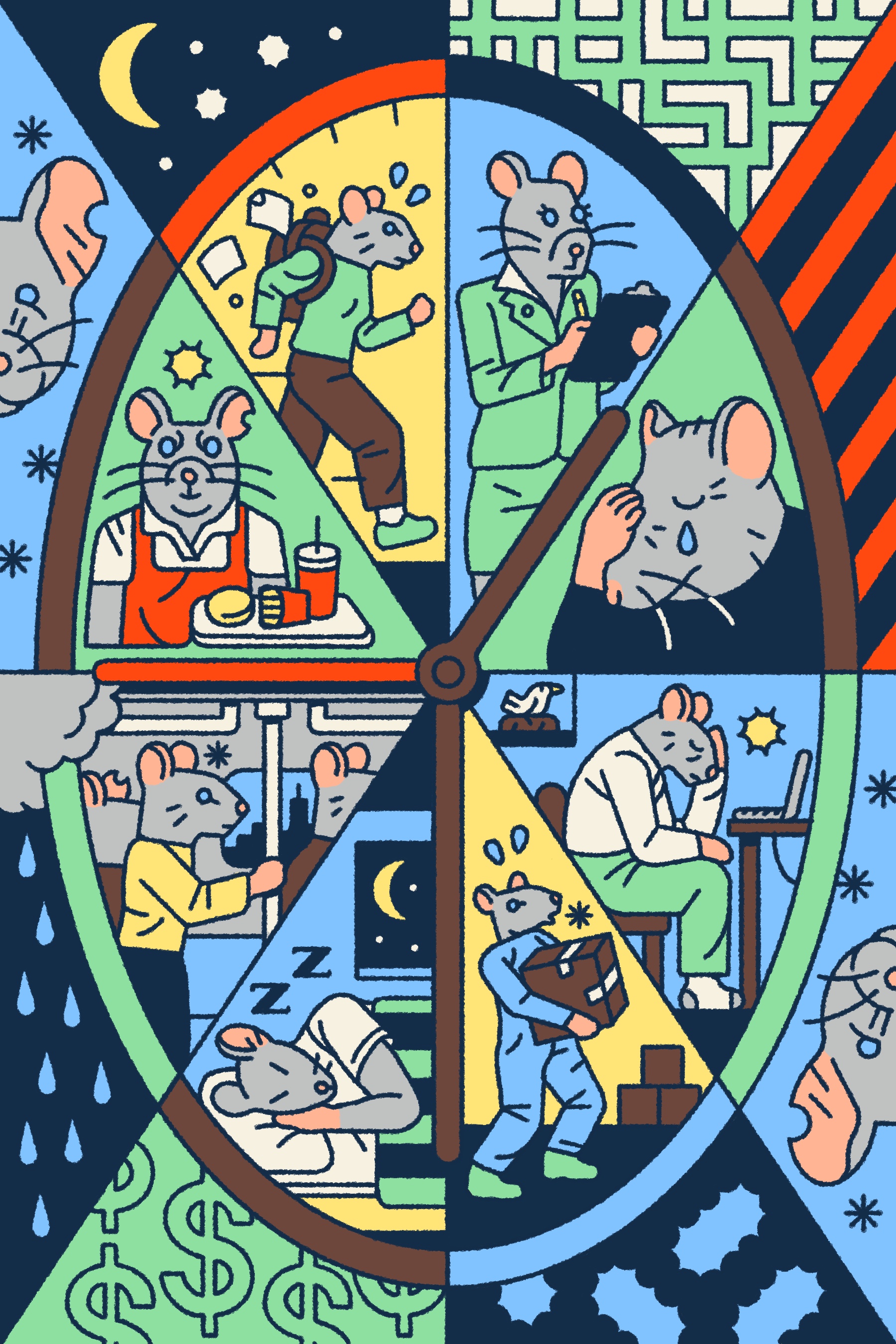
Illustration Credit: Zach Hackman
At one of her three jobs, Makayla, a 22-year-old in Texas, pushes 80-pound crates on a dolly. The seasonal retail position demands a lot of walking and lifting, with customers pulling candles off shelves faster than she can unload them. Makayla (who is going by her first name to protect her privacy) is often sore to the point of pain when she arrives at her other job, where she’s a clerk for a judge, supporting the court’s day-to-day operations.
Though Makayla lives with her parents (who she’s also helped financially in the past, she said), she pays for college tuition, living expenses, and transportation. She’s also saving to pay for law school herself. In addition to working retail and her job with the court, Makayla said she was lucky to find a paid internship related to her major, computer science, where she can build her own schedule. But between the cost of college and the rising cost of living, it feels like it’s not enough.
“It [is] a rat race, but I don’t know who’s chasing me,” Makayla explained. “It’s like I’m chasing myself.”
“Stressful” was one way young workers described days stuffed with side projects, shift schedules, and Google Calendars color-coded by job. “Tiring,” “chaos,” and “shitty” were among others. Makayla is among a growing number of young people with more than one source of income to make ends meet. According to a 2025 Harvard Youth Poll, 43% of young people surveyed say they’re struggling to get by with limited financial security.
This lack of a financial safety net is no accident. This generation’s economic squeeze is the predictable outcome of decades of monopolization and private-equity consolidation while employee wages stagnate and costs of living soar. According to recent data from the Federal Reserve, in the third quarter of 2025, the top 1% of households owned 31.7% of all U.S. wealth. This is the highest recorded disparity since the Federal Reserve began tracking household wealth in 1989.
For a generation that’s never known work without a side of total upheaval—from the pandemic reshaping jobs and internships, to companies offering, then revoking remote work, to now attacks on university funding, the federal workforce, and more—stability feels impossible to come by. With exhaustingly high costs of living and even more political, societal, and economic uncertainty looming, second jobs and side gigs are a crucial part of creating a safety net for young people who don’t have a societal one to catch them.
Why the job market feels impossible for young people right now
Ask anyone and they’ll tell you it’s a bad time to be job searching. After repeated cycles of corruption and privatization—turning housing, utilities, healthcare, and even crisis itself into profit centers—corporations have systematically hollowed out the middle class and extracted value upward. Even if pundits say that “the economy is growing,” all the profits are being pulled out by shareholders at the top. This leaves little for employees to receive basic societal benefits, including fair wages, health and retirement insurance, as well as any sort of path to upward mobility enjoyed by previous generations.
These larger forces are what drive sluggish hiring and endless layoffs, which leads to fewer people leaving or changing positions. There are fewer entry-level jobs with higher requirements — on top of panic that companies are gutting entry-level jobs to replace them with AI. To boot is also the affordability crisis in which the costs of necessities, from healthcare to groceries, have spiked. This sprawling list of factors are part of why so many workers are hanging on to multiple streams of income.
Cloud Benn, a 22-year-old in New Orleans, for instance, works as an English teacher, a gift shop worker in a cultural arts museum, and a writing tutor. Even when they were 18, Benn said working only one job has never felt viable. “Especially me being a minority. I’m Black, and I live in a city that is low-income. I [was] part of what was considered middle-class. I’m part of [the] low-class now with my family,” Benn explained. “Everything has gone up in price, and just to live, just to get your basic necessities, has gone up.”
Rates of people working multiple jobs have been on the rise, including for workers ages 25 to 54, according to Elise Gould, Senior Economist at the Economic Policy Institute. But since less work experiencein a sluggish labor market could mean fewer opportunities to break into the workforce, it feels like a particularly disastrous time to start working life. Landing that one “first job” and working up from there feels like a myth, given the endless economic chaos of the last few years.
During the start of the pandemic, young workers were disproportionately hurt by unemployment and job loss. As employers began hiring again, they had to work harder to attract and retain workers. Gould notes that, in that moment, workers had more leverage. But now, the hiring rate is depressed again, which could hurt young people more than others.
Graduating into a weaker economy can set you back, Gould explained, depending on how long this weakness lasts. Joining the workforce during an economic downturn can negatively impact health, income, and career advancement. While Gould noted this wouldn’t necessarily set you back for your lifetime in terms of career, it could be harder. One notable example, of course, is elder millennials, who graduated into the Great Recession.
Young people are seeing this instability, “among their peers, among their families, among people who often have a lot more experience than they do,” explained Noel Tieszen, a policy strategist focused on youth economic justice at National Collaborative for Transformative Youth Policy. This is especially seen with young Black workers, LGBTQ+ young people, and those whose families come from poorer socio-economic backgrounds. These communities are disproportionately impacted by unemployment or underemployment.
Young people also play multiple roles within their social circles: They are often parents, caregivers, or contributing to their communities or households. When so much time is taken up with multiple jobs, “that’s less time for family. It’s less time for exploring skills and talents,” said Tieszen. “They’re just trying to get by day-to-day, surviving, not thriving.”
It’s not just an affordability issue
In some fields, like the arts, it’s long been an accepted norm that pursuing certain lines of work might happen alongside a day job or extra gigs, an expectation of low wages or limited opportunities that many young artists are pushing back on. But there’s a huge variance in what multiple jobs can look like: While some young workers might have a side hustle outside their day job, others might work multiple jobs if they aren’t getting enough hours at one.
Reporting outlines that, now, working various jobs is appearing across industries. For example, a 2023 survey found workers in the computer and technology space were more likely to have other forms of income; 2025 data found that one in six teachers work a second job; other 2025 estimates note workers in fields like educational and health services and transportation and utilities are more likely to hold a main job with a second job.
But there are also larger shifts within the workforce that are reshaping young people’s relationship to it. Expectations that one will work their way up in a company are almost nonexistent, and stigma around job-hopping has largely been shattered. One 2025 survey noted that over half of Gen Z-ers surveyed think traditional employment will eventually be obsolete.
Thomas Showalter, an independent consultant who specializes in the transition to adulthood, education, job training, and labor, pointed out that for his generation—he’s an elder millennial—the Great Recession was an “acute shock to the system” in terms of labor market prospects. Meaning, some millennials grew up with a sense that there was a social contract, only to find it didn’t add up in early adulthood. “For Gen Z, and probably for [Gen] Alpha too, I think it’s more of a chronic condition,” he explained. “What I observed over the years with younger people is [that] there was never a social contract; I’m just assuming that I’m going to have to hustle all the time.”
This has led many young workers to try to create stability for themselves, since living off one source of income doesn’t always feel possible. Christopher Hendrix, a 25-year-old in Southern California, has a full-time job at a nonprofit, does community organizing work focused on youth homelessness, and is pursuing his master’s degree in social work. In his social circle, he said people are always thinking about what opportunity could be next, and that Gen Z can’t necessarily depend on one job to get them where they want to go. Hendrix grew up low-income and got used to working multiple jobs to support himself. “I can pay my bills. I’m stable, but I still have this itching thought that, no, you got to keep working, because one day it can be taken away from you,” he said.
For some, working multiple jobs can also be a means of pursuing work they’re interested in.
Izabella Escurra, a 23-year-old in New Jersey, works full-time in college admissions and in her off hours has a side hustle as a freelance publicist. “I feel like a lot of Gen Z people are using side hustles to make their own businesses or to take the entrepreneurial mindset,” she said.
She thinks ballooning standards for entry-level jobs are a factor, too. “One to two internships, that’s really not the baseline for a lot of entry-level jobs anymore,” she said. “I think they’re seeing from their older siblings or older relatives that the job market isn’t what it used to be.”
There’s a mental toll to the hustle, too
As workers endlessly hustle, what looms is the toll it takes to work this much—and the potential ramifications it has on the rest of one’s working life.
Burnout, which Gen Z is already experiencing higher rates of, can have a significant impact. “The structural conditions driving young workers toward multiple jobs—wage stagnation, job insecurity, rising costs of living—are themselves chronic stressors that compound the day-to-day demands of managing multiple positions,” said M. Gloria González Morales, an associate professor and director of The Worker Wellbeing Lab at Claremont Graduate University. There is also evidence that work experiences during formative career periods influence someone’s attitude toward work later.
“No one talks about emotionally, how irritable it makes you,” said Makayla. “When you work so much and you’re tired, a lot of times you’re not present for the things you do.”
But there are solutions. Morales pointed to the importance of social support, including from supervisors and coworkers. Workplaces can provide resources, including autonomy, skill development opportunities, and addressing health and safety and work-life balance, she added.
“Policy approaches that improve wages, provide scheduling predictability, and strengthen worker protections could reduce the structural conditions that push young workers toward multiple job arrangements,” Morales said.
Tieszen emphasized the need to ensure young workers are educated about their rights, noting growing interest among young people in unions. But she also noted it demands going beyond jobs: “It’s about making sure that the other systems and structures in society are functioning,” Tieszen said. Funding for healthcare, childcare, and transportation is critical. “The fear of losing a job and having hours cut is real, and it’s grounded in reality,” she said. If other systems are in place, that relieves stress.
Benn said that figuring out how to even survive right now takes a toll, and also believes there needs to be more support and more opportunities for people to talk about what they’re experiencing.
“There are people out there that are like, ‘Oh, young people don’t want to do anything,’” Benn said. “No, we are busting our ass. We’re tired, and we just want to lay down.”
{
"article":
{
"title" : "The Toll Working Multiple Jobs Takes on Young People",
"author" : "Rainesford Stauffer",
"category" : "interviews",
"url" : "https://everythingispolitical.com/readings/toll-working-multiple-jobs-young-people",
"date" : "2026-02-10 13:57:00 -0500",
"img" : "https://everythingispolitical.com/uploads/EverythingisPol-ZachHackman.jpg",
"excerpt" : "“Rat race,” “Chaos,” “Stressful”: these are just a few ways young people are describing days stuffed with side projects, shift schedules, and Google Calendars color-coded by job.",
"content" : "“Rat race,” “Chaos,” “Stressful”: these are just a few ways young people are describing days stuffed with side projects, shift schedules, and Google Calendars color-coded by job.Illustration Credit: Zach HackmanAt one of her three jobs, Makayla, a 22-year-old in Texas, pushes 80-pound crates on a dolly. The seasonal retail position demands a lot of walking and lifting, with customers pulling candles off shelves faster than she can unload them. Makayla (who is going by her first name to protect her privacy) is often sore to the point of pain when she arrives at her other job, where she’s a clerk for a judge, supporting the court’s day-to-day operations.Though Makayla lives with her parents (who she’s also helped financially in the past, she said), she pays for college tuition, living expenses, and transportation. She’s also saving to pay for law school herself. In addition to working retail and her job with the court, Makayla said she was lucky to find a paid internship related to her major, computer science, where she can build her own schedule. But between the cost of college and the rising cost of living, it feels like it’s not enough.“It [is] a rat race, but I don’t know who’s chasing me,” Makayla explained. “It’s like I’m chasing myself.”“Stressful” was one way young workers described days stuffed with side projects, shift schedules, and Google Calendars color-coded by job. “Tiring,” “chaos,” and “shitty” were among others. Makayla is among a growing number of young people with more than one source of income to make ends meet. According to a 2025 Harvard Youth Poll, 43% of young people surveyed say they’re struggling to get by with limited financial security.This lack of a financial safety net is no accident. This generation’s economic squeeze is the predictable outcome of decades of monopolization and private-equity consolidation while employee wages stagnate and costs of living soar. According to recent data from the Federal Reserve, in the third quarter of 2025, the top 1% of households owned 31.7% of all U.S. wealth. This is the highest recorded disparity since the Federal Reserve began tracking household wealth in 1989.For a generation that’s never known work without a side of total upheaval—from the pandemic reshaping jobs and internships, to companies offering, then revoking remote work, to now attacks on university funding, the federal workforce, and more—stability feels impossible to come by. With exhaustingly high costs of living and even more political, societal, and economic uncertainty looming, second jobs and side gigs are a crucial part of creating a safety net for young people who don’t have a societal one to catch them.Why the job market feels impossible for young people right nowAsk anyone and they’ll tell you it’s a bad time to be job searching. After repeated cycles of corruption and privatization—turning housing, utilities, healthcare, and even crisis itself into profit centers—corporations have systematically hollowed out the middle class and extracted value upward. Even if pundits say that “the economy is growing,” all the profits are being pulled out by shareholders at the top. This leaves little for employees to receive basic societal benefits, including fair wages, health and retirement insurance, as well as any sort of path to upward mobility enjoyed by previous generations.These larger forces are what drive sluggish hiring and endless layoffs, which leads to fewer people leaving or changing positions. There are fewer entry-level jobs with higher requirements — on top of panic that companies are gutting entry-level jobs to replace them with AI. To boot is also the affordability crisis in which the costs of necessities, from healthcare to groceries, have spiked. This sprawling list of factors are part of why so many workers are hanging on to multiple streams of income.Cloud Benn, a 22-year-old in New Orleans, for instance, works as an English teacher, a gift shop worker in a cultural arts museum, and a writing tutor. Even when they were 18, Benn said working only one job has never felt viable. “Especially me being a minority. I’m Black, and I live in a city that is low-income. I [was] part of what was considered middle-class. I’m part of [the] low-class now with my family,” Benn explained. “Everything has gone up in price, and just to live, just to get your basic necessities, has gone up.”Rates of people working multiple jobs have been on the rise, including for workers ages 25 to 54, according to Elise Gould, Senior Economist at the Economic Policy Institute. But since less work experiencein a sluggish labor market could mean fewer opportunities to break into the workforce, it feels like a particularly disastrous time to start working life. Landing that one “first job” and working up from there feels like a myth, given the endless economic chaos of the last few years.During the start of the pandemic, young workers were disproportionately hurt by unemployment and job loss. As employers began hiring again, they had to work harder to attract and retain workers. Gould notes that, in that moment, workers had more leverage. But now, the hiring rate is depressed again, which could hurt young people more than others.Graduating into a weaker economy can set you back, Gould explained, depending on how long this weakness lasts. Joining the workforce during an economic downturn can negatively impact health, income, and career advancement. While Gould noted this wouldn’t necessarily set you back for your lifetime in terms of career, it could be harder. One notable example, of course, is elder millennials, who graduated into the Great Recession.Young people are seeing this instability, “among their peers, among their families, among people who often have a lot more experience than they do,” explained Noel Tieszen, a policy strategist focused on youth economic justice at National Collaborative for Transformative Youth Policy. This is especially seen with young Black workers, LGBTQ+ young people, and those whose families come from poorer socio-economic backgrounds. These communities are disproportionately impacted by unemployment or underemployment.Young people also play multiple roles within their social circles: They are often parents, caregivers, or contributing to their communities or households. When so much time is taken up with multiple jobs, “that’s less time for family. It’s less time for exploring skills and talents,” said Tieszen. “They’re just trying to get by day-to-day, surviving, not thriving.”It’s not just an affordability issueIn some fields, like the arts, it’s long been an accepted norm that pursuing certain lines of work might happen alongside a day job or extra gigs, an expectation of low wages or limited opportunities that many young artists are pushing back on. But there’s a huge variance in what multiple jobs can look like: While some young workers might have a side hustle outside their day job, others might work multiple jobs if they aren’t getting enough hours at one.Reporting outlines that, now, working various jobs is appearing across industries. For example, a 2023 survey found workers in the computer and technology space were more likely to have other forms of income; 2025 data found that one in six teachers work a second job; other 2025 estimates note workers in fields like educational and health services and transportation and utilities are more likely to hold a main job with a second job.But there are also larger shifts within the workforce that are reshaping young people’s relationship to it. Expectations that one will work their way up in a company are almost nonexistent, and stigma around job-hopping has largely been shattered. One 2025 survey noted that over half of Gen Z-ers surveyed think traditional employment will eventually be obsolete.Thomas Showalter, an independent consultant who specializes in the transition to adulthood, education, job training, and labor, pointed out that for his generation—he’s an elder millennial—the Great Recession was an “acute shock to the system” in terms of labor market prospects. Meaning, some millennials grew up with a sense that there was a social contract, only to find it didn’t add up in early adulthood. “For Gen Z, and probably for [Gen] Alpha too, I think it’s more of a chronic condition,” he explained. “What I observed over the years with younger people is [that] there was never a social contract; I’m just assuming that I’m going to have to hustle all the time.”This has led many young workers to try to create stability for themselves, since living off one source of income doesn’t always feel possible. Christopher Hendrix, a 25-year-old in Southern California, has a full-time job at a nonprofit, does community organizing work focused on youth homelessness, and is pursuing his master’s degree in social work. In his social circle, he said people are always thinking about what opportunity could be next, and that Gen Z can’t necessarily depend on one job to get them where they want to go. Hendrix grew up low-income and got used to working multiple jobs to support himself. “I can pay my bills. I’m stable, but I still have this itching thought that, no, you got to keep working, because one day it can be taken away from you,” he said.For some, working multiple jobs can also be a means of pursuing work they’re interested in.Izabella Escurra, a 23-year-old in New Jersey, works full-time in college admissions and in her off hours has a side hustle as a freelance publicist. “I feel like a lot of Gen Z people are using side hustles to make their own businesses or to take the entrepreneurial mindset,” she said.She thinks ballooning standards for entry-level jobs are a factor, too. “One to two internships, that’s really not the baseline for a lot of entry-level jobs anymore,” she said. “I think they’re seeing from their older siblings or older relatives that the job market isn’t what it used to be.”There’s a mental toll to the hustle, tooAs workers endlessly hustle, what looms is the toll it takes to work this much—and the potential ramifications it has on the rest of one’s working life.Burnout, which Gen Z is already experiencing higher rates of, can have a significant impact. “The structural conditions driving young workers toward multiple jobs—wage stagnation, job insecurity, rising costs of living—are themselves chronic stressors that compound the day-to-day demands of managing multiple positions,” said M. Gloria González Morales, an associate professor and director of The Worker Wellbeing Lab at Claremont Graduate University. There is also evidence that work experiences during formative career periods influence someone’s attitude toward work later.“No one talks about emotionally, how irritable it makes you,” said Makayla. “When you work so much and you’re tired, a lot of times you’re not present for the things you do.”But there are solutions. Morales pointed to the importance of social support, including from supervisors and coworkers. Workplaces can provide resources, including autonomy, skill development opportunities, and addressing health and safety and work-life balance, she added.“Policy approaches that improve wages, provide scheduling predictability, and strengthen worker protections could reduce the structural conditions that push young workers toward multiple job arrangements,” Morales said.Tieszen emphasized the need to ensure young workers are educated about their rights, noting growing interest among young people in unions. But she also noted it demands going beyond jobs: “It’s about making sure that the other systems and structures in society are functioning,” Tieszen said. Funding for healthcare, childcare, and transportation is critical. “The fear of losing a job and having hours cut is real, and it’s grounded in reality,” she said. If other systems are in place, that relieves stress.Benn said that figuring out how to even survive right now takes a toll, and also believes there needs to be more support and more opportunities for people to talk about what they’re experiencing.“There are people out there that are like, ‘Oh, young people don’t want to do anything,’” Benn said. “No, we are busting our ass. We’re tired, and we just want to lay down.”"
}
,
"relatedposts": [
{
"title" : "Bad Bunny's Halftime Show Is About So Much More Than Symbolism",
"author" : "Zameena Mejia",
"category" : "essays",
"url" : "https://everythingispolitical.com/readings/bad-bunnys-halftime-show-is-about-so-much-more-than-symbolism",
"date" : "2026-02-09 09:10:00 -0500",
"img" : "https://everythingispolitical.com/uploads/Cover_EIP_Bad_Bunny_SB.jpg",
"excerpt" : "Joy Is an Equal Part of Protest as Rage",
"content" : "Joy Is an Equal Part of Protest as RageOn Sunday night, Bad Bunny transformed the Super Bowl LX field in Santa Clara, Calif. into an homage to the Puerto Rican countryside for a historic, almost entirely Spanish set. Weaving through sugar cane fields and scenes of everyday life in Puerto Rico, he carried a football that said, “TOGETHER, WE ARE AMERICA” as he sang a career-spanning medley of his own songs, also splicing in a few classic hits from some of reggaeton’s pioneering voices like Tego Calderón, Don Omar and Daddy Yankee, and a surprise salsa rendition with Lady Gaga of 2025’s most popular song “Die With a Smile.” As red, white, and blue fireworks—specifically a light shade of blue similar to that seen in Puerto Rico’s independence flag—shot up around Bad Bunny, the Puerto Rican artist unabashedly elevated the pride, joy, and struggles that come with being Latino in today’s political climate and reminded us that America is comprised of a full continent of sovereign nations and occupied territories–not just the U.S.For the fans who endearingly coined Sunday’s event “Benito Bowl,” this moment is about so much more than seeing the world’s most popular Spanish-language superstar take the stage: It’s about seeing Bad Bunny leverage his privilege to defend Latinos’ dignity, push back on the U.S. government’s draconian anti-immigrant actions, and rally the American public around something far more fortifying than violence: music and art.Bad Bunny’s performance comes at a time when Latinos and immigrants of other ethnicities in the U.S. are being disappeared, detained, and deported in historic numbers. They have been unable to go to work, send their kids to school, go to their houses of worship, or even attend mandatory immigration hearings without the fear of being targeted by federal law enforcement for the color of their skin or ability to speak English, regardless of their immigration status. In the past few weeks alone, Americans exercising their constitutional rights to protest and document ICE activity have led to the shocking deaths of U.S. citizens Renee Nicole Good and Alex Pretti in Minneapolis, Minn., offering a sobering example of how ICE violence can (and will) affect all of the people in this country, not just Latinos. This does not even begin to cover how American imperialism is affecting Latinos abroad. It has only been a few weeks since the U.S. government attacked Venezuela (and gained more oil control, as a result), captured President Nicolás Maduro, invoked the Monroe Doctrine, threatened to intervene in additional Latin American nations, and continues to carry out deadly attacks on alleged drug boats in the Caribbean Sea and the Eastern Pacific.Holding this dichotomy–elation for the possible, humane future Bad Bunny represents, and the unmitigated state violence America has imposed on Latinos–is not easy. When “el conejo malo,” as Bad Bunny is also known in Spanish, appeared in a gray beanie hat with bunny ears at the halftime show press conference last week, it was difficult to not think back to just a couple of weeks ago when the image of 5-year-old Liam Conejo Ramos went viral as he stood alone circled by federal agents, wearing a bright blue bunny hat when ICE detained him, and abducted him from Minneapolis to an ICE detention facility in Dilley, Texas. (Liam’s family, лoriginally from Ecuador, had entered the country legally and were in the middle of an active asylum case, but in being apprehended, they were denied their Constitutional right to due process, which applies to everyone in the U.S., regardless of immigration status.)But, at a time when Latinos have been threatened with deportation just for speaking Spanish, Bad Bunny’s ascent to global stardom has reinforced Spanish as a language of resistance. Just three years after Bad Bunny’s first-ever Grammy Awards performance of Un Verano Sin Ti, he won the evening’s highest honor, Album of the Year, at the 2026 Grammys for his most political album yet, Debí Tirar Más Fotos. Importantly, though, he gave his acceptance speech almost entirely in Spanish, except for one message in English:“I want to dedicate this award to all the people that had to leave their homeland, their country, to follow their dreams,” he said.Here, Bad Bunny wasn’t just talking about Latinos; he was talking about everyone who has suffered under the oppression of white colonialism. And though Bad Bunny is first and foremost a celebrity and not our savior—for we must always save ourselves—this moment summarized a powerful, collective narrative shift that’s taking place in the U.S.: one in which the anti-immigrant sentiments expressed by the Oval Office feel completely out of step with the future that Americans are demanding. A future where art and music can be used for political good. A future where people can uphold the values of a democracy that includes and represents Latinos and immigrants of all backgrounds.Photo Credit: Eric RojasLeading up to the Super Bowl, anti-ICE posters have been plastered around San Francisco featuring unofficial artwork of el Sapo Concho—an illustrated toad character from Debí Tirar Más Fotos—with the words “chinga la migra” and “ICE out” in bold red and white words. In an ode to the communities across the U.S. who have formed rapid response networks and use red whistles to alert neighbors of ICE activity, the unofficial Sapo Concho also wears a whistle around its neck. Protestors have even dressed up as the album mascot, wearing “chinga la migra” shirts at parties around the Bay Area. Despite the NFL’s recent statements that denied there would be any ICE presence outside of the Super Bowl, Latinos in the Bay Area still feel distrust and fear.Up until this point, the halftime show marked Bad Bunny’s only Debí Tirar Más Fotos concert in the U.S. In 2025, he announced he had excluded the mainland U.S. from his world tour out of concern that ICE officers would target, detain, and deport his fans.And he was right. From the moment Bad Bunny made his Super Bowl Halftime show announcement in September 2025, right-wing conservatives doubled down on inciting fear. Within a week of the news, Kristi Noem, head of the Department of Homeland Security (DHS), said she would ensure ICE presence outside of the Super Bowl. DHS adviser Corey Lewandowski alleged that Bad Bunny hates America. President Donald Trump denounced Bad Bunny’s role, first claiming to not know who the Grammy-award-winning artist was, and later calling the choice “ridiculous” and “terrible,” claiming that “all it does is sow hatred.”Yet it is the right wing that has spent months sowing division among Americans, asserting that Bad Bunny—born Benito Antonio Martínez Ocasio, a U.S. citizen in the unincorporated U.S. territory of Puerto Rico—is “anti-American” and criticized the NFL’s decision to platform an artist who mainly sings in Spanish (which is the most commonly spoken non-English language in the U.S). In response, MAGA conservatives backed a competing halftime show created in protest against Bad Bunny and headlined by country rock singer Kid Rock.At worst, Bad Bunny has used his music to hold up a mirror to Trump’s administration since his first term in office. During a 2017 benefit concert for post-Hurricane Maria relief for Puerto Rico, Bad Bunny made and wore a shirt indirectly targeted at Trump that said, “¿Tu eres twitero o presidente?” which translates to “Are You a Tweeter or President?” In his 2020 song “Compositor del Año,” he rapped in defense of the Black Lives Matter movement, implored young people to vote, and said “there are more important things like fighting for the rights of immigrants,” all while calling out the president’s inaction. And despite his global popularity, Bad Bunny’s political stances remain a significant departure from mainstream political values, especially among the traditionally conservative, increasingly right-leaning Latinos in the U.S. and across Latin America. His ability to reach new audiences and draw connections between distant communities’ struggles by highlighting issues happening in Puerto Rico are prime examples of how global artists can use their music to challenge the political status quo and bring about progressive change.To non-Spanish speakers, Bad Bunny’s blend of salsa, reggaeton, dembow, bomba y plena, and rap makes for music that’s fun and catchy. Lyrically, though, it’s clear how he uses his art to send a loud message. Debí Tirar Más Fotos and its accompanying music videos tackle gentrification and displacement of Puerto Ricans on the island and its diaspora, honor Puerto Rico’s anticolonial heroes and pro-independence movements, and celebrate the resistance. On the song “Lo Que Le Pasó a Hawaiʻi,” which Puerto Rican crooner Ricky Martin performed at the halftime show, he connects the shared struggles U.S. colonization has brought upon Puerto Rico and Hawaii.Beyond American politics, Bad Bunny’s success as a politically forward Caribbean and Puerto Rican artist carries a deeper meaning within the Latino community. Historically, people from Caribbean countries have been marginalized and discriminated against for being largely racialized as Black—as a result of the legacy of slavery in the Caribbean—as well as for having vastly distinct accents from the rest of Latin America due to centuries of being subjugated by colonial powers. Bad Bunny’s success over the past decade brought about newfound attention on Puerto Rican and Caribbean genres, art, fashion, vocabulary, and history.For the many Caribbean Latinos who grew up being told their Spanish was “incorrect” or “not good,” seeing Bad Bunny’s ascent to mainstream TV programming, films, and the overall cultural zeitgeist – without having to codeswitch or change his accent – is validating. White supremacist ideals are still baked into many parts of Latino culture because of centuries of European colonization: for instance, in the way accents are forcibly “corrected” (whitewashed) in order to be deemed professional. Or in the way that traditionally Black Latin music genres like bachata, reggaeton, salsa, and dembow have historically struggled to achieve commercial success until they were extracted from Caribbean countries and performed by white and light-skinned artists from other parts of Latin America or Spain.Through his latest projects, Bad Bunny has invited the world to see Puerto Rico and the Caribbean in its totality—as so much more than just what can be consumed or extracted from our cultures.Photo Credit: Eric RojasThere’s a curious moment in Bad Bunny’s 2025 music video for “NUEVAYoL,” where he imagines a world where Trump apologizes to the Latino community in the music video: “I made a mistake. I want to apologize to the immigrants in America, I mean the United States, I know America is the whole continent,” a Trump impersonator says over a radio. “I want to say that this country is nothing without the immigrants. This country is nothing without Mexicans, Dominicans, Puerto Ricans, Colombians, Venezuelans, Cubans.” Without skipping a beat, those listening to this message shut it off and carry on with what they were doing.The success of Bad Bunny’s Super Bowl halftime show feels like an extension of this very sentiment. It reminds us that our collective strength is more powerful than the divisive, hateful forces that try to silence us. As the NFL capitalizes on Bad Bunny’s stardom, a move that makes sense as the league aims to reach more Latino consumers and continue to push into international markets, it’s important to remember that the NFL needed Bad Bunny more than Bad Bunny needed them—and the Puerto Rican artist likely knows this. He not only brought his Debí Tirar Más Fotos party to the world’s biggest TV event, but he also demonstrated that joy is equally a part of protest as rage. Because nothing makes the opposition more upset than indifference. Than the dissent that it takes to go on living."
}
,
{
"title" : "A Call to Arms",
"author" : "Jeremiah Zaeske",
"category" : "essays",
"url" : "https://everythingispolitical.com/readings/a-call-to-arms",
"date" : "2026-02-03 11:17:00 -0500",
"img" : "https://everythingispolitical.com/uploads/1000013371.jpeg",
"excerpt" : "Birds perch on the gaps in barbed wire",
"content" : "Birds perch on the gaps in barbed wireBeckoning us to join themWater trickles through the obstruction in its path as if it were nonexistentWe have forgotten that we are waterVines weave a tapestry through metalIf trees cannot find a gap in the fence they will squeeze their way through,engulf it,absorb the border within themselvesThis is a call to armsLOVEI want my love to break through glassI want it to uproot the weeds that have grown in my heart as it picks through yoursI want it to burn through every piece of fabric stained with bloodLove was never a pacifistWhere there is evil there will also be two kinds of joyOne that revels in the misery,grinning faces posing with dead bodieswhile others look on in silence growing numbBut love is the joy of resilienceThe joy of knowing we will always need eachother enoughto tear down the walls and reach out our handsin spite of everything, even deathTo grab at the roots of ourselvesand plant flowers in place of the hate that’s been sown,though the stems may have thornsThis love will be the callouses born from fighting our waythrough rough brick and sharp glass edges,but they’ll just make it that much softer when palm meets palmThis love will be the fertilizer for a garden of scar tissue,never again to be buried under earth and thick skinThis love will be the seeds taking rootafter a long cold winter,sprouting from our chests and cracks in the pavementto greet a long-awaited springA NURTURING DEATHShot-gun weddingDrive-by baby showerClose-range baptismBurn down the forest,the church and the steepleThe baby’s gender is Destruction,Death, andPrimordial ChaosWe are unlocking the worlds they shut away,beyond the talons of textbook definitions,worlds they swore could never existworlds they swore to destroyWe’re pulling out fragmentsthrough the cracked open doorto fill the potholes and cracked cementof our bodymindsouls,to make salve for the woundsThe ones they claimed were pre-existingand unfillableand unfixableand “who’s going to pay for that?”We are toppling immovable fortresseslimb by limb,peeling off skin and tearing through tendonto reveal the brittle forgeries of boneWe are de-manufacturing wildernessNot just free reign for the treesor even all the life they hold,but regrowth for the village of Ahwahnee,birds pecking out the eyes of campers at YosemiteWhat remains will be fed back into the ecosystem,into the bellies of bears and mountain lions,swallowed by insects and earthuntil it’s decayed enough to fertilize the soiland grow foodmedicinelifeA rebirthA nurturing death"
}
,
{
"title" : "This is America: Land of the Occupied, Home of the Capitalists",
"author" : "Mattea Mun",
"category" : "essays",
"url" : "https://everythingispolitical.com/readings/this-is-america",
"date" : "2026-02-03 11:11:00 -0500",
"img" : "https://everythingispolitical.com/uploads/ice-protest-2-gty-gmh-260130_1769810312461_hpMain.jpg",
"excerpt" : "They tell us we live in the land of the free. They declare, “we the people,” and we assume they mean us when we were only ever defined – designed – to be the fodder to build their “life, liberty, and pursuit of happiness.”",
"content" : "They tell us we live in the land of the free. They declare, “we the people,” and we assume they mean us when we were only ever defined – designed – to be the fodder to build their “life, liberty, and pursuit of happiness.”On a Thursday, a 2-year-old girl returned home from the store with her father, Elvis Tipan-Echeverria, when unknown, masked agents trespassed onto their driveway and smashed the window in. In the name of defending the pursuit of happiness, she, with her father, was shoved into a car with no car seat and placed on a plane to Texas. This little girl was eventually returned to her mother in Minnesota; her father – still imprisoned in the land of the free.In the name of liberty, 5-year-old Liam Ramos, with his father, was seized and flown away from his mother and his home to sit in a detention facility in Texas, where his education will halt, his freedom is non-existent, and his pursuit of happiness – denied.In the name of life, Chaofeng Ge was “found” hanging, dead, in a shower stall in detention, his death declared a suicide though his hands and feet were bound behind his back, a fact evidently not deemed worthy of being initially disclosed. Geraldo Lunas Campos was handcuffed, tackled and choked – murdered – in detention, in an effort to “save” him. Victor Manuel Diaz, too, was “found” dead, a “presumed suicide,” the autopsy – classified.American voters like to declare that our present reality isn’t “what they voted for,” despite the fact that one of Donald Trump’s campaign promises in the 2024 election was to “carry out the largest domestic deportation operation in American history,” inevitably according to xenophobic and white supremacist lines. What many of us fail to remember is that this is not the first time we have voted for this. Indeed, I am not confident there is any point in American history that we have not collectively voted for this, regardless of so-called “party lines.”We Have Been Here BeforeWhile the Department of Homeland Security’s (DHS) U.S. Immigration and Customs Enforcement (ICE) was founded in 2003, slavery and genocide predated the very Constitution of the United States, the bodies of African Americans and Indigenous Americans brutalized and broken in the service of laying the foundations of (white) American wealth. Though slavery was “abolished” in 1865 by the 13th amendment, this did not end the policing of racialized bodies.During the Reconstruction era, convict leasing and black codes preserved the conditions and social hierarchy that existed under slavery. Moreover, any legal rights afforded Black Americans were and still are persistently undermined by their inferior social caste, whereby their deaths and suffering at the hands of law enforcement, the healthcare system and other Americans often goes unprosecuted and/or unpunished.Within WWII-era Japanese internment camps, inmates were stripped of their freedom to move, subjected to harsh living conditions and coerced to partake in underpaid, unprotected labor.The Lucrative Business of Slavery and its Bipartisan ProfiteersTo this day, the prison system remains a potent vestige of slavery, again for the sake of profit, as inmates’ human rights are systematically liquidated. As early as the 1980s, the federal government has contracted for-profit prison corporations to operate federal detention facilities. Today, over 90% of ICE detention facilities are operated by for-profit prison corporations as of 2023, a figure which increased from 79% within Biden’s presidency alone.These trends, in conjunction with the ongoing mass detainments of America’s people of color, are not surprising when we consider the immense profits our politicians and some Americans stand to gain, made possible by the continuous enslavement of racialized bodies.Our bodies are their profit.Under the Voluntary Work Program, forced carceral labor is codified, whereby detainees are to receive “monetary compensation of not less than $1.00 per day of work completed,” their “voluntary” labor absolving them of legal employee protections, such as minimum wage. And although ICE affirms that “all detention facilities shall comply with all applicable health and safety regulations and standards,” there is confusion as to how these standards are checked, especially when we consider the Trump administration closed the DHS’s Office for Civil Rights and Civil Liberties in March 2025.Nevertheless, several lawsuits and detainee testimonies attest to the fact that the work program is rarely voluntary, the survival of themselves and the facilities imprisoning them hinging upon their labor and minimal income. Indeed, many detainees are expected to purchase their own basic products, such as toilet paper and soap. Other detainees recall being threatened with solitary confinement, poorer living conditions and material punishment if they refused to work. Martha Gonzalez was denied access to sanitary pads when she requested a day off work, demonstrative of a larger pattern of ICE’s refusal to provide hygiene products and spaces to maintain one’s hygiene in a dignified manner.In 2023, GEO Group, one of the largest for-profit prison corporations, made over $2.4 billion in revenue, of which ICE, as their largest customer, accounted for 43%, or $1.04 million. ICE also accounted for 30% of CoreCivic’s – another large for-profit prison corporation – revenue. Thus, our bodies enable these companies to amass hundreds of millions in profit.Incidentally, CoreCivic and GEO Group are among the private prison companies that contribute the most to political campaigns, parties and candidates. In the 2024 election cycle, GEO Group gave $3.7 million in contributions, including $1 million to Make America Great Again Inc, while CoreCivic provided roughly $785,000 in contributions. While Republican candidates and committees have been the recipient of the large majority of these funds in recent years, Democrats and the Democratic Party are also guilty of accepting funding from these corporations, among others. In the 2024 cycle, CoreCivic contributed $50,000 to the Democratic Lieutenant Governors Association and Kamala Harris received $9,500 from GEO Group.The opportunities for profit extend even further beyond the U.S.’s borders as more and more nations are gradually entering deals to imprison noncitizen deportees coming from the U.S. In November, $7.5 million was paid out to Equatorial Guinea for this purpose. Alongside other Latin American countries like Costa Rica and El Salvador, Argentina is also rumored to strike their own deal with the U.S.Our bodies are their profit.The ongoing ICE campaign stands as a bipartisan issue, mirroring the ways our country’s deepest social inequalities have been repeatedly upheld on all sides of the political aisle throughout our history.The Occupied Mind and BodyMoreover, the policing of racialized bodies does not merely pertain to the body alone as a site to be moved and removed. Rather, this violence is also waged in our social spaces, in our fears and inside of our bodies.In the classroom, our curriculums hardly, if at all, represent a version of events where we existed and meanwhile the current administration actively tries to erase any part of history we are given a claim to. Such initiatives, too, have been supported for generations, reflected in the 150-year period Indigenous American and Hawaiian children were forcibly taken from their homes and sent to boarding schools designed to facilitate their assimilation and more seamless theft of their native lands.In our social spaces and lives – if not yet brutally taken – liberty and the pursuit of happiness is not ours for the taking. We are perpetually told under what conditions our movement is permissible. Decades of redlining have, in many ways, preserved segregation and pooled the best resources for the white and the wealthy to the detriment of communities of color.But even this is not enough.They police us from the inside, too. In exchange for gifts like food and photographs of her daughter, a Nicaraguan woman was subjected to have sex with a now former ICE officer whilst in detention. A “romantic relationship,” according to federal prosecutors. Our suffering is still romanticized even when guilt has been assigned. What they still do not realize is that there is no place for romance to reside so long as we remain shackled, our bodies – looted.From the inside, they forcibly remove our reproductive organs, then and now. Many of us were among the 70,000 forcibly sterilized in the 20th-century, deemed “unfit” to reproduce. As we speak, 32% of surgeries performed in ICE detention facilities are performed without proper authorization, and there are reports of mass hysterectomies being exacted behind closed doors.They dictate our movements, lock us up, take our insides out, inject their fantasies onto and into our bodies, deprive us of our right to learn and to work and to live. And even if they have not yet come bounding at our doorstep, we lie anxiously in wait for the moment our past may catch up with us and seep, once again, back into our present.And yet, they have the audacity to say that it is by our hands that we are dying; that if only we had lived and loved differently, things wouldn’t be this way. In the name of safety and peace, they force our bodies into hiding or otherwise out onto the streets, despite the fact that only 5% of us have been implicated in a violent crime. In the name of safety, they drag a half-naked ChongLy Thao into snow-covered streets for existing, in their eyes, incorrectly; that is, non-whitely. In the name of safety, a one-year-old and her father are pepper-sprayed in the eyes whilst sitting in their car at the wrong time.Dismantling the Oppressor to Dismantle OppressionFor all the state’s claims that a “war on crime” is being waged, it has always been and remains a war against our bodies, the means with which they wish to realize ICE’s utopic “Amazon Prime for human beings.” Similarly, the War on Drugs only ever served to terrorize our communities, to lock up and exploit our bodies. Meanwhile, this matter of “crime” never dissipated. For centuries, they tell us that it is our fault – our heinous “crimes” – that we are stripped of our families and our dignity. Meanwhile, politicians of all parties and colors have sat idle even while claiming to bear our interests to heart. We forget that they hold their money closer.And, not so unlike the slave catchers recruited and paid out to return runaway slaves to their owners, so, too, it is we who are being recruited and paid out to bind and beat one another, to tease out the “other.” That is, unless we bring ourselves to see ourselves not only in the “other,” but in the ones dragging our tired feet across the pavement, forcing our bodies into further submission, pulling the trigger – all whilst looking us dead in the eye.It was James Baldwin who said, “Everyone you’re looking at is also you. You could be that person. You could be that monster, you could be that cop. And you have to decide, in yourself, not to be.”Whilst the money and military might of the state and the oppressive systems that prop it up are, no doubt, daunting, their power is nevertheless maintained by individual choices made in the service of oppression and possession, as opposed to liberation. However, it is also important to remember that other individual choices are the reason we remain today, more free than before even if that freedom may be incomplete. Thus, just as individual choices have the power to oppress, so, too, individual choices have the power to resist oppression; to hold our people in check; to liberate.Only through our decision to not become the monster we fear do we have any hope of collective liberation."
}
]
}