

Digital & Print Membership
Yearly + Receive 8 free printed back issues
$420 Annually
Monthly + Receive 3 free printed back issues
$40 Monthly
The Real Test for Zohran Mamdani—and the Rest of Us
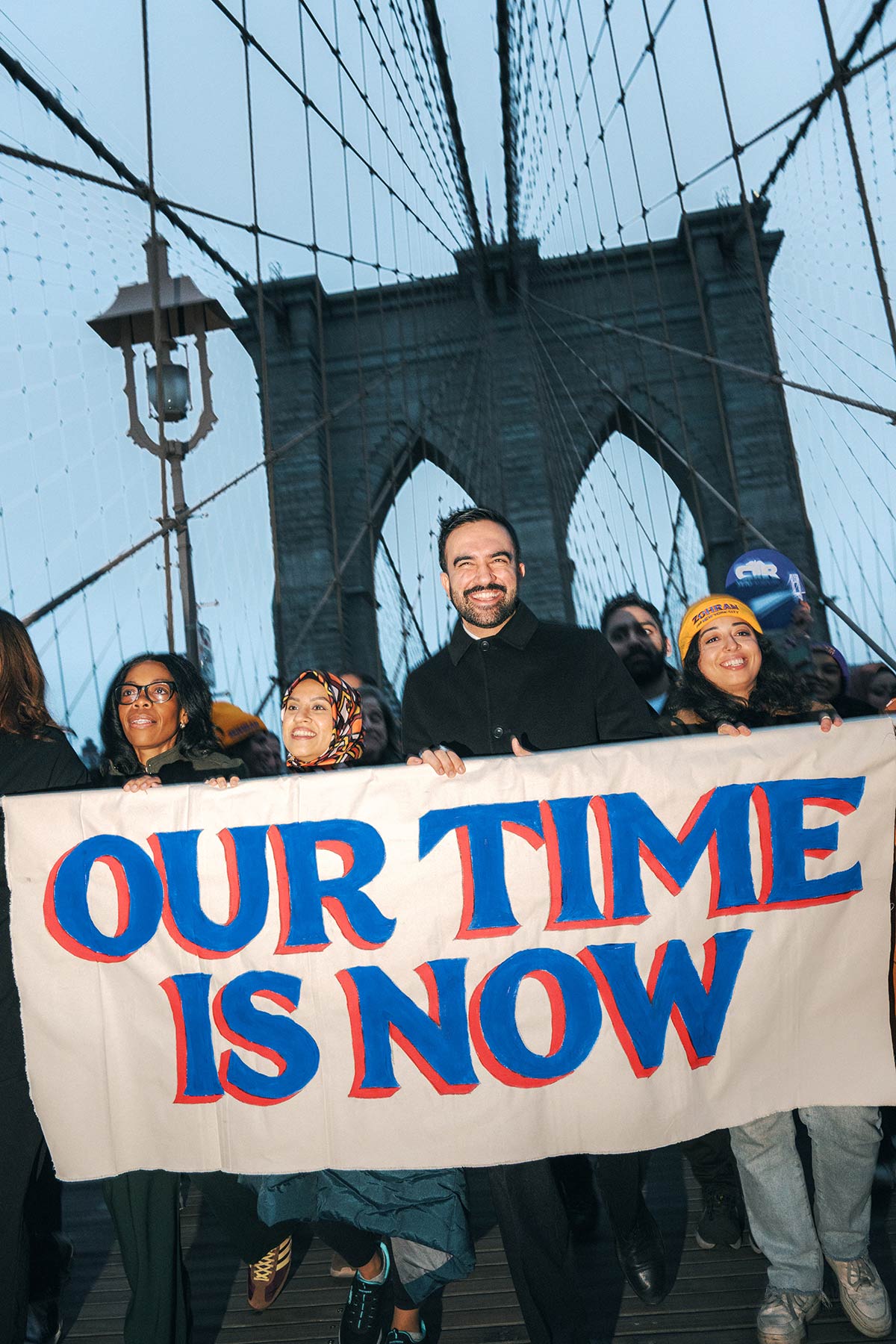
“We have toppled a political dynasty,” Zohran Mamdani, mayor-elect of New York City, triumphantly exclaimed during his victory speech late Tuesday night, Nov. 4, in Brooklyn, NY. After a year-long arduous campaign against disgraced former NY governor, Andrew Cuomo, Mamdani’s win feels historic—because it is. One only needed to feel the energy in NYC on election night to understand the gravity of its importance: a palpable hope, inspiring people across the ideological spectrum and around the world that someone can boldly challenge the corrupt political and economic status quo and win.
But here’s the thing: while Mamdani’s win is certainly encouraging, no one should be surprised by it. The overwhelming majority of the global population is bound by a shared experience of being crushed by corporate capitalism and its stranglehold on governments and the people. So any politician aiming to do literally anything to oppose corruption and economic exploitation already has an advantage. Mamdani’s message was simple, and it spoke to the majority. It was “The Rent is Too Damn High” for a new generation, without the satire, and it worked. (Not to mention, he’s charming.)
But now the harder part actually starts: the work that it takes to create change. Not only for Mamdani—but for us, too.
The pushback from Republicans and establishment Democrats alike is going to be strong and sustained. And they will come together to sabotage this movement with every tool they have in city hall, in the media, and elsewhere.
They will try, like they do with the majority of progressive politicians, to neutralize the threat Mamdani poses to the status quo: first, by sabotaging his efforts to enact his agenda. (We’ve seen this happen with Brandon Johnson, the current mayor of Chicago, who ran on a progressive platform and has received major pushback from establishment politicians.) Second, by sustaining a lengthy war of attrition on Mamdani’s morals against the status quo and corrupt systems, wearing him down into submission. More sinisterly, Republicans may even try to co-opt this message. Conservative businessman and former U.S. presidential candidate Vivek Ramaswamy’s response to Mamdani’s win was, “We got our a** handed to us; … Our side needs to focus on affordability.”
If this forces a broader focus on economic equality, great. But more likely, it could signal a path to hollow out a truly progressive agenda with more lies and lip service.
Despite all of these obstacles, Mamdani still has a number of cards that he can play to create change.
Immediately, he can make several new appointments and key hires in city government: Deputy Mayors, commissioners of more than 80 departments and agencies like DOT, DOE, NYPD, FDNY, DEP, DSNY; Rent Guidelines Board (RGB) for rent freezes or reductions; City Planning Commission (CPC) which has huge power over housing justice; Taxi & Limousine Commission (TLC) which regulates rideshare and taxi workers; the Board of Correction (BOC), an oversight body that is crucial to a decarceration agenda; the Economic Development Corporation (EDC) which controls billions in contracts, development projects, and waterfront property; the Workforce Development Board which shapes labor policy, job programs, and union partnerships; and even the Head of the NYC Law Department, who could change the city’s litigation strategies to drop harmful suits, defend protesters, or pursue housing violations.
All these major systems can begin to immediately implement a more egalitarian and justice-based progressive agenda. He can also freeze the rent for millions of New Yorkers by appointing supportive members to the Rent Board (provided Eric Adams doesn’t replace all the members with expired terms before his official tenure in December). He can certainly enact the city-run grocery stores, and use the kluge that the Trump administration is using à go-go— the Executive Order—to fast-track some of his policies.
But there are three crucial things he can’t do alone and where we, as constituents, cannot take a back seat. He will not be able to get a budget passed in the City Council without citizen pressure on their local borough presidents and city council members. He will also not be able to get a 2% tax hike on the ultra-wealthy passed in Albany or make buses free without Gov. Kathy Hochul’s support. (Hochul, being a notorious establishment Democrat, might give him trouble on this.)
Yes, he won, and that is great news. Let’s celebrate it. But this can’t be politics “as usual.” Now, we who pledged our support for these policies must show up and make it clear to the rest of the political system that our demands must be met.
In Conversation:
Photography by:
Topics:
Filed under:
Location:
{
"article":
{
"title" : "The Real Test for Zohran Mamdani—and the Rest of Us",
"author" : "Collis Browne, Rachel Sonis",
"category" : "essays",
"url" : "https://everythingispolitical.com/readings/the-real-test-for-zohran-mamdani-and-the-rest-of-us",
"date" : "2025-11-06 11:39:00 -0500",
"img" : "https://everythingispolitical.com/uploads/Zohran-bridge-parade.jpg",
"excerpt" : "“We have toppled a political dynasty,” Zohran Mamdani, mayor-elect of New York City, triumphantly exclaimed during his victory speech late Tuesday night, Nov. 4, in Brooklyn, NY. After a year-long arduous campaign against disgraced former NY governor, Andrew Cuomo, Mamdani’s win feels historic—because it is. One only needed to feel the energy in NYC on election night to understand the gravity of its importance: a palpable hope, inspiring people across the ideological spectrum and around the world that someone can boldly challenge the corrupt political and economic status quo and win.",
"content" : "“We have toppled a political dynasty,” Zohran Mamdani, mayor-elect of New York City, triumphantly exclaimed during his victory speech late Tuesday night, Nov. 4, in Brooklyn, NY. After a year-long arduous campaign against disgraced former NY governor, Andrew Cuomo, Mamdani’s win feels historic—because it is. One only needed to feel the energy in NYC on election night to understand the gravity of its importance: a palpable hope, inspiring people across the ideological spectrum and around the world that someone can boldly challenge the corrupt political and economic status quo and win.But here’s the thing: while Mamdani’s win is certainly encouraging, no one should be surprised by it. The overwhelming majority of the global population is bound by a shared experience of being crushed by corporate capitalism and its stranglehold on governments and the people. So any politician aiming to do literally anything to oppose corruption and economic exploitation already has an advantage. Mamdani’s message was simple, and it spoke to the majority. It was “The Rent is Too Damn High” for a new generation, without the satire, and it worked. (Not to mention, he’s charming.)But now the harder part actually starts: the work that it takes to create change. Not only for Mamdani—but for us, too.The pushback from Republicans and establishment Democrats alike is going to be strong and sustained. And they will come together to sabotage this movement with every tool they have in city hall, in the media, and elsewhere.They will try, like they do with the majority of progressive politicians, to neutralize the threat Mamdani poses to the status quo: first, by sabotaging his efforts to enact his agenda. (We’ve seen this happen with Brandon Johnson, the current mayor of Chicago, who ran on a progressive platform and has received major pushback from establishment politicians.) Second, by sustaining a lengthy war of attrition on Mamdani’s morals against the status quo and corrupt systems, wearing him down into submission. More sinisterly, Republicans may even try to co-opt this message. Conservative businessman and former U.S. presidential candidate Vivek Ramaswamy’s response to Mamdani’s win was, “We got our a** handed to us; … Our side needs to focus on affordability.”If this forces a broader focus on economic equality, great. But more likely, it could signal a path to hollow out a truly progressive agenda with more lies and lip service.Despite all of these obstacles, Mamdani still has a number of cards that he can play to create change.Immediately, he can make several new appointments and key hires in city government: Deputy Mayors, commissioners of more than 80 departments and agencies like DOT, DOE, NYPD, FDNY, DEP, DSNY; Rent Guidelines Board (RGB) for rent freezes or reductions; City Planning Commission (CPC) which has huge power over housing justice; Taxi & Limousine Commission (TLC) which regulates rideshare and taxi workers; the Board of Correction (BOC), an oversight body that is crucial to a decarceration agenda; the Economic Development Corporation (EDC) which controls billions in contracts, development projects, and waterfront property; the Workforce Development Board which shapes labor policy, job programs, and union partnerships; and even the Head of the NYC Law Department, who could change the city’s litigation strategies to drop harmful suits, defend protesters, or pursue housing violations.All these major systems can begin to immediately implement a more egalitarian and justice-based progressive agenda. He can also freeze the rent for millions of New Yorkers by appointing supportive members to the Rent Board (provided Eric Adams doesn’t replace all the members with expired terms before his official tenure in December). He can certainly enact the city-run grocery stores, and use the kluge that the Trump administration is using à go-go— the Executive Order—to fast-track some of his policies.But there are three crucial things he can’t do alone and where we, as constituents, cannot take a back seat. He will not be able to get a budget passed in the City Council without citizen pressure on their local borough presidents and city council members. He will also not be able to get a 2% tax hike on the ultra-wealthy passed in Albany or make buses free without Gov. Kathy Hochul’s support. (Hochul, being a notorious establishment Democrat, might give him trouble on this.)Yes, he won, and that is great news. Let’s celebrate it. But this can’t be politics “as usual.” Now, we who pledged our support for these policies must show up and make it clear to the rest of the political system that our demands must be met."
}
,
"relatedposts": [
{
"title" : "Couture in Paris, Cuts at the 'Post'",
"author" : "Louis Pisano",
"category" : "essay",
"url" : "https://everythingispolitical.com/readings/bezos-sanchez-paris-couture-week-wapo-layoffs",
"date" : "2026-02-02 10:49:00 -0500",
"img" : "https://everythingispolitical.com/uploads/Cover_EIP_Bezos_Sanchez_Pisano.jpg",
"excerpt" : "The Cruel Irony of the Bezos-Sánchez Empire",
"content" : "The Cruel Irony of the Bezos-Sánchez EmpireLate on January 25, as snow dusted Washington, about 60 foreign correspondents at The Washington Post hit send on an email that felt like a last stand. They had dodged gunfire in Ukraine, documented Iran’s water crises and protester crackdowns, risked sources’ lives in gang territories. Now they faced their own existential threat: rumors of up to 300 company-wide layoffs, with foreign desks, sports, metro, and arts likely gutted. Their collective letter to owner Jeff Bezos was direct, almost pleading.“Robust, powerful foreign coverage is essential to The Washington Post’s brand and its future success in whatever form the paper takes moving forward,” they wrote. “We urge you to consider how the proposed layoffs will certainly lead us first to irrelevance, not the shared success that remains attainable.” They offered flexibility on costs but drew a line: slashing overseas reporting in Trump’s second term, amid global flashpoints, would hollow out the institution they had built.Whether Bezos opened that email remains unclear. As of this writing, he has not publicly responded to it. In fact, Bezos was 4,000 miles away, strolling hand-in-hand with Lauren Sánchez Bezos into Schiaparelli’s Haute Couture show in Paris. Flashbulbs popped as they arrived, Sánchez in a blood red skirt suit from the house and a white crocodile bag. Hours on, she switched to a steel-blue-gray vintage Dior pencil-skirt suit, its enormous fur collar evoking a mob wife, for Jonathan Anderson’s couture debut with the house.The two didn’t just sit front row, either. Backstage at Dior, Bezos and Sánchez posed with Anderson and LVMH CEO Delphine Arnault. Sánchez lunched with Anna Wintour at The Ritz and was allegedly dressed by Law Roach, the “image architect” behind Zendaya’s accession to fashion darling, who once declared fashion’s power to challenge norms and amplify the marginalized. Roach reshared Sánchez’s Instagram stories, crediting the vintage Dior; later, they toured Schiaparelli’s atelier together. The partnership felt sudden and loaded.Back in D.C., the newsroom simmered. Staffers posted on X under #SaveThePost, Yeganeh Torbati recounting government violence against protesters, Loveday Morris describing blasts rattling windows and the mortal risks to sources, tagging Bezos directly in urgent appeals. In a guild-prompted twist meant to amplify the message, the Washington-Baltimore News Guild encouraged tagging even Lauren Sánchez, though not every reporter followed through. The betrayal stung deeper after years of buyouts, a libertarian-tilted Opinions section, a rebranded mission (“Riveting Storytelling for All of America”) that rang corporate. Losses topped $100 million in 2024 and now the axe is hovering over desks that produced the scoops Bezos once praised when he bought the paper for $250 million in 2013. Now, Bezos parties on in Paris, his wife climbing fashion’s ranks.While the billionaires party, a profound unease is permeating the American media landscape, exacerbated by political shifts and technological disruptions that empower owners like Bezos to sideline core missions in favor of personal ventures. The press, once a vigilant watchdog against authority, now frequently finds itself complicit with power structures, buckling under misinformation, partisan censorship, and budgetary constraints that stifle investigative depth. This dynamic deprives the public of the unflinching journalism that is capable of exposing foreign policy overreaches or everyday human struggle, amplified by economic slowdowns and subscription fatigue in an increasingly fragmented ecosystem. With eroding confidence driving audiences to social platforms, now eclipsing traditional TV and websites as the primary news source in the U.S., the fallout further deepens this public distrust.To be clear, fashion isn’t innocent in this. It loves to posture as progressive, touting body positivity, diversity, resistance as it’s relevant, but rolling out the red carpet for the ultra-rich when the checks clear, especially when the checks come from people whose fortunes are built on real harm. Once upon a time, you couldn’t simply buy your way into the Met Gala; invitations were curated by Wintour based on cultural relevance, creative influence, and a carefully guarded sense of who truly belonged in the room. That’s all over now. The Bezoses have turned every norm in fashion on its head, sponsoring the 2026 Met Gala (funding the event and reportedly influencing invites), making their debut as a couple in 2024, and now leveraging those ties to claim space in couture’s inner circles. Bezos and Sánchez’s couture jaunt is just the latest proof that fashion’s gates, once guarded by creativity and taste, now swing widest for raw wealth and access.Wintour lunches and their prominent sponsorship role in the Met Gala don’t help quell the whispers that Bezos is eyeing Condé Nast (Vogue, Vanity Fair, The New Yorker) as a “wedding gift” to Sánchez. Rumors denied yet persistent, revived by every Paris sighting.Not everyone in fashion is staying silent. Some insiders are pushing back hard against the normalization. Gabriella Karefa-Johnson, a longtime voice in the industry, posted bluntly on X: “The hyper normalization is doing my head in… keep your mouth shut about ICE if you’re mingling with them, seating them, dressing them. Accepting their cash.” She called out Amazon’s cloud systems as the backbone of DHS deportation operations and billions in government contracts that sustain what she called “Trump’s terror machine,” concluding that Bezos and Sánchez are at couture simply because they are rich—and their wealth comes from profoundly harming millions daily. “I feel crazy,” she wrote. While couture has always been a bastian of the uber-rich, Karefa-Johnson’s frustration underscores how even fashion’s own are starting to question the cost of that welcome.If that Conde-Nast deal ever materializes, the consequences would compound because control over fashion’s most influential titles would allow Bezos the opportunity to shape narratives around billionaires, soften coverage of labor abuses, environmental costs, or surveillance contracts. The same hand that funds AWS’s CIA contracts, DoD cloud deals, ICE enforcement tools, fossil-fuel operations, warehouse injuries, anti-union tactics, and small-business-crushing monopoly would quietly steer the stories about wealth and style. Already deferential to its biggest advertisers and attendees, fashion journalism would fold into the same closed loop, fusing tech dominance with cultural gatekeeping into one unassailable private empire—all of it ultimately bankrolling the yachts, the space joyrides with Katy Perry, the private-jet hops to couture shows and fashion influence, to polish an image that the Post’s own reporters once might have skewered.[x] It’s almost elegant the way one empire’s dirt gets laundered through another.It’s cruelly ironic how wide the gap between the risks assumed by WaPo correspondents tasked with holding power to account and the comfort with which their owner moves among the powerful in Paris actually is. Fashion has political power, as Roach once said. It can challenge and provoke. It can also resist. But when it courts figures like Bezos, whose empire thrives on the very inequalities it sometimes pretends to critique, it becomes another asset in his already enormous portfolio.But there is no challenge, no provocation. There is no major resistance. Instead, there’s champagne and constant disassociation. Somewhere between the clink of glasses and the photos, Bezos and his wife get a glow up while The Washington Post newsroom waits, knowing the cuts are coming but not yet here. No one is confused about what happened; this is simply how the trade now unfortunately works.Wealth drifts through media, fashion, culture, picking up prestige and shedding people along the way. Whether Bezos ever read the letter is beside the point. The stranger thing is how little anyone expects him, or anyone like him, to answer anymore."
}
,
{
"title" : "Why We Must Bring Disability into Immigrant Liberation",
"author" : "Conchita Hernandez Legorreta, Qudsiya Naqui",
"category" : "essays",
"url" : "https://everythingispolitical.com/readings/disability-immigrant-liberation",
"date" : "2026-02-02 09:49:00 -0500",
"img" : "https://everythingispolitical.com/uploads/Disability-Immigration-Collage-Compressed.jpeg",
"excerpt" : "It is the only way to move toward collective liberation.",
"content" : "It is the only way to move toward collective liberation.A vertical digital collage in shades of orange, teal, and blue. In the background, a semi-transparent AAC communication device displays the text “I can help.” The top left shows a woman with a hearing aid in profile. On the right, a woman in a black headscarf gestures toward her ear. At the bottom, a woman and a child stand on a bed of large, realistic ice cubes; both are using white canes for the blind. Orange sparks float across the center, and the overall style is grainy, reminiscent of a Riso-printed protest zine. Illustration Credit: Jennifer White-JohnsonThe deadly surge of ICE agents in Minneapolis and across the country has wreaked havoc across communities, with particularly dangerous consequences for disabled people. In one instance on January 15, 2026, a woman in Minneapolis, Aliya Rahman, was pulled from her car and into an ICE vehicle, despite telling the ICE agents that she was on her way to a doctor’s appointment. The woman explained that she was autistic and needed accommodations, which the ICE agents readily ignored.The reentrenchment of ableism in Trump 2.0 is everywhere. In July 2025, for example, the president issued an executive order, “Ending Crime and Disorder on America’s Streets,” which seeks to overturn decades of progress for disabled people. The “R- word,” a slur against people with cognitive disabilities and a word that so many activists fought to eliminate from our daily lexicon, is back in full force. And for many immigrants with disabilities, the cultural landscape is more treacherous than ever: since Trump’s ascent, his administration has continued to double down on a centuries-old legacy of ableism and maltreatment of disabled immigrants. Most recently, the State Department announced that it will suspend the processing of immigrant visas from 75 countries because their citizens are collectively deemed likely to become reliant on public assistance if admitted into the U.S. This not only reflects our government’s racist and xenophobic approach to immigration—it is also a clear manifestation of its contempt for disabled people, or anyone perceived as unable to produce the labor that drives American capitalism.This is why conversations about disability must be central to the movement for immigrant justice. When we create resources and protections for the most marginalized, we move closer to liberation for all immigrant communities.The term “no le digas a nadie” or “do not tell anyone” is a phrase many immigrants know and take to heart. It speaks to the fear that, if you tell the wrong person, your life and your family’s can be turned upside down. This is felt tenfold by disabled immigrants: Today, an estimated 1 in 4 Americans has a disability. With over 15.2 million immigrants in the United States, a large portion may have disabilities, even if they do not identify as having one. Disability is often stigmatized, leading people to hide their conditions or have less access to information and services. Disability is also the only minority group that anyone can join at any time, whether from birth, through chronic illness, or accident. What’s more, many people become disabled as they travel long distances to cross borders. The immigration system itself creates disability in the violence of enforcement and the terrible conditions of immigrant detention.As a formerly undocumented blind educator and a blind law professor who has spent the past 15 years advocating for immigrant and disability justice, we understand firsthand the added layer that comes with being disabled, in addition to being a target of immigration enforcement. One of us (Conchita) remembers feeling anxious to go outside while growing up undocumented, for fear of having any type of encounter with law enforcement. She and her family were terrified of disclosing any information to the wrong person who might report them to immigration officials. As a result, Conchita hid her immigration and disability status from most people. This led to a lack of information and access to resources, as well as exclusion from a community that could have supported her.Conchita’s story is not unique. We have heard countless accounts of disabled immigrants being arrested and detained without basic access to the tools they need to communicate and defend themselves. In November 2025, ICE detained a blind man in New York and denied him access to his white cane and a text-to-speech app on his phone that he needed in order to read legal documents. A few months before that, in June, a Deaf man lawfully present in the U.S. was arrested in Los Angeles, and even though he signaled to the ICE agents that he could not speak, he was thrown into a vehicle and sent to a detention center without any communication about why he was being detained. ICE took away his phone when he attempted to communicate, and when he arrived at the detention facility in El Paso, Texas, he was provided with documents in Spanish, a language he cannot read. In all of these situations, lack of accessibility led to needless incarceration and family separation without fair due process.But despite this struggle, ableism, disability, and accessibility are rarely discussed in the fight for immigrant justice. Activists on the front lines of immigration work often do not understand the full scope of disability and its impact on people’s lives. Many immigration advocates tend to be on a shoestring budget and have told us, “We do not have the capacity right now” when we’ve asked to make immigration resources accessible, or to grow their understanding of disability rights laws and the lived experiences of disabled people. Not to mention, disabled lawyers and legal advocates are grossly underrepresented in their professions, and as a consequence, this perspective, including making critical legal information accessible to all, is not part of the conversation. For instance, videos that show how to confront ICE should include captions, transcripts, and audio descriptions, but rarely do.This became clear to us when we presented a “Know Your Rights” webinar to support disabled immigrants in August 2025, as ICE enforcement actions expanded across the country. To our surprise, over 150 people attended the webinar, including disabled immigrants and their allies concerned about how they would protect themselves if they encountered ICE. We received questions like, “What do I do if I’m blind and I’m presented with a paper warrant I can’t read?” or “What if ICE agents take my phone and I can’t signal to them that I’m deaf and need an interpreter?”What many people tend to forget is that when accessibility and inclusion are part of the conversation for any movement work, the result benefits everyone. We saw this during the COVID-19 pandemic, when immigration and disability rights advocates came together to challenge the detention of those at risk of severe illness or death using federal disability rights laws. This helped reduce transmission rates, reaffirm fair legal standards for all, and strengthen public health by giving everyone accessible vaccination information and even food resources. Designing a world and protections that help people with disabilities is just as crucial to our advocacy as organizing protests, defending individuals in deportation cases, and lobbying our lawmakers to support more humane immigration policies.Our plea to immigration advocates is that they make it a priority to understand the full extent of how immigration and disability justice intersect. They can do this by educating themselves on disability rights laws that apply in detention centers and when people come into contact with federal, state, and local law enforcement. Immigration advocates must also ensure that legal information and other educational content they produce are accessible to everyone.Above all, they must form coalitions with people with disabilities and incorporate their ideas into all advocacy efforts. Because our shared survival depends on the survival of every individual and community affected by this administration. Bringing disability into the immigrant struggle is the only way to move toward collective access, cross-movement solidarity, and collective liberation."
}
,
{
"title" : "Against Dictators and Intervention: Sahar Delijani on Iran",
"author" : "Sahar Delijani, Céline Semaan",
"category" : "interviews",
"url" : "https://everythingispolitical.com/readings/sahar-delijani-on-iran",
"date" : "2026-02-01 16:53:00 -0500",
"img" : "https://everythingispolitical.com/uploads/2026_01_29_Sahar_Interview_1.jpg",
"excerpt" : "CÉLINE:These are very difficult times as we are watching what’s happening in Iran unfolding in such a rapid pace, there are numbers that are coming out in the news: first we saw a few thousand, then we saw 5000 reported on Democracy Now! and recently, we have gone from 30,000 to 45,000 people massacred in Iran. What is the latest that you’ve heard from your end, from Iranian sources?",
"content" : "CÉLINE:These are very difficult times as we are watching what’s happening in Iran unfolding in such a rapid pace, there are numbers that are coming out in the news: first we saw a few thousand, then we saw 5000 reported on Democracy Now! and recently, we have gone from 30,000 to 45,000 people massacred in Iran. What is the latest that you’ve heard from your end, from Iranian sources?SAHAR DELIJANI:I’m hearing the same numbers, I’ve heard anything from 20,000 to 30,000 to 40,000. It’s really hard to verify for the people on the ground and for people human rights organizations, even though I know that they’re working around the clock to be able to identify bodies, but the regime is really trying as much as it can to repress the information coming out. We are even hearing news of mass graves, of bodies that were just taken from the morgues and never seen again. We hear news of families that have been just going from morgue to morgue, station to station, hospital to hospital, looking for their loved ones, and they still haven’t found them.We hear news of doctors who were helping the wounded who are now imprisoned under the charge of collaborating with Israel or waging war against God, which is one of the charges that usually Islamic Republic uses to push for execution. Terrible news coming out from all these small towns, all these areas in Iran where thousands of people have been killed, and a lot of them with gunshot wounds at close range in their chest or their neck or their heads.So it’s an absolute to nightmare. I don’t even know what the right word is, but it’s one of the biggest slaughters of civil uprising we’ve ever seen in our recent history.CÉLINE:Thank you. And I know that now everyone is watching, holding their breath for what is potentially a US intervention. The situation is escalating. There are the people of Iran are facing their own government oppression, and they might be also under US bombs. Do you have any family members in Iran? How are you coping with the news, and what are the best ways to follow what’s happening now closely on the ground?SAHAR DELIJANI:Yes, I do have family and friends, and it’s just devastating that they are now sort of trapped between these two absolutely brutal forces. One is the Islamic Republic on the ground, just slaughtering its own people. And then you know, the threat of wars and bombs and the devastation that we know it will bring. The tragedy is immense. I don’t even have the right words to talk about it. Iranian people have worked so hard in the past 30-40 years to be able to build a democratic society, to be able to have freedom for everyone, for minorities, for women, for a society to be built on equality and justice.This isn’t the first time the Iranian people have been fighting against this regime — this has been a long, long fight, and I feel like it has reached a point of no return. We will not be the same people. I am not the same person as I was just a few days, few weeks back. And you know, this is also, in some ways, the story of our of our region. There’s just too much blood, too much violence, and there’s this open wound that had been in Iran since the 80s, with the mass executions of political prisoners, including my own family members, and that wound was still open, and now we have this we have this slaughter. Our region needs and deserves something more than wars or dictatorship. We deserve to be able to fight for what we want. We deserve to be able to live in safe societies, to live in dignity, to live in freedom, and the right to fight for it.CÉLINE:An attack on Iran is an attack on the region, on the Iranian people, first and foremost, but also has repercussions on the entire region. A lot of people think that the Iranian government is holding the Palestinian cause, and is the only force that has been against Israel. How is it looking like from your perspective, as someone who is understanding of the Palestinian cause and seeing what’s happening and unfolding today?SAHAR DELIJANI:I think any attack on any country in the region is an attack on the region. I don’t think this is only about valid for Iran. When Iraq was attacked, it was an attack on the region, when Afghanistan was attacked, when it was an attack on the region, all of our fates are intertwined, they’re not separate from each other. They’re not isolated. I do not believe that the Iranian regime has been fighting for the Palestinian cause. I believe that, yes, the Iranian regime is the enemy of Israel. That doesn’t mean that it has the Palestinian cause in its heart. It only means that it has its own geopolitical interest and advancements that it wants to push forward.It wants more power and more influence in the region. And it uses the Syrian civil war, it uses the opportunities it has in Iraq, and throughout the region, it’s only pushing forward its own agenda. I think that is very important to note also, because a country that has been torturing and killing its own people, how could it liberate another people?What does that liberation even look like when we talk about America bringing this rhetoric of liberation, why don’t we believe it? Because we know what it means, because we’ve seen it historically, and we also see what it does to its own people. If an American power that speaks of liberation for the Iranian does this to its own people—kills them in broad daylight, their shoots them in the face, in their car, or arrest protesters, abducts people. Same goes for Iran and Palestine. What kind of liberation does Iran have in mind for Palestine, if it’s killing its own people, if it’s repressing its own people?I believe that anti war movements, anti imperialist movements must go hand in hand with anti dictatorship movements and pro democracy movements. Otherwise, it’s just empty shells, it changes nothing for the people on the ground. We need to want the same things for everyone, we can’t pick and choose whose liberation we want or whose repression is okay for now, no one’s repression is okay. Because I think more everybody wants the same thing. We might have different ways of expressing it, but people want to live in dignity and safety and equality, right? Everybody wants that, so we need to listen to them, instead of imposing our own geopolitical agendas or our own interpretation of the region, without listening to the people living that reality.CÉLINE:Absolutely. How can a dictator that is also violating the rights of their own constituents and their own citizens in the United States, such as Donald Trump, want the best for Iranians? That’s where the cognitive dissonance happens online when we have members of the Iranian diaspora who are calling for US intervention, and in that same breath, harassing or attacking or creating a campaign against anyone who is raising a flag that US intervention might not lead to liberation for Iranian people. US intervention has a track record of being disastrous, from Iraq to Afghanistan to what’s going on in Venezuela around the world, wherever the United States came in to “save” it never really ended up being for the people. How do you make sense of this call for US intervention?SAHAR DELIJANI:I think in the diaspora, we have a responsibility not to call for more violence, especially when we’re not going to be the victims of that violence, not being in Iran ourselves. Because when we say no bombs, no intervention in Iran, we mean it for everybody. But the people in Iran who are asking for [US military intervention] are not just completely crazy—just think about the reality that the extremely difficult, violent reality that the Iranian regime, the Islamic Republic, has made for people, that they’ve reached a point that they’re thinking, “Oh, maybe bombs, at least would save us from this violence.”People who have lived through a tragedy, a massacre of 30,000 people in just a few days, you know, there is just so much pain. There’s so much pain, okay, but you’re saying, you know that the foreign intervention is dangerous, but look at what is happening to us now. The only way we are credible to the people on the ground if we want to stand against this sort of imperialist interventions and forces, is if we stand as strongly against the dictators that are killing them. Now, if we are just a little bit hesitant, even a tiny bit hesitant, to stand against those dictators, we are being huge hypocrites, and nobody will believe us. Nobody will believe that we have their liberation in mind when we stand against imperialist intervention. You are just telling us to choose between two types of killings. We need to stand against all types of oppression, no matter who’s doing it. It’s not about who does it, it’s about what we can do to bring it to an end."
}
]
}