

Digital & Print Membership
Yearly + Receive 8 free printed back issues
$420 Annually
Monthly + Receive 3 free printed back issues
$40 Monthly
The Billionaire Who Bought the Met Gala
What the Bezoses’ Check Means for Fashion’s Future
On the morning of November 17, 2025, the Metropolitan Museum of Art announced that Jeff Bezos and Lauren Sánchez Bezos would serve as the sole lead sponsors of the 2026 Met Gala and its accompanying Costume Institute exhibition, “Costume Art”. Saint Laurent and Condé Nast were listed as supporting partners. To be clear, this is not a co-sponsorship. It is not “in association with.” It is the first time in the modern history of the gala that the headline slot, previously occupied by Louis Vuitton, TikTok, or a discreet old-money surname, has been handed to a tech billionaire and his wife. The donation amount remains undisclosed, but sources familiar with the negotiations place it comfortably north of seven figures, in line with the checks that helped the event raise $22 million last year.
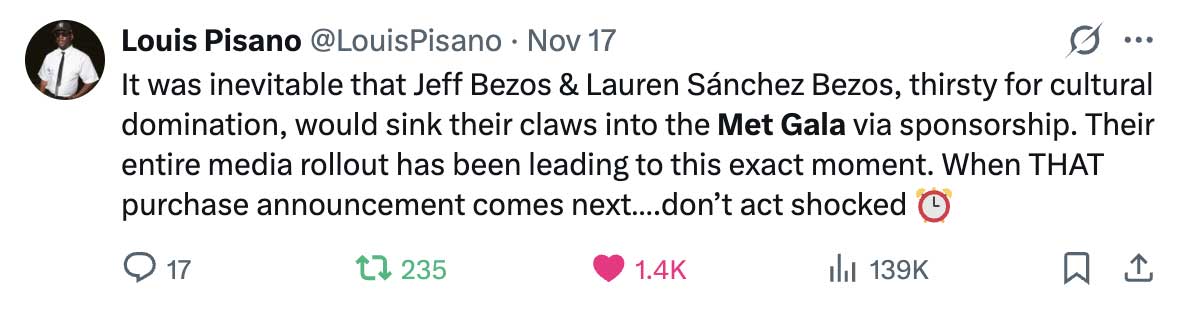
Within hours of the announcement, the Met’s Instagram post was overrun with comments proclaiming the gala “dead.” On TikTok and X, users paired declarations of late-stage capitalism with memes of the museum staircase wrapped in Amazon boxes. Not that this was unexpected. Anyone paying attention could see it coming for over a decade.
When billionaires like Bezos, whose Amazon warehouses reported injury rates nearly double the industry average in 2024 and whose fashion supply chain has been linked to forced labor and poverty wages globally, acquire influence over prestigious institutions like the Met Museum through sponsorships, it risks commodifying fashion as a tool for not only personal but corporate image-laundering. To put it simply: who’s going to bite the hand that feeds them? Designers, editors, and curators will have little choice but to turn a blind eye to keep the money flowing and the lights on.
Back in 2012, Amazon co-chaired the “Schiaparelli and Prada” gala, and honorary chair Jeff Bezos showed up in a perfectly respectable tux with then-wife MacKenzie Scott by his side and an Anna Wintour-advised pocket square. After his divorce from Scott in 2019, Bezos made a solo appearance at the Met Gala, signaling that he was becoming a familiar presence in fashion circles on his own. Of course, by that point, he already had Lauren Sánchez. Fast forward to 2020: print advertising was crumbling, and Anna Wintour co-signed The Drop, a set of limited CFDA collections sold exclusively on Amazon, giving the company a veneer of fashion credibility. By 2024, Sánchez made her Met debut in a mirrored Oscar de la Renta gown personally approved by Wintour, signaling that the Bezos orbit was now squarely inside the fashion world.
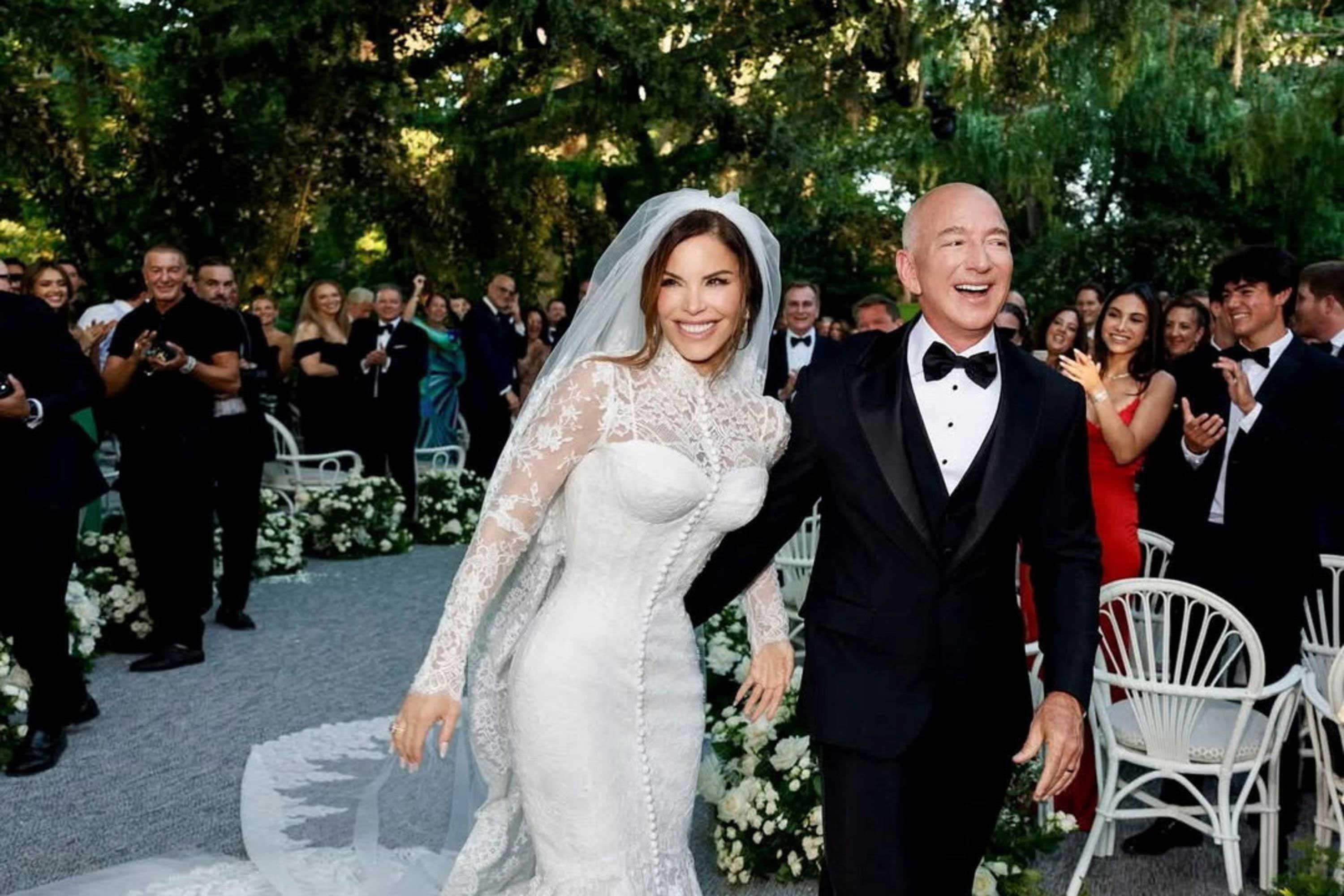
Then, the political world started to catch up, as it always does. In January 2025, Sánchez and Bezos sat three rows behind President-elect Donald Trump at the inauguration. Amazon wrote a one-million-dollar check to Trump’s inaugural fund, and Bezos, once mocked by Trump as “Jeff Bozo,” publicly congratulated Trump on an “extraordinary political comeback.” By June 2025, Bezos and Sánchez became cultural and political mainstays: Sánchez married Bezos in Venice, wearing a Dolce & Gabbana gown Wintour had helped select. This landed Sánchez the digital cover of American Vogue almost immediately afterward. Wintour quietly handed day-to-day control of the magazine to Chloe Malle but kept the Met Gala, the global title, and her Condé Nast equity stake, cementing a new era of fashion power where money, influence, and optics are inseparable.
Underneath all of it, the quiet hum of Amazon’s fashion machine continued to whirr. By 2024, the company already controlled 16.2 percent of every dollar Americans spent on clothing, footwear, and accessories—more than Walmart, Target, Macy’s, and Nordstrom combined. That same year, it generated $34.7 billion in U.S. apparel and footwear revenue that year, with the women’s category alone on pace to top $40 billion. No legacy house has ever had that volume of real-time data on what people actually try on, keep, or return in shame. Amazon can react in weeks rather than seasons, reordering winning pieces, tweaking existing ones, and killing unpopular options before they’re even produced at scale.
Wintour did more than simply observe this shift; she engineered a soft landing by bringing Amazon in when it was still somewhat uncool and seen mostly as a discount retailer, lending it credibility when it needed legitimacy, and spending the last two years turning Sánchez from tabloid footnote to Vogue cover star. The Condé Nast sale rumors that began circulating in July 2025, complete with talk of Wintour cashing out her equity and Sánchez taking a creative role, have been denied by every official mouthpiece. But they have also refused to die, because the timeline is simply too tidy.
The clearest preview of what billionaire ownership can do to a cultural institution remains Bezos’ other pet project, The Washington Post. Bezos bought it for $250 million in 2013, saved it from bankruptcy, and built it into a profitable digital operation with 2.5 million subscribers. Then, in October 2024, he personally blocked a planned editorial endorsement of Kamala Harris. More than 250,000 subscribers canceled in the following days. By February 2025, the opinion section was restructured around “personal liberties and free markets,” triggering another exodus and the resignation of editorial page editor David Shipley. Former executive editor Marty Baron called it “craven.” The timing, just months after Bezos began warming to the incoming Trump administration, was not lost on anyone.
The story didn’t stop there: in the last few days, U.S. Vice President J.D. Vance revealed he had texted Bezos suggesting the hiring of a right-leaning Breitbart journalist, Matthew Boyle, to run the Post’s political coverage. This is a clear signal of how staffing decisions at a storied paper now sit within the same power matrix that funds the Met Gala and shapes culture, media, and politics alike. It’s a tangled, strategic web—all of Bezos’ making.
It’s curious that, in the same 30-day window that the Trump DOJ expanded its antitrust inquiry into Amazon, specifically how its algorithms favor its own products over third-party sellers, including many fashion brands, the MET, a city-owned museum, handed the keys of its marquee event to the man whose company now wields outsized influence over designers’ fortunes and faces regulatory scrutiny from the administration he helped reinstall. This is not sponsorship; it’s leverage. Wintour once froze Melania Trump out of Vogue because she could afford to.But she cannot freeze out Sánchez or Bezos. Nor does she want to.
So on the first Monday in May, the museum doors will open as they always do for the Met Gala. The carpet will still be red (or whatever color the theme demands). The photographs of celebrities posing in their interpretations of “Costume Art” will still break the internet. Andrew Bolton’s exhibition, roughly 200 objects tracing the dressed body across five millennia, displayed in the newly renamed Condé Nast Galleries, will still be brilliant. But the biggest check will come from the couple who already control 16 percent of America’s clothing spend, who own The Washington Post, and who sat three rows behind Trump at the inauguration. Everything else, guest list tweaks, livestream deals, shoppable moments, will flow from that single source of money and power. That is who now has the final word on the most influential night in American fashion.
{
"article":
{
"title" : "The Billionaire Who Bought the Met Gala: What the Bezoses’ Check Means for Fashion’s Future",
"author" : "Louis Pisano",
"category" : "essays",
"url" : "https://everythingispolitical.com/readings/the-billionaire-who-bought-the-met-gala",
"date" : "2025-11-27 10:41:00 -0500",
"img" : "https://everythingispolitical.com/uploads/Cover_EIP_TBesos_MET_Galajpg.jpg",
"excerpt" : "On the morning of November 17, 2025, the Metropolitan Museum of Art announced that Jeff Bezos and Lauren Sánchez Bezos would serve as the sole lead sponsors of the 2026 Met Gala and its accompanying Costume Institute exhibition, “Costume Art”. Saint Laurent and Condé Nast were listed as supporting partners. To be clear, this is not a co-sponsorship. It is not “in association with.” It is the first time in the modern history of the gala that the headline slot, previously occupied by Louis Vuitton, TikTok, or a discreet old-money surname, has been handed to a tech billionaire and his wife. The donation amount remains undisclosed, but sources familiar with the negotiations place it comfortably north of seven figures, in line with the checks that helped the event raise $22 million last year.",
"content" : "On the morning of November 17, 2025, the Metropolitan Museum of Art announced that Jeff Bezos and Lauren Sánchez Bezos would serve as the sole lead sponsors of the 2026 Met Gala and its accompanying Costume Institute exhibition, “Costume Art”. Saint Laurent and Condé Nast were listed as supporting partners. To be clear, this is not a co-sponsorship. It is not “in association with.” It is the first time in the modern history of the gala that the headline slot, previously occupied by Louis Vuitton, TikTok, or a discreet old-money surname, has been handed to a tech billionaire and his wife. The donation amount remains undisclosed, but sources familiar with the negotiations place it comfortably north of seven figures, in line with the checks that helped the event raise $22 million last year.Within hours of the announcement, the Met’s Instagram post was overrun with comments proclaiming the gala “dead.” On TikTok and X, users paired declarations of late-stage capitalism with memes of the museum staircase wrapped in Amazon boxes. Not that this was unexpected. Anyone paying attention could see it coming for over a decade.When billionaires like Bezos, whose Amazon warehouses reported injury rates nearly double the industry average in 2024 and whose fashion supply chain has been linked to forced labor and poverty wages globally, acquire influence over prestigious institutions like the Met Museum through sponsorships, it risks commodifying fashion as a tool for not only personal but corporate image-laundering. To put it simply: who’s going to bite the hand that feeds them? Designers, editors, and curators will have little choice but to turn a blind eye to keep the money flowing and the lights on.Back in 2012, Amazon co-chaired the “Schiaparelli and Prada” gala, and honorary chair Jeff Bezos showed up in a perfectly respectable tux with then-wife MacKenzie Scott by his side and an Anna Wintour-advised pocket square. After his divorce from Scott in 2019, Bezos made a solo appearance at the Met Gala, signaling that he was becoming a familiar presence in fashion circles on his own. Of course, by that point, he already had Lauren Sánchez. Fast forward to 2020: print advertising was crumbling, and Anna Wintour co-signed The Drop, a set of limited CFDA collections sold exclusively on Amazon, giving the company a veneer of fashion credibility. By 2024, Sánchez made her Met debut in a mirrored Oscar de la Renta gown personally approved by Wintour, signaling that the Bezos orbit was now squarely inside the fashion world.Then, the political world started to catch up, as it always does. In January 2025, Sánchez and Bezos sat three rows behind President-elect Donald Trump at the inauguration. Amazon wrote a one-million-dollar check to Trump’s inaugural fund, and Bezos, once mocked by Trump as “Jeff Bozo,” publicly congratulated Trump on an “extraordinary political comeback.” By June 2025, Bezos and Sánchez became cultural and political mainstays: Sánchez married Bezos in Venice, wearing a Dolce & Gabbana gown Wintour had helped select. This landed Sánchez the digital cover of American Vogue almost immediately afterward. Wintour quietly handed day-to-day control of the magazine to Chloe Malle but kept the Met Gala, the global title, and her Condé Nast equity stake, cementing a new era of fashion power where money, influence, and optics are inseparable.Underneath all of it, the quiet hum of Amazon’s fashion machine continued to whirr. By 2024, the company already controlled 16.2 percent of every dollar Americans spent on clothing, footwear, and accessories—more than Walmart, Target, Macy’s, and Nordstrom combined. That same year, it generated $34.7 billion in U.S. apparel and footwear revenue that year, with the women’s category alone on pace to top $40 billion. No legacy house has ever had that volume of real-time data on what people actually try on, keep, or return in shame. Amazon can react in weeks rather than seasons, reordering winning pieces, tweaking existing ones, and killing unpopular options before they’re even produced at scale.Wintour did more than simply observe this shift; she engineered a soft landing by bringing Amazon in when it was still somewhat uncool and seen mostly as a discount retailer, lending it credibility when it needed legitimacy, and spending the last two years turning Sánchez from tabloid footnote to Vogue cover star. The Condé Nast sale rumors that began circulating in July 2025, complete with talk of Wintour cashing out her equity and Sánchez taking a creative role, have been denied by every official mouthpiece. But they have also refused to die, because the timeline is simply too tidy.The clearest preview of what billionaire ownership can do to a cultural institution remains Bezos’ other pet project, The Washington Post. Bezos bought it for $250 million in 2013, saved it from bankruptcy, and built it into a profitable digital operation with 2.5 million subscribers. Then, in October 2024, he personally blocked a planned editorial endorsement of Kamala Harris. More than 250,000 subscribers canceled in the following days. By February 2025, the opinion section was restructured around “personal liberties and free markets,” triggering another exodus and the resignation of editorial page editor David Shipley. Former executive editor Marty Baron called it “craven.” The timing, just months after Bezos began warming to the incoming Trump administration, was not lost on anyone. The story didn’t stop there: in the last few days, U.S. Vice President J.D. Vance revealed he had texted Bezos suggesting the hiring of a right-leaning Breitbart journalist, Matthew Boyle, to run the Post’s political coverage. This is a clear signal of how staffing decisions at a storied paper now sit within the same power matrix that funds the Met Gala and shapes culture, media, and politics alike. It’s a tangled, strategic web—all of Bezos’ making.It’s curious that, in the same 30-day window that the Trump DOJ expanded its antitrust inquiry into Amazon, specifically how its algorithms favor its own products over third-party sellers, including many fashion brands, the MET, a city-owned museum, handed the keys of its marquee event to the man whose company now wields outsized influence over designers’ fortunes and faces regulatory scrutiny from the administration he helped reinstall. This is not sponsorship; it’s leverage. Wintour once froze Melania Trump out of Vogue because she could afford to.But she cannot freeze out Sánchez or Bezos. Nor does she want to.So on the first Monday in May, the museum doors will open as they always do for the Met Gala. The carpet will still be red (or whatever color the theme demands). The photographs of celebrities posing in their interpretations of “Costume Art” will still break the internet. Andrew Bolton’s exhibition, roughly 200 objects tracing the dressed body across five millennia, displayed in the newly renamed Condé Nast Galleries, will still be brilliant. But the biggest check will come from the couple who already control 16 percent of America’s clothing spend, who own The Washington Post, and who sat three rows behind Trump at the inauguration. Everything else, guest list tweaks, livestream deals, shoppable moments, will flow from that single source of money and power. That is who now has the final word on the most influential night in American fashion."
}
,
"relatedposts": [
{
"title" : "The Aesthetics of Atrocity:: Lockheed Martin’s Streetwear Pivot",
"author" : "Louis Pisano",
"category" : "",
"url" : "https://everythingispolitical.com/readings/the-aesthetics-of-atrocity",
"date" : "2025-12-20 10:30:00 -0500",
"img" : "https://everythingispolitical.com/uploads/Cover_EIP_Lockheed_StreetWar.jpg",
"excerpt" : "On December 12, The Business of Fashion published an article titled “The Unlikely Rise and Uncertain Future of Lockheed Martin Streetwear,” detailing the world’s largest arms manufacturer’s entrance into casual apparel.",
"content" : "On December 12, The Business of Fashion published an article titled “The Unlikely Rise and Uncertain Future of Lockheed Martin Streetwear,” detailing the world’s largest arms manufacturer’s entrance into casual apparel.Through a licensing deal with South Korea’s Doojin Yanghang Corp., Lockheed turns fighter jet graphics, corporate slogans, and its star logo into gorpcore staples. Oversized outerwear, tactical pants, and advanced synthetic fabrics sell out at Seoul pop-ups like the Hyundai department store with young Korean consumers chasing the edgy, functional vibe. Andy Koh, a Seoul-based content creator, tells BoF that while arms manufacturing is, in theory, political, he has never encountered widespread discomfort among Korean consumers. “As long as it looks cool and the product functions as expected,” he says, “they seem okay with it.”This trend aligns with a broader South Korean fashion phenomenon: licensing logos from global non-fashion brands to create popular streetwear lines. Examples include National Geographic puffers, Yale crewnecks, Kodak retro tees, CNN hoodies, Discovery jackets, Jeep outdoor wear, and university apparel from institutions like Harvard and UCLA. These licensed collections, often featuring media, academia, sports leagues, or adventure themes, have become staples on online retailers like Musinsa and in brick-and-mortar stores, propelled by K-pop influence and a tech-savvy youth market that make these odd crossovers multimillion-dollar successes.Lockheed, however, is categorically different. Its core business is not exploration, education, or journalism. It is industrialized death, and its arrival in fashion forces a reckoning with how far commodification can stretch.Having spent years in the military, maybe I’m the wrong person to critique this. Or maybe I’m exactly the right one. I know what weapons are for, how they’re used, and the human cost they carry. Lockheed manufactures F-16 and F-35 fighter jets, Hellfire missiles, and precision-guided systems that human rights organizations have repeatedly linked to civilian casualties across multiple conflicts. In Yemen, U.S.-supplied weapons incorporating Lockheed technology contributed to thousands of civilian deaths since 2015, most notoriously the 2018 airstrike on a school bus in Saada that killed dozens of children. In Gaza, since October 2023, Lockheed-supplied F-35s and munitions have formed the backbone of air operations that Amnesty International and other watchdogs have flagged for potential violations of international humanitarian law, cases now under examination by the International Court of Justice.In 2024, the company reported $71 billion in revenue, almost entirely from military contracts, with more than 1,100 F-35s already delivered worldwide and production lines running hotter than ever. That staggering scale is the reality lurking beneath a logo now casually printed on everyday apparel.So why does the planet’s largest arms manufacturer license its brand to streetwear? The answer seems to be twofold: easy money and sophisticated image laundering. Licensing delivers low-risk royalties from Korea’s reported $35-40 billion apparel market with virtually no operational headache. Lockheed simply collects checks while a third-party manufacturer handles design, production, distribution, and deals with all the mess of retail.The far more ambitious goal, however, is reputational refurbishment. Doojin deliberately markets the line around “future-oriented technical aesthetics” and “aerospace innovation,” leaning on cutting-edge fabrics to conjure high-tech futurism instead of battlefield carnage. By late 2025, as U.S. favorability in South Korea continued to slide amid trade tensions and regional geopolitical shifts, the brand quietly de-emphasized its American roots, according to Lockheed representatives. The strategy clearly tries to sever the logo from political controversy and plant it firmly in youth culture, where aesthetic appeal routinely outmuscles ethical concern.Lockheed has honed this kind of rebranding for decades. Their corporate brochures overflow with talk of “driving innovation” and “advancing scientific discovery,” spotlighting STEM scholarships, veteran hiring initiatives, and rapid-response disaster aid. The clothing itself carries the same sanitized messaging. One prominent slogan reads “Ensuring those we serve always stay ahead of ready”, euphemistic corporate-speak that sounds heroic until you remember that “those we serve” includes forces deploying Hellfire missiles against civilian targets. Other pieces feature F-35 graphics paired with copy declaring the jet “strengthens national security, enhances global partnerships, and powers economic growth”. It’s textbook PR varnish. Instruments designed for lethal efficiency, now rebranded as symbols of progress and prosperity.We’ve also seen this trick before: Fast fashion brands that slap “sustainable” labels on sweatshop products. Tech giants that fund glamorous art installations while they harvest user data. Oil companies that rebrand themselves as forward-thinking “energy” players as the Earth’s climate burns. Lockheed, though, traffics in something uniquely irreversible: export-grade death. By licensing its identity to apparel, multibillion-dollar arms contracts are reduced to mere intellectual property; civilian casualties dissolved into, simply, background static.In other words, vibes overpower victims. And when those vibes are stamped with the logo of the planet’s preeminent death merchant, resistance feels futile.Gorpcore has always drawn from military surplus for its rugged utility: endless cargo pockets, indestructible nylons, tactical silhouettes born in combat and repurposed for city streets. Brands like Arc’teryx, The North Face, and Supreme mine that heritage for authenticity and performance. After World War II, army fatigues became symbols of genuine rebellion, worn by anti-war protesters as an act of defiance against the establishment. Today, the dynamic threatens to invert entirely. The establishment itself, the world’s preeminent arms dealer, now supplies the “authentic” merchandise, turning subversion into subtle endorsement.Streetwear grew out of skate culture, hip-hop, and grassroots rebellion against mainstream norms. Importing the aesthetics of atrocity risks converting that legacy into compliance, rendering militarism the newest version of mainstream cool. For a generation immersed in filtered feeds and rapid trend cycles, Lockheed’s logo can sit comfortably beside NASA patches or National Geographic emblems, conveniently severed from the charred wreckage in Saada or the devastation in Gaza. Research on “ethical fading” demonstrates how strong visual design can mute moral alarms, a phenomenon intensified in Korea’s hyper-trendy ecosystem, where mandatory military service may further desensitize young consumers to defense branding while K-pop’s global engine drives relentless consumption.If the line proves durable, escalation feels inevitable. Palantir, another cornerstone of the defense-tech world, has already gone there, hyping limited merch drops that sell out in hours: $99 athletic shorts stamped “PLTR—TECH,” $119 nylon totes, hoodies emblazoned with CEO Alex Karp’s likeness or slogans about “dominating” threats. What’s to stop Northrop Grumman from launching its own techwear line? Or BAE Systems from dropping high-end collaborations?Lockheed already licenses merchandise worldwide through various agencies; broader international rollouts beyond Korea seem only a matter of time. Backlash is possible, boycotts from ethically minded buyers, perhaps even regulatory scrutiny as anti-militarism sentiment swells. Gorpcore’s longstanding flirtation with military aesthetics could calcify into outright fetish, obliterating whatever daylight remained between practical function and state-sanctioned propaganda.Yet, history suggests that in oversaturated markets, “cool” almost always trumps conscience. Lockheed’s streetwear pivot is a stark illustration of how fashion and culture launder raw power, enabling the machinery of war to conceal itself among hype, hoodies, and sold-out drops."
}
,
{
"title" : "Our Era of Insecurity: How Unaffordability and Uncertainty Became Our Monoculture",
"author" : "Alissa Quart",
"category" : "essays",
"url" : "https://everythingispolitical.com/readings/our-era-of-insecurity",
"date" : "2025-12-16 11:56:00 -0500",
"img" : "https://everythingispolitical.com/uploads/Cover_EIP_Unaffordability.jpg",
"excerpt" : "In 2025, I’ve interviewed a number of people who saw themselves as living in “survival mode.” At first, their professions might surprise you. They are government contractors, public broadcasters, and tech workers, formerly safe professions. And some of their jobs disappeared this year due to DOGE “efficiency” cuts, the dismantling of the Corporation for Public Broadcasting, and AI acceleration. They are among the millions now living through an experience that I call terra infirma, a new level of economic and social uncertainty.",
"content" : "In 2025, I’ve interviewed a number of people who saw themselves as living in “survival mode.” At first, their professions might surprise you. They are government contractors, public broadcasters, and tech workers, formerly safe professions. And some of their jobs disappeared this year due to DOGE “efficiency” cuts, the dismantling of the Corporation for Public Broadcasting, and AI acceleration. They are among the millions now living through an experience that I call terra infirma, a new level of economic and social uncertainty.It’s the mood that encapsulates so much of Trump 2.0. A November 2025 Pew study found that almost half of U.S. adults are uncertain about having enough retirement income. When it comes to health insurance, they may be waiting for their ACA health subsidies to sunset or for their partner’s premiums to skyrocket. Addressing unaffordability and uncertainty is even the newest theme song in politics, most recently in the Maine campaign of gubernatorial candidate, oyster farmer and military veteran Graham Platner.Seventy years ago, the critic Raymond Williams used the term “structure of feeling” to describe a collective emotion that is tied to a time and place, as well as social and economic conditions. Today, our “structure of feeling” is uncertainty. You could even take it further, and call “precarity” the last monoculture as it’s a condition shared by so many Americans. As Astra Taylor, author of The Age of Insecurity: Coming Together as Things Fall Apart, says, insecurity is a “defining feature of our time.”As far as mass moods go, “insecurity” is certainly a disconcerting one. The economist Pranab Bardhan writes in A World of Insecurity, that “insecurity, more than inequality, agitates people.” What makes 2025 different from other years, however, is the degree to which we all experienced this precarity. The usual uncertainty level has been turned up from a whine to a 135-decibel air raid scream.What’s happened? Tariffs have raised our costs. Medicaid will be scaled back over the next decade by a trillion dollars. Meanwhile, dozens of Venezuelan fishermen have been exploded by our armed forces. And while two-thirds of Americans are already living with economic insecurity, their feelings about it don’t necessarily involve the discrepancy between their lot and those of the very rich. As Steven Semler, the co-founder of Security Policy Reform Institute (SPRI), explains it to me, these Americans have a mindset that “is more fearful of poverty than aspirations of being a millionaire.”The people of terra infirma do describe such fears. In the words of one, they’ve experienced a “mental health decline and a loss of purpose” and in another, “a serious financial pinch”, because they are their family’s main breadwinner. Uncertainty is the common refrain of the growing number of laid-off software workers, according to Human-Centered Design scholar Samuel So. In addition to feeling destabilized about their professional security for the first time, software workers have experienced disillusionment and alienation from the technology industry’s “military and police partnerships.” Jobs themselves are part of this insecurity, with never-ending hiring processes, the race of automation, and ghost jobs, the twisted contemporary version of the perished Russian serfs of Nikolai Gogol’s Dead Souls, except now professional opportunities are offered that don’t actually exist. People are also nervous about their future, because insecurity is a temporal emotion, as much about the future as the present. Many of us wonder how our security will further erode, as our health plan premiums soar, or as our subways catch on fire, or as ICE comes to our cities. This causes not only stress in the moment, but discomfort about what lies ahead.Of course, it’s not just Trump 2.0 alone that has caused this. The forces behind Trump’s win in 2024—and the anger at the traditional Democratic party—have something to do with this disposition, as well. In the weeks leading up to Trump’s election, people surveyed by the Federal Reserve Board ranked one of their top concerns as pricing and their top concern as inflation. Disparate phenomena—AI slop, job cuts, relentless and confusing cutbacks in crucial academic research—are entwined. It’s as if they were all figures in a paranoiac Thomas Pynchon novel. In a “world of insecurity,” as economist Bardhan writes, instabilities interlink. In other words, what I think of as “informational insecurity”—bots, false ads, fake news—often joins up with economic instability.These different instances of confusion and instability blend into a gnarly color wheel of distress. Economic distress, sure—that is also accentuated by societal, cultural, environmental, and physical examples of insecurity we see all around us, every day.How do we pick apart these knotted-together insecurities? For starters, we can embrace candidates who address economic uncertainty head-on, including New York’s new mayor, Zohran Mamdani, Seattle’s new mayor, Katie Wilson, and Virginia’s governor-elect Abigail Spanberger. These politicians, as Nicholas Jacobs has written of Maine candidate Platner, are “speaking to grievances that are real, measurable, and decades in the making.”Another line of defense is being brave and grasping for community in any way we can. I think of the ordinary people blowing whistles near Chicago to alert their neighbors when ICE showed up in their suburban towns: they were accidental upstanders, refusing to be part of manufactured uncertainty and instability.One traditional definition of security is “freedom from fear.” And while we are unlikely to experience that freedom from fear as long as the populist American Right continues its goosestep, it’s also important to remember that uncertainty, like any “structure of feeling,” is an unfinished emotion.Yes, insecurity shapes us now. But we, as a collective, are so much more than it. Because even if we are living in a time of such negative uncertainty, it won’t necessarily stay that way. We can still redefine ourselves and, most importantly, recognize we are not alone."
}
,
{
"title" : "On the Failures of Mainstream Media: The Rise of Independent Newsrooms",
"author" : "Céline Semaan",
"category" : "essays",
"url" : "https://everythingispolitical.com/readings/on-the-failures-of-mainstream-media",
"date" : "2025-12-15 15:53:00 -0500",
"img" : "https://everythingispolitical.com/uploads/B417273E-EA4A-4BB8-9245-081928282D6D.jpeg",
"excerpt" : "Has it become immoral to be featured in the New York Times? I remember when I first saw my face in the iconic newspaper that for decades was regarded as a global standard‑bearer of mainstream journalism, I felt vindicated. Vindicated because, finally, my Lebanese family stopped asking if I had a real career. Vindicated because they would maybe stop worrying that I had blown my chances (and their immense sacrifices getting me an education), devoting my life instead to art and endless revolution. The New York Times’ legitimacy, now long gone, was regarded as the highest badge of honor, in particular, for immigrant kids who chose a different path than the usual career options afforded to us, and despite their rebellion, found a way to be recognized for it.",
"content" : "Has it become immoral to be featured in the New York Times? I remember when I first saw my face in the iconic newspaper that for decades was regarded as a global standard‑bearer of mainstream journalism, I felt vindicated. Vindicated because, finally, my Lebanese family stopped asking if I had a real career. Vindicated because they would maybe stop worrying that I had blown my chances (and their immense sacrifices getting me an education), devoting my life instead to art and endless revolution. The New York Times’ legitimacy, now long gone, was regarded as the highest badge of honor, in particular, for immigrant kids who chose a different path than the usual career options afforded to us, and despite their rebellion, found a way to be recognized for it.When the headline for the piece read “Refugee Designer Shines a Light on Global Issues,” my mother called me that day, not to congratulate me, but to demand I contact the editor and have them remove the word “refugee” before the word “designer.” I tried, in vain. Little did I know that this form of belittling, discrediting, and choice of words designed to incite disdain and eventually violence was core to the New York Times’ ethos.Over the past two years, increasingly immoral headlines and editorial choices in its Opinion section have eroded that credibility among many readers and contributors, particularly around coverage of the war in Gaza. A growing number of scholars, writers, and public intellectuals have publicly criticized the Times for framing geopolitical violence in ways that align with oppressive power structures rather than interrogate them — a criticism that raises deep concerns about misinformation and manufactured consent of dangerous ideologies.Headlines like “Bondi Beach Is What ‘Globalize the Intifada’ Looks Like” and “No, Israel Is Not Committing Genocide in Gaza” are editorial strategies designed to reshape public understanding of systemic violence to support far-right narratives and the interests of the global military-industrial complex. What happens when mainstream media becomes a mouthpiece for fascism and arms dealers? Where “objectivity” is marketed as truth, but really serves as a code for “obey the rulers” and “ask no questions.”This editorial leadership at the New York Times has sparked significant backlash within the intellectual community and among independent journalists. More than 300 writers, scholars, and former contributors have pledged a boycott of the Times’ Opinion pages, accusing the paper of anti‑Palestinian bias and demanding editorial accountability, including a re‑evaluation of its coverage and calls for a U.S. arms embargo on Israel. Alongside this, peace and justice organizations have condemned their editorial decisions, such as rejecting advertising that simply described Israel’s actions in Gaza as genocide.The larger consequence of these controversies is not simply a reputational dispute; it reflects a broader shift in public trust away from legacy media toward people‑driven platforms that prioritize accountability, lived experience, and political context over corporate interests or geopolitical alignment. As mainstream outlets retreat from confronting systemic violence in favor of the bottom line, audiences — especially younger and more globally connected readers — are turning to independent media for context and truth‑telling that legacy institutions increasingly fail to provide.That’s where platforms like Everything is Political come in. I started this platform because I was fed up with pitching stories to mainstream media platforms and receiving bogus rejections, only to later read the most outrageous takes in their Opinion section, exposing racism and deliberate calls for violence that had real consequences for my people back home. Rather than treating opinion as a commodity or a battleground for corporate narratives, independent media like EIP can center historically grounded analysis, intersectional understanding, and ethical engagement with stories that cover conflict and power. In an age of globalization and hypermediated conflict, how media frames violence matters deeply — not just to who lives or dies on the ground, but also whose stories are amplified, whose suffering is recognized, and whose futures are imagined. Platforms accountable to audiences rather than corporate advertisers and shareholders must emerge to fill a vacuum created by a legacy press that too often places power over people. Outlets like Democracy Now!, The Intercept, BTNews, and countless others are leading the way, reporting accurate news without ever compromising their moral compass."
}
]
}