

Digital & Print Membership
Yearly + Receive 8 free printed back issues
$420 Annually
Monthly + Receive 3 free printed back issues
$40 Monthly
Reimagining Ethical Fashion

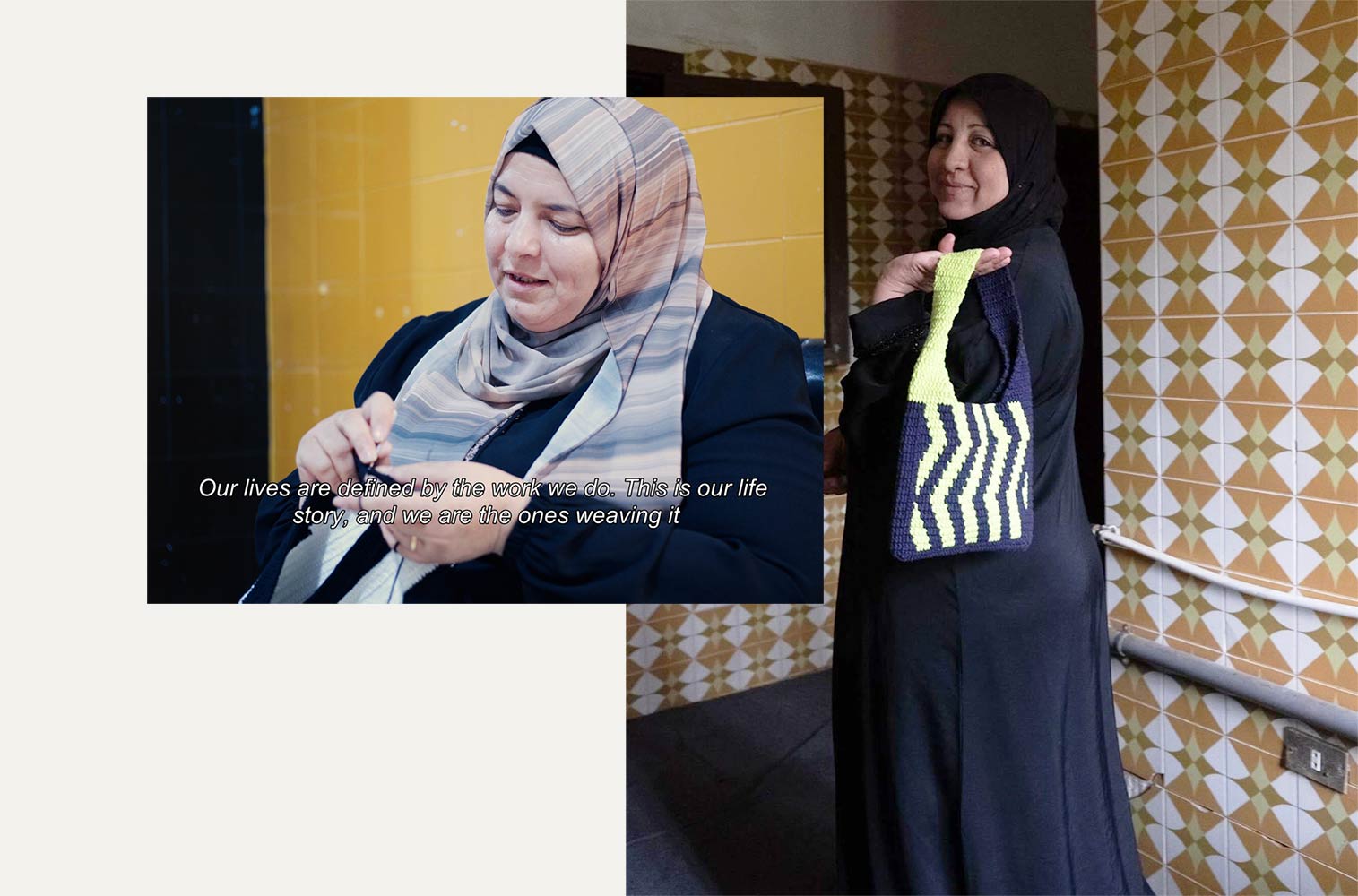
“Our lives are defined by the work we do. This is our life story, and we are the ones writing it.”
In the eastern region of Lebanon, lies a fertile valley that borders Syria: the Bekaa. Since the start of the Syrian war in 2011, nearly 500,000 Syrians have fled to this part of Lebanon in order to be close to their homeland. This is the largest number of refugees per capita globally. Being able to live in a similar climate, sharing language, culture, seasonal fruits, vegetables, and a mountain, offers comfort, and proximity nourishes the hope of one day returning. In December 2024, with the fall of the Assad Regime, this became possible. A weight, becoming almost too heavy to bear, had been lifted.
This weight I speak of is the burden of refugeehood. For the past 14 years Syrians in Lebanon have endured a pernicious, state manufactured, vulnerability. Maintaining legal status in Lebanon is an onerous and expensive bureaucratic process characterized by waiting and failure. Without paperwork, life becomes shaped by uncertainty and a litany of unknowns. In this liminal situation, mobility is prevented by a fear of arrest or deportation, work permits cannot be issued, children cannot enroll in school, healthcare cannot be accessed, apartment contracts remain unsigned, birth certificates difficult to obtain and bank accounts difficult to open.
In the summer of 2024, the Lebanese state conducted the most aggressive anti-Syrian campaign in its history. In the Beirut neighborhood where I live, leaflets on the streets read:
“To illegal Syrians…leave immediately, you have been warned. To Lebanese who are violating the law, it is forbidden to hire illegal Syrians and employ them in your shops and establishments. You are committing high treason. You have been warned.”
Denied the opportunity to re-root or re-ground, life in refuge is shaped by a distorted time-space. In this grueling headspace, there is a deep longing for a lost past life, dragging the mind and body into a cycle of inaction. Such inaction challenges future thinking and the building of community.
At Multi-Aid Programs (MAPs), a grassroots Syrian-led humanitarian organization in the Bekaa, a team of Syrians have been strategizing how to piece their fragmented community back together and maintain hope for a better future. I have spent the past six years working and collaborating with MAPs, designing projects that support the refugee community to preserve this hope. It is here that we developed LAMSA, a community-based fashion brand leveraging the power of craft to provide dignified employment and a space to develop new social bonds.
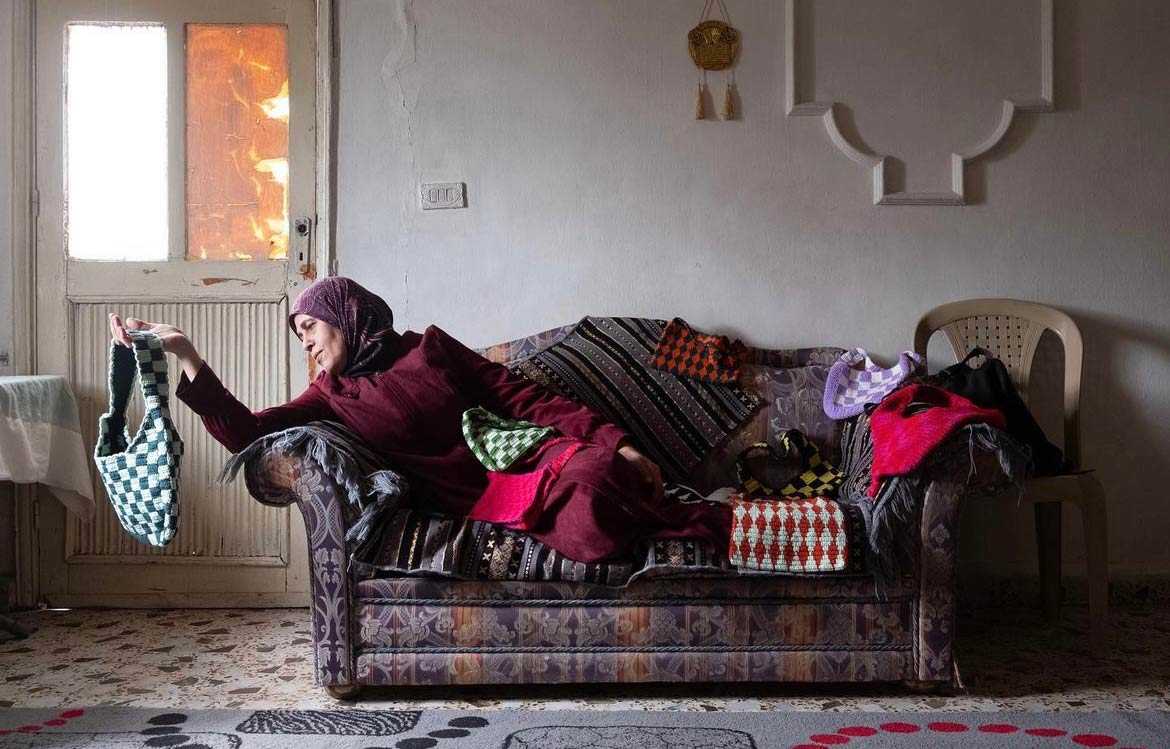
With crochet knowledge and skills already embedded in the community, passed down from generations of women, the development of LAMSA was an organic process. ‘Lamsa’ translates to mean touch: a physical touch, an emotional touch, a special touch. It is a call to rethink and reimagine forms of solidarity through craft. Amidst uncertainty and compounding crises, we experiment with color and pattern, nurturing beauty, joy and imagination through a caring design process that shares untold stories. Our work resists normative top-down models of humanitarian aid which entrap refugees in cycles of dependency and strips communities of their dignity. Instead, we work in an intimate way primarily in the home. By rejecting the power dynamics embedded in the humanitarian industrial complex, we arrive at an egalitarian space of co- creation where livelihoods are sustained through craft making, not through a food box.
In pushing the boundaries of normative models of aid delivery, we are carving out a new space at the intersection of grassroots community building and fashion. This goes beyond ‘ethical fashion’ - a term that addresses working rights, production line transparency and environmental sustainability, but fails to critically explore the dynamics at play between Global South- based artisans and Global North-based designers. Similar to humanitarianism, the fashion world is riddled with power imbalances. These create unethical and extractive tendencies that often appropriates Indigenous craft or limit artisans’ creative agency.
Working with intimacy and care in these interactions are crucial to the creation of all LAMSA pieces. Part of what makes our work a radical act of community building is that we center the lives and subjectivities of the artisans, leveraging the dignifying process of self-expression. These experiences are revealed in UNSPOKEN, an ongoing storytelling collection that reimagines what ethical fashion can be.
As our process evolves, we are strengthening a community that is committed to nurturing the seeds we planted. And while there is a powerful sense of renewed hope of a better future, uncertainty continues to linger. Returning home to Syria necessitates the rebuilding of basic governmental infrastructures, the security of finding work, and the money to rebuild destroyed homes. Our artisans are desperate to return, but it will take time. Until then, we will continue to create. And even in Syria, we will continue. With the weight of protracted refugeehood now lifted, maybe you will feel a difference in our crochet.
{
"article":
{
"title" : "Reimagining Ethical Fashion",
"author" : "Natalie Garland",
"category" : "essays",
"url" : "https://everythingispolitical.com/readings/lamsa-reimagining-ethical-fashion",
"date" : "2025-02-04 15:33:00 -0500",
"img" : "https://everythingispolitical.com/uploads/lamsa-Rihab.jpg",
"excerpt" : "",
"content" : " “Our lives are defined by the work we do. This is our life story, and we are the ones writing it.”In the eastern region of Lebanon, lies a fertile valley that borders Syria: the Bekaa. Since the start of the Syrian war in 2011, nearly 500,000 Syrians have fled to this part of Lebanon in order to be close to their homeland. This is the largest number of refugees per capita globally. Being able to live in a similar climate, sharing language, culture, seasonal fruits, vegetables, and a mountain, offers comfort, and proximity nourishes the hope of one day returning. In December 2024, with the fall of the Assad Regime, this became possible. A weight, becoming almost too heavy to bear, had been lifted.This weight I speak of is the burden of refugeehood. For the past 14 years Syrians in Lebanon have endured a pernicious, state manufactured, vulnerability. Maintaining legal status in Lebanon is an onerous and expensive bureaucratic process characterized by waiting and failure. Without paperwork, life becomes shaped by uncertainty and a litany of unknowns. In this liminal situation, mobility is prevented by a fear of arrest or deportation, work permits cannot be issued, children cannot enroll in school, healthcare cannot be accessed, apartment contracts remain unsigned, birth certificates difficult to obtain and bank accounts difficult to open.In the summer of 2024, the Lebanese state conducted the most aggressive anti-Syrian campaign in its history. In the Beirut neighborhood where I live, leaflets on the streets read:“To illegal Syrians…leave immediately, you have been warned. To Lebanese who are violating the law, it is forbidden to hire illegal Syrians and employ them in your shops and establishments. You are committing high treason. You have been warned.”Denied the opportunity to re-root or re-ground, life in refuge is shaped by a distorted time-space. In this grueling headspace, there is a deep longing for a lost past life, dragging the mind and body into a cycle of inaction. Such inaction challenges future thinking and the building of community.At Multi-Aid Programs (MAPs), a grassroots Syrian-led humanitarian organization in the Bekaa, a team of Syrians have been strategizing how to piece their fragmented community back together and maintain hope for a better future. I have spent the past six years working and collaborating with MAPs, designing projects that support the refugee community to preserve this hope. It is here that we developed LAMSA, a community-based fashion brand leveraging the power of craft to provide dignified employment and a space to develop new social bonds.With crochet knowledge and skills already embedded in the community, passed down from generations of women, the development of LAMSA was an organic process. ‘Lamsa’ translates to mean touch: a physical touch, an emotional touch, a special touch. It is a call to rethink and reimagine forms of solidarity through craft. Amidst uncertainty and compounding crises, we experiment with color and pattern, nurturing beauty, joy and imagination through a caring design process that shares untold stories. Our work resists normative top-down models of humanitarian aid which entrap refugees in cycles of dependency and strips communities of their dignity. Instead, we work in an intimate way primarily in the home. By rejecting the power dynamics embedded in the humanitarian industrial complex, we arrive at an egalitarian space of co- creation where livelihoods are sustained through craft making, not through a food box. In pushing the boundaries of normative models of aid delivery, we are carving out a new space at the intersection of grassroots community building and fashion. This goes beyond ‘ethical fashion’ - a term that addresses working rights, production line transparency and environmental sustainability, but fails to critically explore the dynamics at play between Global South- based artisans and Global North-based designers. Similar to humanitarianism, the fashion world is riddled with power imbalances. These create unethical and extractive tendencies that often appropriates Indigenous craft or limit artisans’ creative agency.Working with intimacy and care in these interactions are crucial to the creation of all LAMSA pieces. Part of what makes our work a radical act of community building is that we center the lives and subjectivities of the artisans, leveraging the dignifying process of self-expression. These experiences are revealed in UNSPOKEN, an ongoing storytelling collection that reimagines what ethical fashion can be.As our process evolves, we are strengthening a community that is committed to nurturing the seeds we planted. And while there is a powerful sense of renewed hope of a better future, uncertainty continues to linger. Returning home to Syria necessitates the rebuilding of basic governmental infrastructures, the security of finding work, and the money to rebuild destroyed homes. Our artisans are desperate to return, but it will take time. Until then, we will continue to create. And even in Syria, we will continue. With the weight of protracted refugeehood now lifted, maybe you will feel a difference in our crochet."
}
,
"relatedposts": [
{
"title" : "Our Era of Insecurity: How Unaffordability and Uncertainty Became Our Monoculture",
"author" : "Alissa Quart",
"category" : "essays",
"url" : "https://everythingispolitical.com/readings/our-era-of-insecurity",
"date" : "2025-12-16 11:56:00 -0500",
"img" : "https://everythingispolitical.com/uploads/Cover_EIP_Unaffordability.jpg",
"excerpt" : "In 2025, I’ve interviewed a number of people who saw themselves as living in “survival mode.” At first, their professions might surprise you. They are government contractors, public broadcasters, and tech workers, formerly safe professions. And some of their jobs disappeared this year due to DOGE “efficiency” cuts, the dismantling of the Corporation for Public Broadcasting, and AI acceleration. They are among the millions now living through an experience that I call terra infirma, a new level of economic and social uncertainty.",
"content" : "In 2025, I’ve interviewed a number of people who saw themselves as living in “survival mode.” At first, their professions might surprise you. They are government contractors, public broadcasters, and tech workers, formerly safe professions. And some of their jobs disappeared this year due to DOGE “efficiency” cuts, the dismantling of the Corporation for Public Broadcasting, and AI acceleration. They are among the millions now living through an experience that I call terra infirma, a new level of economic and social uncertainty.It’s the mood that encapsulates so much of Trump 2.0. A November 2025 Pew study found that almost half of U.S. adults are uncertain about having enough retirement income. When it comes to health insurance, they may be waiting for their ACA health subsidies to sunset or for their partner’s premiums to skyrocket. Addressing unaffordability and uncertainty is even the newest theme song in politics, most recently in the Maine campaign of gubernatorial candidate, oyster farmer and military veteran Graham Platner.Seventy years ago, the critic Raymond Williams used the term “structure of feeling” to describe a collective emotion that is tied to a time and place, as well as social and economic conditions. Today, our “structure of feeling” is uncertainty. You could even take it further, and call “precarity” the last monoculture as it’s a condition shared by so many Americans. As Astra Taylor, author of The Age of Insecurity: Coming Together as Things Fall Apart, says, insecurity is a “defining feature of our time.”As far as mass moods go, “insecurity” is certainly a disconcerting one. The economist Pranab Bardhan writes in A World of Insecurity, that “insecurity, more than inequality, agitates people.” What makes 2025 different from other years, however, is the degree to which we all experienced this precarity. The usual uncertainty level has been turned up from a whine to a 135-decibel air raid scream.What’s happened? Tariffs have raised our costs. Medicaid will be scaled back over the next decade by a trillion dollars. Meanwhile, dozens of Venezuelan fishermen have been exploded by our armed forces. And while two-thirds of Americans are already living with economic insecurity, their feelings about it don’t necessarily involve the discrepancy between their lot and those of the very rich. As Steven Semler, the co-founder of Security Policy Reform Institute (SPRI), explains it to me, these Americans have a mindset that “is more fearful of poverty than aspirations of being a millionaire.”The people of terra infirma do describe such fears. In the words of one, they’ve experienced a “mental health decline and a loss of purpose” and in another, “a serious financial pinch”, because they are their family’s main breadwinner. Uncertainty is the common refrain of the growing number of laid-off software workers, according to Human-Centered Design scholar Samuel So. In addition to feeling destabilized about their professional security for the first time, software workers have experienced disillusionment and alienation from the technology industry’s “military and police partnerships.” Jobs themselves are part of this insecurity, with never-ending hiring processes, the race of automation, and ghost jobs, the twisted contemporary version of the perished Russian serfs of Nikolai Gogol’s Dead Souls, except now professional opportunities are offered that don’t actually exist. People are also nervous about their future, because insecurity is a temporal emotion, as much about the future as the present. Many of us wonder how our security will further erode, as our health plan premiums soar, or as our subways catch on fire, or as ICE comes to our cities. This causes not only stress in the moment, but discomfort about what lies ahead.Of course, it’s not just Trump 2.0 alone that has caused this. The forces behind Trump’s win in 2024—and the anger at the traditional Democratic party—have something to do with this disposition, as well. In the weeks leading up to Trump’s election, people surveyed by the Federal Reserve Board ranked one of their top concerns as pricing and their top concern as inflation. Disparate phenomena—AI slop, job cuts, relentless and confusing cutbacks in crucial academic research—are entwined. It’s as if they were all figures in a paranoiac Thomas Pynchon novel. In a “world of insecurity,” as economist Bardhan writes, instabilities interlink. In other words, what I think of as “informational insecurity”—bots, false ads, fake news—often joins up with economic instability.These different instances of confusion and instability blend into a gnarly color wheel of distress. Economic distress, sure—that is also accentuated by societal, cultural, environmental, and physical examples of insecurity we see all around us, every day.How do we pick apart these knotted-together insecurities? For starters, we can embrace candidates who address economic uncertainty head-on, including New York’s new mayor, Zohran Mamdani, Seattle’s new mayor, Katie Wilson, and Virginia’s governor-elect Abigail Spanberger. These politicians, as Nicholas Jacobs has written of Maine candidate Platner, are “speaking to grievances that are real, measurable, and decades in the making.”Another line of defense is being brave and grasping for community in any way we can. I think of the ordinary people blowing whistles near Chicago to alert their neighbors when ICE showed up in their suburban towns: they were accidental upstanders, refusing to be part of manufactured uncertainty and instability.One traditional definition of security is “freedom from fear.” And while we are unlikely to experience that freedom from fear as long as the populist American Right continues its goosestep, it’s also important to remember that uncertainty, like any “structure of feeling,” is an unfinished emotion.Yes, insecurity shapes us now. But we, as a collective, are so much more than it. Because even if we are living in a time of such negative uncertainty, it won’t necessarily stay that way. We can still redefine ourselves and, most importantly, recognize we are not alone."
}
,
{
"title" : "On the Failures of Mainstream Media: The Rise of Independent Newsrooms",
"author" : "Céline Semaan",
"category" : "essays",
"url" : "https://everythingispolitical.com/readings/on-the-failures-of-mainstream-media",
"date" : "2025-12-15 15:53:00 -0500",
"img" : "https://everythingispolitical.com/uploads/B417273E-EA4A-4BB8-9245-081928282D6D.jpeg",
"excerpt" : "Has it become immoral to be featured in the New York Times? I remember when I first saw my face in the iconic newspaper that for decades was regarded as a global standard‑bearer of mainstream journalism, I felt vindicated. Vindicated because, finally, my Lebanese family stopped asking if I had a real career. Vindicated because they would maybe stop worrying that I had blown my chances (and their immense sacrifices getting me an education), devoting my life instead to art and endless revolution. The New York Times’ legitimacy, now long gone, was regarded as the highest badge of honor, in particular, for immigrant kids who chose a different path than the usual career options afforded to us, and despite their rebellion, found a way to be recognized for it.",
"content" : "Has it become immoral to be featured in the New York Times? I remember when I first saw my face in the iconic newspaper that for decades was regarded as a global standard‑bearer of mainstream journalism, I felt vindicated. Vindicated because, finally, my Lebanese family stopped asking if I had a real career. Vindicated because they would maybe stop worrying that I had blown my chances (and their immense sacrifices getting me an education), devoting my life instead to art and endless revolution. The New York Times’ legitimacy, now long gone, was regarded as the highest badge of honor, in particular, for immigrant kids who chose a different path than the usual career options afforded to us, and despite their rebellion, found a way to be recognized for it.When the headline for the piece read “Refugee Designer Shines a Light on Global Issues,” my mother called me that day, not to congratulate me, but to demand I contact the editor and have them remove the word “refugee” before the word “designer.” I tried, in vain. Little did I know that this form of belittling, discrediting, and choice of words designed to incite disdain and eventually violence was core to the New York Times’ ethos.Over the past two years, increasingly immoral headlines and editorial choices in its Opinion section have eroded that credibility among many readers and contributors, particularly around coverage of the war in Gaza. A growing number of scholars, writers, and public intellectuals have publicly criticized the Times for framing geopolitical violence in ways that align with oppressive power structures rather than interrogate them — a criticism that raises deep concerns about misinformation and manufactured consent of dangerous ideologies.Headlines like “Bondi Beach Is What ‘Globalize the Intifada’ Looks Like” and “No, Israel Is Not Committing Genocide in Gaza” are editorial strategies designed to reshape public understanding of systemic violence to support far-right narratives and the interests of the global military-industrial complex. What happens when mainstream media becomes a mouthpiece for fascism and arms dealers? Where “objectivity” is marketed as truth, but really serves as a code for “obey the rulers” and “ask no questions.”This editorial leadership at the New York Times has sparked significant backlash within the intellectual community and among independent journalists. More than 300 writers, scholars, and former contributors have pledged a boycott of the Times’ Opinion pages, accusing the paper of anti‑Palestinian bias and demanding editorial accountability, including a re‑evaluation of its coverage and calls for a U.S. arms embargo on Israel. Alongside this, peace and justice organizations have condemned their editorial decisions, such as rejecting advertising that simply described Israel’s actions in Gaza as genocide.The larger consequence of these controversies is not simply a reputational dispute; it reflects a broader shift in public trust away from legacy media toward people‑driven platforms that prioritize accountability, lived experience, and political context over corporate interests or geopolitical alignment. As mainstream outlets retreat from confronting systemic violence in favor of the bottom line, audiences — especially younger and more globally connected readers — are turning to independent media for context and truth‑telling that legacy institutions increasingly fail to provide.That’s where platforms like Everything is Political come in. I started this platform because I was fed up with pitching stories to mainstream media platforms and receiving bogus rejections, only to later read the most outrageous takes in their Opinion section, exposing racism and deliberate calls for violence that had real consequences for my people back home. Rather than treating opinion as a commodity or a battleground for corporate narratives, independent media like EIP can center historically grounded analysis, intersectional understanding, and ethical engagement with stories that cover conflict and power. In an age of globalization and hypermediated conflict, how media frames violence matters deeply — not just to who lives or dies on the ground, but also whose stories are amplified, whose suffering is recognized, and whose futures are imagined. Platforms accountable to audiences rather than corporate advertisers and shareholders must emerge to fill a vacuum created by a legacy press that too often places power over people. Outlets like Democracy Now!, The Intercept, BTNews, and countless others are leading the way, reporting accurate news without ever compromising their moral compass."
}
,
{
"title" : "Mercy Over Speed: Revolutionizing Our Political Imagination",
"author" : "Sue Ariza",
"category" : "essays",
"url" : "https://everythingispolitical.com/readings/mercy-over-speed",
"date" : "2025-12-11 13:40:00 -0500",
"img" : "https://everythingispolitical.com/uploads/Cover_EIP_Mercy_Speed.jpg",
"excerpt" : "2025 was a masterclass in haste.",
"content" : "2025 was a masterclass in haste.Policies rushed to enact a merciless agenda that benefit only the few—President Donald Trump scrapped Biden’s AI executive order within hours of taking office, wiping out safety and transparency requirements as we enter a new digital age. Immigration officials were ordered to quadruple immigration arrests overnight. Food assistance was frozen while billions in relief funds sat unused; hunger used as a pawn in the longest government shutdown in American history. Entire communities pushed not just to autopilot, but to survival—by algorithms that cannot see them, by bureaucracies that cannot pause long enough to understand them, by political actors who confuse immediacy with leadership.Of course, the real crisis isn’t speed on its own. It’s what speed erases: attention, nuance, reflection, and the fundamental truth that human beings are not statistics or administrative burdens. Perhaps nowhere was this clearer than in the State Department’s human rights reports earlier this year. In the name of “streamlining,” references to prison abuse, LGBTQIA+ persecution, and attacks on human rights defenders were quietly removed. The language was technocratic—reduce redundancy, tidy up the narrative—but the effect was ideological: whole communities and categories of suffering erased from national memory.Because the truth is, what speed strategically, ruthlessly, obliterates is the one crucial political practice we need most: mercy.Our world has taught us to think of mercy in opposition to speed, too soft for our lived realities, though it’s anything but that: Mercy is the commitment to respond to harm, conflict, or complexity with clarity rather than panic—with discernment instead of reflex. Mercy is the refusal to collapse a person, an idea, or a crisis into something smaller than it is. Mercy is political imagination: the capacity to see beyond what urgency allows and stay with one another long enough to resist the reflexes that turn disagreement into instant judgment—so we can listen before we attack or defend.But what does mercy actually demand of us? For us to reclaim it politically, we first must understand what it means and how it offers a counter-rhythm to our frantic culture of speed and instant gratification.The word itself tells a story. Mercy comes from the Latin merces—wages, payment, the price of goods. Ancient Romans understood it as a transaction. But early Christians shifted the word toward the sacred: the spiritual reward for showing kindness where cruelty was expected. They moved a word about the marketplace into a vocabulary of grace.Judaism’s rachamim, Islam’s rahma, Buddhism’s karuṇā, and Hinduism’s dayā all insist on the same truth: mercy is a way of recognizing the sacredness in others.That transformation mirrors what mercy asks of us now: to move beyond the logic of exchange, beyond what is earned or owed. It asks us to look at someone who has caused pain, and instead of asking What do they deserve? ask, What does healing require here? It is seeing beyond someone’s worst moment and choosing curiosity over condemnation.But mercy is more than individual forgiveness. It is a way of moving through the world that assumes people are larger than their failures; that redemption remains possible; that, importantly, time is not a scarce resource, but something we can afford to give. Mercy requires attention—what French philosopher Simone Weil called “the rarest and purest form of generosity.” It is why American novelist James Baldwin described love as an active emotion: the daily labor of truly seeing another person, especially when the systems around us tell us to look away.The problem, however, is that attention is precisely what our culture has made almost impossible to give. We are overstimulated, overextended, algorithmically hijacked, not only bearing witness to incredible amounts of suffering, but scrolling past it. We don’t refuse mercy because we’re cruel. We refuse it because we’ve built a world that makes stopping feel unimaginable—impractical.This is why mercy is not opposed to speed; it is opposed to false urgency. There are moments when mercy requires swift, decisive intervention. The problem is not action—it’s reaction: the unexamined acceleration that mistakes immediacy for moral clarity and treats nuance as an inconvenience.Consider how the culture of speed is destabilizing basic public systems. Take the Supplemental Nutrition Assistance Program (SNAP) that feeds more than 42 million Americans. This year, households faced unprecedented threats to their benefits—not because their needs had changed, not because the money didn’t exist, but because the administration chose to let billions in contingency funds sit untouched. The crisis wasn’t a failure of capacity. It was a political choice dressed up as inevitability.Or look at the rush to implement AI—a race happening not because anyone has thought deeply about what these systems are for, but because companies fear being the last to adopt them. Across industries, AI is being plugged into hiring platforms, healthcare systems, education tools, corporate workflows, and crisis-response mechanisms, often with little understanding of the consequences. “Innovation” has become a justification to move faster than ethics, oversight, or even common sense can keep up. In that scramble to avoid falling behind, speed becomes a substitute for understanding what people actually need and for the mercy that governance requires.A merciful politics would insist that deliberation is not inefficiency but protection, and that slowing down is an ethical requirement. Because the stakes of leadership and governance without it are real: if AI systems are going to help determine who gets hired, who gets healthcare, who receives support, which students get flagged for discipline, then refusing to slow down is not neutrality—it is a political choice with human costs.Our addiction to speed also shapes how we respond to political disagreement. Our culture no longer rewards thinking or meaningful conversation. Instead, it rewards reacting. Watch how career Democrats responded to New York Assembly member Zohran Mamdani’s mayoral campaign in November. Rather than engaging with his proposals on housing, healthcare, or municipal governance, establishment voices moved immediately to demonization. Senate Minority Leader Chuck Schumer withheld his endorsement entirely. His ideas required discussion, which takes time and attention. His vision challenged party orthodoxy, which requires deliberation to refute or incorporate. Instead of dialogue, we see instant censure, moral panic, and swift punishment.The speed of the response is the point. It signals that dissent is tolerable only when it can be quickly absorbed or quickly dismissed. Ideas that require conversation are treated as threats simply because they resist rapid processing. The issue isn’t whether Mamdani’s proposals are correct (and of course, it remains to be seen how they will actually be implemented); it’s that the reflex to demonize rather than debate reveals a political culture that has forgotten how to think collectively.We see this punitive speed logic everywhere. Students disciplined for language before conversations can happen. Social movements judged by headlines rather than the work. Communities criminalized in real time by social media cycles that flatten context into consumable outrage. We’ve built a society quicker to punish than to understand, quicker to condemn than to contextualize.But mercy could help us move differently. Mercy would refuse to relegate a person or an idea to a caricature simply because the truth requires time. Mercy asks us to hold uncertainty long enough to respond with discernment rather than reflex. It asks us to think—together.Legal scholar Matthias Mahlmann writes that dignity is “subversive,” an insistence that every human life carries irreducible worth. But dignity has a temporal requirement: you cannot witness another person’s humanity at speed. You cannot attend to the complexity of a life if you’re only interested in the fastest possible outcome.This is why systems built around optimization always feel so violent. Algorithmic welfare reviews, automated policing, real-time public shaming—all of them demand that human beings be compressed into categories that can be processed quickly. The violence isn’t just in the outcome; it’s in the refusal of attention itself.Mercy and dignity are inseparable. Dignity names the inherent worth that every person carries; mercy is the discipline that protects that worth in practice. Dignity says there is something unbreakable in each of us. Mercy is how we honor that unbreakable thing, especially when harm or conflict tempts us to forget it. What would shift if our reflex wasn’t How fast can we react?, but How deeply can we understand? What becomes possible when we refuse to hurry past another person’s humanity?Mercy is not sentiment. It is resistance. It is the refusal of dignity fatigue. It is the discipline of witnessing: in political policy, in the conversations we have, in how we treat each other’s failures and hopes. 2025 taught us what haste can destroy. The question now is whether we’re willing to build something slower—and more human—in its place."
}
]
}